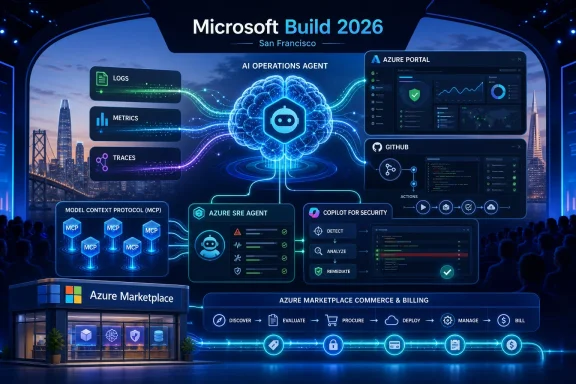
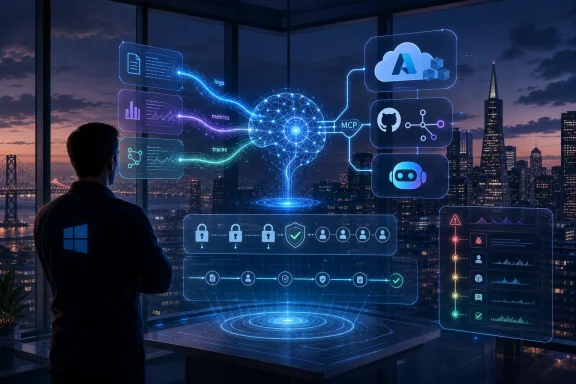
New Relic used Microsoft Build 2026 in San Francisco on June 2 and 3 to promote a deeper Microsoft partnership, new Azure and GitHub integrations, and double-digit year-over-year growth in customer committed bookings through Microsoft Marketplace transactions. The announcement is less about one observability vendor enjoying a good sales channel than about where Microsoft’s cloud ecosystem is moving. Observability is being pulled out of dashboards and pushed into agents, coding assistants, deployment pipelines, and procurement workflows. That shift could make life easier for developers and SREs, but it also raises a familiar enterprise question: who controls the operational truth when every tool claims to be intelligent?
New Relic’s Build 2026 message is straightforward on the surface: its 14-year Microsoft relationship is growing, its Azure Marketplace motion is producing double-digit bookings growth, and its integrations now reach into Microsoft’s most strategic developer and AI surfaces. That is a tidy partner announcement. It is also a useful snapshot of how the software operations market is being rewritten around AI-assisted work.
The company is not merely saying that Azure customers can buy New Relic more easily. It is saying that New Relic data should appear where engineers already make decisions: inside Azure SRE Agent, Microsoft Foundry, GitHub Copilot, GitHub Actions, and related development workflows. The old pitch for observability was that teams needed a single pane of glass. The new pitch is that the glass should disappear.
That framing matters because observability has historically lived one step away from the action. A developer writes code in an IDE, a pipeline deploys it, an incident fires, and an engineer pivots into a monitoring tool to understand what broke. New Relic’s Microsoft integrations attempt to collapse those steps into a more continuous loop, where telemetry becomes fuel for automated diagnosis, suggested remediation, and eventually autonomous action.
The commercial backdrop is just as important. Marketplace bookings growth tells us that enterprise procurement is now part of the product strategy. For software vendors, Microsoft Marketplace is not simply a catalog; it is a distribution system embedded inside Azure commitments, budgets, and buying processes. For customers, that can turn an observability purchase from a new negotiation into a cloud-spend allocation decision.
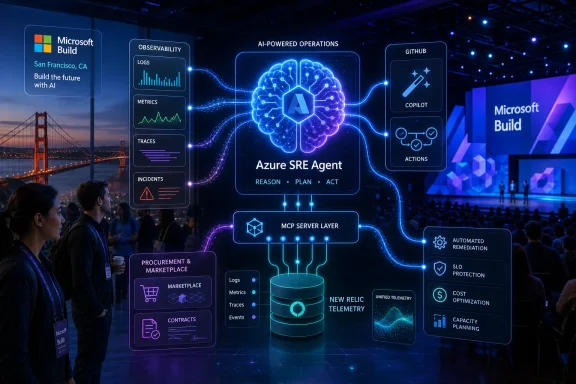
That is where New Relic’s Model Context Protocol Server enters the picture. Microsoft’s Azure SRE Agent can connect to New Relic’s observability platform through the MCP server and query telemetry such as application performance data, logs, infrastructure metrics, alerts, incidents, dashboards, and entities. In plain English, the agent gets a structured way to ask New Relic what is happening in production.
The phrase Model Context Protocol is easy to dismiss as another acronym in an already crowded AI stack. But MCP is becoming one of the more consequential plumbing layers in enterprise AI because it standardizes how agents reach external systems. If agents are going to diagnose outages, open pull requests, summarize incidents, or recommend fixes, they need authenticated access to the evidence. MCP is one answer to the question of how that evidence gets into the model’s working memory.
New Relic’s positioning is therefore tactical and strategic at once. Tactically, it wants Azure SRE Agent to use New Relic as an observability backend. Strategically, it wants New Relic telemetry to become a trusted operational context layer for AI systems. That is a much more durable ambition than selling another dashboard to a cloud operations team.
New Relic Monitoring for Microsoft Foundry is aimed at teams building AI applications and agents, collecting logs and metrics from Azure and presenting them around application and agent performance. That is a sensible response to a real problem: AI agents are harder to reason about than conventional services because their behavior can be probabilistic, tool-driven, and dependent on context. When something fails, the question is often not just whether the service is up, but what the agent attempted, which tool it called, what data it saw, and why it chose a particular path.
The GitHub integrations push the same idea closer to code. New Relic’s Security RX integration for GitHub Copilot uses runtime context to identify vulnerabilities, evaluate them, and suggest remediation. Its GitHub Actions integration is designed to detect missing instrumentation during deployment, a more mundane but highly practical problem. A service that ships without useful telemetry is not merely under-instrumented; it is an incident waiting to become longer and more expensive than necessary.
The integration with GitHub Copilot’s coding agent extends the ambition further, promising to automate portions of change validation and incident response. That is where the story becomes more provocative. The industry is moving from “AI suggests a fix” to “AI evaluates the change, connects it to runtime behavior, and participates in the operational loop.” That could be valuable. It could also be dangerous if organizations mistake automation for accountability.
For Azure customers, the attraction is obvious. If a New Relic purchase can count against existing Azure consumption commitments, the deal may be easier to justify, approve, and operationalize. Procurement teams like consolidated spend. Finance teams like predictable commitments. Engineering teams like fewer months lost to vendor onboarding.
For Microsoft, the marketplace reinforces Azure’s role as the operating center of enterprise technology decisions. Even when the software is not built by Microsoft, the buying path, identity model, deployment pattern, and often the operational context remain tied to Microsoft’s cloud. That is ecosystem leverage, and it is one reason independent software vendors keep deepening their Microsoft integrations.
For New Relic, the marketplace provides more than sales convenience. It puts the company near two of the most valuable enterprise workflows in software: cloud operations on Azure and software development on GitHub. A monitoring vendor that sits in both places is better positioned than one waiting for users to open a separate console after something breaks.
This is also why the announcement emphasizes New Relic Monitoring for SAP Solutions in the marketplace, described by New Relic as an agentless certified RISE with SAP observability product for Azure customers. SAP environments are rarely glamorous, but they are deeply consequential. If marketplace procurement helps New Relic reach core enterprise workloads rather than just cloud-native applications, the Microsoft channel becomes more than a growth tactic.
AI coding tools can generate useful code, but they can also generate plausible code that behaves badly under production conditions. They may omit instrumentation, mishandle edge cases, introduce inefficient queries, or produce fixes that pass tests while shifting failure elsewhere. The more organizations rely on AI-assisted development, the more they need runtime evidence to validate what the tools produce.
This is the strongest version of New Relic’s argument. Observability is not just a post-deployment troubleshooting function anymore. It becomes part of the software supply chain, feeding context back into coding assistants, security tools, deployment gates, and incident workflows. In that world, telemetry is not merely descriptive. It becomes part of the control plane.
That term should make administrators and security teams pause. If telemetry informs automated remediation, then data quality, permissions, retention, and context boundaries matter more than ever. A badly instrumented application might not just be harder to debug; it might cause an AI agent to recommend the wrong action. A misconfigured permission model might expose operational data to tools or users that should not see it.
The industry’s phrase for this is often agentic operations, but the less glamorous description is more useful: software is being wired so that machines can observe, infer, and act across systems. That can reduce toil, shorten outages, and surface hidden problems faster. It also makes governance a first-class engineering requirement rather than a compliance afterthought.
But SRE is also where overconfidence becomes expensive. Incident response is not just pattern matching. It involves judgment about risk, customer impact, rollback timing, dependencies, and organizational tolerance for change. An agent that suggests the next step is useful. An agent that takes independent action needs much stronger guardrails.
New Relic’s language leans into “actionable, autonomous intelligence,” and that is exactly the phrase enterprise IT should interrogate. Autonomy is not a binary feature. It is a ladder, starting with read-only summaries, moving through recommendations, then approved actions, then limited automated remediation, and eventually broader self-healing systems. Most organizations will need to climb that ladder slowly.
The safest near-term value is likely in context assembly. An Azure SRE Agent connected to New Relic can help engineers ask natural-language questions about a live incident, correlate telemetry, and reduce the time spent jumping between tools. That is meaningful. It does not require pretending that AI should be trusted to make every operational decision alone.
Over time, however, the pressure to automate will increase. If competitors can restore service faster with agent-assisted remediation, laggards will feel the pull. The challenge for IT leaders is to distinguish repeatable, low-risk actions from interventions that require human accountability. Restarting a known bad worker process is not the same thing as modifying traffic routing for a revenue-critical service.
New Relic’s Security RX integration for GitHub Copilot fits neatly into that shift. Security findings become more useful when they include runtime context, because not every theoretical vulnerability carries the same production risk. A vulnerable path that is never invoked, shielded by compensating controls, or isolated from sensitive data may not deserve the same priority as one sitting on a hot path in a customer-facing service.
That does not mean runtime context should excuse sloppy security. It means remediation queues can become smarter. Security teams are drowning in findings, many of which lack the context needed for prioritization. If New Relic can help Copilot explain why a vulnerability matters in the running system and suggest a fix, the integration could reduce friction between developers and security teams.
The GitHub Actions instrumentation check is less flashy but arguably more practical. Missing instrumentation is one of those avoidable mistakes that becomes obvious only after an outage. Catching it during deployment turns observability from a best-practice lecture into a pipeline-enforced behavior. That is the kind of small operational control that can compound across hundreds of services.
The Copilot coding agent integration points to the next stage: change validation tied to production awareness. A coding agent that understands not only the repository but also how the service behaves in production could help developers avoid regressions. The danger, again, is that teams may accept generated fixes too quickly if the assistant’s confidence sounds authoritative.
Because enterprise environments are messy. Customers run hybrid systems, multi-cloud estates, legacy applications, third-party databases, SAP landscapes, Kubernetes platforms, and custom services with years of accumulated operational history. Microsoft can provide the platform, but specialist vendors still carry deep domain knowledge and established telemetry relationships inside customer environments.
New Relic benefits from Microsoft’s distribution and AI surfaces. Microsoft benefits by making Azure and GitHub feel more complete to customers who already use New Relic. The result is not a simple vendor-reseller relationship; it is a mutual dependency shaped by the realities of enterprise IT.
That dependency also complicates the competitive map. Observability vendors such as New Relic, Datadog, Dynatrace, and others increasingly need to integrate with cloud-native agent frameworks while differentiating on data quality, analysis, and automation. Cloud providers, meanwhile, want ecosystems rich enough to attract enterprise workloads without surrendering too much strategic control to third parties.
For WindowsForum readers, the practical lesson is not that one vendor has “won” observability. It is that the boundaries among cloud operations, developer tooling, security triage, and AI assistance are dissolving. Buying decisions that once belonged to separate teams are becoming entangled.
Organizations adopting these integrations should think carefully about scope. Read-only access is different from action access. Querying logs is different from changing infrastructure. Suggesting a remediation is different from applying it. Each step should map to explicit permissions, approval flows, audit logs, and rollback plans.
There is also the problem of context freshness. Production systems change constantly, and an agent’s reasoning is only as good as the data it receives. If instrumentation is incomplete, alerts are noisy, service ownership metadata is stale, or dashboards encode outdated assumptions, AI will not magically fix the operational model. It may simply automate its weaknesses.
Security and compliance constraints deserve equal attention. New Relic’s own documentation notes that some preview MCP capabilities are not appropriate for accounts or data under certain compliance mandates, including FedRAMP or HIPAA. That kind of caveat is not boilerplate for regulated organizations. It is a reminder that the AI integration layer is now part of the compliance boundary.
The responsible path is not to reject these tools, but to pilot them with production realism. Test them during controlled incidents. Measure false positives, false confidence, and time saved. Decide which actions can be automated and which must remain human-approved. Treat the agent as a junior operator with fast access to data, not as an oracle.
That is a major shift in product design. The dashboard was built for human navigation. The agent integration is built for machine consumption. The product experience moves from “open New Relic and investigate” to “ask the system what changed, what broke, and what should happen next.” The vendor that owns the answer may not be the same vendor that owns the interface.
This is why MCP-style integrations matter. They are not just connectors. They define which tools can participate in the agent-mediated enterprise. A monitoring platform disconnected from that layer may still collect valuable data, but it will sit outside the flow of decisions.
Microsoft’s role amplifies the stakes. Azure and GitHub are already embedded in enterprise software delivery. If Microsoft’s agents become common work surfaces for developers and operators, then integrations with those agents become competitive necessities. New Relic is moving early enough to claim relevance in that emerging layer.
The most useful way to read the announcement is as a roadmap for near-term evaluation rather than a finished operating model. Teams should ask whether New Relic data inside Azure SRE Agent actually reduces mean time to resolution in their environment. They should test whether Security RX improves vulnerability prioritization or merely adds another stream of AI-generated suggestions. They should verify whether GitHub Actions checks catch real instrumentation gaps without slowing deployments unnecessarily.
They should also examine identity and access design. When agents query observability systems, whose permissions do they use? Are actions logged in a way auditors and incident reviewers can understand? Can teams restrict data by environment, application, or role? These questions are not implementation trivia; they determine whether agentic workflows can survive contact with enterprise governance.
Cost belongs in the same conversation. Marketplace procurement can simplify buying, but it can also make spend feel abstract because it disappears into cloud commitments. Observability bills are already a sensitive topic for many organizations, especially those generating massive logs and traces. AI-driven workflows may increase the appetite for telemetry, which means cost controls and data hygiene matter even more.
 New Relic Is Selling More Than Monitoring at Build
New Relic’s Build 2026 message is straightforward on the surface: its 14-year Microsoft relationship is growing, its Azure Marketplace motion is producing double-digit bookings growth, and its integrations now reach into Microsoft’s most strategic developer and AI surfaces. That is a tidy partner announcement. It is also a useful snapshot of how the software operations market is being rewritten around AI-assisted work.The company is not merely saying that Azure customers can buy New Relic more easily. It is saying that New Relic data should appear where engineers already make decisions: inside Azure SRE Agent, Microsoft Foundry, GitHub Copilot, GitHub Actions, and related development workflows. The old pitch for observability was that teams needed a single pane of glass. The new pitch is that the glass should disappear.
That framing matters because observability has historically lived one step away from the action. A developer writes code in an IDE, a pipeline deploys it, an incident fires, and an engineer pivots into a monitoring tool to understand what broke. New Relic’s Microsoft integrations attempt to collapse those steps into a more continuous loop, where telemetry becomes fuel for automated diagnosis, suggested remediation, and eventually autonomous action.
The commercial backdrop is just as important. Marketplace bookings growth tells us that enterprise procurement is now part of the product strategy. For software vendors, Microsoft Marketplace is not simply a catalog; it is a distribution system embedded inside Azure commitments, budgets, and buying processes. For customers, that can turn an observability purchase from a new negotiation into a cloud-spend allocation decision.
Microsoft’s Agent Strategy Needs Operational Memory
Microsoft has spent the past several years turning Copilot from a product name into a platform pattern. Build 2026 continues that trajectory, with Microsoft Foundry positioned as a place to build and run AI agents at scale, GitHub Copilot becoming more agentic, and Azure increasingly framed as an execution environment for AI-driven operations. But agents without operational context are clever autocomplete machines attached to production systems.That is where New Relic’s Model Context Protocol Server enters the picture. Microsoft’s Azure SRE Agent can connect to New Relic’s observability platform through the MCP server and query telemetry such as application performance data, logs, infrastructure metrics, alerts, incidents, dashboards, and entities. In plain English, the agent gets a structured way to ask New Relic what is happening in production.
The phrase Model Context Protocol is easy to dismiss as another acronym in an already crowded AI stack. But MCP is becoming one of the more consequential plumbing layers in enterprise AI because it standardizes how agents reach external systems. If agents are going to diagnose outages, open pull requests, summarize incidents, or recommend fixes, they need authenticated access to the evidence. MCP is one answer to the question of how that evidence gets into the model’s working memory.
New Relic’s positioning is therefore tactical and strategic at once. Tactically, it wants Azure SRE Agent to use New Relic as an observability backend. Strategically, it wants New Relic telemetry to become a trusted operational context layer for AI systems. That is a much more durable ambition than selling another dashboard to a cloud operations team.
The Dashboard Is Giving Way to the Workflow
The most interesting part of the announcement is not that New Relic can display Azure and application telemetry in dashboards. The industry has been doing some version of that for years. The more important change is that New Relic wants telemetry to appear inside the workflow before an engineer thinks to go looking for it.New Relic Monitoring for Microsoft Foundry is aimed at teams building AI applications and agents, collecting logs and metrics from Azure and presenting them around application and agent performance. That is a sensible response to a real problem: AI agents are harder to reason about than conventional services because their behavior can be probabilistic, tool-driven, and dependent on context. When something fails, the question is often not just whether the service is up, but what the agent attempted, which tool it called, what data it saw, and why it chose a particular path.
The GitHub integrations push the same idea closer to code. New Relic’s Security RX integration for GitHub Copilot uses runtime context to identify vulnerabilities, evaluate them, and suggest remediation. Its GitHub Actions integration is designed to detect missing instrumentation during deployment, a more mundane but highly practical problem. A service that ships without useful telemetry is not merely under-instrumented; it is an incident waiting to become longer and more expensive than necessary.
The integration with GitHub Copilot’s coding agent extends the ambition further, promising to automate portions of change validation and incident response. That is where the story becomes more provocative. The industry is moving from “AI suggests a fix” to “AI evaluates the change, connects it to runtime behavior, and participates in the operational loop.” That could be valuable. It could also be dangerous if organizations mistake automation for accountability.
Marketplace Growth Turns Procurement Into Platform Gravity
New Relic’s double-digit growth in customer committed bookings through Microsoft Marketplace transactions over the 12 months ending March 31, 2026, is the business signal underneath the technical story. Marketplace procurement has become one of the quiet power centers of cloud computing. It lets cloud providers turn their ecosystems into purchasing rails, and it lets vendors ride those rails into enterprise accounts.For Azure customers, the attraction is obvious. If a New Relic purchase can count against existing Azure consumption commitments, the deal may be easier to justify, approve, and operationalize. Procurement teams like consolidated spend. Finance teams like predictable commitments. Engineering teams like fewer months lost to vendor onboarding.
For Microsoft, the marketplace reinforces Azure’s role as the operating center of enterprise technology decisions. Even when the software is not built by Microsoft, the buying path, identity model, deployment pattern, and often the operational context remain tied to Microsoft’s cloud. That is ecosystem leverage, and it is one reason independent software vendors keep deepening their Microsoft integrations.
For New Relic, the marketplace provides more than sales convenience. It puts the company near two of the most valuable enterprise workflows in software: cloud operations on Azure and software development on GitHub. A monitoring vendor that sits in both places is better positioned than one waiting for users to open a separate console after something breaks.
This is also why the announcement emphasizes New Relic Monitoring for SAP Solutions in the marketplace, described by New Relic as an agentless certified RISE with SAP observability product for Azure customers. SAP environments are rarely glamorous, but they are deeply consequential. If marketplace procurement helps New Relic reach core enterprise workloads rather than just cloud-native applications, the Microsoft channel becomes more than a growth tactic.
AI-Generated Code Makes Observability Less Optional
The partnership lands at a moment when software teams are under pressure to move faster with AI-generated code, coding agents, and automated development workflows. That speed has an obvious appeal. It also multiplies the number of changes moving toward production, which means the cost of weak telemetry rises sharply.AI coding tools can generate useful code, but they can also generate plausible code that behaves badly under production conditions. They may omit instrumentation, mishandle edge cases, introduce inefficient queries, or produce fixes that pass tests while shifting failure elsewhere. The more organizations rely on AI-assisted development, the more they need runtime evidence to validate what the tools produce.
This is the strongest version of New Relic’s argument. Observability is not just a post-deployment troubleshooting function anymore. It becomes part of the software supply chain, feeding context back into coding assistants, security tools, deployment gates, and incident workflows. In that world, telemetry is not merely descriptive. It becomes part of the control plane.
That term should make administrators and security teams pause. If telemetry informs automated remediation, then data quality, permissions, retention, and context boundaries matter more than ever. A badly instrumented application might not just be harder to debug; it might cause an AI agent to recommend the wrong action. A misconfigured permission model might expose operational data to tools or users that should not see it.
The industry’s phrase for this is often agentic operations, but the less glamorous description is more useful: software is being wired so that machines can observe, infer, and act across systems. That can reduce toil, shorten outages, and surface hidden problems faster. It also makes governance a first-class engineering requirement rather than a compliance afterthought.
The SRE Agent Is a Promise With a Blast Radius
Azure SRE Agent is one of the more telling Microsoft surfaces for New Relic to target. SRE work is full of repetitive diagnosis, runbook execution, context gathering, and post-incident analysis. If an agent can reliably pull together logs, traces, metrics, alerts, deployment history, and known incidents, it can save real time.But SRE is also where overconfidence becomes expensive. Incident response is not just pattern matching. It involves judgment about risk, customer impact, rollback timing, dependencies, and organizational tolerance for change. An agent that suggests the next step is useful. An agent that takes independent action needs much stronger guardrails.
New Relic’s language leans into “actionable, autonomous intelligence,” and that is exactly the phrase enterprise IT should interrogate. Autonomy is not a binary feature. It is a ladder, starting with read-only summaries, moving through recommendations, then approved actions, then limited automated remediation, and eventually broader self-healing systems. Most organizations will need to climb that ladder slowly.
The safest near-term value is likely in context assembly. An Azure SRE Agent connected to New Relic can help engineers ask natural-language questions about a live incident, correlate telemetry, and reduce the time spent jumping between tools. That is meaningful. It does not require pretending that AI should be trusted to make every operational decision alone.
Over time, however, the pressure to automate will increase. If competitors can restore service faster with agent-assisted remediation, laggards will feel the pull. The challenge for IT leaders is to distinguish repeatable, low-risk actions from interventions that require human accountability. Restarting a known bad worker process is not the same thing as modifying traffic routing for a revenue-critical service.
GitHub Is Becoming the New Operations Console
The GitHub side of the New Relic announcement may be more important than it first appears. GitHub is no longer just where code is stored. With Copilot, Actions, Advanced Security, code scanning, pull request automation, and coding agents, it is becoming an operational command surface for the software lifecycle.New Relic’s Security RX integration for GitHub Copilot fits neatly into that shift. Security findings become more useful when they include runtime context, because not every theoretical vulnerability carries the same production risk. A vulnerable path that is never invoked, shielded by compensating controls, or isolated from sensitive data may not deserve the same priority as one sitting on a hot path in a customer-facing service.
That does not mean runtime context should excuse sloppy security. It means remediation queues can become smarter. Security teams are drowning in findings, many of which lack the context needed for prioritization. If New Relic can help Copilot explain why a vulnerability matters in the running system and suggest a fix, the integration could reduce friction between developers and security teams.
The GitHub Actions instrumentation check is less flashy but arguably more practical. Missing instrumentation is one of those avoidable mistakes that becomes obvious only after an outage. Catching it during deployment turns observability from a best-practice lecture into a pipeline-enforced behavior. That is the kind of small operational control that can compound across hundreds of services.
The Copilot coding agent integration points to the next stage: change validation tied to production awareness. A coding agent that understands not only the repository but also how the service behaves in production could help developers avoid regressions. The danger, again, is that teams may accept generated fixes too quickly if the assistant’s confidence sounds authoritative.
The Partnership Also Reveals Microsoft’s Dependency on Specialists
Microsoft has its own monitoring, security, and developer tooling. Azure Monitor, Application Insights, Defender, GitHub Advanced Security, Copilot, Foundry, and related services already cover a broad span of the operational stack. So why does a New Relic partnership matter?Because enterprise environments are messy. Customers run hybrid systems, multi-cloud estates, legacy applications, third-party databases, SAP landscapes, Kubernetes platforms, and custom services with years of accumulated operational history. Microsoft can provide the platform, but specialist vendors still carry deep domain knowledge and established telemetry relationships inside customer environments.
New Relic benefits from Microsoft’s distribution and AI surfaces. Microsoft benefits by making Azure and GitHub feel more complete to customers who already use New Relic. The result is not a simple vendor-reseller relationship; it is a mutual dependency shaped by the realities of enterprise IT.
That dependency also complicates the competitive map. Observability vendors such as New Relic, Datadog, Dynatrace, and others increasingly need to integrate with cloud-native agent frameworks while differentiating on data quality, analysis, and automation. Cloud providers, meanwhile, want ecosystems rich enough to attract enterprise workloads without surrendering too much strategic control to third parties.
For WindowsForum readers, the practical lesson is not that one vendor has “won” observability. It is that the boundaries among cloud operations, developer tooling, security triage, and AI assistance are dissolving. Buying decisions that once belonged to separate teams are becoming entangled.
The Operational Risk Moves From Dashboards to Decisions
The old observability failure mode was simple: nobody looked at the dashboard until it was too late. The new failure mode is subtler: an AI system looks at the telemetry, draws the wrong conclusion, and accelerates a bad decision. That does not make agentic observability a bad idea. It makes verification more important.Organizations adopting these integrations should think carefully about scope. Read-only access is different from action access. Querying logs is different from changing infrastructure. Suggesting a remediation is different from applying it. Each step should map to explicit permissions, approval flows, audit logs, and rollback plans.
There is also the problem of context freshness. Production systems change constantly, and an agent’s reasoning is only as good as the data it receives. If instrumentation is incomplete, alerts are noisy, service ownership metadata is stale, or dashboards encode outdated assumptions, AI will not magically fix the operational model. It may simply automate its weaknesses.
Security and compliance constraints deserve equal attention. New Relic’s own documentation notes that some preview MCP capabilities are not appropriate for accounts or data under certain compliance mandates, including FedRAMP or HIPAA. That kind of caveat is not boilerplate for regulated organizations. It is a reminder that the AI integration layer is now part of the compliance boundary.
The responsible path is not to reject these tools, but to pilot them with production realism. Test them during controlled incidents. Measure false positives, false confidence, and time saved. Decide which actions can be automated and which must remain human-approved. Treat the agent as a junior operator with fast access to data, not as an oracle.
The Build Announcement Says Where Enterprise Software Is Headed
The New Relic-Microsoft announcement is easy to categorize as partner marketing, but that undersells its significance. It shows how enterprise software vendors are adapting to a world where AI assistants are becoming the interface layer for work. If users increasingly ask Copilot, Foundry agents, or SRE agents what to do next, vendors must make their data available to those agents or risk becoming invisible.That is a major shift in product design. The dashboard was built for human navigation. The agent integration is built for machine consumption. The product experience moves from “open New Relic and investigate” to “ask the system what changed, what broke, and what should happen next.” The vendor that owns the answer may not be the same vendor that owns the interface.
This is why MCP-style integrations matter. They are not just connectors. They define which tools can participate in the agent-mediated enterprise. A monitoring platform disconnected from that layer may still collect valuable data, but it will sit outside the flow of decisions.
Microsoft’s role amplifies the stakes. Azure and GitHub are already embedded in enterprise software delivery. If Microsoft’s agents become common work surfaces for developers and operators, then integrations with those agents become competitive necessities. New Relic is moving early enough to claim relevance in that emerging layer.
The Fine Print IT Teams Should Read Before the Demo
New Relic’s Build 2026 pitch contains several concrete items that administrators and engineering leaders should separate from the broader AI enthusiasm. The announcement is strongest where it addresses immediate pain: marketplace procurement, missing instrumentation, runtime-aware security triage, and faster incident context. It is more speculative where it gestures toward autonomous remediation.The most useful way to read the announcement is as a roadmap for near-term evaluation rather than a finished operating model. Teams should ask whether New Relic data inside Azure SRE Agent actually reduces mean time to resolution in their environment. They should test whether Security RX improves vulnerability prioritization or merely adds another stream of AI-generated suggestions. They should verify whether GitHub Actions checks catch real instrumentation gaps without slowing deployments unnecessarily.
They should also examine identity and access design. When agents query observability systems, whose permissions do they use? Are actions logged in a way auditors and incident reviewers can understand? Can teams restrict data by environment, application, or role? These questions are not implementation trivia; they determine whether agentic workflows can survive contact with enterprise governance.
Cost belongs in the same conversation. Marketplace procurement can simplify buying, but it can also make spend feel abstract because it disappears into cloud commitments. Observability bills are already a sensitive topic for many organizations, especially those generating massive logs and traces. AI-driven workflows may increase the appetite for telemetry, which means cost controls and data hygiene matter even more.
The Real Build 2026 Message Is Hidden in the Plumbing
The practical takeaways from New Relic’s Microsoft push are less about a single product launch and more about a new operating model for Azure and GitHub-centric teams. The future being advertised is one where telemetry, AI agents, code changes, and procurement channels reinforce one another.- New Relic is using Microsoft Build 2026 to position its observability platform as context infrastructure for Azure SRE Agent, Microsoft Foundry, GitHub Copilot, and GitHub Actions.
- The reported double-digit growth in committed bookings through Microsoft Marketplace shows that procurement channels are becoming strategic distribution platforms for enterprise software vendors.
- The most immediate operational value is likely to come from faster incident context, instrumentation checks during deployment, and runtime-aware security prioritization.
- The riskiest claims sit around autonomous remediation, where organizations need strict permissions, auditability, rollback paths, and human approval for high-impact actions.
- The broader industry direction is clear: observability data is moving from standalone dashboards into the AI-assisted workflows where developers and SREs already work.
References
- Primary source: iTWire
Published: Wed, 03 Jun 2026 03:09:55 GMT
New Relic Celebrates Strategic Partnership with Microsoft at Build 2026 | iTWire
Observability leader grew customer committed bookings through Microsoft Marketplace transactions by double digits over recent 12 months Collaborative innovations empower... itwire.com
- Independent coverage: IT Brief Australia
Published: 2026-06-03T02:30:12.333761
New Relic touts Microsoft partnership as bookings rise
Marketplace bookings through Microsoft rose by double digits as New Relic deepened integrations aimed at helping customers manage AI-era software risk. itbrief.com.au
- Official source: techcommunity.microsoft.com
Get started with the New Relic MCP server in Azure SRE Agent | Microsoft Community Hub
Overview The New Relic MCP server is a cloud-hosted bridge between your New Relic account and Azure SRE Agent. Once configured, it enables real-time... techcommunity.microsoft.com
- Official source: learn.microsoft.com
Azure Native New Relic Service overview - Azure Native Integrations | Microsoft Learn
Learn about using New Relic in Azure Marketplace.learn.microsoft.com - Related coverage: newrelic.com
- Official source: devblogs.microsoft.com
Build and run agents at scale with Microsoft Foundry at Build 2026 | Microsoft Foundry Blog
Learn how Microsoft Foundry helps developers build, deploy, and operate production-ready agents with Agent Framework, Toolboxes, hosted agents, Microsoft 365 distribution, observability, and agent optimization.devblogs.microsoft.com
- Official source: azuremarketplace.microsoft.com
Microsoft Marketplace | cloud solutions, AI apps, and agents
azuremarketplace.microsoft.com
- Official source: developer.microsoft.com
Bringing work context to your code in GitHub Copilot - Microsoft for Developers
This week we shipped the GitHub Copilot SDK which takes the agent loop from the Copilot CLI and makes it easy to embed in other applications. We’ve beendeveloper.microsoft.com - Related coverage: natlawreview.com
New Relic Celebrates Strategic Partnership with Microsoft at Build 2026
Observability leader grew customer committed bookings through Microsoft Marketplace transactions by double digits over recent 12 months Collaborative innovations empnatlawreview.com
- Official source: eventtools.event.microsoft.com