

Microsoft Is No Longer Selling AI as a Feature
The first phase of Microsoft’s generative AI strategy was easy to understand. Copilot was bolted onto products people already used: Word, Excel, Outlook, Teams, GitHub, Windows, and Azure. The pitch was that every surface could become a little more helpful if a model could summarize, draft, search, or generate something inside the familiar rectangle of an app.
Build 2026 was different. Microsoft’s framing shifted from AI inside applications to agents acting across them. That sounds like a marketing distinction until you look at the economics. A feature justifies a subscription uplift; an agent justifies a platform tax.
That is the real growth-catalyst argument. If Microsoft can persuade enterprises that agents are not toys but operational software, the revenue opportunity moves beyond Copilot seats. It touches Azure consumption, Microsoft 365 licensing, identity, compliance, endpoint management, developer tooling, model hosting, and perhaps even new hardware classes. The agent is not merely another assistant in the sidebar. It is Microsoft’s candidate for the next control plane.
This is why investors are right to pay attention, but wrong to treat every agent demo as proof of imminent upside. Microsoft has a habit of seeing platform shifts early and then spending years sanding them into something enterprises can actually buy. Agents could be the next Office macro, the next SharePoint workflow, the next Teams bot, or the next Windows Runtime. The difference will be whether the product becomes boring enough for administrators to trust.
Project Solara Puts the Agent Before the App
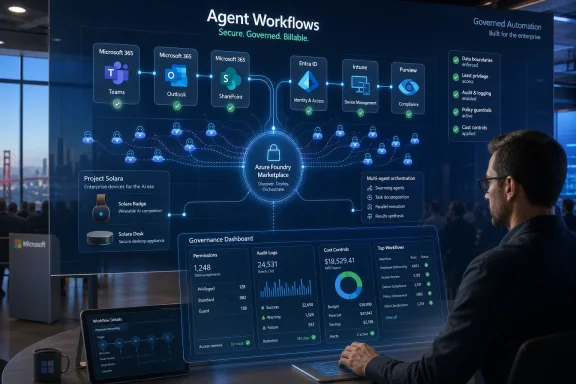
Project Solara is the most speculative of the Build announcements, which also makes it the most revealing. Microsoft described it as a chip-to-cloud platform for an open, multi-agent world, aimed at devices built around agents rather than conventional applications. The prototypes reportedly included badge-like and desk-based concepts, the kind of devices that suggest Microsoft is thinking beyond laptops without pretending the PC is suddenly dead.
That distinction matters. Microsoft has spent decades profiting from general-purpose computing, but agentic AI creates pressure for more contextual machines. A nurse, warehouse manager, retail associate, or field technician may not want a full desktop session. They may want an authenticated, policy-controlled device that can listen, surface the right workflow, confirm an action, and disappear.
The risk is obvious: the tech industry is littered with failed “post-smartphone” and “ambient computing” devices. Consumer AI gadgets have struggled because they often solve the wrong problem at the wrong price with the wrong trust model. Microsoft’s enterprise angle gives Solara a more credible starting point. A device that looks absurd in a consumer demo may make sense in a hospital, factory, call center, or logistics hub if it plugs into identity, policy, audit logs, and line-of-business systems.
The more interesting piece is that Solara appears to treat user interface as something generated or adapted on demand. That is a profound shift from the Windows tradition, where applications bring their own windows, menus, ribbons, and settings. In an agent-first model, the interface may be temporary: a confirmation card, a voice prompt, a projected workflow, a small screen on a desk device, or a glanceable wearable interaction.
For developers, this is both liberating and dangerous. Microsoft is essentially saying: stop building full apps for every context, and start exposing capabilities that agents can use. That could reduce friction, but it also risks abstracting developers away from the user relationship. If the agent owns the interaction, the platform owner owns the tollbooth.
The Windows Angle Is More Complicated Than the Keynote Suggests
For a WindowsForum.com audience, Solara raises an uncomfortable question: is Microsoft’s agent future a Windows future? The answer appears to be “not necessarily,” and that is worth sitting with. Reports around Solara suggest Microsoft is willing to use lighter, specialized platform layers for agent-first devices rather than treating Windows as the inevitable substrate for every endpoint.
That is not a betrayal of Windows so much as an admission of reality. Windows remains an enormous enterprise desktop platform, but it is not the right answer for every sensor, badge, kiosk, desk appliance, and embedded workflow terminal. The old Microsoft might have tried to stretch Windows into every form factor. The current Microsoft is more likely to ask whether the device increases Azure, Microsoft 365, Entra, Intune, Purview, and Copilot usage.
This is the Nadella-era playbook in hardware form. The operating system is important, but the account, graph, policy layer, model endpoint, and developer platform are more important. If Solara devices become real, Microsoft will care less whether they look like PCs than whether they participate in Microsoft’s managed enterprise fabric.
That should make Windows watchers more cautious, not more alarmed. The PC is still where complex work happens. But Microsoft’s center of gravity has shifted from Windows as the universal platform to Microsoft Cloud as the universal business environment. Agents accelerate that shift because they care less about where a window is drawn and more about what permissions, data, and tools they can access.
Scout Is the Real Enterprise Test
If Solara is the moonshot, Microsoft Scout is the nearer-term test of whether agents can become revenue rather than theater. Scout was presented as an always-on Microsoft 365 agent that works across Teams, Outlook, OneDrive, SharePoint, calendars, and local resources. In plain English, Microsoft wants to build an agent that understands the mess of knowledge work and does something useful before you remember to ask.
That is the right target. Most office work is not blocked by a lack of text generation. It is blocked by context switching, buried decisions, forgotten follow-ups, meeting sprawl, version confusion, and the soft chaos of distributed accountability. Microsoft 365 already contains much of that exhaust. The question is whether Microsoft can transform it into action without creating a surveillance machine wearing a productivity badge.
Scout’s value proposition is not that it will write prettier emails. It is that it might notice that the email matters, the Teams thread changed the decision, the document in SharePoint is now stale, the meeting needs a pre-read, and the person responsible for the deliverable has gone quiet. That is much closer to how work actually breaks.
But the word always-on should make administrators tense. An agent that can prepare, coordinate, flag, and act across a workplace is only useful if its authority is bounded. The old nightmare was data leakage through search. The new nightmare is data leakage plus autonomous action.
Microsoft knows this, which is why the Scout story leans heavily on enterprise controls: Entra identity, scoped credentials, Intune configuration, Purview enforcement, sensitivity labels, and data loss prevention. These details are not footnotes. They are the product. In enterprise AI, governance is not the thing that slows down adoption; governance is the thing that makes adoption possible.
The Best Agent Will Be the One That Knows When to Stop
The hardest part of Scout will not be summarization or retrieval. It will be judgment. A good agent needs to know when it has enough context, when it needs confirmation, when it should escalate, and when it should do nothing.
That is where many AI demos collapse in production. A keynote shows the agent chaining tasks together smoothly. A real workplace contains contradictory instructions, ambiguous authority, sensitive documents, private conversations, regulatory boundaries, and people who do not agree on what “done” means. The agent’s failure mode is not merely being wrong. It is being confidently helpful in a way that creates work, risk, or mistrust.
This is why Microsoft’s rollout discipline matters. A Frontier program, policy-gated access, and opt-in controls may sound conservative, but the alternative is worse. If Scout arrives as another noisy assistant that employees mute and administrators distrust, Microsoft will burn the very audience it needs most.
The social contract is as important as the technical stack. Workers will tolerate automation that saves time. They will resist automation that feels like management has installed a tireless observer inside their inbox. Scout has to be useful without being creepy, proactive without being presumptuous, and transparent enough that people know why it acted.
That balance will determine whether Microsoft’s agent strategy becomes durable. Enterprises do not buy AI because it is magical. They buy it when the risk-adjusted outcome is better than the current process.
The MAI Models Are About Leverage, Not Ego
The announcement of seven new MAI models may be the most strategically important part of the Build package. Microsoft has spent the past several years benefiting enormously from its OpenAI partnership, but no platform company wants its most important layer permanently dependent on another company’s roadmap, pricing, capacity, and governance choices. The MAI family is Microsoft’s hedge against that dependency becoming a ceiling.
MAI-Thinking-1, described as Microsoft’s first advanced reasoning model, is especially symbolic. Reasoning models have become a shorthand for seriousness in AI because they promise better performance on multi-step tasks, planning, code, math, and long-context work. But Microsoft does not need to win every benchmark to make MAI matter.
The business case is more pragmatic. Microsoft needs models that are good enough, cheaper enough, controllable enough, and integrated enough to power products at enterprise scale. A model that is not the world’s smartest may still be the most profitable if it is optimized for GitHub Copilot, Microsoft 365 workflows, Azure AI Foundry deployments, speech transcription, image generation, or internal orchestration.
That is the difference between AI as a research race and AI as a software business. Frontier model labs chase the ceiling. Microsoft also cares about the floor: latency, reliability, compliance, routing, regional availability, cost per task, support contracts, and whether the feature can be sold inside an existing enterprise agreement.
The MAI portfolio gives Microsoft more knobs to turn. It can route tasks to different models, tune for product-specific workloads, bundle capabilities into Copilot tiers, expose models through Foundry, and negotiate with outside model providers from a stronger position. OpenAI remains strategically important, but Build 2026 made the direction obvious: Microsoft wants optionality.
Azure Foundry Becomes the Marketplace Where the Stack Converges
The model announcements also reinforce Azure’s role as the clearinghouse for enterprise AI. Microsoft does not have to convince every customer to use only Microsoft models. It has to convince them to build, govern, deploy, monitor, and pay for AI through Microsoft’s platform.
That is a subtler and stronger position. If Azure AI Foundry becomes the place where companies choose among Microsoft, OpenAI, open-weight, and third-party models, Microsoft wins even when a customer picks someone else’s model. The cloud meter still runs. The identity layer still matters. The governance tooling still matters. The developer workflow still flows through Microsoft’s ecosystem.
This is why the agent-first strategy is bigger than Copilot. Agents need models, tools, memory, permissions, observability, connectors, evaluation, and lifecycle management. Those are cloud platform problems, not chatbot problems. Microsoft is trying to turn the messy middle of enterprise AI into a managed service.
For IT pros, that means the next wave of AI adoption will look less like installing a new app and more like standing up a new class of workload. There will be agent inventories, permissions reviews, model policies, prompt and tool auditing, data boundary decisions, cost controls, and incident response playbooks. Microsoft is betting that enterprises would rather buy that scaffolding from a vendor already embedded in their tenant than stitch it together themselves.
That is a reasonable bet. It is also where Microsoft will face its toughest scrutiny. The more central Azure Foundry and Microsoft 365 become to agentic work, the more customers will ask whether they are gaining productivity or deepening lock-in.
The Growth Story Is Real, but It Is Not a Straight Line
The investment case around Microsoft’s agents should not be reduced to a one-day stock move. Shares can fall on macro concerns, valuation compression, or sector rotation even when a company’s long-term strategy improves. A conference announcement is not a revenue line. But Build 2026 did clarify where Microsoft thinks the next growth layer sits.
The obvious path is Microsoft 365 monetization. If Scout and related agents become trusted productivity infrastructure, Microsoft can justify premium Copilot tiers, role-specific agents, and expanded enterprise licensing. The more agents touch regulated work, the more governance and compliance features become part of the upsell.
The second path is Azure consumption. Agents that reason, retrieve, call tools, transcribe audio, process images, generate code, and run background workflows consume compute. Even if model costs fall, usage can grow faster. Microsoft’s cloud business benefits if enterprise AI moves from pilot chatbots to persistent operational agents.
The third path is developer capture. GitHub Copilot, Visual Studio Code, Azure AI Foundry, and Microsoft’s model catalog form a funnel. If developers build agentic applications using Microsoft’s tools, Microsoft participates in the economics before those applications ever reach end users.
The fourth path is endpoint expansion. Solara-like devices may never become a huge standalone hardware business, but they could create new managed endpoints that pull through Intune, Entra, Azure services, and industry-specific solutions. Microsoft does not need to become Apple to profit from hardware. It needs devices to make its cloud indispensable in more physical workflows.
The caution is that all four paths require patience. Enterprises are still digesting the first wave of generative AI. Many are asking whether Copilot licenses have produced measurable returns. Agents raise the stakes because they promise more value but also create more operational risk. Microsoft’s growth catalyst is credible precisely because it runs through enterprise adoption, and enterprise adoption is never instantaneous.
The OpenAI Dependency Is Shrinking, Not Disappearing
One of the more tempting narratives is that Microsoft’s in-house MAI models represent a clean break from OpenAI. That overstates the case. Microsoft and OpenAI remain deeply entangled commercially and technically, and OpenAI’s frontier models still carry enormous weight in the market.
What has changed is leverage. Microsoft does not want to be a reseller of someone else’s intelligence layer forever. It wants to be the company that can choose the right model for the job, whether that model comes from OpenAI, Microsoft AI, an open-source ecosystem, or another provider.
That strategy mirrors how Microsoft handled cloud infrastructure. Azure does not win because Microsoft invented every component from scratch. It wins when enterprises trust Microsoft to operate the platform, integrate the services, secure the identity plane, and bill the workload. Models are becoming part of that platform logic.
The MAI family also gives Microsoft a way to optimize for its own products. A general-purpose frontier model may be impressive, but an internal model tuned for GitHub workflows, Microsoft 365 context, or speech scenarios can be more valuable in practice. The model does not have to be famous. It has to be useful, cheap enough, and always available.
This is where the investor story becomes more durable. Microsoft’s AI upside is not only tied to whether it has the single best model. It is tied to whether it can industrialize AI across the software estate it already controls. That is a much more Microsoft-shaped opportunity.
The Admin’s Nightmare Is Also Microsoft’s Moat
Every agent announcement eventually runs into the same wall: permissions. What can the agent see? What can it do? Who approved it? What happens when it acts incorrectly? How is the action logged? Can the organization reconstruct the chain of reasoning, data access, and tool calls after something goes wrong?
For Microsoft, these questions are not obstacles to the strategy. They are the reason the strategy might work. The company’s biggest advantage in enterprise AI is not that it can produce a clever demo. It is that it already owns much of the boring machinery required to make the demo deployable.
Entra governs identity. Intune governs devices. Purview governs data protection and compliance. Microsoft 365 contains the content graph. Teams contains the collaboration layer. Azure hosts the infrastructure. GitHub and Visual Studio Code capture developers. Windows remains the daily workbench for millions of professionals. Agents become more credible when they can inherit that machinery.
The danger is that complexity can become its own drag. Microsoft licensing is already infamous. Admin portals multiply. Security and compliance settings can feel like archaeology. If agent governance becomes another maze of SKUs, toggles, preview flags, and overlapping consoles, many organizations will slow-roll adoption no matter how good the demos look.
The winning version of Microsoft’s agent strategy makes governance legible. It gives administrators a clear inventory of agents, scopes, identities, data access, actions, costs, and exceptions. It makes rollback possible. It treats agents as managed principals, not magical coworkers.
That is the difference between “AI transformation” and operational software. Enterprises can tolerate imperfection. They cannot tolerate unbounded ambiguity.
Workers Will Judge Agents by Interruption, Not Intelligence
Microsoft also has to win a human factors battle. The company has increasingly woven AI into Windows and Microsoft 365, but users do not experience strategy. They experience pop-ups, sidebars, nudges, summaries, buttons, and notifications.
An agent that interrupts at the wrong time is worse than a dumb tool. A dumb tool waits. A bad agent intrudes. The more proactive Scout becomes, the more Microsoft must prove that its judgment is helpful in the rhythm of actual work.
This is especially true for Windows users who already feel that the operating system has become too eager to recommend, promote, and steer. If agentic AI becomes another layer of unsolicited suggestions, it will face resistance. If it quietly removes friction, it will become invisible in the best possible way.
Microsoft’s challenge is to resist the temptation to over-show the AI. The most successful agents may not look like chatbots at all. They may look like a meeting that starts with the right context, a ticket that arrives already classified, a document that carries its approval history, or a workstation that knows which workflow belongs to the person wearing the badge.
That is less glamorous than a talking assistant, but it is closer to enterprise value. Workers do not need a synthetic personality. They need fewer dropped balls.
The Build 2026 Bet Comes Down to Five Practical Tests
Microsoft’s agent strategy now has enough shape to be judged by execution rather than adjectives. The company has a plausible platform story, a credible enterprise advantage, and a growing in-house model portfolio. What it still needs is proof that agents can produce measurable outcomes without creating new categories of risk.
- Microsoft’s AI growth case depends on agents becoming governed workflows, not merely better chat interfaces.
- Project Solara is important because it shows Microsoft preparing for agent-first devices even when Windows is not the center of the design.
- Scout is the near-term enterprise test because it asks customers to trust an always-on agent inside Microsoft 365’s most sensitive work context.
- The MAI model family gives Microsoft more control over cost, routing, latency, and product-specific optimization, even if OpenAI remains a major partner.
- IT departments should evaluate agent deployments like managed workloads, with identity, permissions, logging, data boundaries, cost controls, and rollback plans defined before broad rollout.
Microsoft’s Next Catalyst Looks Less Like a Product Than a Permission Model
The most important thing Microsoft announced at Build 2026 was not a single device, model, or assistant. It was a theory of computing in which the user no longer opens software as often, because software is increasingly represented by agents that understand intent, context, and policy. That is a radical idea wrapped in very Microsoft clothing.
The company’s advantage is that it can make the radical seem administrative. It can take a speculative AI pattern and route it through procurement, compliance, identity, endpoint management, developer tooling, and cloud billing. That is not as exciting as a breakthrough model demo, but it is how enterprise platforms are built.
Whether this becomes Microsoft’s next growth catalyst depends on whether customers see agents as an upgrade to work rather than another layer of noise. If Scout saves time without feeling intrusive, if MAI models improve margins without degrading quality, if Solara finds real industry use cases, and if Azure becomes the default operating layer for agentic workloads, Microsoft will have found more than a new feature cycle. It will have found a way to tax the next interface between people and their work.
The bet is still early, and the market will punish any gap between AI spending and AI returns. But Microsoft’s Build 2026 strategy has the shape of a real platform transition: control the models where it matters, govern the agents where enterprises demand it, extend the endpoint where the workflow requires it, and make the whole thing purchasable through relationships Microsoft already owns. If the agent era arrives as a managed enterprise stack rather than a consumer gadget fad, Microsoft is better positioned than almost anyone to turn it into the next engine of growth.
References
- Has Microsoft (MSFT) Found Its Next Growth Catalyst in AI Agents Kavout · 2026-06-06T16:12:07.044318
- news.microsoft.com news.microsoft.com