

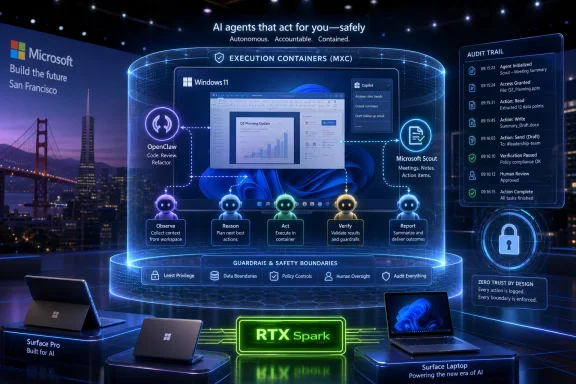
Microsoft used Build 2026 in San Francisco to recast Windows 11 as the operating system for local AI agents, pairing OpenClaw support with Microsoft Execution Containers, new RTX Spark-based Surface hardware, and an imminent Microsoft Scout agent for business users. The message was not subtle: Windows is no longer being pitched primarily as the place where people open apps, arrange windows, and click buttons. Microsoft wants it to become the controlled environment where software agents observe, decide, and act. That future may be technically impressive, but it is also the most radical redefinition of the PC since Windows itself made the desktop mainstream.
For decades, the Windows pitch was simple enough for anyone to understand. A PC was a general-purpose machine, and Windows was the interface between the user and the machine’s power. You installed applications, managed files, joined networks, ran scripts, played games, edited documents, and occasionally cursed at drivers.
At Build 2026, that old arrangement looked almost quaint. Microsoft’s new center of gravity is not the application, the desktop, or even Copilot as a chat box. It is the agent: software that can receive an instruction, reason through a task, use tools, access files, interact with services, and keep working while the user does something else.
That is why the most revealing line from the keynote was not really about OpenClaw, Surface, or Scout. It was Nvidia CEO Jensen Huang’s framing of the PC’s evolution from personal computer to “personal AI.” That phrase captures the strategic shift better than any product name. Microsoft and Nvidia are not merely arguing that AI will make Windows more convenient. They are arguing that the PC itself is being reclassified.
The danger for Microsoft is that this pitch asks users to accept a bargain they have not yet been shown in practical terms. People understand why a faster laptop matters. Developers understand why local model execution matters. IT administrators understand why isolation matters. But the average Windows user has not yet been given a compelling reason to hand routine computer activity to an autonomous system, especially one that needs unusually broad access to become useful.
That is the correct instinct. The first serious question about desktop agents is not whether they can book meetings, summarize emails, or reorganize folders. It is whether they can be stopped. An agent that can use the system like a person can also make mistakes like a person, except faster, more literally, and potentially across many connected services at once.
Microsoft Execution Containers are Microsoft’s answer to that problem. The idea is to let developers and administrators define what an agent can access, then rely on Windows to enforce those limits at the operating-system level. In the Build framing, Windows becomes less like a passive launchpad and more like a containment field.
That is a powerful idea, especially for enterprises that already live in Microsoft’s management stack. If agent permissions can be governed through familiar administrative models and integrated with identity, endpoint management, auditing, and data protection, Microsoft has a credible path into corporate deployment. The company does not need every employee to love agents on day one. It needs CIOs to believe that agents can be piloted without turning every workstation into an uncontrolled experiment.
But the demo also reveals the fear Microsoft is trying to outrun. If the memorable proof point for your future platform is “it tried to delete everything and failed,” then the audience is already thinking about the version that does not fail safely. That is not paranoia. It is the obvious mental model for anyone who has watched automation go wrong.
OpenClaw gives Microsoft a sharper narrative. It is agentic, local, dangerous enough to require a new security model, and interesting enough to make developers pay attention. That matters because developer attention is what Build is for. Microsoft does not need to convince the keynote crowd that AI is important; it needs to convince them that Windows is the right substrate for the next wave of AI software.
This is where the hardware story matters. The Surface Laptop Ultra and Surface RTX Spark Dev Box are not just flashy machines for a keynote slide. They are proof that Microsoft and Nvidia want the PC to run meaningful AI workloads locally, not merely serve as a thin client for cloud inference. Local execution promises lower latency, better privacy possibilities, offline capability, and a different cost model for developers experimenting with agents.
The catch is that Microsoft is once again trying to create demand and infrastructure at the same time. Windows needs powerful local AI hardware to make agents feel native. The hardware needs useful agents to justify its premium. Developers need APIs, isolation, and distribution paths before they commit. Enterprises need governance before they allow deployment. Consumers need examples that are better than “my computer can now do chores if I trust it enough.”
That circular dependency is not impossible to break. Microsoft has broken similar loops before with Windows, Office, Xbox services, Azure, and developer tooling. But it means the Build 2026 pitch is less a product launch than a platform referendum.
That is sensible. A new version number would invite the old questions: new Start menu, new system requirements, new upgrade path, new compatibility headaches. Microsoft clearly wants a different conversation. It wants to say that Windows 11 is already the runway for agentic computing, provided the system gains the right containers, models, hardware acceleration, and management hooks.
For Windows enthusiasts, this is both exciting and deflating. It is exciting because Windows could become technically more interesting than it has been in years. The classic desktop is mature, and much of the recent Windows debate has revolved around ads, account pressure, telemetry, AI branding, and UI churn. A serious local-agent architecture at least gives the platform a real engineering frontier.
It is deflating because users hoping for a cleaner, lighter, more coherent Windows may see yet another layer being added before old irritations are resolved. Microsoft has a habit of announcing the future while the present still contains rough edges. If File Explorer, Settings, backup prompts, widgets, search, and default-app behaviors remain inconsistent, users may not be thrilled to hear that the next layer of Windows involves autonomous assistants with file access.
Windows 12 may arrive eventually. But Build 2026 made it clear that the more important question is whether Windows becomes an agent platform before it becomes a newly branded OS. Microsoft appears to think the version number is a distraction. It may be right.
That matters because agents ask for more trust than Recall ever did. Recall’s controversial premise was that Windows could remember what you had seen. Agents go further. They may act on what they see, and the difference between memory and agency is enormous.
Microsoft’s MXC pitch is partly an attempt to show that it learned the lesson. Do not simply bolt an AI feature onto Windows and promise that users will like it. Build the containment story first. Show the failed deletion. Bring developers and IT administrators into the permission model. Treat security not as a footnote but as the demo.
Still, trust is not restored by architecture diagrams alone. IT pros will want to know how policies are expressed, how exceptions are audited, how agents authenticate to services, how secrets are handled, how prompts and tool calls are logged, how data boundaries are enforced, and how quickly Microsoft can patch bypasses. Enthusiasts will want to know whether consumer Windows becomes more transparent or more opaque as agents gain system privileges.
The uncomfortable truth is that the more useful an agent becomes, the more dangerous it becomes. A harmless agent is easy to secure because it cannot do much. A valuable agent needs context, tools, memory, and permission to act. Microsoft’s challenge is not to eliminate that tension. It is to make the tension governable.
Consumers are a harder sell. A home user may like the idea of an assistant that can organize photos, handle travel planning, clean up files, configure settings, or troubleshoot a printer. But the same user may recoil when asked to grant enough access for those tasks to work. Microsoft has not yet found the simple, emotionally satisfying example that makes local agents feel inevitable.
Enterprise buyers, by contrast, are used to controlled delegation. They already allow software to enforce policies, scan files, manage devices, inspect mail, classify data, and automate workflows. The agent is new, but the governance pattern is familiar. If Microsoft can put agents behind admin controls and compliance language, it can make the new model feel like an extension of existing IT practice rather than a consumer leap of faith.
That does not mean corporate adoption will be easy. Security teams will ask whether MXC containment survives malicious prompts, compromised connectors, poisoned files, excessive permissions, and confused-deputy attacks. Legal teams will ask who is responsible when an agent takes an action that creates a contractual, HR, financial, or regulatory problem. Help desks will ask how to debug a task that failed because the agent reasoned badly rather than because a traditional application crashed.
This is where Microsoft’s platform advantage matters. Windows, Defender, Entra, Intune, Purview, Microsoft 365, Azure, and GitHub give the company more places to insert controls than almost any competitor. If agents become another managed workload, Microsoft can make Windows the administrative center of gravity. That is the strategic prize.
Developers can imagine workflows because developers live inside complicated toolchains. They can see why a local agent with access to files, terminals, browsers, IDEs, issue trackers, and documentation might be useful. A coding agent that can inspect a repository, run tests, open a pull request, and explain failures has obvious appeal.
But general-purpose computing is messier. Users do not always know how to specify what they want. Their files are inconsistent. Their accounts are scattered. Their data is sensitive in unpredictable ways. Their tolerance for mistakes is low when the machine is touching personal photos, tax documents, work files, messages, or purchases.
This is why Microsoft needs developers. The killer agent experience is unlikely to be invented entirely inside Windows engineering. It will emerge from many narrow, task-specific agents that prove their worth in bounded domains. The agent that safely reconciles invoices may matter more than the agent that promises to “use your PC.” The agent that handles a developer’s build failures may matter more than the agent that claims to manage a whole workday.
The risk is that developers build impressive demos that do not translate into durable habits. The software industry is full of automation tools that looked magical on stage and gathered dust in daily life because setup costs, edge cases, and trust barriers outweighed the benefit. Agents will not escape that pattern just because they use larger models.
Nvidia’s role is therefore more than supplier. It is co-author of the story. RTX Spark gives Microsoft a way to say that agentic Windows is not just software aspiration. It is silicon, memory architecture, developer boxes, laptop designs, and local model capacity. That is a much stronger pitch to builders than another cloud-only assistant.
Still, hardware specifications do not solve the trust problem. A faster agent can make mistakes faster. A local model can be more private than a cloud model while still mishandling local data. A powerful developer box can accelerate experimentation without proving that the results belong on ordinary office PCs.
The practical question for Windows users is not whether RTX Spark systems are impressive. They almost certainly are. The question is whether Microsoft can make advanced AI hardware feel like it serves the user rather than the platform’s appetite for more automation. If the best features require expensive new machines, agentic Windows could become another premium-tier demo that leaves mainstream users with branding and prompts rather than benefits.
There is also a timing issue. Enterprises refresh hardware slowly. Consumers refresh even more slowly when prices are high and existing PCs work well enough. If agentic Windows depends on a new class of AI-capable machines, Microsoft will need a graceful fallback story for the hundreds of millions of Windows 11 systems that are not Surface Laptop Ultras.
But calm computing cannot be built by adding another demanding presence to the system. If the agent becomes one more thing asking for attention, permissions, subscriptions, corrections, and explanations, it will worsen the problem it claims to solve. The best agentic experiences may be the least theatrical ones: quiet, reversible, auditable actions taken inside narrow lanes.
That is why Microsoft’s focus on guardrails is encouraging. The company seems to understand that agentic Windows cannot be marketed only through capability. It must be marketed through restraint. “Look what it can do” has to be balanced by “look what it cannot do without permission.”
The unresolved issue is interface. How does a user understand what an agent is allowed to do? How does Windows explain that without burying people in enterprise policy language? How does a user revoke access after a task? How does the system show an audit trail in plain English? How does it distinguish between a helpful autonomous action and an overreach?
These are not cosmetic questions. They are the product. In agentic computing, the permissions interface is as important as the model. If users cannot understand the boundary, they cannot trust the autonomy.
That is a welcome change. A Windows machine with strong local inference, serious containment, Linux-friendly development workflows, and enterprise-grade policy could be a formidable platform. It could make the PC feel less like a legacy endpoint and more like an active node in a distributed AI workflow.
But excitement should not be mistaken for reassurance. Microsoft has to prove that MXC is more than a keynote abstraction. It has to prove that Scout is more than a Microsoft 365 upsell. It has to prove that OpenClaw on Windows is not merely a way to domesticate a dangerous open-source phenomenon for corporate buyers. Most importantly, it has to prove that users remain in command.
The phrase “agents are more important than human users” may be an exaggeration of the vibe rather than an official doctrine, but it captures the anxiety. Windows became dominant because it empowered users and developers to do an enormous range of things. If agentic Windows starts to feel like a system where users supervise opaque software acting on their behalf, the emotional contract changes.
Power users will demand switches, logs, local controls, and ways to say no. Administrators will demand policy and proof. Ordinary users will demand obvious value. Microsoft needs to satisfy all three groups, and they will not all want the same thing.
 Microsoft Is No Longer Selling the PC as a Tool
For decades, the Windows pitch was simple enough for anyone to understand. A PC was a general-purpose machine, and Windows was the interface between the user and the machine’s power. You installed applications, managed files, joined networks, ran scripts, played games, edited documents, and occasionally cursed at drivers.At Build 2026, that old arrangement looked almost quaint. Microsoft’s new center of gravity is not the application, the desktop, or even Copilot as a chat box. It is the agent: software that can receive an instruction, reason through a task, use tools, access files, interact with services, and keep working while the user does something else.
That is why the most revealing line from the keynote was not really about OpenClaw, Surface, or Scout. It was Nvidia CEO Jensen Huang’s framing of the PC’s evolution from personal computer to “personal AI.” That phrase captures the strategic shift better than any product name. Microsoft and Nvidia are not merely arguing that AI will make Windows more convenient. They are arguing that the PC itself is being reclassified.
The danger for Microsoft is that this pitch asks users to accept a bargain they have not yet been shown in practical terms. People understand why a faster laptop matters. Developers understand why local model execution matters. IT administrators understand why isolation matters. But the average Windows user has not yet been given a compelling reason to hand routine computer activity to an autonomous system, especially one that needs unusually broad access to become useful.
The Demo Failed Because Microsoft Needed It To Fail
The most important moment in the PCMag account was not the arrival of OpenClaw on Windows. It was the staged failure. Microsoft showed an agent attempting to delete desktop files and being blocked by guardrails. In a normal software demo, failure is a risk. In this one, failure was the product.That is the correct instinct. The first serious question about desktop agents is not whether they can book meetings, summarize emails, or reorganize folders. It is whether they can be stopped. An agent that can use the system like a person can also make mistakes like a person, except faster, more literally, and potentially across many connected services at once.
Microsoft Execution Containers are Microsoft’s answer to that problem. The idea is to let developers and administrators define what an agent can access, then rely on Windows to enforce those limits at the operating-system level. In the Build framing, Windows becomes less like a passive launchpad and more like a containment field.
That is a powerful idea, especially for enterprises that already live in Microsoft’s management stack. If agent permissions can be governed through familiar administrative models and integrated with identity, endpoint management, auditing, and data protection, Microsoft has a credible path into corporate deployment. The company does not need every employee to love agents on day one. It needs CIOs to believe that agents can be piloted without turning every workstation into an uncontrolled experiment.
But the demo also reveals the fear Microsoft is trying to outrun. If the memorable proof point for your future platform is “it tried to delete everything and failed,” then the audience is already thinking about the version that does not fail safely. That is not paranoia. It is the obvious mental model for anyone who has watched automation go wrong.
OpenClaw Gives Microsoft a Story It Could Not Build With Copilot Alone
Copilot has always had a branding problem. Depending on the month and product, it has been a chatbot, a search assistant, an Office helper, a Windows sidebar, a coding partner, and a broad corporate strategy. Microsoft has poured the Copilot name over so many surfaces that it sometimes feels less like a product than a weather system.OpenClaw gives Microsoft a sharper narrative. It is agentic, local, dangerous enough to require a new security model, and interesting enough to make developers pay attention. That matters because developer attention is what Build is for. Microsoft does not need to convince the keynote crowd that AI is important; it needs to convince them that Windows is the right substrate for the next wave of AI software.
This is where the hardware story matters. The Surface Laptop Ultra and Surface RTX Spark Dev Box are not just flashy machines for a keynote slide. They are proof that Microsoft and Nvidia want the PC to run meaningful AI workloads locally, not merely serve as a thin client for cloud inference. Local execution promises lower latency, better privacy possibilities, offline capability, and a different cost model for developers experimenting with agents.
The catch is that Microsoft is once again trying to create demand and infrastructure at the same time. Windows needs powerful local AI hardware to make agents feel native. The hardware needs useful agents to justify its premium. Developers need APIs, isolation, and distribution paths before they commit. Enterprises need governance before they allow deployment. Consumers need examples that are better than “my computer can now do chores if I trust it enough.”
That circular dependency is not impossible to break. Microsoft has broken similar loops before with Windows, Office, Xbox services, Azure, and developer tooling. But it means the Build 2026 pitch is less a product launch than a platform referendum.
Windows 12 Is Beside the Point
One of the more interesting details in the PCMag report is what Microsoft did not talk about. There was no Windows 12 reveal. That absence is not just a scheduling choice. It suggests Microsoft believes the next Windows transition is architectural and experiential, not necessarily numerical.That is sensible. A new version number would invite the old questions: new Start menu, new system requirements, new upgrade path, new compatibility headaches. Microsoft clearly wants a different conversation. It wants to say that Windows 11 is already the runway for agentic computing, provided the system gains the right containers, models, hardware acceleration, and management hooks.
For Windows enthusiasts, this is both exciting and deflating. It is exciting because Windows could become technically more interesting than it has been in years. The classic desktop is mature, and much of the recent Windows debate has revolved around ads, account pressure, telemetry, AI branding, and UI churn. A serious local-agent architecture at least gives the platform a real engineering frontier.
It is deflating because users hoping for a cleaner, lighter, more coherent Windows may see yet another layer being added before old irritations are resolved. Microsoft has a habit of announcing the future while the present still contains rough edges. If File Explorer, Settings, backup prompts, widgets, search, and default-app behaviors remain inconsistent, users may not be thrilled to hear that the next layer of Windows involves autonomous assistants with file access.
Windows 12 may arrive eventually. But Build 2026 made it clear that the more important question is whether Windows becomes an agent platform before it becomes a newly branded OS. Microsoft appears to think the version number is a distraction. It may be right.
Recall Still Haunts the Room
Any discussion of AI on Windows now passes through the shadow of Recall. Microsoft’s original Recall rollout created exactly the kind of trust problem that agentic Windows cannot afford. Even after changes, delays, and additional controls, the episode established a public memory: Microsoft was willing to put a deeply sensitive AI feature close to the operating system before users and security observers were fully comfortable with the implications.That matters because agents ask for more trust than Recall ever did. Recall’s controversial premise was that Windows could remember what you had seen. Agents go further. They may act on what they see, and the difference between memory and agency is enormous.
Microsoft’s MXC pitch is partly an attempt to show that it learned the lesson. Do not simply bolt an AI feature onto Windows and promise that users will like it. Build the containment story first. Show the failed deletion. Bring developers and IT administrators into the permission model. Treat security not as a footnote but as the demo.
Still, trust is not restored by architecture diagrams alone. IT pros will want to know how policies are expressed, how exceptions are audited, how agents authenticate to services, how secrets are handled, how prompts and tool calls are logged, how data boundaries are enforced, and how quickly Microsoft can patch bypasses. Enthusiasts will want to know whether consumer Windows becomes more transparent or more opaque as agents gain system privileges.
The uncomfortable truth is that the more useful an agent becomes, the more dangerous it becomes. A harmless agent is easy to secure because it cannot do much. A valuable agent needs context, tools, memory, and permission to act. Microsoft’s challenge is not to eliminate that tension. It is to make the tension governable.
Enterprise IT Gets the First Real Vote
Microsoft is wisely taking the enterprise route first. Businesses already pay for management, compliance, identity, endpoint security, and productivity integration. They also have repetitive workflows that can plausibly be delegated to agents. If Scout can prepare meetings, resolve scheduling conflicts, assemble documents, file tickets, update CRM records, or coordinate approvals inside Microsoft 365, there is at least a business case to evaluate.Consumers are a harder sell. A home user may like the idea of an assistant that can organize photos, handle travel planning, clean up files, configure settings, or troubleshoot a printer. But the same user may recoil when asked to grant enough access for those tasks to work. Microsoft has not yet found the simple, emotionally satisfying example that makes local agents feel inevitable.
Enterprise buyers, by contrast, are used to controlled delegation. They already allow software to enforce policies, scan files, manage devices, inspect mail, classify data, and automate workflows. The agent is new, but the governance pattern is familiar. If Microsoft can put agents behind admin controls and compliance language, it can make the new model feel like an extension of existing IT practice rather than a consumer leap of faith.
That does not mean corporate adoption will be easy. Security teams will ask whether MXC containment survives malicious prompts, compromised connectors, poisoned files, excessive permissions, and confused-deputy attacks. Legal teams will ask who is responsible when an agent takes an action that creates a contractual, HR, financial, or regulatory problem. Help desks will ask how to debug a task that failed because the agent reasoned badly rather than because a traditional application crashed.
This is where Microsoft’s platform advantage matters. Windows, Defender, Entra, Intune, Purview, Microsoft 365, Azure, and GitHub give the company more places to insert controls than almost any competitor. If agents become another managed workload, Microsoft can make Windows the administrative center of gravity. That is the strategic prize.
Developers Are Being Asked to Build the Missing Use Case
The PCMag piece lands on the right skepticism: Microsoft’s vision is clearer than the everyday use case. That is not a minor complaint. It is the central gap in the agentic computing story.Developers can imagine workflows because developers live inside complicated toolchains. They can see why a local agent with access to files, terminals, browsers, IDEs, issue trackers, and documentation might be useful. A coding agent that can inspect a repository, run tests, open a pull request, and explain failures has obvious appeal.
But general-purpose computing is messier. Users do not always know how to specify what they want. Their files are inconsistent. Their accounts are scattered. Their data is sensitive in unpredictable ways. Their tolerance for mistakes is low when the machine is touching personal photos, tax documents, work files, messages, or purchases.
This is why Microsoft needs developers. The killer agent experience is unlikely to be invented entirely inside Windows engineering. It will emerge from many narrow, task-specific agents that prove their worth in bounded domains. The agent that safely reconciles invoices may matter more than the agent that promises to “use your PC.” The agent that handles a developer’s build failures may matter more than the agent that claims to manage a whole workday.
The risk is that developers build impressive demos that do not translate into durable habits. The software industry is full of automation tools that looked magical on stage and gathered dust in daily life because setup costs, edge cases, and trust barriers outweighed the benefit. Agents will not escape that pattern just because they use larger models.
The Hardware Race Is Really a Trust Race
The Surface Laptop Ultra and RTX Spark Dev Box make the agentic Windows story feel tangible. Local AI needs compute, memory, and acceleration. If Microsoft wants agents to run continuously, privately, and quickly, the beige-box assumptions of old Windows computing are not enough. The PC has to become an AI workstation without becoming a furnace or a cloud terminal.Nvidia’s role is therefore more than supplier. It is co-author of the story. RTX Spark gives Microsoft a way to say that agentic Windows is not just software aspiration. It is silicon, memory architecture, developer boxes, laptop designs, and local model capacity. That is a much stronger pitch to builders than another cloud-only assistant.
Still, hardware specifications do not solve the trust problem. A faster agent can make mistakes faster. A local model can be more private than a cloud model while still mishandling local data. A powerful developer box can accelerate experimentation without proving that the results belong on ordinary office PCs.
The practical question for Windows users is not whether RTX Spark systems are impressive. They almost certainly are. The question is whether Microsoft can make advanced AI hardware feel like it serves the user rather than the platform’s appetite for more automation. If the best features require expensive new machines, agentic Windows could become another premium-tier demo that leaves mainstream users with branding and prompts rather than benefits.
There is also a timing issue. Enterprises refresh hardware slowly. Consumers refresh even more slowly when prices are high and existing PCs work well enough. If agentic Windows depends on a new class of AI-capable machines, Microsoft will need a graceful fallback story for the hundreds of millions of Windows 11 systems that are not Surface Laptop Ultras.
The Calm Computing Pitch Needs Discipline
Microsoft’s apparent desire for calmer computing is not foolish. Modern PCs are noisy in every sense: notifications, updates, meetings, chats, browser tabs, background apps, security prompts, cloud sync errors, and settings scattered across old and new interfaces. A trustworthy agent that reduces that noise could be genuinely valuable.But calm computing cannot be built by adding another demanding presence to the system. If the agent becomes one more thing asking for attention, permissions, subscriptions, corrections, and explanations, it will worsen the problem it claims to solve. The best agentic experiences may be the least theatrical ones: quiet, reversible, auditable actions taken inside narrow lanes.
That is why Microsoft’s focus on guardrails is encouraging. The company seems to understand that agentic Windows cannot be marketed only through capability. It must be marketed through restraint. “Look what it can do” has to be balanced by “look what it cannot do without permission.”
The unresolved issue is interface. How does a user understand what an agent is allowed to do? How does Windows explain that without burying people in enterprise policy language? How does a user revoke access after a task? How does the system show an audit trail in plain English? How does it distinguish between a helpful autonomous action and an overreach?
These are not cosmetic questions. They are the product. In agentic computing, the permissions interface is as important as the model. If users cannot understand the boundary, they cannot trust the autonomy.
Windows Enthusiasts Should Be Excited, But Not Reassured
For the WindowsForum crowd, the Build 2026 direction is fascinating because it pushes Windows back into the center of a serious platform war. For years, much of the most interesting developer energy has lived in the cloud, the browser, mobile ecosystems, Linux tooling, and cross-platform frameworks. Agentic Windows gives Microsoft a reason to argue that the local OS matters again.That is a welcome change. A Windows machine with strong local inference, serious containment, Linux-friendly development workflows, and enterprise-grade policy could be a formidable platform. It could make the PC feel less like a legacy endpoint and more like an active node in a distributed AI workflow.
But excitement should not be mistaken for reassurance. Microsoft has to prove that MXC is more than a keynote abstraction. It has to prove that Scout is more than a Microsoft 365 upsell. It has to prove that OpenClaw on Windows is not merely a way to domesticate a dangerous open-source phenomenon for corporate buyers. Most importantly, it has to prove that users remain in command.
The phrase “agents are more important than human users” may be an exaggeration of the vibe rather than an official doctrine, but it captures the anxiety. Windows became dominant because it empowered users and developers to do an enormous range of things. If agentic Windows starts to feel like a system where users supervise opaque software acting on their behalf, the emotional contract changes.
Power users will demand switches, logs, local controls, and ways to say no. Administrators will demand policy and proof. Ordinary users will demand obvious value. Microsoft needs to satisfy all three groups, and they will not all want the same thing.
The Future Microsoft Showed Is Real Enough to Be Uncomfortable
The most concrete thing to take from Build 2026 is that Microsoft is no longer treating agents as a sidecar to Windows. It is building the plumbing, courting the developers, aligning with Nvidia, and preparing business-facing products that make agents part of the operating environment. The vision is early, but it is not vapor.- Microsoft is positioning Windows 11, not a hypothetical Windows 12, as the launchpad for agentic computing.
- Microsoft Execution Containers are the company’s attempt to make local AI agents governable rather than merely impressive.
- OpenClaw gives Microsoft a developer-friendly agent story with enough risk and momentum to justify new Windows security primitives.
- RTX Spark-based Surface hardware shows that local AI performance is becoming part of the Windows platform strategy, not just a workstation niche.
- Microsoft still has not shown a mainstream consumer use case strong enough to overcome privacy, security, and trust concerns.
- The success of agentic Windows will depend less on keynote demos than on permissions, auditability, reversibility, and boring administrative controls.
References
- Primary source: PCMag UK
Published: Sat, 06 Jun 2026 12:55:06 GMT
I Saw the Future of Windows at Microsoft Build, and It's Unrecognizable
OpenClaw AI agents were a big hit with the Build crowd, and Microsoft is making Windows increasingly friendly to non-human users.uk.pcmag.com - Related coverage: tomshardware.com
- Related coverage: axios.com
Microsoft debuts Nvidia-powered Microsoft Surface Ultra laptop
Microsoft is trying again to redefine the PC for the AI era.www.axios.com
- Related coverage: windowscentral.com
Microsoft is making a Surface mini PC for AI developers: Meet the Surface RTX Spark Dev Box, featuring 128GB RAM and one petaflop of AI compute power | Windows Central
Coming later this year, Microsoft is shipping its first Surface branded mini PC, aimed solely at AI developers looking to adopt NVIDIA's new RTX Spark platform.www.windowscentral.com - Related coverage: tomsguide.com
Biggest Microsoft Build 2026 announcements — agentic AI, RTX Spark Dev Box, GitHub Copilot app, new MAI models, and more | Tom's Guide
All the big news from Microsoft's AI-focused eventwww.tomsguide.com - Official source: blogs.microsoft.com
Microsoft Build 2026: Be yourself at work - The Official Microsoft Blog
Platforms shift when developers build. We explore, choose tools, dream, create. This platform shift comes with more information than ever, ready at your fingertips. This shift, it’s about building fast AND THEN: it’s about building, operating, optimizing and observing. Securing your...blogs.microsoft.com
- Related coverage: pcworld.com
No Windows 12 at Build, but Microsoft has something else up its sleeve | PCWorld
Microsoft's Pavan Davuluri confirmed Windows 12 won't appear at Build 2026, but the new Surface Laptop Ultra with Nvidia N1X might steal the show.www.pcworld.com - Official source: blogs.windows.com
Build 2026: Furthering Windows as the trusted platform for development
Build is one of our favorite moments each year - a chance to connect with the global developer community and share what we’ve been building. Over the past year, we have connected with many developers pushing the boundaries of what’s possible onblogs.windows.com - Official source: news.microsoft.com
Microsoft Build en directo
El lugar donde seguir en tiempo real las últimas noticias a medida que se anuncien desde el Microsoft Build, los días 2 y 3 de junio de 2026.news.microsoft.com - Related coverage: arstechnica.com
Microsoft plans Linux tools and an RTX Spark desktop for Windows developers - Ars Technica
One hardware announcement and several software highlights from Microsoft Build.arstechnica.com - Related coverage: techradar.com
Microsoft warns OpenClaw could quietly turn your everyday workstation into a high-risk automation gateway | TechRadar
OpenClaw uses legitimate API calls in ways that may leak sensitive datawww.techradar.com - Related coverage: ridehome.info
Microsoft Build
Microsoft dominated Build with Scout, an always-on Teams agent, the Surface RTX Spark Dev Box, its first reasoning model MAI-Thinking-1 aimed squarely at Anthropic,…www.ridehome.info - Related coverage: techcrunch.com
Microsoft is working on yet another OpenClaw-like agent | TechCrunch
The new features would be geared toward enterprise customers, with better security controls than the famously risky open source OpenClaw agent.techcrunch.com - Related coverage: windowslatest.com
Microsoft confirms it's not launching Windows 12, as it teases a big announcement
Microsoft officially shut down Windows 12 rumors to make way for a hardware breakthrough with the new NVIDIA N1X coming for Windows on ARM www.windowslatest.com
- Related coverage: netmag.tw
微軟 Build 2026 發表本地 AI 開發機 免雲端跑大型模型
微軟於Build 2026發表Surface RTX Spark Dev Box、Project Solara與Scout,並推出七款自研MAI模型,主打本地執行AI、代理人裝置並降低對OpenAI的依賴。netmag.tw - Official source: microsoft.com
