

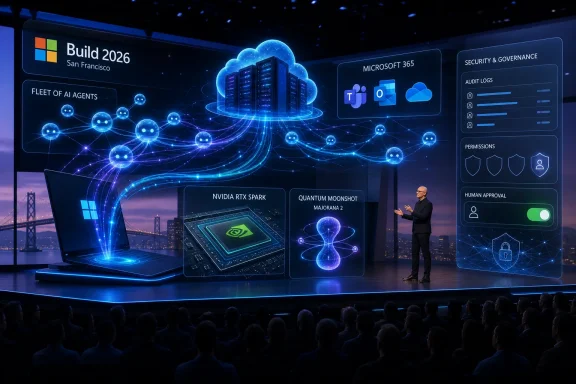
Microsoft used Build 2026 in San Francisco to tie Windows, Microsoft 365, Azure, Nvidia silicon, in-house AI models, and a new Majorana quantum chip into one argument: the next computing platform is not a chatbot, but a managed fleet of agents running across local PCs and cloud infrastructure. That is the headline hiding under the product confetti. Microsoft is no longer merely adding AI features to Windows; it is trying to make Windows the operating layer for autonomous work. The wager is enormous, because it asks customers to trust not just a model, but a persistent software actor with memory, tools, identity, and compute choices of its own.
For most of the cloud era, the Windows PC was Microsoft’s legacy fortress: profitable, ubiquitous, and increasingly less central to the company’s growth story than Azure, Microsoft 365, GitHub, and security subscriptions. Build 2026 reframes that hierarchy. Windows is being recast as the local endpoint for AI agents that need privacy, low latency, device context, and enough compute to do real work without round-tripping every thought to the cloud.
The Microsoft-Nvidia partnership is the clearest sign of that shift. Nvidia’s RTX Spark platform is not just another GPU announcement with a Windows logo taped to the side. It is Microsoft acknowledging that the agentic PC needs a different hardware baseline: more local memory, faster model execution, better developer tools, and a way to move between local inference and Azure-scale workloads without treating the PC as a thin client.
That matters because the first wave of generative AI made the endpoint feel oddly passive. Users typed into a web box, waited for a cloud model, and copied the answer back into a local workflow. Microsoft’s Build message is that the next phase will be less like search and more like delegation: a local agent observes work, calls applications, drafts documents, schedules meetings, invokes cloud tools, and hands off heavier jobs to Azure when the endpoint runs out of gas.
This is a familiar Microsoft move. The company is taking a chaotic developer shift and trying to turn it into a platform boundary. In the 1990s, that boundary was Win32; in the 2000s, Active Directory and Office; in the 2010s, Azure and Microsoft 365. In 2026, Microsoft wants the boundary to be the agent runtime that spans Windows, Office data, GitHub, and cloud AI.
RTX Spark is aimed directly at that gap. Nvidia has positioned the platform as a Windows agentic AI foundation, with systems capable of running very large local models, handling heavy creative workloads, and giving developers access to CUDA-enabled AI workflows on Windows devices. Microsoft’s own Surface RTX Spark Dev Box underlines the point: this is not merely about consumer laptops with a Copilot key. It is about giving developers a local AI workstation class that feels native to the Windows ecosystem.
The practical promise is attractive. A developer could prototype an agent locally, test privacy-sensitive workflows on-device, and then scale the same logic into Azure. A designer or analyst could run large-context workflows without sending every intermediate artifact to a remote service. A company could choose which tasks stay on the endpoint, which go to a private cloud, and which require Microsoft-hosted frontier models.
But the risk is equally obvious. Microsoft has spent years trying to make Windows on Arm credible, make AI PCs meaningful, and persuade developers that the Windows client is still where serious platform innovation happens. Nvidia brings the performance halo Microsoft needs, but also a dependency Microsoft cannot fully control. If the future Windows agent stack is most compelling on Nvidia hardware, Microsoft’s platform story becomes intertwined with Nvidia’s roadmap, pricing, and supply constraints.
That is not necessarily bad for Microsoft. It may be unavoidable. AI workloads have made silicon strategy impossible to separate from software strategy, and Nvidia remains the gravitational center of accelerated computing. Microsoft’s decision is pragmatic: if the agentic PC needs a serious accelerator, better to make Windows the first-class home for that accelerator than to let developers drift toward Linux workstations, macOS creative systems, or bespoke AI appliances.
The reported spread is telling: reasoning, coding, image generation and editing, transcription, voice, and faster variants aimed at practical deployment. That is not a research vanity project. It is a product map. Microsoft needs models that can be tuned for Copilot, GitHub, Microsoft 365, Windows, accessibility, media generation, enterprise transcription, and agent orchestration.
The most interesting claim is not that Microsoft has a reasoning model. Everyone with sufficient capital and ambition now claims a reasoning model. The more important development is that Microsoft appears to be designing models for placement inside its own products rather than merely offering generic API endpoints. A 5-billion-parameter coding model, for example, is not trying to win a leaderboard against the largest frontier systems. It is trying to be fast, cheap, local or near-local, and good enough for specific Copilot workflows.
That is how enterprise AI usually becomes real. Most organizations do not need every task routed to the largest model on the planet. They need a hierarchy of capabilities: small models for routine automation, specialized models for narrow tasks, larger models for reasoning, and governed access to frontier systems when the stakes justify the cost. Microsoft’s MAI strategy fits that operational reality.
There is also a defensive angle. If Microsoft owns more of the models inside Microsoft 365 and Windows, it can control release cadence, safety policies, latency, integration depth, and margins. OpenAI remains central to Microsoft’s AI story, but Build 2026 suggests Microsoft does not want to be perceived as a wrapper around another company’s intelligence. It wants to be seen as a full-stack AI vendor, from silicon partnerships to local runtimes to proprietary models to enterprise identity.
Traditional assistants wait. Scout acts. Microsoft’s description places it across Teams, Outlook, OneDrive, SharePoint, desktop, web, and cloud contexts, handling tasks such as meeting coordination, schedule risk detection, preparation drafting, and time blocking. That is exactly the kind of clerical glue work that makes enterprise employees receptive to AI. It is also exactly the kind of access pattern that makes security teams nervous.
An agent that can read email, inspect files, understand calendar obligations, draft documents, communicate across tools, and operate under its own identity is not just another productivity feature. It is a new class of enterprise principal. It needs policy, auditing, permission scoping, data-loss prevention, lifecycle management, incident response, and a kill switch that administrators actually trust.
Microsoft has an advantage here because it already owns the enterprise substrate. Entra identity, Purview, Defender, Intune, Microsoft 365 admin controls, SharePoint permissions, Teams governance, and Exchange policies give the company a natural place to put agent controls. That is the optimistic reading: Microsoft can make autonomous agents governable because it already governs the systems they need to touch.
The skeptical reading is that enterprise permissions are already messy before autonomy enters the room. Many organizations have years of inherited SharePoint sprawl, overbroad Teams memberships, stale guest accounts, mailbox delegation quirks, and file-sharing exceptions. An agent that faithfully operates within those permissions can still surface or act on information that a human would never have found manually. In security terms, Scout may not need to break the rules to create new risk; it only needs to make existing rule failures faster and easier to exploit.
Yet the agentic desktop will succeed or fail on trust, not novelty. Users need to know when an agent is observing, when it is acting, what data it used, what it changed, and how to unwind a bad action. Administrators need to know whether agent actions are logged as first-class events, whether they can be attributed, whether permissions are inherited or separately granted, and whether sensitive workflows can require human approval.
There is a subtle user-experience problem here. If an agent asks permission for everything, it becomes another nagging assistant. If it asks permission for too little, it becomes a compliance and social hazard. The right answer is probably a tiered autonomy model: read-only suggestions for some tasks, reversible automation for others, and explicit approval for anything involving external communication, financial commitment, privilege changes, deletion, or regulated data.
Microsoft has been through this pattern before. Macros made Office programmable and dangerous. ActiveX made Windows powerful and porous. Cloud sync made files accessible and accidentally shareable. Each expansion of capability required a later expansion of control. The difference with agents is that the software is no longer merely executing a user’s explicit command; it is interpreting intent and deciding steps.
That is why the “personal agent” framing deserves scrutiny. In enterprise environments, the agent may be personal in user experience but organizational in consequence. A Scout instance preparing a meeting brief from internal documents is touching corporate information. A Scout instance scheduling across teams is shaping operational behavior. A Scout instance drafting a response is participating in business communication. IT cannot treat that as a cute productivity layer.
Microsoft says Majorana 2 uses a new materials stack and topological qubits that are far more reliable than its prior generation, with a reported mean qubit lifetime of 20 seconds and some instances lasting up to a minute. The company now says it is targeting a scalable, commercially valuable quantum computer by 2029. If that timeline holds, it would represent an aggressive acceleration of Microsoft’s long-running quantum roadmap.
The technical appeal of Microsoft’s topological approach has always been that more stable qubits could reduce the immense error-correction overhead that makes useful quantum computing so difficult. In plain terms, quantum machines are not held back merely by a lack of qubits. They are held back by the fragility of those qubits, the error rates of operations, and the challenge of scaling without turning the whole system into a noise factory.
Majorana 2 is therefore a claim about direction, not completion. A longer-lived qubit is important, but it is not the same thing as a fault-tolerant, broadly useful quantum computer. Microsoft still has to show reproducibility, scaling, control, error correction, integration with classical systems, and practical workloads that justify the machine. The 2029 target is a stake in the ground, not a shipping date for sysadmins to put into procurement calendars.
The AI connection is more than marketing, though Microsoft will certainly market it. The company says agentic AI helped accelerate the design and discovery process behind Majorana 2. That fits a broader industry pattern in which AI becomes a tool for materials science, chip design, chemistry, and simulation. If Microsoft can credibly show that AI-assisted discovery improved its quantum hardware roadmap, it strengthens the argument that AI’s return on investment will come not only from office automation but from faster scientific and engineering cycles.
The industry’s capex curve is brutal. Microsoft, Google, Amazon, Meta, OpenAI partners, and others are spending vast sums on data centers, GPUs, networking, power, and software infrastructure. The first phase of generative AI rewarded companies for showing they had access to models. The second phase is less forgiving. Customers want productivity gains, automation, revenue impact, or cost savings that survive a CFO’s spreadsheet.
Microsoft is better positioned than most because it sells into the workflows where AI can be monetized. Microsoft 365 Copilot, GitHub Copilot, Azure AI, security copilots, developer tooling, and Windows endpoints all give the company surfaces where it can charge or defend existing subscriptions. But the Build announcements also increase the burden of proof. If agents are now the story, Microsoft must show that agents do more than generate impressive demos.
That is especially true for Scout. Enterprises will not deploy always-on autonomous agents at scale simply because they are available. They will ask whether the agents reduce meetings, improve response times, cut administrative work, shorten development cycles, or create measurable operational leverage. They will also ask who is liable when an agent makes a mistake.
The strongest version of Microsoft’s argument is that AI value compounds when it lives where work already happens. An agent inside Microsoft 365 has access to the documents, messages, calendars, identities, and workflows that define enterprise operations. The weakest version is that Microsoft is layering automation onto already bloated productivity suites and asking customers to pay more for another abstraction they must govern.
A user shopping for a Windows laptop in late 2026 may have to parse whether a system is good for Copilot features, local small models, large local models, creative AI workloads, developer inference, gaming, or enterprise-managed agent workflows. Those are not the same thing. An NPU-equipped ultraportable and an RTX Spark-class machine may both be called AI PCs, but they will not offer the same experience.
This is where Microsoft needs discipline. The company has a long history of letting branding outrun product clarity. If every device is an AI PC, the term becomes useless. If only expensive Nvidia-backed hardware delivers the most convincing agentic workflows, Microsoft must say that plainly rather than pretending all modern Windows systems are equally ready for the future.
There is also the upgrade question. Windows 11 adoption has already been shaped by hardware requirements, TPM debates, and the looming end of Windows 10 support for many users. Layering an AI hardware ladder on top of that may leave some customers feeling that the PC they just bought is already second-class. Enthusiasts may tolerate that. Enterprise fleet managers will not be amused.
Still, local AI is a real reason to care about PC hardware again. For years, performance improvements were incremental for office users. If local agents, transcription, coding, media editing, and private document analysis become everyday workloads, compute headroom matters again. Microsoft and Nvidia are betting that the next replacement cycle will be driven not by prettier screens or thinner chassis, but by whether the machine can host useful intelligence close to the user.
The Surface RTX Spark Dev Box is emblematic. A mini PC with large unified memory and serious AI compute is not aimed at someone who wants Outlook to summarize email faster. It is aimed at developers who need to run models locally, test tool-calling behavior, build extensions, and avoid burning cloud credits for every experiment. If Microsoft can make that workflow smooth, it can pull agent development toward Windows instead of ceding the culture to Linux boxes and cloud notebooks.
GitHub is the other lever. Coding agents are likely to be among the earliest economically defensible AI agents because software development already has test suites, repositories, issue trackers, CI systems, and measurable outputs. A small, fast MAI coding model integrated into GitHub Copilot and VS Code could be more valuable than a giant model that is too expensive or slow for constant use.
The developer opportunity is not limited to coding. Enterprises will need agents that understand procurement, legal review, incident response, HR onboarding, compliance reporting, customer support, engineering operations, and industry-specific workflows. Microsoft wants those agents to authenticate through Entra, store context in Microsoft 365, run on Azure, surface in Teams, and reach users through Windows.
That is a powerful flywheel if it works. It is also a lock-in machine. The more useful agents become, the more valuable the surrounding data graph becomes, and the harder it becomes to move away from the platform that hosts the graph. Microsoft will describe that as integration. Competitors and some customers will call it dependency.
Prompt injection remains one obvious problem. If an agent reads email, documents, web pages, chats, or tickets, it may encounter malicious instructions embedded in content. The agent must distinguish between data it should summarize and instructions it should obey. That distinction is easy for humans to describe and hard for models to guarantee.
Data boundaries are another problem. Microsoft 365 tenants are full of information that is permissioned correctly in theory and chaotically in practice. An agent with broad read access may generate summaries that collapse context from multiple sources into a new artifact with different sharing rules. That can create leakage without a traditional breach.
Then there is action integrity. If Scout or a related agent can schedule meetings, draft emails, assign tasks, update documents, or trigger workflows, organizations need high-confidence logs of why an action happened. “The model decided” is not an audit trail. Enterprise admins will expect event records that tie agent behavior to user intent, source data, policy state, and approval paths.
Microsoft has the ingredients to address these issues, but ingredients are not a finished meal. The company must prove that agent governance is not an afterthought sold as an E5 upsell after the first wave of incidents. For many WindowsForum readers, this will be the practical dividing line: agents will be welcome when they are observable, controllable, and reversible; they will be resisted when they feel like another opaque cloud feature imposed on already stretched IT teams.
The hardware layer comes from Nvidia-backed local compute and Azure-scale infrastructure. The model layer comes from Microsoft’s own MAI family alongside partner and frontier models. The application layer comes from Microsoft 365, Windows, GitHub, and Teams. The identity and governance layer comes from Microsoft’s enterprise control plane. The moonshot layer comes from quantum and AI-assisted discovery.
That is why this Build matters. It is not merely Microsoft saying it has AI features. It is Microsoft saying that the company best positioned for the next era is the one that owns the operating environment where agents live. In Microsoft’s view, that environment is not a single app. It is Windows plus Microsoft 365 plus Azure plus GitHub plus security policy plus hardware acceleration.
Competitors will challenge every layer of that stack. Apple will argue for privacy and integrated devices. Google will argue for models, cloud-native collaboration, and search-derived context. OpenAI and Anthropic will push model-first agent platforms. Amazon will sell infrastructure and enterprise services. Nvidia may happily empower all of them while remaining the silicon tollbooth.
Microsoft’s advantage is distribution. Windows is still on enormous numbers of PCs. Microsoft 365 is embedded in enterprise work. Azure is already a strategic cloud. GitHub is where developers live. If Microsoft can make agents useful across those surfaces before customers standardize elsewhere, it can turn the AI transition into another decade of platform gravity.
 Microsoft Is Turning the PC Back Into a Strategic Platform
For most of the cloud era, the Windows PC was Microsoft’s legacy fortress: profitable, ubiquitous, and increasingly less central to the company’s growth story than Azure, Microsoft 365, GitHub, and security subscriptions. Build 2026 reframes that hierarchy. Windows is being recast as the local endpoint for AI agents that need privacy, low latency, device context, and enough compute to do real work without round-tripping every thought to the cloud.The Microsoft-Nvidia partnership is the clearest sign of that shift. Nvidia’s RTX Spark platform is not just another GPU announcement with a Windows logo taped to the side. It is Microsoft acknowledging that the agentic PC needs a different hardware baseline: more local memory, faster model execution, better developer tools, and a way to move between local inference and Azure-scale workloads without treating the PC as a thin client.
That matters because the first wave of generative AI made the endpoint feel oddly passive. Users typed into a web box, waited for a cloud model, and copied the answer back into a local workflow. Microsoft’s Build message is that the next phase will be less like search and more like delegation: a local agent observes work, calls applications, drafts documents, schedules meetings, invokes cloud tools, and hands off heavier jobs to Azure when the endpoint runs out of gas.
This is a familiar Microsoft move. The company is taking a chaotic developer shift and trying to turn it into a platform boundary. In the 1990s, that boundary was Win32; in the 2000s, Active Directory and Office; in the 2010s, Azure and Microsoft 365. In 2026, Microsoft wants the boundary to be the agent runtime that spans Windows, Office data, GitHub, and cloud AI.
Nvidia Supplies the Muscle Microsoft Cannot Pretend Away
Microsoft’s alliance with Nvidia is as much an admission as it is a partnership. The AI PC story cannot survive on branding alone. If agents are expected to run locally, summarize large document sets, manipulate media, execute code, and maintain private context, the hardware has to move beyond the thin-and-light assumptions that defined much of the Windows laptop market.RTX Spark is aimed directly at that gap. Nvidia has positioned the platform as a Windows agentic AI foundation, with systems capable of running very large local models, handling heavy creative workloads, and giving developers access to CUDA-enabled AI workflows on Windows devices. Microsoft’s own Surface RTX Spark Dev Box underlines the point: this is not merely about consumer laptops with a Copilot key. It is about giving developers a local AI workstation class that feels native to the Windows ecosystem.
The practical promise is attractive. A developer could prototype an agent locally, test privacy-sensitive workflows on-device, and then scale the same logic into Azure. A designer or analyst could run large-context workflows without sending every intermediate artifact to a remote service. A company could choose which tasks stay on the endpoint, which go to a private cloud, and which require Microsoft-hosted frontier models.
But the risk is equally obvious. Microsoft has spent years trying to make Windows on Arm credible, make AI PCs meaningful, and persuade developers that the Windows client is still where serious platform innovation happens. Nvidia brings the performance halo Microsoft needs, but also a dependency Microsoft cannot fully control. If the future Windows agent stack is most compelling on Nvidia hardware, Microsoft’s platform story becomes intertwined with Nvidia’s roadmap, pricing, and supply constraints.
That is not necessarily bad for Microsoft. It may be unavoidable. AI workloads have made silicon strategy impossible to separate from software strategy, and Nvidia remains the gravitational center of accelerated computing. Microsoft’s decision is pragmatic: if the agentic PC needs a serious accelerator, better to make Windows the first-class home for that accelerator than to let developers drift toward Linux workstations, macOS creative systems, or bespoke AI appliances.
The New MAI Models Signal a More Independent Microsoft AI
The seven in-house MAI models announced at Build point to another strategic correction. Microsoft remains deeply tied to OpenAI, but it cannot build its entire consumer, enterprise, and developer stack on the assumption that one partner’s models will always be the right fit, price, latency, governance model, or product dependency. The MAI family is Microsoft’s attempt to own more of the model layer without abandoning the multi-model posture that Azure AI already promotes.The reported spread is telling: reasoning, coding, image generation and editing, transcription, voice, and faster variants aimed at practical deployment. That is not a research vanity project. It is a product map. Microsoft needs models that can be tuned for Copilot, GitHub, Microsoft 365, Windows, accessibility, media generation, enterprise transcription, and agent orchestration.
The most interesting claim is not that Microsoft has a reasoning model. Everyone with sufficient capital and ambition now claims a reasoning model. The more important development is that Microsoft appears to be designing models for placement inside its own products rather than merely offering generic API endpoints. A 5-billion-parameter coding model, for example, is not trying to win a leaderboard against the largest frontier systems. It is trying to be fast, cheap, local or near-local, and good enough for specific Copilot workflows.
That is how enterprise AI usually becomes real. Most organizations do not need every task routed to the largest model on the planet. They need a hierarchy of capabilities: small models for routine automation, specialized models for narrow tasks, larger models for reasoning, and governed access to frontier systems when the stakes justify the cost. Microsoft’s MAI strategy fits that operational reality.
There is also a defensive angle. If Microsoft owns more of the models inside Microsoft 365 and Windows, it can control release cadence, safety policies, latency, integration depth, and margins. OpenAI remains central to Microsoft’s AI story, but Build 2026 suggests Microsoft does not want to be perceived as a wrapper around another company’s intelligence. It wants to be seen as a full-stack AI vendor, from silicon partnerships to local runtimes to proprietary models to enterprise identity.
Scout Is the Part That Should Make Administrators Sit Up
The most consequential announcement may not be the new models or even the Nvidia tie-up. It may be Scout, Microsoft’s always-on personal agent for Microsoft 365. The difference between a chatbot and Scout is the difference between asking software for help and giving software a job.Traditional assistants wait. Scout acts. Microsoft’s description places it across Teams, Outlook, OneDrive, SharePoint, desktop, web, and cloud contexts, handling tasks such as meeting coordination, schedule risk detection, preparation drafting, and time blocking. That is exactly the kind of clerical glue work that makes enterprise employees receptive to AI. It is also exactly the kind of access pattern that makes security teams nervous.
An agent that can read email, inspect files, understand calendar obligations, draft documents, communicate across tools, and operate under its own identity is not just another productivity feature. It is a new class of enterprise principal. It needs policy, auditing, permission scoping, data-loss prevention, lifecycle management, incident response, and a kill switch that administrators actually trust.
Microsoft has an advantage here because it already owns the enterprise substrate. Entra identity, Purview, Defender, Intune, Microsoft 365 admin controls, SharePoint permissions, Teams governance, and Exchange policies give the company a natural place to put agent controls. That is the optimistic reading: Microsoft can make autonomous agents governable because it already governs the systems they need to touch.
The skeptical reading is that enterprise permissions are already messy before autonomy enters the room. Many organizations have years of inherited SharePoint sprawl, overbroad Teams memberships, stale guest accounts, mailbox delegation quirks, and file-sharing exceptions. An agent that faithfully operates within those permissions can still surface or act on information that a human would never have found manually. In security terms, Scout may not need to break the rules to create new risk; it only needs to make existing rule failures faster and easier to exploit.
The Agentic Desktop Needs Trust More Than Magic
Microsoft’s product language naturally emphasizes convenience. The pitch is that Scout and similar Autopilots can smooth the day: prepare for meetings, notice conflicts, manage follow-ups, assemble context, and reduce the administrative drag of modern work. That is appealing because the administrative drag is real. The average knowledge worker’s day is a thicket of notifications, documents, stale threads, duplicated status updates, and meetings created to resolve the confusion created by previous meetings.Yet the agentic desktop will succeed or fail on trust, not novelty. Users need to know when an agent is observing, when it is acting, what data it used, what it changed, and how to unwind a bad action. Administrators need to know whether agent actions are logged as first-class events, whether they can be attributed, whether permissions are inherited or separately granted, and whether sensitive workflows can require human approval.
There is a subtle user-experience problem here. If an agent asks permission for everything, it becomes another nagging assistant. If it asks permission for too little, it becomes a compliance and social hazard. The right answer is probably a tiered autonomy model: read-only suggestions for some tasks, reversible automation for others, and explicit approval for anything involving external communication, financial commitment, privilege changes, deletion, or regulated data.
Microsoft has been through this pattern before. Macros made Office programmable and dangerous. ActiveX made Windows powerful and porous. Cloud sync made files accessible and accidentally shareable. Each expansion of capability required a later expansion of control. The difference with agents is that the software is no longer merely executing a user’s explicit command; it is interpreting intent and deciding steps.
That is why the “personal agent” framing deserves scrutiny. In enterprise environments, the agent may be personal in user experience but organizational in consequence. A Scout instance preparing a meeting brief from internal documents is touching corporate information. A Scout instance scheduling across teams is shaping operational behavior. A Scout instance drafting a response is participating in business communication. IT cannot treat that as a cute productivity layer.
Quantum Gives Microsoft a Moonshot Beside the Workaday AI Grind
Majorana 2 sits in a different category from RTX Spark and Scout. The AI announcements are near-term platform moves. The quantum chip is a long-term credibility play, a signal that Microsoft still wants to be associated with fundamental computing breakthroughs and not merely subscription packaging.Microsoft says Majorana 2 uses a new materials stack and topological qubits that are far more reliable than its prior generation, with a reported mean qubit lifetime of 20 seconds and some instances lasting up to a minute. The company now says it is targeting a scalable, commercially valuable quantum computer by 2029. If that timeline holds, it would represent an aggressive acceleration of Microsoft’s long-running quantum roadmap.
The technical appeal of Microsoft’s topological approach has always been that more stable qubits could reduce the immense error-correction overhead that makes useful quantum computing so difficult. In plain terms, quantum machines are not held back merely by a lack of qubits. They are held back by the fragility of those qubits, the error rates of operations, and the challenge of scaling without turning the whole system into a noise factory.
Majorana 2 is therefore a claim about direction, not completion. A longer-lived qubit is important, but it is not the same thing as a fault-tolerant, broadly useful quantum computer. Microsoft still has to show reproducibility, scaling, control, error correction, integration with classical systems, and practical workloads that justify the machine. The 2029 target is a stake in the ground, not a shipping date for sysadmins to put into procurement calendars.
The AI connection is more than marketing, though Microsoft will certainly market it. The company says agentic AI helped accelerate the design and discovery process behind Majorana 2. That fits a broader industry pattern in which AI becomes a tool for materials science, chip design, chemistry, and simulation. If Microsoft can credibly show that AI-assisted discovery improved its quantum hardware roadmap, it strengthens the argument that AI’s return on investment will come not only from office automation but from faster scientific and engineering cycles.
Wall Street Heard the Cost Before the Promise
The reported drop in Microsoft’s stock during the Build news cycle is a useful reminder that product ambition and investor patience are not the same thing. Microsoft can announce models, agents, Nvidia hardware, and quantum milestones in a single week and still face the market’s central question: when does AI spending translate into durable, visible profit growth?The industry’s capex curve is brutal. Microsoft, Google, Amazon, Meta, OpenAI partners, and others are spending vast sums on data centers, GPUs, networking, power, and software infrastructure. The first phase of generative AI rewarded companies for showing they had access to models. The second phase is less forgiving. Customers want productivity gains, automation, revenue impact, or cost savings that survive a CFO’s spreadsheet.
Microsoft is better positioned than most because it sells into the workflows where AI can be monetized. Microsoft 365 Copilot, GitHub Copilot, Azure AI, security copilots, developer tooling, and Windows endpoints all give the company surfaces where it can charge or defend existing subscriptions. But the Build announcements also increase the burden of proof. If agents are now the story, Microsoft must show that agents do more than generate impressive demos.
That is especially true for Scout. Enterprises will not deploy always-on autonomous agents at scale simply because they are available. They will ask whether the agents reduce meetings, improve response times, cut administrative work, shorten development cycles, or create measurable operational leverage. They will also ask who is liable when an agent makes a mistake.
The strongest version of Microsoft’s argument is that AI value compounds when it lives where work already happens. An agent inside Microsoft 365 has access to the documents, messages, calendars, identities, and workflows that define enterprise operations. The weakest version is that Microsoft is layering automation onto already bloated productivity suites and asking customers to pay more for another abstraction they must govern.
Windows Users Will Feel This First as Hardware Confusion
For Windows enthusiasts, the near-term impact will be messier than the keynote suggests. AI PCs are already an awkward category, split among NPUs, GPUs, Arm systems, x86 systems, Copilot branding, local model claims, and cloud-dependent features. Nvidia’s RTX Spark push may clarify the high end while making the middle even harder to explain.A user shopping for a Windows laptop in late 2026 may have to parse whether a system is good for Copilot features, local small models, large local models, creative AI workloads, developer inference, gaming, or enterprise-managed agent workflows. Those are not the same thing. An NPU-equipped ultraportable and an RTX Spark-class machine may both be called AI PCs, but they will not offer the same experience.
This is where Microsoft needs discipline. The company has a long history of letting branding outrun product clarity. If every device is an AI PC, the term becomes useless. If only expensive Nvidia-backed hardware delivers the most convincing agentic workflows, Microsoft must say that plainly rather than pretending all modern Windows systems are equally ready for the future.
There is also the upgrade question. Windows 11 adoption has already been shaped by hardware requirements, TPM debates, and the looming end of Windows 10 support for many users. Layering an AI hardware ladder on top of that may leave some customers feeling that the PC they just bought is already second-class. Enthusiasts may tolerate that. Enterprise fleet managers will not be amused.
Still, local AI is a real reason to care about PC hardware again. For years, performance improvements were incremental for office users. If local agents, transcription, coding, media editing, and private document analysis become everyday workloads, compute headroom matters again. Microsoft and Nvidia are betting that the next replacement cycle will be driven not by prettier screens or thinner chassis, but by whether the machine can host useful intelligence close to the user.
Developers Are the Real Audience at Build
Build is a developer conference, and the developer angle is not incidental. Microsoft knows that agents become a platform only if developers can build, test, deploy, monitor, and monetize them. The company’s announcements around local AI hardware, MAI models, GitHub Copilot integration, VS Code, and Azure are designed to make the Microsoft stack feel like the default workshop for agentic software.The Surface RTX Spark Dev Box is emblematic. A mini PC with large unified memory and serious AI compute is not aimed at someone who wants Outlook to summarize email faster. It is aimed at developers who need to run models locally, test tool-calling behavior, build extensions, and avoid burning cloud credits for every experiment. If Microsoft can make that workflow smooth, it can pull agent development toward Windows instead of ceding the culture to Linux boxes and cloud notebooks.
GitHub is the other lever. Coding agents are likely to be among the earliest economically defensible AI agents because software development already has test suites, repositories, issue trackers, CI systems, and measurable outputs. A small, fast MAI coding model integrated into GitHub Copilot and VS Code could be more valuable than a giant model that is too expensive or slow for constant use.
The developer opportunity is not limited to coding. Enterprises will need agents that understand procurement, legal review, incident response, HR onboarding, compliance reporting, customer support, engineering operations, and industry-specific workflows. Microsoft wants those agents to authenticate through Entra, store context in Microsoft 365, run on Azure, surface in Teams, and reach users through Windows.
That is a powerful flywheel if it works. It is also a lock-in machine. The more useful agents become, the more valuable the surrounding data graph becomes, and the harder it becomes to move away from the platform that hosts the graph. Microsoft will describe that as integration. Competitors and some customers will call it dependency.
The Security Story Is Still Catching Up to the Product Story
The most important unresolved issue is security. Not in the narrow sense of whether Microsoft can bolt Defender onto agent activity, but in the deeper sense of whether autonomous software can be made legible enough for organizations to govern. Agentic AI turns ordinary enterprise mess into executable surface area.Prompt injection remains one obvious problem. If an agent reads email, documents, web pages, chats, or tickets, it may encounter malicious instructions embedded in content. The agent must distinguish between data it should summarize and instructions it should obey. That distinction is easy for humans to describe and hard for models to guarantee.
Data boundaries are another problem. Microsoft 365 tenants are full of information that is permissioned correctly in theory and chaotically in practice. An agent with broad read access may generate summaries that collapse context from multiple sources into a new artifact with different sharing rules. That can create leakage without a traditional breach.
Then there is action integrity. If Scout or a related agent can schedule meetings, draft emails, assign tasks, update documents, or trigger workflows, organizations need high-confidence logs of why an action happened. “The model decided” is not an audit trail. Enterprise admins will expect event records that tie agent behavior to user intent, source data, policy state, and approval paths.
Microsoft has the ingredients to address these issues, but ingredients are not a finished meal. The company must prove that agent governance is not an afterthought sold as an E5 upsell after the first wave of incidents. For many WindowsForum readers, this will be the practical dividing line: agents will be welcome when they are observable, controllable, and reversible; they will be resisted when they feel like another opaque cloud feature imposed on already stretched IT teams.
The Build Message Was Bigger Than Any One Demo
The temptation is to treat Build 2026 as a pile of separate announcements: Nvidia partnership, seven models, Scout, Majorana 2, Surface AI hardware, developer tooling. That misses the pattern. Microsoft is assembling a full-stack answer to the post-chatbot era.The hardware layer comes from Nvidia-backed local compute and Azure-scale infrastructure. The model layer comes from Microsoft’s own MAI family alongside partner and frontier models. The application layer comes from Microsoft 365, Windows, GitHub, and Teams. The identity and governance layer comes from Microsoft’s enterprise control plane. The moonshot layer comes from quantum and AI-assisted discovery.
That is why this Build matters. It is not merely Microsoft saying it has AI features. It is Microsoft saying that the company best positioned for the next era is the one that owns the operating environment where agents live. In Microsoft’s view, that environment is not a single app. It is Windows plus Microsoft 365 plus Azure plus GitHub plus security policy plus hardware acceleration.
Competitors will challenge every layer of that stack. Apple will argue for privacy and integrated devices. Google will argue for models, cloud-native collaboration, and search-derived context. OpenAI and Anthropic will push model-first agent platforms. Amazon will sell infrastructure and enterprise services. Nvidia may happily empower all of them while remaining the silicon tollbooth.
Microsoft’s advantage is distribution. Windows is still on enormous numbers of PCs. Microsoft 365 is embedded in enterprise work. Azure is already a strategic cloud. GitHub is where developers live. If Microsoft can make agents useful across those surfaces before customers standardize elsewhere, it can turn the AI transition into another decade of platform gravity.
The Fine Print Behind Microsoft’s Agentic Land Grab
The concrete lesson from Build 2026 is that Microsoft is collapsing several formerly separate roadmaps into one agent-centered strategy. For Windows users and IT pros, the details matter more than the keynote sweep, because the next few years will decide whether this becomes a productivity layer or a governance nightmare.- Microsoft is positioning Windows as a local execution environment for AI agents, not merely as a client for cloud chatbots.
- Nvidia’s RTX Spark gives the Windows AI PC story a credible high-performance tier, but it may also widen the gap between ordinary “AI PCs” and machines that can run serious local models.
- Microsoft’s MAI models suggest the company wants more control over the cost, latency, specialization, and integration of the AI systems inside its own products.
- Scout is the most operationally important announcement because an always-on Microsoft 365 agent creates new productivity possibilities and new administrative risk.
- Majorana 2 is a significant long-term bet, but Microsoft still has to prove that improved qubit reliability can scale into a fault-tolerant, commercially useful quantum computer.
- Enterprise adoption will depend less on demo quality than on auditability, permission controls, rollback, data boundaries, and clear evidence of return on investment.
References
- Primary source: Stocktwits
Published: 2026-06-21T14:12:07.559320
Microsoft Build: MSFT Partners With NVDA On AI Hardware Push, Launches New Models And Quantum Chip
Microsoft Corp. and Nvidia Corp. have announced a sweeping hardware and software partnership to deploy advanced artificial intelligence agents across local Windows devices and cloud infrastructure. The collaboration leads a wave of aggressive AI and quantstocktwits.com - Official source: quantum.microsoft.com
Microsoft Quantum | Microsoft Quantum Hardware
Learn about Majorana 2, Microsoft's most advanced quantum processor featuring scalable topological qubits resistant to errors at the hardware level.quantum.microsoft.com
- Official source: news.microsoft.com
Majorana 2, made more reliable with Microsoft Discovery agentic AI
How Microsoft’s new quantum chip was made 1,000x more reliable with the help of Microsoft Discovery's agentic AI.news.microsoft.com - Related coverage: notebookcheck.net
Microsoft unveils Majorana 2, wants useful quantum computing by 2029 - Notebookcheck News
Microsoft has unveiled Majorana 2, a next-generation quantum chip it says brings practical quantum computing closer to reality. The company claims significantly improved qubit stability and a path toward commercially useful quantum systems by 2029. www.notebookcheck.net
- Related coverage: tomshardware.com
Microsoft announces Majorana 2 quantum computing chip — claims a practical machine will come in 2029 | Tom's Hardware
With new materials, Microsoft is accelerating its quantum roadmap.www.tomshardware.com - Related coverage: investor.nvidia.com
NVIDIA Corporation - NVIDIA and Microsoft Reinvent Windows PCs for the Age of Personal AI
RTX Spark — a 1-Petaflop Superchip, the Full CUDA and RTX Ecosystem, and Windows-Native Agents — a New Beginning for Personal Computers News Summary: NVIDIA RTX Spark powers the world’s first Windows PCs purpose-built for personal agents, featuring 1 petaflop of AI performance, industry-leading...investor.nvidia.com
- Related coverage: investing.com
Microsoft’s Quantum Bet Depends on Proving Majorana 2 at Scale | Investing.com
Market Analysis by covering: Microsoft Corporation. Read 's Market Analysis on Investing.comwww.investing.com - Related coverage: windowscentral.com
Microsoft is making a Surface mini PC for AI developers: Meet the Surface RTX Spark Dev Box, featuring 128GB RAM and one petaflop of AI compute power | Windows Central
Coming later this year, Microsoft is shipping its first Surface branded mini PC, aimed solely at AI developers looking to adopt NVIDIA's new RTX Spark platform.www.windowscentral.com - Related coverage: itpro.com
Microsoft says its Majorana 2 chip was built using AI – and it helped deliver huge performance gains | IT Pro
The Majorana 2 quantum chip is 1000x more powerful than its predecessor, and was developed with the help of the Microsoft Discovery platform.www.itpro.com - Related coverage: axios.com
Microsoft debuts Nvidia-powered Microsoft Surface Ultra laptop
Microsoft is trying again to redefine the PC for the AI era.www.axios.com
- Related coverage: arturmarkus.com
