

Newport City Council’s draft policy on artificial intelligence and automation frames the change as a practical effort to empower staff and speed services — “not about replacing people with computers” — while promising human oversight, data-protection compliance and a ban on automated decision‑making or profiling that might affect residents’ rights.
Newport’s leadership has signalled an explicit shift from reflexive prohibition to managed, tenancy‑bound adoption of generative AI tools such as Microsoft Copilot. The council presents AI as a productivity amplifier: streamlining repetitive work, accelerating information retrieval, and enabling more personalised citizen contact — but only where there is a clear business case and a demonstrable community benefit. The draft policy stresses that AI use will be restricted to work purposes and accompanied by human review, training, and technical safeguards.
That posture mirrors a growing municipal pattern: councils increasingly prefer enterprise-grade assistants that can be kept inside a Microsoft 365 tenancy rather than ad‑hoc consumer chatbots, while simultaneously attaching governance controls (DPIAs, equality assessments, and published transparency statements) to any deployment. The stated goal is to capture low‑risk, high‑volume productivity gains without sacrificing legal or democratic accountability.
Transparency to residents builds social licence: publishing plain‑English notices of where AI is used, how outputs are checked, and a simple route to request human review are practical trust builders. Similarly, when AI is used in engagement or consultation, an assurance statement that explains what the AI did and who reviewed it should accompany outputs.
Success requires prompt action on procurement, tenant verification, training, records mapping, and transparent reporting. If the council locks down contracts with enforceable non‑training and deletion clauses, audits tenant settings, mandates role‑based training, and publishes measurable KPIs, it can realise genuine productivity gains without ceding accountability. If those operational steps are delayed or half‑implemented, the policy’s protective language may prove brittle when a misconfiguration, a hallucination or a procurement surprise occurs.
The immediate priorities are clear: audit the Microsoft tenancy, lock procurement terms that survive vendor product changes, mandate training and make AI artefacts auditable and discoverable on the council’s terms, not a vendor’s. Delivered properly, the policy can deliver measurable efficiency and improved citizen experience; left incomplete, it risks eroding the public trust it seeks to preserve.
Source: Nation.Cymru Council's new AI policy 'not about replacing people with computers'
 Background / Overview
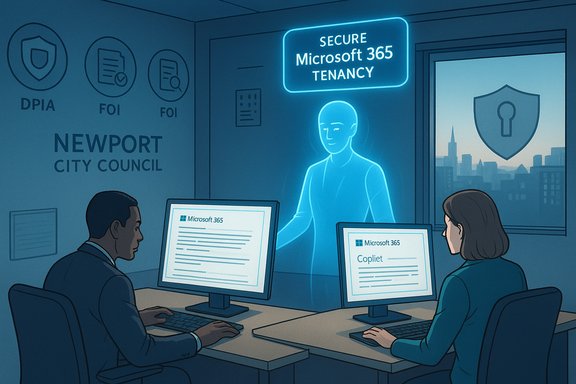
Newport’s leadership has signalled an explicit shift from reflexive prohibition to managed, tenancy‑bound adoption of generative AI tools such as Microsoft Copilot. The council presents AI as a productivity amplifier: streamlining repetitive work, accelerating information retrieval, and enabling more personalised citizen contact — but only where there is a clear business case and a demonstrable community benefit. The draft policy stresses that AI use will be restricted to work purposes and accompanied by human review, training, and technical safeguards.That posture mirrors a growing municipal pattern: councils increasingly prefer enterprise-grade assistants that can be kept inside a Microsoft 365 tenancy rather than ad‑hoc consumer chatbots, while simultaneously attaching governance controls (DPIAs, equality assessments, and published transparency statements) to any deployment. The stated goal is to capture low‑risk, high‑volume productivity gains without sacrificing legal or democratic accountability.
What Newport’s draft policy actually says
Headline commitments
- AI and automation permitted for official use only when there is a clear business case and tangible benefit to the community.
- Existing internal adoption includes enterprise Copilot‑style tools integrated with Microsoft 365; consumer model endpoints are to be restricted.
- No automation of formal decisions or profiling of individuals; outputs must be verified by staff and treated as drafts until attested.
- Compliance with UK data‑protection law (including DPIAs where appropriate), plus “appropriate” security measures against malicious attack.
Limits and guardrails highlighted in the draft
- Explicit recognition of hallucination risk — generative outputs can be incorrect, misleading, or fabricated — with an attendant duty on staff to validate factual claims.
- Prompt and output logging, retention and redaction must be defined so AI artifacts do not create uncontrolled Freedom of Information exposure.
- Human‑in‑the‑loop requirements for any output that could materially affect residents’ rights or entitlements.
Legal and regulatory context: what the council must (and mustn’t) do
UK data‑protection obligations and public‑sector duties
The policy explicitly ties AI use to UK data‑protection law and the expectations of public regulators. Practically, this means:- Data Protection Impact Assessments (DPIAs) for new or higher‑risk AI uses are mandatory; the ICO expects public bodies to assess and mitigate privacy and fairness risks before deployment.
- Avoidance of solely automated decision‑making that produces legal or similarly significant effects for individuals (the public‑sector equivalent of Article 22 concerns). Any decision‑facing use must have documented human accountability and a clear audit trail.
- Obligation to respond to individual rights requests where AI systems process personal data; councils must be able to locate, extract and, where appropriate, delete or redact AI‑derived records.
Public‑law and equality duties
Councils must also meet equality obligations: AI can introduce proxy discrimination where non‑sensitive inputs correlate with protected characteristics. The draft correctly signals the need for equality impact assessments and proxy‑bias testing before expanding any service that touches entitlements or enforcement.Technical reality: Microsoft Copilot, tenancy controls and the false sense of safety
Microsoft Copilot and similar enterprise assistants are commonly chosen by councils because they can be configured within a council’s Microsoft 365 tenancy and managed by the IT team. That tenancy‑bound posture provides important controls — DLP rules, Purview retention, role‑based access controls, and tenant logging — but it is not a panacea.- Administrative features only protect what is correctly configured; misconfiguration is the most common failure mode in tenant‑bound rollouts. A tenancy doesn’t guarantee compliance by itself.
- Vendor marketing claims (for example, “we don’t train on customer data” or similar statements) are helpful but not a substitute for robust contract language: councils should insist on non‑training clauses, deletion/egress guarantees, audit access and clear data‑residency commitments.
- Prompt and output logging must be instrumented with redaction rules, retention policies, and mapping into the council’s records classes so Freedom of Information and archival obligations are not accidentally breached.
Strengths of Newport’s approach
- Pragmatic middle path: The policy rejects both blanket bans and unregulated experimentation, which is politically and operationally sensible for local government.
- Enterprise‑first posture: Preferring Microsoft Copilot‑style tenancy binding reduces the immediate surface area for data leakage compared with ad‑hoc consumer tools.
- Clear red lines: Explicit bans on automated decision‑making and profiling are politically and legally astute; they put human accountability front and centre.
Key risks and unresolved gaps
1. Operational detail is missing from public statements
The policy’s public text works as a high‑level statement but omits crucial operational specifics: who conducts tenant audits, how long prompt logs are retained, what retention and redaction rules will be applied, and which contractual clauses have already been negotiated. Without these, the policy risks remaining aspirational rather than enforceable.2. Procurement and non‑training guarantees
Vendor assurances do not bind successors or product roadmaps. Councils must secure contractual non‑training clauses, deletion rights, and audit access in the Data Processing Agreement or procurement schedule. Failing to do so leaves the council exposed to cross‑border processing, model retraining on council data, or opaque telemetry practices.3. Shadow AI and human behaviour
If sanctioned tools are inconvenient, staff will use consumer chatbots on personal devices — creating the “shadow AI” problem. Technical controls (network and endpoint DLP) must be paired with usable sanctioned alternatives so staff have a practical reason to comply.4. Hallucinations and public‑facing accuracy
Generative models can invent facts. If an AI‑generated statement about eligibility, statute, or procedure is published unverified, the council can face reputational and legal consequences. The policy’s human‑in‑the‑loop requirement is necessary but must be enforced with named attestations and sampling checks.5. Records, FOI and auditability
AI prompts and outputs may become discoverable records. Without explicit mapping of prompt logs to retention schedules and redaction rules, the council could be forced to disclose sensitive prompt material under Freedom of Information requests. The policy must define retention, redaction, and disclosure procedures before wide rollout.Practical, prioritised checklist to operationalise the policy
The difference between a safe AI programme and a risky one is in execution. The following checklist prioritises actions for the first 90 days.- Conduct a tenant security and Purview/DLP audit for Microsoft 365/Copilot; publish a remediation plan within 30 days.
- Complete DPIAs and equality impact assessments for all use cases that will touch personal data or entitlements.
- Lock procurement terms: insert non‑training guarantees, deletion/egress rights, audit access and explicit data‑residency clauses into all AI vendor contracts.
- Create an AI governance group with IT/security, legal/records, communications and operational leads; designate departmental AI stewards.
- Implement mandatory role‑based training and make licence issuance conditional on completion. Training must include prompt hygiene, PII handling, and verification duties.
- Instrument prompt and output logging with selective redaction and retention schedules mapped to records classes; publish a one‑page resident notice describing where AI is used.
- Block known consumer AI endpoints on council networks and provide supported, usable sanctioned alternatives to prevent shadow AI.
- Pilot narrow use cases (meeting recaps, internal drafting, triage) with measurable KPIs: time saved, human edit rate, incident counts, and redaction volume. Scale only after independent evaluation.
Procurement and contract drafting: specific clauses to insist on
- Non‑training covenant: vendor confirms not to use council prompts, documents or outputs to train foundation models.
- Deletion and exit rights: ability to export all council‑origin data in structured format and documented deletion verification.
- Audit and third‑party review access: right to commission red‑team tests and review telemetry.
- Data‑residency guarantees: assurances that processing occurs within legal jurisdiction required by the council’s obligations.
- Breach notification and SLAs: clear timeframes for incident reporting and remediation commitments for hallucination/spread incidents.
Workforce impacts, training and social licence
Newport’s framing — AI as an empowerment tool — is constructive, but the council must pair adoption with a workforce strategy. That includes mandatory micro‑credential training, reskilling pathways for roles where automation reduces repetitive tasks, and early engagement with unions to avoid surprise and mistrust.Transparency to residents builds social licence: publishing plain‑English notices of where AI is used, how outputs are checked, and a simple route to request human review are practical trust builders. Similarly, when AI is used in engagement or consultation, an assurance statement that explains what the AI did and who reviewed it should accompany outputs.
Measuring success: sensible KPIs
Track a compact set of measurable indicators for the first 6–12 months:- Average time saved per targeted task (before vs after).
- Percentage of AI‑assisted outputs that required human edits or corrections.
- Number of policy violations, incident reports, and FOI requests related to AI artifacts.
- Volume of prompts retained and proportion redacted for PII.
- Total cost metrics: Copilot licence counts, agent fees, and governance overhead.
Quick technical primer for IT teams in Newport
- Verify Purview and DLP are configured to block uploads of PII and special‑category data to unsanctioned endpoints.
- Run a connector inventory: which third‑party connectors are enabled in Teams/Outlook/SharePoint and who can create new connectors.
- Treat any agentic automation (agents that act across systems) as high risk: sandbox these in non‑production with least‑privilege identities and explicit human‑approval gates. Maintain an agent registry with owner and last audit date.
- Apply short‑lived credentials and JIT elevation for service identities that interact with cross‑system APIs.
Where the council should be cautious and what needs verification
- Any public claim that Copilot (or another vendor product) “does not train on customer data” should be treated as vendor‑provided technical documentation until corroborated by contract language and an independent audit; vendors can change product operations, and only contractual commitments are durable. Flag these claims as provisional and require contractual proof.
- Retention periods for prompt logs are a recurring blind spot. The council must decide up front what prompt logs count as records and how redaction will be performed for FOI compliance. Until those rules are set, staff should treat prompts as potentially discoverable.
Political economy and public perceptions
AI policy for councils is inherently political. The explicit prohibitions on automated decision‑making and profiling are smart from a democratic‑legitimacy perspective; they address the most salient public fears (job losses, opaque decisions, bias) while allowing low‑risk productivity pilots to proceed. However, the council must make governance visible: publish the governance committee’s remit, the training programme outline, and an annual AI usage statement so residents can see the trade‑offs being made. Failure to make governance visible will quickly erode the social licence the policy seeks to preserve.Verdict: a cautious yes — if the hard work follows the words
Newport’s draft policy is the right rhetorical posture: it avoids prohibitive panic and embraces measured, tenancy‑bound innovation while committing to human oversight and legal compliance. That sets up a defensible approach — but the real test will be execution.Success requires prompt action on procurement, tenant verification, training, records mapping, and transparent reporting. If the council locks down contracts with enforceable non‑training and deletion clauses, audits tenant settings, mandates role‑based training, and publishes measurable KPIs, it can realise genuine productivity gains without ceding accountability. If those operational steps are delayed or half‑implemented, the policy’s protective language may prove brittle when a misconfiguration, a hallucination or a procurement surprise occurs.
Conclusion
Newport’s announcement — that AI adoption is not about replacing people with computers but about equipping staff to deliver better, faster public services — is welcome in tone and direction. The draft policy contains the right red lines and an appropriate enterprise‑first posture. The council now faces the operational challenge: make those words enforceable.The immediate priorities are clear: audit the Microsoft tenancy, lock procurement terms that survive vendor product changes, mandate training and make AI artefacts auditable and discoverable on the council’s terms, not a vendor’s. Delivered properly, the policy can deliver measurable efficiency and improved citizen experience; left incomplete, it risks eroding the public trust it seeks to preserve.
Source: Nation.Cymru Council's new AI policy 'not about replacing people with computers'
