

The agent era arrived in 2025 not as a whisper but as a product rewrite: vendors moved beyond “can it chat?” to “can it plan, act, and close the loop inside my systems?” This piece surveys the companies that led that move — what they shipped, how they positioned agents for business use, the engineering patterns that make agents reliable, and the governance and security trade-offs every IT leader must evaluate before pressing agents into service. Much of the contemporary industry narrative and the examples below were collected and summarized from a curated report of branded AI agents and corroborated against public product posts and industry analysis.
The transition from "assistant" to "agent" is a product-level shift: agents are expected to plan, call tools, retain scoped memory, and execute actions under governance — not merely answer questions. Vendors repositioned these properties as first-class product features in 2025: plan previews, stepwise execution, tool arbitration, scoped memory stores, telemetry hooks, and auditable action logs are now table stakes for enterprise buyers.
For IT leaders, the imperative is clear: evaluate agents by their operational controls and organizational fit, instrument them heavily, and redesign approval and supervision structures so authorized agents can safely act at scale. The upside is compelling: where agents succeed, they convert hours of low-value work into decisions and actions anchored to observable metrics. But success demands both technical discipline and deliberate change management — not just the best model.
The industry resources that informed this analysis include vendor product posts, engineering playbooks, and enterprise research reports; these documents show the same pattern repeatedly: agents win when they are engineered, governed, and measured as part of business operations.
Source: Brand Vision All the Companies With AI Agents in 2025: From Microsoft Copilot Agents to Anthropic Claude Agents | Brand Vision
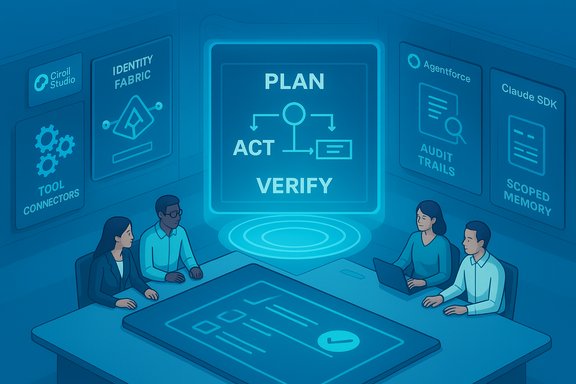 Background: from assistants to agents — what changed in product thinking
The transition from "assistant" to "agent" is a product-level shift: agents are expected to plan, call tools, retain scoped memory, and execute actions under governance — not merely answer questions. Vendors repositioned these properties as first-class product features in 2025: plan previews, stepwise execution, tool arbitration, scoped memory stores, telemetry hooks, and auditable action logs are now table stakes for enterprise buyers.- Agents present a proposed plan before executing, giving humans approval or the ability to tune steps.
- Agents retain scoped memory (team- or task-specific) to maintain context without granting permanent, wide data access.
- Agents can call external tools and APIs (calendars, CRM records, cloud resources) and write results back into systems with an auditable trail.
Microsoft Copilot agents: orchestration where identity and data already live
What Microsoft shipped and why it matters
Microsoft framed 2025 as the “age of AI agents” by turning Copilot from an embedded assistant into an orchestration and governance layer across Microsoft 365, Azure, and GitHub. Copilot Studio became the primary authoring environment for agents that:- Break complex work into stepwise plans (plan -> act -> verify).
- Select and call tools across the Microsoft stack and third-party endpoints.
- Offer scoped memory and activity logs for auditability.
- Surface model selection and fallbacks inside an enterprise tenant.
Copilot’s multi-model posture and the Anthropic integration
In late 2025 Microsoft introduced selectable Anthropic Claude models (for example, Claude Sonnet 4 and Claude Opus 4.1) inside Copilot’s Researcher and Copilot Studio surfaces, promoting a right-model-for-the-job approach. The move makes Copilot a multi‑model router: tenants can opt in, administrators enable vendor options, and sessions can route sub-tasks to different backends to balance cost, latency, and capability. That diversification reduces single-vendor concentration risk but introduces cross-cloud hosting and contractual complexity because some third‑party models remain hosted outside Microsoft-managed environments.Why Copilot’s placement matters operationally
Copilot agents run inside the same identity, data, and permission fabrics (Azure AD / Microsoft 365) enterprises already rely on. That co-location shortens the path from a conversational suggestion to an auditable action executed with corporate identity. For many IT teams, this built-in identity + auditability is the main reason Microsoft’s agent strategy is attractive: agents can act where data already lives and where access controls are enforced, reducing bespoke glue-code and risky “shadow AI” integrations.Salesforce Agentforce: agents built into CRM workflows with audit-first design
Agentforce’s product positioning
Salesforce rebranded and consolidated its assistant capabilities under Agentforce — agents that explicitly plan, act inside CRM records, and create auditable change trails enforced by the Einstein Trust Layer. Agentforce emphasizes:- Grounding on Data Cloud and Customer 360 for first‑party data.
- Stepwise plans (draft → approval → execute) that write back into the Salesforce object model.
- Built-in governance and logging to satisfy regulated revenue and service workflows.
Why Agentforce is notable for customer‑facing work
Revenue and service work has clear KPIs and well-defined transactions — the ideal early use cases for autonomy. Agentforce’s most important product virtue is its record-centric execution: when an agent changes a CRM object, the system logs the plan, the approval, the action, and the resulting data change. That plan → act → audit sequence is precisely what compliance, legal, and finance teams request before allowing autonomous actions that touch customer or financial records.Anthropic Claude Agents and the Claude Agent SDK: making agents engineering‑grade
The Claude Agent SDK and reliability as a product requirement
Anthropic’s engineering posts and the Claude Agent SDK reframe reliability as a product feature: the SDK bundles tool arbitration, memory stores, verification hooks, and testing recommendations so agents behave predictably in production. The docs explicitly advise agent authors to construct loops that gather context, take actions, verify results, and repeat — with rules, evals, and failure modes codified as part of development. That operational playbook is now a go‑to baseline for teams building production agents.Why this engineering guidance matters
Enterprises can no longer treat agent brittleness as an offline problem to be “fixed later.” Anthropic’s playbooks emphasize telemetry, explicit stop conditions, and rule-based verification — all required for repeatable audits. For regulated industries, published, testable agent patterns reduce regulatory friction because they make behavior observable and reproducible at scale. In short: reliability is a selling point, not a side-effect.Hyperscaler convergence: similar patterns, different tradeoffs
Major cloud and model providers converged on similar agent architectures in 2025: planners that preview steps, memory that’s scoped by tenant, tool connectors and guardrails, and admin controls for model choice and data routing. The practical differences between providers are increasingly about:- Identity and integration depth (which enterprise systems are first‑class).
- Cost control and observability tooling (telemetry, per‑action billing).
- Governance posture (data residency, hosting model, contractual protections).
Microsoft Security Copilot agents: a domain where agents are measurable
The security use case: structured inputs, measurable outcomes
Security operations is an ideal proving ground for agents: alerts are high-volume, workflows are structured, and outcomes are measurable (precision/recall, mean time to respond). Microsoft extended Security Copilot with purpose-built agents for phishing triage, alert triage, vulnerability remediation planning, conditional access optimization, and bespoke partner agents that integrate threat telemetry. These agents operate inside defender workflows and are instrumented to reduce false positives and accelerate triage.Why success here is a bellwether
If an agent can reliably triage alerts and improve MTTR without introducing new attack vectors, it demonstrates the core value proposition of agentic automation: measurable efficiency gains while preserving or improving accuracy. Security teams are rigorous about testing and red‑teaming, so Security Copilot’s early previews and partner integrations provide a high‑quality exemplar for other domains.Vertical startups and the first wave of narrow, measurable autonomy
A tranche of startups shipped focused agents for research, browsing, CX, and operations where the task is repetitive, toolable, and clearly measured. These narrow agents typically succeed where:- The task is well-scoped and repeatable.
- Success metrics are straightforward (replies handled, resolution time, clicks saved).
- Integration surfaces are standardized (APIs, web interfaces, or specific SaaS platforms).
Scaling agents: organizational change is the bottleneck (McKinsey’s lens)
McKinsey’s 2025 work on AI adoption underscores a central point: the biggest barrier to scaling AI is the operating model, not model selection. The firms that achieve durable ROI pair technical pilots with new role designs, governance practices, and data plumbing. For agents, that specifically means:- Define default permissioning and escalation rules so agents can act without manual friction.
- Create supervision roles and approval gates for high‑risk actions.
- Invest in telemetry and evals that track agent performance against business KPIs.
- Rewire processes (e.g., sales approval flows, SOC playbooks) to allow agents to execute audited work.
Strengths: what the best branded agents bring to the table
- Operational integration: Agents that run inside identity and permissions fabrics eliminate shadow AI and maintain a single audit surface.
- Plan-first UX: Presenting plans for human approval reduces surprise actions and supports compliance.
- Tool-first architectures: Agents that call verified tool connectors (MCP connectors, SDKs) are easier to govern and test.
- Published engineering patterns: SDKs and playbooks (for example, Anthropic’s) make agents easier to build, test, and certify.
- Measurability in safety‑sensitive domains: Security and CRM workflows enable tight success metrics that expose agent weaknesses quickly.
Risks and failure modes every buyer must mitigate
- Cross‑cloud data paths and contractual complexity: multi‑model routing often means tenant data may traverse third‑party clouds; confirm residency, retention, and DPA terms before enabling external models.
- Agent supply chain hacks: attackers can weaponize agent sharing or agent builder channels to harvest tokens or escalate privileges; apply app consent restrictions and tight sharing policies.
- Over‑automation without role redesign: agents that act by default can break domain workflows if escalation rules and human guardrails aren’t codified. McKinsey’s analysis shows that leadership and operating model are the binding constraints.
- Hidden cost drift: multi‑model orchestration can optimize accuracy but create billing surprises unless telemetry and per‑action cost controls are in place.
- Data masking and context fidelity trade-offs: masking data reduces privacy exposure but can degrade agent accuracy for tasks that need exact values; vendors differ in when and how masking is applied.
How to build a dependable agent: practical checklist
- Start with the business metric: pick a use case with clear KPIs (MTTR, time saved, conversions).
- Choose the minimal action surface: allow the agent to act only where it’s easiest to audit (CRM records, ticket updates).
- Adopt a published agent pattern: use a vetted SDK or playbook (e.g., Claude Agent SDK patterns) to get basic loops right.
- Implement plan review and approval gates: require human sign-off for high-risk steps and capture the plan as structured metadata.
- Enforce scoped memory and least privilege: memory stores should be task-scoped and accessible only to necessary identities.
- Instrument telemetry and set SLOs: track correctness, hallucination rates, action failure rates, and cost-per-action.
- Create a rollback and forensics path: log actions, inputs, and tool calls so you can revert or investigate.
- Iteratively test with a held-out eval set: build programmatic evals reflecting production data and failure cases.
- Harden the supplier contract: verify hosting residency, data processing terms, and liability clauses for vendor models.
- Educate and reorganize roles: create agent stewards, approval roles, and runbooks for exceptions.
Product and procurement guide: what to ask vendors
- Where are model inferences hosted and what DPAs cover tenant data?
- Do agents produce a machine-readable plan before execution, and is the plan logged?
- Can the agent honor field-level masking or redaction? What falls back if masking reduces accuracy?
- What telemetry is available by default (per-action latency, success, cost)?
- What are the vendor’s testing artifacts (benchmarks, eval sets, security red-team results)?
The competitive landscape in brief
- Microsoft: broad enterprise integration, identity and data fabric advantages, multi‑model orchestration in Copilot Studio and Microsoft 365.
- Salesforce: CRM-centric agents (Agentforce) that act inside records with auditable plans, emphasizing revenue and service workflows.
- Anthropic: SDK and engineering playbooks that make agent reliability a first-class engineering discipline.
- Hyperscalers (Google, AWS, others): comparable agent patterns with choice determined by integration depth, model capabilities, and governance tooling.
- Vertical startups: narrow, KPI-driven agents that win where tasks are repeatable and measurable.
Conclusion: agents are a product, not a feature
In 2025 the market learned a hard lesson: autonomy without operability is vaporware. The winners — both incumbents and startups — are those that treat agents as productized workflows with observable behaviors, firm guardrails, and clear operational playbooks. Vendors that combined agent ergonomics (plan previews, tool connectors), enterprise-grade governance (scoped memory, audit logs), and engineering guidance (reliability SDKs and evals) became the default choices for businesses pushing beyond pilots.For IT leaders, the imperative is clear: evaluate agents by their operational controls and organizational fit, instrument them heavily, and redesign approval and supervision structures so authorized agents can safely act at scale. The upside is compelling: where agents succeed, they convert hours of low-value work into decisions and actions anchored to observable metrics. But success demands both technical discipline and deliberate change management — not just the best model.
The industry resources that informed this analysis include vendor product posts, engineering playbooks, and enterprise research reports; these documents show the same pattern repeatedly: agents win when they are engineered, governed, and measured as part of business operations.
Source: Brand Vision All the Companies With AI Agents in 2025: From Microsoft Copilot Agents to Anthropic Claude Agents | Brand Vision
