

Davos has gone from debating generative chat to field‑testing the next phase of enterprise automation: agentic AI that reasons, orchestrates workflows and — critically — initiates real‑world actions on behalf of users and organizations.
The conversation at the World Economic Forum’s 2026 Annual Meeting in Davos crystallized a simple but consequential shift: enterprise AI is moving from “assist” to “act.” Leaders and platformsm vendors — from Microsoft and Salesforce to Mastercard and the World Economic Forum itself — presented agentic systems as the practical next step for automation, not just a research curiosity. That framing combines long‑context models, tool invocation APIs, and persistent systems that plan, execute and record multi‑step operations across enterprise systems. Two realities drove the narrative at Davos. First, major vendors are shipping product primitives — runtimes, identity primitives, observability and governance controls — that make agents realistic to operate in production. Second, enterprises increasingly demand measured ROI: they want agents that complete workflows (schedule meetings, initiate payments, file produce drafts. The result is a vendor and customer race to prove value while hardening the safety rails around identity, authorization and auditability.
Davos made one thing clear for enterprise IT and Windows administrators: agentic AI is inevitable, and the central question is not whether to adopt it but how to adopt it safely and measurably. The technical and organizational work — identity, grounding, observability, lifecycle controls and human‑in‑the‑lead governance — is practical and urgent. Those who act now to establish these primitives will not just avoid the pitfalls; they’ll shape the rails that govern how agents shop, pay and operate in the enterprise economy.
Source: PYMNTS.com Enterprise AI Gets Real as Davos 2026 Focuses on Agents | PYMNTS.com
 Background / Overview
The conversation at the World Economic Forum’s 2026 Annual Meeting in Davos crystallized a simple but consequential shift: enterprise AI is moving from “assist” to “act.” Leaders and platformsm vendors — from Microsoft and Salesforce to Mastercard and the World Economic Forum itself — presented agentic systems as the practical next step for automation, not just a research curiosity. That framing combines long‑context models, tool invocation APIs, and persistent systems that plan, execute and record multi‑step operations across enterprise systems. Two realities drove the narrative at Davos. First, major vendors are shipping product primitives — runtimes, identity primitives, observability and governance controls — that make agents realistic to operate in production. Second, enterprises increasingly demand measured ROI: they want agents that complete workflows (schedule meetings, initiate payments, file produce drafts. The result is a vendor and customer race to prove value while hardening the safety rails around identity, authorization and auditability. What happened at Davos: signals and one big proof‑of‑production
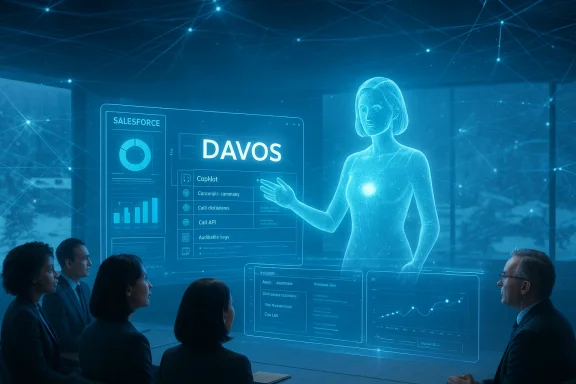
Davos 2026 was not short on rhetoric, but it featured at least one visible production deployment that turned the rhetoric into operating reality: the World Economic Forum’s deployment of an agentic concierge, EVA, powered by Salesforce’s Agentforce 360. The agent is explicitly designed to do more than answer queries — it’s built to prioritize, book meetings, generate briefing documents and reason across the Forum’s institutional knowledge for thousands of attendees. Salesforce described the rollout as a demonstration of the “Agentic Enterprise” in action. Salesforce framed EVA as a doer, not a chatbot: a persistent, identity‑bound agent that acts on behalf of leaders at the event. Salesforce CEO Marc Benioff’s language — “far more than a chatbot” — summarizes the vendor pitch: agentic features are not a cosmetic add‑on but are being positioned as a new enterprise architecture. That positioning is echoed across vendor roadmaps (Copilot runtimes, Agent 365 control planes, Bedrock/Foundry agent tooling) that seek to make agents discoverable, auditable and governed. Microsoft’s CEO Satya Nadella used the Davos stage to reframe the global priority: use AI to change outcomes for people, communities and industries — a practical, outcomes‑first mandate that aligns with enterprise expectations for measurable impact. His remarks underline the market’s pressure: prototypes and clever demos no longer suffice; boards want metrics and audited production flows. Taken together, these on‑stage messages and the Forum’s own agent deployment sent a clear signal: agentic AI has left the lab and entered the operational runway. But the runway is narrow: safety, identity and commerce rails are the gating factors.EVA, the agentic concierge — what it proves and what it doesn’t
What EVA demonstrates
- EVA integrates the Forum’s decade‑plus institutional data and can generate briefings, recommend and book bilaterals, and provide navigation and agenda management for 3,000+ attendees. This is a scaled, scoped example of an agent performing cross‑system actions under a governance envelope.
- The deployment highlights three production patterns enterprises need to replicate: centralized knowledge backbones (Data 360), connectors for transactional systems (MuleSoft), and observability / reporting (Tableau dashboards). These are standard enterprise building blocks repurposed for agentic use.
Caveats and limits
- EVA is a well‑controlled, single‑tenant, event‑scoped deployment with careful human oversight and pre‑authorized actions — not a free‑wheeling, unrestricted agent with broad write access to corporate ledgers.
- Production claims in vendor press releases should be tested empirically in your environment. The features that matter to governance teams — immutable audit trails, cryptographically verifiable agent identity, intent‑verification for financial actions — are not automatic simply because an agent responds to natural language. Treat event deployments as proofs of concept for integration patterns, not as turnkey safety certifications.
Agent‑led commerce and payments rails: Mastercard’s playbook
One of the most consequential Davos adjacencies for banks and fintechs is the race to define how agents will shop and pay. Mastercard used Davos to position Agent Pay as the payments backbone for agentic commerce, arguing the technical battleground is less about model quality and more about trust, identity, and secure authorization when software agents spend money. Mastercard is integrating Agent Pay with Microsoft’s Copilot Checkout and OpenAI’s Instant Checkout in ChatGPT to support intent‑verified payments embedded inside AI shopping flows. That roadmap was reported exclusively by Axios and immediately picked up across trade outlets. Why this matters:- Payments are the trust boundary; the moment an agent initiates money movement is where liability, fraud controls and identity proofing converge. Tokenization, scoped credentials and intent verification become mandatory primitives.
- If networks (Mastercard, Visa) can standardize how agents assert authority and how merchants validate intent, agentic commerce could scale more predictably. If not, a fragmented approach will spawn merchant fragmentation and higher friction for consumers and banks.
- Banks and fintechs must engage with payments networks and platform partners now — the rails and rules are being written.
- Prepare to support tokenized, delegated payment credentials and new KYC/intent‑verification protocols — these will be procurement and compliance priorities in 2026–27.
The security and identity problem: the unresolved core
Across Davos sessions the subtext was consistent: identity and lifecycle management for agents is an open problem. EY’s Raj Sharma put it bluntly: agents “have access to your data. It has no name,” stressing the need for industrial‑grade controls to bind agent actions to accountable human or organizational identities. KPMG US CEO Tim Walsh explained why CISOs are cautious — organizations are pausing rollouts, keeping sensitive data on‑prem and rethinking encryption posture in light of future quantum threats. “Quantum breaks everything,” Walsh warned, pointing to the long‑horizon risks to conventional crypto anchors. Key risks to manage now:- Agent identity: agents must carry verifiable, revocable identities tied to humans or organizations, with auditable attestations of intent and scope.
- Least‑privilege and time‑boxed credentials: agents should receive the minimum permissions required for a bounded task and should be constrained by explicit lifecycles and human approvals.
- Immutable telemetry and provenance: full tracing of reasoning steps, tool calls and data sources is required for compliance, dispute resolution and security forensics.
- Post‑quantum readiness: long‑lived agent credentials and audit trails should be designed with migration paths for post‑quantum cryptography.
Technical plumbing and operational controls enterprises must demand
To move agents from pilot projects to business‑critical functions, organizations need to treat them as production software. That includes a combination of platform primitives, developer workflows and governance constructs:- Agent identity & lifecycle control planes — agent registration, certificate lifecycle, role‑based access control and revocation semantics.
- Tool contracts and structured I/O — use of protocols (Model Context Protocol, Agent‑to‑Agent specs) to make tool calls deterministic and auditable.
- Observability & tracing — end‑to‑end telemetry that captures reasoning steps, tool invocations and the resulting state changes; extend OpenTelemetry for agent flows.
- Context‑first grounding — retrieval‑augmented generation (RAG) with curated provenance stacks so agents reason with validated business data, not unconstrained model hallucinations.
- CI/CD, testing and red‑teaming — version control for agent manifests, automated regression suites, and adversarial testing tailored to destructive scenarios (fraud, manipulation, safety failures).
- Human‑in‑the‑lead governance — clear escalation paths, approval gates and human oversight for any actions that alter records or move funds.
Use cases with early traction — where agents make measurable differences
Enterprises are already reporting meaningful value when agents take responsibility for clearly scoped workflows:- Manufacturing: Foxconn and BCG’s work to scale an “AI agent ecosystem” reportedly automates a large share of decision workflows and claims quantifiable value in the hundreds of millions. These cases emphasize closed‑loop orchestration across sensors, digital twins and human supervisors. (WEF and partner reporting describe the scale and estimated value but treat figures as programmatic results that should be validated.
- Retail & commerce: Agentic checkout integrations (Copilot Checkout, OpenAI Instant Checkout + Agent Pay) compress discovery-to‑purchase flows and promise improved conversion, but they also shift significant implementation burden to merchants for accurate product metadata and tokenized settlement rails.
- Finance & audit: Professional services firms are using agents to orchestrate audit workflows (KPMG Clara example) with end‑to‑end traceability — scenarios where observability and governance make agents immediately useful.
- Operations & SRE: Observability vendors integrating with SRE agents to suggest or execute remediation can materially reduce MTTR — but they require very conservative scopes and clear rollback semantics.
Governance and the human role: “human in the lead”
A recurring governance mantra at Davos was succinct: design agentic systems so that humans are in the lead, not merely in the loop. Accenture CEO Julie Sweet captured this by saying, “It’s human in the lead, not human in the loop,” emphasizing the shift from passive review to active human leadership and oversight of agentic systems. Meta’s Dina Powell McCormick framed AI as a “group sport,” calling for cross‑industry cooperation so “humanity” stays central to AI design and deployment. Those reframes matter: they guide policy responses, procurement demands and internal operating models for AI adoption. Practical governance implications:- Elevate AI decisions to executive governance boards that include legal, security, HR and worker representatives.
- Define role‑based authorities and clear human approval thresholds for agentic actions that change contracts, move money or affect people’s rights.
- Publish internal transparency practices and audit trails; provide dispute resolution and appeals paths when agents act on behalf of humans.
- Invest in reskilling programs focused on agent design, prompt engineering, and model validation so human leaders can make evidence‑based decisions.
For banks and fintechs: strategic options and near‑term actions
- Treat agentic commerce as a platform risk/opportunity: payments networks (Mastercard) are attempting to set industry rules. Banks should engage with these efforts to ensure their risk models, liability allocations and tokenization strategies are compatible with emerging agent standards.
- Define delegated payments models: pilot tokenized, intent‑verified payment flows with clearly scoped agent personas and expiration semantics. Test merchant reconciliation, chargeback handling and fraud detection in controlled pilot programs.
- Harden identity & KYC for agents: create short‑lived, auditable credentials with attestation of purpose and human ownership; consider hardware‑backed keys or enterprise HSMs and map an upgrade path to post‑quantum cryptography.
- Require auditable RAG provenance: when agents make decisions about accounts or funds, insist on retrieval pipelines that capture source documents and a defensible decision trail.
- Build cross‑functional playbooks: create SRE + security + legal runbooks for agent‑initiated incidents (unauthorized payments, data exfiltration, erroneous writebacks). Test these runbooks via tabletop and red‑team exercises.
Risks that could derail early agent wins
- Fragmented standards: if payments, identity and tool‑invocation specs splinter across platforms without interoperability, merchant and consumer adoption will be stymied.
- Hallucinations with consequences: when agents act (not just recommend) on poor grounding, errors become real world damages — reputational, legal and financial.
- Concentration risk: heavy depeperscaler or model provider increases systemic exposure; multi‑vendor strategy and portability plans mitigate this risk.
- Regulatory backlash: lack of clear rules for agentic authorization could prompt enforcement that slows adoption; proactive engagement with regulators and transparent governance can reduce this risk.
Short roadmap for IT leaders and Windows administrators
- Inventory: run a 30–60 day task audit to identify high‑frequency, low‑risk workflows suitable for agent pilots (meeting scheduling, internal FAQs, invoice triage).
- Grounding first: build a context pipeline (canonical docs, metadata tagging, versioned retrieval) before exposing agents to sensitive systems.
- Identity and least privilege: design agent identities in Entra/Azure AD (or equivalent) with revocation and timeboxing baked in.
- Observability: extend OpenTelemetry to capture agent reasoning and tool calls; store immutable audit logs.
- Pilot and measure: run tight, auditable pilots with clear KPIs — time saved, error rates, rework reduction — and require red‑team validation for safety.
Final assessment — why this moment matters
Davos 2026 signaled that agentic AI is no longer speculative. The event combined vendor roadmaps (agent runtimes, checkout integrations), high‑profile deployments (EVA), standards momentum (payments and tool protocols), and an unmistakable governance agenda focused on identity, auditability and human‑led oversight. The contours of an agent economy are being drawn in real time: the winners will be those who simultaneously demonstrate operational value and the structural controls that preserve trust. Caveat: many of the reported metrics and dollar figures (for example, Foxconn/BCG’s $800 million estimate) come from WEF case reports and partner materials. These are powerful directional signals, but organizations should demand independent validation and reproducible KPIs before extrapolating similar returns to their own operations.Davos made one thing clear for enterprise IT and Windows administrators: agentic AI is inevitable, and the central question is not whether to adopt it but how to adopt it safely and measurably. The technical and organizational work — identity, grounding, observability, lifecycle controls and human‑in‑the‑lead governance — is practical and urgent. Those who act now to establish these primitives will not just avoid the pitfalls; they’ll shape the rails that govern how agents shop, pay and operate in the enterprise economy.
Source: PYMNTS.com Enterprise AI Gets Real as Davos 2026 Focuses on Agents | PYMNTS.com
