

Nexcom’s latest Embedded World showcase is a clear signal that industrial PC vendors are doubling down on fanless reliability, local AI capability, and ruggedized edge platforms — the company has unveiled the APPC C21‑01 fanless panel PC family for factory HMIs, a Jetson‑powered robotics controller, and a portfolio of hardened edge systems aimed at transport and smart‑city deployments.
NEXCOM chose Embedded World 2026 in Nuremberg to position a compact but strategically coherent product story: lightweight, fanless panel PCs for operator stations; high‑throughput robotics controllers for motion and multimodal inference; and IP67‑class edge boxes for vehicle and roadside video processing. That messaging ties to two broader industry trends. First, manufacturers want compute pushed closer to sensors and machines rather than relying solely on central cloud resources. Second, operational technology (OT) buyers now demand integrated security, hardware‑backed trust, and predictable long lifecycle support — features that industrial OEMs increasingly bake into new hardware and software offerings.
Key product highlights (as described by the OEM):
NexVIC’s low‑code, drag‑and‑drop workflow approach for IIoT is an important operational convenience: it can speed small automations and alarms without deep PLC programming. However, for safety‑critical or latency‑sensitive control loops, tightly coded PLC or RTOS logic remains indispensable. Use NexVIC for monitoring, analytics and non‑deterministic workflows; rely on certified controllers for safety‑critical motion and interlocks.
Competitors will offer variations: some will prefer more overt GPU/NPU headroom in ventilated chassis, while others will offer ultra‑rugged MIL‑STD certified boxes for extreme vehicle deployments. Nexcom’s strength is its portfolio coherence — the same vendor can supply panel PCs, Jetson robotics controllers, and IP67 edge nodes — which reduces integration friction for customers looking to standardize vendors across projects.
If you are evaluating these systems:
Source: IT Brief Australia https://itbrief.com.au/story/nexcom-unveils-fanless-panel-pcs-rugged-edge-systems/
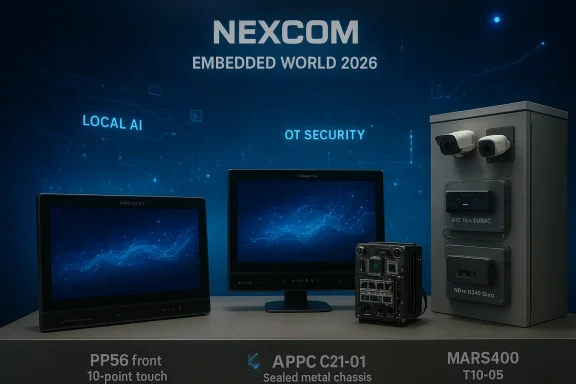 Background
NEXCOM chose Embedded World 2026 in Nuremberg to position a compact but strategically coherent product story: lightweight, fanless panel PCs for operator stations; high‑throughput robotics controllers for motion and multimodal inference; and IP67‑class edge boxes for vehicle and roadside video processing. That messaging ties to two broader industry trends. First, manufacturers want compute pushed closer to sensors and machines rather than relying solely on central cloud resources. Second, operational technology (OT) buyers now demand integrated security, hardware‑backed trust, and predictable long lifecycle support — features that industrial OEMs increasingly bake into new hardware and software offerings.What Nexcom announced (the headline pieces)
APPC C21‑01: Two fanless panel PC sizes, Core Ultra 5 under the hood
Nexcom’s APPC C21‑01 family includes two narrow‑bezel Full HD touch panel PCs: the APPC160 C21‑01 (15.6‑inch) and the APPC210 C21‑01 (21.5‑inch). Both are offered around Intel’s Core Ultra 5 125U (Meteor Lake‑U) platform, ship with 10‑point projected capacitive touch, and expose industrial‑grade I/O including four Gigabit Ethernet ports and RS‑232/485 serial connectivity. The front face is rated IP65, and the systems are presented as fanless for continuous‑operation environments, with TPM 2.0 and OS options that include Windows 10/11 IoT and Ubuntu Linux.Key product highlights (as described by the OEM):
- 15.6" and 21.5" narrow‑bezel FHD displays with 10‑point P‑Cap touch.
- Intel Core Ultra 5 125U (12 cores / 14 threads, 15 W base power class).
- IP65 front panel, fanless chassis, TPM 2.0, CE and FCC Class A approvals.
- Ample connectivity: 4 × GbE, multiple USB 3.2 ports, RS‑232/485, M.2 and mini‑PCIe expansion.
MARS400 T10‑05: Jetson T5000 robotics controller
On the robotics side Nexcom is showcasing the MARS400 T10‑05 robotic controller, which the company pairs with the NVIDIA Jetson T5000 (Blackwell‑based) module to deliver massive on‑device inference capability. Nexcom’s product brief and demo materials cite a 2070 TFLOPS figure for AI inference performance (FP4, sparse) when using the Jetson T5000 family — a number consistent with the raw TOPS/TFLOPS marketing disclosed for the Jetson AGX Thor / Jetson T5000 family in industry coverage. The MARS400 is targeted at motion control and humanoid robot use cases and includes rich camera and sensor I/O.Rugged edge and smart‑city kit
Nexcom’s show roster also includes vehicle‑grade and IP67 edge computers such as the ATC 3561‑NA4C (Jetson Orin Nano SoM in some SKUs) and the NDiS B340 Duro Edge display/edge node with DockInfinity PCIe expansion for capture/PoE/I/O cards. These platforms are pitched at ADAS, ANPR, ITS, and digital signage / smart‑city display deployments where local video analytics and persistent outdoor operation are essential.Why these announcements matter: the industrial edge in 2026
1) Fanless panel PCs remain the practical HMI
Factory operator stations and local control panels are still dominated by panel PCs for good reasons: a single product that combines display, touch input, industrial I/O and a sealed chassis simplifies integration, service, and lifecycle planning. Nexcom’s APPC C21‑01 refresh is notable because it pairs that traditional role with an increasingly capable compute fabric — the Intel Core Ultra Series 1 U‑class silicon — that now brings a modest NPU/AI boost for light on‑device inference tasks. That allows operator screens to run local analytics, real‑time vision overlays, or pre‑filter telemetry before sending it upstream.2) Compute stack convergence: CPU + NPU + GPU
By selecting the Intel Core Ultra 5 125U for APPC models, Nexcom is riding the wider industry move to hybrid CPU/GPU/NPU stacks at the edge. The 125U is a Meteor Lake‑U SKU with a 15 W base power profile and hybrid core layout that favors efficiency while unlocking accelerated neural compute engines for on‑device AI. That makes fanless designs credible again for workloads that five years ago would have required server racks or GPU boxes. Still, real‑world AI performance depends on model choice, power budget and thermal headroom — so the marketing pitch should be read as capability, not guaranteed throughput.3) Robotics and physical AI are becoming productized
The MARS400 family and Nexcom’s robotics messaging show how physical AI — low‑latency perception + control loops — is being productized. Packing a Jetson T5000‑class SOM and motion control interfaces into a single controller shortens development time for integrators building humanoids, mobile robots and AMRs. The 2070 TFLOPS figure is eye‑catching and aligns with Nvidia’s Blackwell‑era marketing, but integrators must still validate determinism, latency, power, and safety when moving from demo to production.4) Security and lifecycle matter as much as raw throughput
Nexcom is explicitly tying product features to OT security and long lifecycle support: TPM 2.0, adherence to CE/FCC Class A, upgradable OS choices and Nexcom’s eSAF Guardian software for OT intrusion protection, plus their NexVIC IIoT asset management and an on‑prem GenAI stack (AIC AI‑X). These are functional differentiators for industrial procurement teams that plan multi‑year deployments and expect field manageability and compliance to IEC/ISA 62443 frameworks.Technical deep dive: APPC C21‑01 hardware and deployment considerations
Display and touch
Both APPC models use an FHD (1920×1080) panel in 16:9 format and support 10‑point projected capacitive touch. That’s a pragmatic balance: FHD is still the most interoperable resolution for factory HMIs, and P‑Cap touch provides accurate multi‑touch and glove compatibility options when tuned correctly. Nexcom lists brightness values and surface hardness ratings in the product datasheets to match industrial viewing and durability needs.Compute platform: Intel Core Ultra 5 125U
The choice of the Core Ultra 5 125U places APPC C21‑01 in the new U‑series family that mixes Redwood Cove P‑cores and Crestmont E‑cores, with a 15 W base power envelope and integrated AI acceleration. Intel’s product brief confirms the U‑series SKUs offer 12 logical cores in that power class and include Neural Compute Engines intended for small to medium on‑device models and acceleration of common AI primitives. This is a decisive change from older 15 W U‑class parts, as the Meteor Lake family exposes tiles that couple AI silicon with CPU/GPU in ways that OEMs can leverage for local inference. In practical terms, expect the APPC devices to be suitable for GUI, light vision (pre‑processing, small CNNs) and edge‑filtering tasks rather than heavy, multi‑camera inferencing at high frame rates.I/O and expansion
Nexcom’s APPC models expose:- 4 × GbE (useful for segregating OT traffic),
- multiple USB 3.2 ports,
- 1 × RS‑232/485 (DB9) for legacy PLCs and sensors,
- M.2 (Key M & E) and mini‑PCIe slots for NVMe storage, Wi‑Fi/BT and add‑on I/O.
Thermal and mechanical design: the tradeoffs of fanless
Fanless enclosures reduce maintenance and eliminate moving parts that frequently fail in dusty or oily environments, but they are not a panacea. Fanless machines rely on chassis conduction and strategic heat‑spreading to keep thermals under control. If the device is installed inside a sealed cabinet, or if tasked with sustained high CPU/GPU/NPU workloads in high ambient temperatures, users can see sustained throttling unless the system is sized and ventilated correctly. Vendor guidance and independent embedded‑PC best‑practice writeups recommend checking thermal-design parameters and the specific duty‑cycle of intended AI workloads during system selection. Nexcom lists operating temperature windows and vibration/shock specs; integrators must validate those against field conditions.Software, manageability and security
TPM 2.0, OS support, and IIoT management
Nexcom documents TPM 2.0 on the APPC series and mainstream OS support for Windows 10/11 IoT and Ubuntu. TPM enables hardware‑backed key storage, measured boot and secure attestation — features that asset owners can tie to device identity and firmware verification workflows. Nexcom’s NexVIC asset management suite is described as a web‑based IIoT monitoring and low‑code automation tool that can pair with the APPC devices to deliver remote telemetry, health checks and simple workflow automation on the edge fleet. For many industrial customers, that combination of device identity, asset monitoring and local workflow tooling is what differentiates commodity HMIs from an enterprise‑grade offering.eSAF Guardian and ISA/IEC 62443 alignment
Nexcom’s eSAF Guardian is promoted as an OT‑focused security agent for embedded targets that monitors system calls, file access and network activity and helps organizations align with ISA/IEC 62443 security practices. The ISA/IEC 62443 suite is the de‑facto industrial cybersecurity standardset for IACS, and product‑level adherence or conformance to its component‑level requirements is a material procurement factor for critical infrastructure and regulated industries. That said, claims of compliance should be validated through certifications or third‑party attestations before being treated as contractually binding security guarantees.The robotics and Jetson angle: practicality vs headroom
Nexcom’s MARS400 series and the cited Jetson T5000 performance figures place the company in the same “physical AI + robotics” conversation as other niche OEMs integrating Nvidia Blackwell silicon into productized controllers. The Jetson T5000 marketing number of 2070 TFLOPS (FP4, sparse) is consistent with industry reporting and Nvidia’s own high‑level claims — and it signals genuine headroom for multimodal perception, sensor fusion and model pipelines used by humanoid or advanced mobile platforms. However, high advertised TFLOPS rarely map 1:1 to application throughput: model format (FP4 vs FP16 vs INT8), sparsity exploitation, thermal envelope, I/O bandwidth, and system‑level software stack all govern delivered performance. Integrators should benchmark representative loads (camera count, resolution, batch size, control loop latency) under real‑world power and thermal constraints.Strengths and practical advantages
- Maintenance reduction and reliability: Fanless, sealed front panels and solid‑state storage reduce routine service needs and increase MTBF for deployments that run 24/7. This reduces lifetime operational cost in dusty or noisy industrial contexts.
- Balanced edge compute: The use of Intel Core Ultra 5 125U gives a credible mix of single‑threaded responsiveness, multi‑core concurrency and a small NPU for lightweight inference — enough for local preprocessing and HMI augmentation without needing external GPUs.
- OT‑aware integration: RS‑232/485 serial ports, multiple GbE NICs and TPM 2.0 show Nexcom is thinking in OT terms: backward compatibility with legacy sensors and forward compatibility with secure provisioning and fleet management.
- Robotics ecosystem moves quickly: Combining Jetson T5000 power and real‑time motion control interfaces reduces integration friction for robotics integrators, enabling closer coupling between perception and motion stacks.
Risks, limitations and buyer cautions
- Thermal headroom in sealed, fanless chassis
- Fanless panels are excellent for reliability, but sustained high NPU/GPU loads in warm ambient conditions will induce throttling. Verify sustained throughput targets with vendor benchmarks in your operating temperature profile.
- Marketing numbers vs application reality
- The Jetson T5000’s 2070 TFLOPS figure is an architecture‑level peak (FP4, sparse). Actual inference performance depends on model precision, sparsity, memory bandwidth and system software. Treat TFLOPS as directional capacity, not guaranteed application performance.
- Security claims need validation
- eSAF Guardian and IEC/ISA 62443 alignment are positive signals, but procurement should require evidence: certification, penetration test reports, or third‑party attestation. Don’t accept unqualified compliance statements without documentation.
- Lifecycle and long‑term support
- Industrial customers buy predictable support windows. Nexcom highlights long‑lifecycle support, but buyers should clarify OS image maintenance, patch cadence, and firmware update policies — particularly for on‑prem GenAI components where models and dependencies evolve rapidly.
- Integration work remains non‑trivial
- Even with M.2/mini‑PCIe expansion and broad I/O, integrating panel PCs into an existing PLC/SCADA environment, certifying safety for motion control, or tuning RAG pipelines for on‑prem GenAI requires systems engineering and testing cycles. Plan for that in procurement budgets and timelines.
Practical procurement checklist (what systems integrators should ask Nexcom or distributors)
- Request sustained workload benchmarks: multi‑camera inference throughput, CPU/GPU/NPU utilization and throttling curves at expected ambient temperatures.
- Ask for OT security artifacts: eSAF Guardian test reports, hardening guides, and any third‑party IEC/ISA 62443 attestations.
- Confirm OS image maintenance: how long will Windows IoT/Ubuntu images be maintained, who provides patches, and what is the rollback story?
- Validate expandability: check which M.2/mini‑PCIe slots map to which lanes and whether a vendor‑approved AI accelerator is supported.
- Agree SLAs for spare parts and repairs, and get firm RMA and depot repair lead times for your region.
The software story: on‑prem GenAI and NexVIC
Nexcom’s AIC AI‑X positioning — an on‑prem GenAI platform with RAG (retrieval‑augmented generation) capabilities — mirrors a broader industry push to give enterprises local LLM inference and knowledge retrieval while keeping sensitive data behind the firewall. On‑prem GenAI can address privacy and latency needs, but it raises practical tradeoffs: model lifecycle management, hardware provisioning for larger models, and the operational overhead of keeping embeddings, retrievers, and fine‑tuned components up to date. Nexcom’s message is consistent with strong vendor interest in bundled hardware+software stacks for regulated verticals, but buyers should treat on‑prem GenAI offers as solutions that require integration and ongoing ops work, not drop‑in features.NexVIC’s low‑code, drag‑and‑drop workflow approach for IIoT is an important operational convenience: it can speed small automations and alarms without deep PLC programming. However, for safety‑critical or latency‑sensitive control loops, tightly coded PLC or RTOS logic remains indispensable. Use NexVIC for monitoring, analytics and non‑deterministic workflows; rely on certified controllers for safety‑critical motion and interlocks.
Where Nexcom sits in the market
Nexcom’s APPC family and robot controller messaging places the vendor in a competitive bracket with industrial PC specialists and systems integrators who bundle compute, I/O, and software for factory automation and transport use cases. The product decisions are pragmatic: mainstream FHD displays, a balanced Intel Core Ultra U‑series CPU, IP65 sealing for HMIs, Jetson‑based controllers for robotics and an emphasis on manageability and security.Competitors will offer variations: some will prefer more overt GPU/NPU headroom in ventilated chassis, while others will offer ultra‑rugged MIL‑STD certified boxes for extreme vehicle deployments. Nexcom’s strength is its portfolio coherence — the same vendor can supply panel PCs, Jetson robotics controllers, and IP67 edge nodes — which reduces integration friction for customers looking to standardize vendors across projects.
Conclusion — who should care and next steps
Nexcom’s Embedded World 2026 announcements are meaningful for systems integrators, OEMs and industrial IT buyers who need sealed, manageable HMIs with modest on‑device AI capability and a route to higher‑end robotics controllers. The APPC C21‑01 series is the kind of incremental but practical product refresh that fits many brownfield and greenfield automation projects: familiar I/O, upgraded compute and explicit OT security features.If you are evaluating these systems:
- Treat vendor claims as the start of technical due diligence, not the finish line. Request representative benchmarking under your operational profile.
- Insist on documented security artifacts and an end‑of‑support roadmap for images and firmware.
- For robotics and heavy vision workloads, benchmark Jetson‑based controllers with your target models and camera topology to understand real latency and throughput.
Source: IT Brief Australia https://itbrief.com.au/story/nexcom-unveils-fanless-panel-pcs-rugged-edge-systems/
