

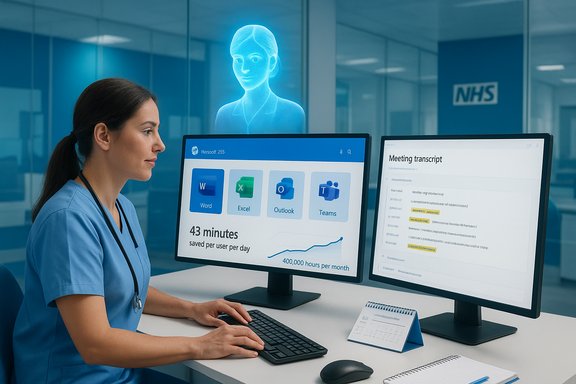
The NHS’s recent pilot of Microsoft 365 Copilot produced headline figures that are hard to ignore: participants reported an average saving of 43 minutes per staff member per working day, and sponsors modelled that, if scaled, the technology could reclaim around 400,000 staff hours every month — a finding the Department of Health and Social Care and Microsoft have both promoted as a major productivity breakthrough.
The programme deployed Microsoft 365 Copilot — the AI assistant embedded into Word, Excel, Outlook, PowerPoint and Teams — across a distributed set of NHS organisations to test whether generative AI integrated into everyday productivity apps can reduce administrative burden and free clinicians and administrators for frontline care. The pilot reached roughly 90 NHS organisations and involved more than 30,000 staff in clinical and administrative roles, making it one of the largest healthcare AI pilots publicly reported to date. Organisers presented a breakdown of the headline savings that divided the aggregate projection into task-specific components: automated meeting note-taking, email summarisation/triage, template drafting and spreadsheet assistance. The public messaging estimated that about 83,333 hours a month could be saved from meeting note-taking and around 271,000 hours a month from email summarisation — figures driven by NHS‑wide volume inputs the sponsors used in their modelling. Those volume assumptions include estimates of monthly Teams meetings and email traffic across the service.
Although Microsoft Copilot Chat has been made available across the NHS under existing arrangements and tens of thousands of staff were reported as already using Microsoft 365 Copilot during the pilot, the specific mix of Copilot features (Copilot Chat vs full Microsoft 365 Copilot licence) varied between organisations in the trial. NHS support documentation also describes staged onboarding and licensing steps for Copilot features.
If those guardrails are applied — and if follow‑on pilots produce independently verified, repeatable outcomes — Copilot‑style assistants can become a legitimate force‑multiplier for the NHS: reclaiming clinician time, improving throughput, and enabling staff to focus more of their working hours on patient care rather than paperwork. The path is promising; the work to prove it at scale is only just beginning.
Source: Open Access Government NHS AI trial saves 400,000 hours a month with Microsoft 365 Copilot
 Background / Overview
The programme deployed Microsoft 365 Copilot — the AI assistant embedded into Word, Excel, Outlook, PowerPoint and Teams — across a distributed set of NHS organisations to test whether generative AI integrated into everyday productivity apps can reduce administrative burden and free clinicians and administrators for frontline care. The pilot reached roughly 90 NHS organisations and involved more than 30,000 staff in clinical and administrative roles, making it one of the largest healthcare AI pilots publicly reported to date. Organisers presented a breakdown of the headline savings that divided the aggregate projection into task-specific components: automated meeting note-taking, email summarisation/triage, template drafting and spreadsheet assistance. The public messaging estimated that about 83,333 hours a month could be saved from meeting note-taking and around 271,000 hours a month from email summarisation — figures driven by NHS‑wide volume inputs the sponsors used in their modelling. Those volume assumptions include estimates of monthly Teams meetings and email traffic across the service.Although Microsoft Copilot Chat has been made available across the NHS under existing arrangements and tens of thousands of staff were reported as already using Microsoft 365 Copilot during the pilot, the specific mix of Copilot features (Copilot Chat vs full Microsoft 365 Copilot licence) varied between organisations in the trial. NHS support documentation also describes staged onboarding and licensing steps for Copilot features.
Trial design, measurement and how the headline numbers were produced
What was measured and how
The pilot combined participant self‑reports with sponsor modelling to produce both the per‑user metric and the system‑level projections. The 43 minutes per day figure originates primarily from surveys and self‑reported participant responses during the trial period. The 400,000 hours per month headline is an extrapolation: multiply the average minutes saved per user by the number of users and working days in a month, then add separately modelled savings from meeting and email volume estimates. This arithmetic is straightforward but critically dependent on scaling assumptions about adoption and task eligibility.Why self‑reporting matters
Self‑reported time savings are a valid early signal of perceived improvement, but they are susceptible to biases:- Novelty and enthusiasm: early adopters often report larger perceived gains during initial use.
- Verification overhead undercounting: time spent validating, correcting or reworking AI outputs may not be fully captured by a single “minutes saved” survey question.
- Selection effects: pilot participants may be teams predisposed to benefit or those already digitally active, which can overstate average gains when extrapolated service‑wide.
The arithmetic behind 400,000 hours — unpacking the components
The sponsors presented the projection as the sum of several task‑level savings. The essential mechanics are:- Take reported per‑user daily saving (43 minutes).
- Multiply by an assumed user population and the number of working days in a month.
- Add separately modelled savings derived from service‑level volume estimates for:
- Teams meeting note‑taking (automated transcripts, summaries, action lists).
- Email summarisation and triage (condensing long threads, drafting templated replies).
- Optionally add estimates for template drafting and spreadsheet assistance.
What Copilot actually did in practical NHS workflows
High‑impact, bounded tasks
The pilot focused on high‑volume, repeatable tasks where generative AI is most likely to deliver consistent benefits:- Meeting summarisation and action extraction: Copilot can transcribe Teams meetings and generate concise summaries, highlight decisions, and list action owners — reducing the time clinicians and managers spend converting spoken discussion into written notes. This maps tightly to operational and governance meetings and many multidisciplinary team (MDT) gatherings.
- Email triage and summarisation: High‑volume administrative inboxes — referrals, bookings, procurement and HR — often contain long threads with repetitive formats. AI can summarise conversations, propose short briefs and draft templated responses, cutting drafting time for clerical teams.
- First‑draft documentation: Discharge summaries, referral letters, patient information leaflets and many standard operating procedures follow predictable structures. Generating a well‑formed first draft reduces keystrokes and cognitive load for clinicians and administrators who then perform final validation.
- Spreadsheet assistance: Roster updates, booking lists and routine reporting benefit from Copilot’s formula generation and natural‑language summarisation for non‑specialist users.
Integration into tools staff already use
A major practical strength of the pilot was embedding Copilot into familiar apps (Teams, Outlook, Word, Excel, PowerPoint). This lowers adoption friction, shortens training needs and allows users to ask prompts in the context they already work in — a design choice sponsors emphasised as crucial to rapid uptake.Strengths and immediate operational benefits
- Low friction adoption: embedding AI into existing productivity apps reduces the need to switch tools, which speeds early impact and user acceptance.
- Rapid time‑to‑value for repetitive tasks: where outputs are predictable and human verification is straightforward, the AI delivers high‑quality first drafts and summaries that materially reduce keystrokes and routine cognitive load.
- Policy alignment: the pilot was explicitly framed within the government’s productivity agenda and the NHS 10‑Year Health Plan. The results are therefore politically resonant and can feed capital planning and efficiency targets.
- Potential financial upside: the sponsors modelled that the tool could save the NHS millions of pounds monthly under selected user-count scenarios, offering a potential route to reinvest saved time and costs into frontline services. These financial estimates depend on converting time reclaimed into cashable efficiencies — a non‑trivial implementation challenge.
Risks, governance and safety considerations
While the promise is substantial, several material risks must be managed before treating the headline numbers as operational guarantees.Methodological and measurement risks
- Projection vs measurement: the 400,000‑hour figure is a projection, not a directly observed aggregate measurement. Without robust telemetry and time‑and‑motion validation, organisations risk expecting benefits that may not materialise. Independent measurement is essential.
- Verification overhead: if staff must spend significant time checking or correcting AI outputs, net time savings will be lower than gross estimates. That trade‑off must be measured empirically during rollout.
Clinical safety and medico‑legal exposure
- Clinical records and patient data: any AI output that alters or creates clinical records requires a formal clinical safety case and clear human‑in‑the‑loop sign‑off protocols to maintain patient safety and legal accountability. Automation must not bypass professional judgement.
- Auditability and traceability: systems must log Copilot outputs, human edits and decision provenance to satisfy medico‑legal standards and enable incident investigation. Contracts should guarantee telemetry access and audit rights.
Data protection and vendor transparency
- Data use and retention: procurement must specify what data Microsoft or any vendor may store, for how long, and whether secondary uses (model training, analytics) are permitted. NHS procurement teams should insist on contractual transparency and explicit data processing agreements.
- Model updates and change control: generative models change over time. The NHS must require change‑control clauses and red‑team testing so any behavioural drift is detected and managed before clinical deployment.
Workforce and ethical considerations
- Expectation management: framing AI as an immediate productivity panacea risks staff frustration if promised time is not rapidly realised. Transparent communication and staged goals reduce backlash.
- Skills and redeployment: reclaimed hours should be invested into patient care and staff wellbeing, but long‑term role changes also demand upskilling and reallocation programs to prevent role erosion or redundancy fears.
Practical implementation realities and costs
Licensing and availability
Public statements indicate that Copilot Chat is available NHS‑wide under existing arrangements and that tens of thousands of NHS staff were already using Microsoft 365 Copilot during the pilot. NHS technical pages document staged licence allocation and a pathway to general availability via NHS.net Connect, noting the evaluation programme and scheduling for broader purchase options. These operational details frame the rollout timeline and governance constraints.Integration, training and change management
Effective scale‑up will require:- Role‑based training that includes Responsible AI principles and verification expectations.
- Change management resources embedded in trusts to translate pilot use cases into routine practice.
- IT operational readiness to handle authentication, SSO, and access controls for Copilot features within the NHS estate.
Hidden or one‑off costs to budget for
- Clinical safety case development and legal review.
- Procurement clauses for telemetry and auditing rights.
- Ongoing monitoring and red‑team testing budgets.
- Change management and re‑training programmes.
These are real expenses that temper headline net‑savings estimates and should be built into business cases.
Financial framing: savings, reinvestment and the difference between “time” and “cash”
The sponsors modelled that, at larger user counts (for example 100,000 users in modelling scenarios), the time savings could translate into millions of pounds monthly and hundreds of millions annually. Translating reclaimed hours into cashable savings depends on whether the NHS:- Reduces headcount (unlikely politically and ethically); or
- Reallocates staff time to patient‑facing activities that shorten waits, increase throughput, or reduce overtime and agency spend — outcomes that can be monetised over time.
Verification checklist: converting projection into proof
To move from an encouraging pilot to a reliable, system‑level capability, procurement and clinical leaders should insist on the following before large‑scale roll‑out:- Instrumented pilots combining:
- Self‑reports,
- Independent time‑and‑motion studies,
- Telemetry that measures task durations before and after deployment.
- Formal clinical safety cases for all use cases that produce or influence clinical records, with mandated human sign‑off and audit trails.
- Contractual guarantees from vendors on data handling, retention, model‑operation transparency and telemetry access for independent audit.
- Red‑team testing, continuous monitoring, and a change‑control process for model updates to detect drift or unintended behaviour.
- Clear workforce and redeployment plans so reclaimed time measurably improves patient care or reduces avoidable costs rather than creating uncertainty.
Broader context and independent corroboration
The pilot’s headline metrics have been repeated in government and vendor communications, and the Department of Health and Social Care published an official press release that explicitly sets out the numbers and the pilot’s scale. Microsoft’s accounts of the pilot and NHS technical guidance on Copilot availability corroborate the launch, availability of Copilot Chat, and staged licensing. These multiple public accounts provide independent corroboration for the core claims — but they also consistently describe the system‑level totals as modelled projections built from participant responses and service‑level volume assumptions. That pattern of corroboration supports the plausibility of the pilot’s findings while underlining the need for independent validation.What this means for IT leaders, clinicians and procurement teams
- Treat the 43‑minute per‑user metric as an empirical signal to be tested, not a guaranteed delivery target.
- Require instrumented, repeatable measurement during follow‑on pilots that capture telemetry and task timings, not only self‑reports.
- Insist on clinical safety cases, human‑in‑the‑loop approvals for clinical outputs, auditable trails and contractual transparency on data and telemetry access.
- Plan for change management costs and reskilling budgets so reclaimed time improves care and staff wellbeing rather than creating managed expectations that cannot be met.
- Use staged rollouts targeted at low‑risk, high‑volume workflows first (e.g., admin inboxes, routine meeting notes) to build an evidence base before moving to clinical records‑adjacent tasks.
Conclusion
The NHS Microsoft 365 Copilot pilot offers a compelling demonstration of how generative AI, when integrated into the productivity tools staff use every day, can unlock meaningful time savings at scale. The Department of Health and Social Care and Microsoft have published headline figures — 43 minutes per person per day and a modelled 400,000 hours of staff time per month — that make an attractive policy and operational case for further investment. At the same time, the evidence supporting those headlines is best read as promising and modelled rather than definitive. The per‑user metric came from participant self‑reports and the large monthly total is an extrapolation that depends on adoption rates, task eligibility and the real world verification burden of AI outputs. To convert the pilot’s promise into durable, cashable and safe improvements will require disciplined, instrumented rollouts, strong clinical governance, rigorous procurement terms and independent evaluation.If those guardrails are applied — and if follow‑on pilots produce independently verified, repeatable outcomes — Copilot‑style assistants can become a legitimate force‑multiplier for the NHS: reclaiming clinician time, improving throughput, and enabling staff to focus more of their working hours on patient care rather than paperwork. The path is promising; the work to prove it at scale is only just beginning.
Source: Open Access Government NHS AI trial saves 400,000 hours a month with Microsoft 365 Copilot
