

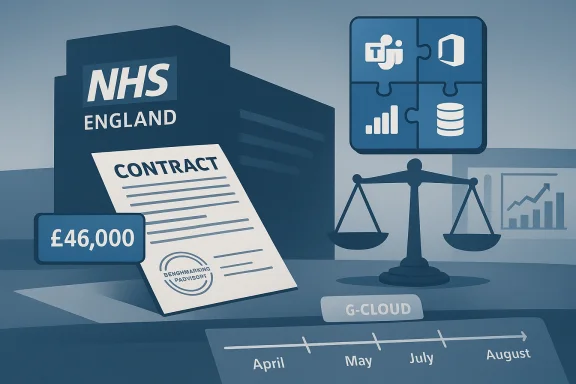
NHS England’s £46,000 spend on software licensing benchmarking may be small in absolute terms, but it is a strong signal that a much larger Microsoft negotiation is coming into view. The newly published procurement notice points to advisory work designed to help the health service understand market pricing before it returns to the table for a major licensing round. For a public body that already spends hundreds of millions on Microsoft software, the move looks less like routine consultancy and more like preparation for a high-stakes commercial fight.
The timing matters. NHS England is still operating under a Microsoft enterprise agreement awarded in August 2024 to Bytes Software Services for £2.709 million over three years for user licences such as Office 365, Power BI, and SQL, a contract explicitly routed through the Crown Commercial Service framework. That sits alongside the broader national Microsoft estate the NHS relies on every day, including NHSmail and Teams, which were supporting more than 1.5 million Microsoft Teams meetings per week in 2022/23. In other words, the organisation is not shopping for a niche tool; it is trying to manage one of the most strategically important software relationships in UK public sector IT. (contractsfinder.service.gov.uk)
The NHS’s dependence on Microsoft software did not appear overnight. Over the past decade, the health service has steadily built operational dependence on collaboration tools, identity services, productivity suites, endpoint controls, and analytics platforms that sit inside or adjacent to Microsoft’s licensing ecosystem. That dependence has only grown as the NHS expanded remote working, digital appointments, and cross-organisational coordination during and after the pandemic. The result is a technology stack that is deeply embedded in day-to-day service delivery.
By 2022/23, NHS England was already reporting that NHSmail and Microsoft Teams had become central to its communication fabric. The annual report said the collaboration platform had supported more than 800,000 audio calls, 1.5 million Teams meetings, and 9 million Teams chats per week, illustrating the scale of operational reliance. Once tools reach that level of usage, they stop being discretionary software and become infrastructure. That makes licensing renewals far more complex than ordinary procurement. (assets.publishing.service.gov.uk)
The latest notice suggests that NHS England is now taking a more deliberate, evidence-based stance before the next renewal cycle. Rather than jumping straight into a vendor-led discussion, it has hired IDC to provide benchmarking and advisory services on software licensing and pricing via the G-Cloud 14 framework. That sort of exercise typically aims to establish what “good” looks like in the market before negotiations start in earnest. It is a classic move when a buyer suspects that list prices, bundle structures, or commercial terms may not reflect its true bargaining power.
The broader procurement backdrop also matters. G-Cloud 14 is still active, but its timeline is tightening. Crown Commercial Service says the framework runs for 18 months from 29 October 2024 and was later extended for six months, with call-off contracts able to run for up to 48 months in total. That creates a window in which public sector buyers can still procure cloud software and support, but also pressures them to plan ahead carefully. The NHS clearly does not want to be caught negotiating under time pressure. (crowncommercial.gov.uk)
It also helps buyers decide whether to renew, rebalance, or replace components of the estate. A well-run benchmarking exercise can expose underused licences, suggest alternatives to premium SKUs, and show where the buyer is paying for features it does not need. In a large public sector environment, those savings can be meaningful without requiring an immediate platform migration.
The contract value is modest at £46,000, which is enough to buy expertise but not enough to alter strategy by itself. That is why the spend should be read as a signal rather than a conclusion. Public bodies often use low-value advisory contracts to de-risk major procurements before they expose themselves to vendor pressure or internal disagreement. The money is small; the implications are not.
That matters because vendors often know far more about pricing behaviour than buyers do. A well-resourced supplier can segment customers by complexity, dependency, and switching cost, then use that segmentation to defend margins. An independent benchmark can flatten that information asymmetry, even if it does not eliminate it. Information parity is often the real prize.
This structure is typical of the UK public sector. Buyers often do not contract directly with Microsoft for every component; instead, they go through a reseller or licensing partner. That adds another layer of commercial complexity, because the negotiation is not only about Microsoft’s terms but also about channel economics, support arrangements, and framework conditions. The NHS has to manage both the vendor and the intermediary.
The existence of a reseller layer also changes the negotiation dynamic. It can give the buyer more room to compare alternative channels, but it can also create dependency on a small number of approved partners with specialised expertise. In practice, the buyer may be negotiating against a chain of commercial interests rather than a single supplier.
The software itself is also deeply integrated. If you already depend on Teams, Outlook, SharePoint, Azure-adjacent identity controls, and compliance workflows, switching parts of the stack is costly and risky. That creates vendor lock-in even when the buyer is unhappy with price. Lock-in does not always mean you cannot leave; it often means leaving is too disruptive to justify.
This is why benchmarking is often justified even when the advisory fee looks trivial. If a consultant helps secure a few percentage points of savings on a high-value licensing deal, the return on investment can be enormous. The practical question is whether the buyer has enough internal commercial maturity to use that advice effectively. Benchmarking is only valuable if it changes the negotiating position, not just the slide deck.
A poor licensing decision can generate hidden costs: user friction, lost productivity, shadow IT, and support tickets. A good one can quietly improve reliability and reduce waste. The NHS has to manage both outcomes at once, which is why these deals are rarely just about price.
However, framework speed can be a double-edged sword. It simplifies access, but it can also narrow the procurement conversation to vendors already inside the framework ecosystem. That may be efficient, yet it may not always produce the best long-term value if the customer is not disciplined about specification and benchmarking. The NHS, given its scale, seems to understand that risk.
That is why early advisory work matters. It allows the buyer to test assumptions before they become baked into a formal tender. In a market as mature as Microsoft licensing, the first specification draft often determines the outcome long before bids are submitted.
For rivals, the opportunity is more subtle. Direct displacement of Microsoft across the NHS is unlikely in the near term, but benchmarking can still create openings around adjacent services, specialised workloads, and price-sensitive components. Competing vendors may benefit if the NHS decides some users do not need premium bundles or if it starts segmenting workloads more aggressively. Even incremental substitution can matter at NHS scale.
There is also a risk of false comparability. Public sector software estates are rarely identical, so benchmarks can be misleading if they do not account for bundle differences, service levels, migration costs, and risk assumptions. A low headline price from another organisation may not be transferable to the NHS’s specific environment. Cheap is not the same as comparable.
Those questions are especially important because Microsoft licensing is often a game of incremental optimisation rather than dramatic reinvention. Savings tend to come from better segmentation, cleaner entitlement management, and stronger timing discipline. The NHS may not be looking for a revolutionary switch. It may simply want to stop overpaying for complexity it no longer needs.
For enterprise and public-sector technology leaders, however, this is a textbook example of procurement strategy meeting platform dependency. The NHS has to preserve continuity while still challenging a dominant supplier. That requires a much more sophisticated approach than a normal office software renewal. The stakes are higher because the operational tolerance for failure is lower.
That broader lesson is likely the real significance of the £46,000 spend. It is not just about one contract. It is about whether large public institutions can still negotiate effectively with platform vendors in an era of deep software dependence.
Another opportunity is internal discipline. Benchmarking can force the organisation to clean up its licence inventory, map actual use, and separate essential services from legacy habit. Even if the headline savings are moderate, the operational hygiene benefits can be substantial.
There is also the familiar danger of procurement theatre. It is easy to spend money on advisory services, produce a detailed report, and still renew much the same arrangement because the operational cost of change is too high. That is not necessarily failure, but it can be disappointing if expectations were inflated.
The broader market should expect more of this kind of behaviour from public bodies. As software estates mature and budgets remain tight, the pressure to quantify value will increase. That may not reduce Microsoft’s dominance, but it should make renewals more disciplined and more data-driven. In a market where lock-in is real, discipline is one of the few tools buyers still control.
Source: theregister.com NHS pays £46K to prep next Microsoft licensing round
The timing matters. NHS England is still operating under a Microsoft enterprise agreement awarded in August 2024 to Bytes Software Services for £2.709 million over three years for user licences such as Office 365, Power BI, and SQL, a contract explicitly routed through the Crown Commercial Service framework. That sits alongside the broader national Microsoft estate the NHS relies on every day, including NHSmail and Teams, which were supporting more than 1.5 million Microsoft Teams meetings per week in 2022/23. In other words, the organisation is not shopping for a niche tool; it is trying to manage one of the most strategically important software relationships in UK public sector IT. (contractsfinder.service.gov.uk)
 Background
The NHS’s dependence on Microsoft software did not appear overnight. Over the past decade, the health service has steadily built operational dependence on collaboration tools, identity services, productivity suites, endpoint controls, and analytics platforms that sit inside or adjacent to Microsoft’s licensing ecosystem. That dependence has only grown as the NHS expanded remote working, digital appointments, and cross-organisational coordination during and after the pandemic. The result is a technology stack that is deeply embedded in day-to-day service delivery.By 2022/23, NHS England was already reporting that NHSmail and Microsoft Teams had become central to its communication fabric. The annual report said the collaboration platform had supported more than 800,000 audio calls, 1.5 million Teams meetings, and 9 million Teams chats per week, illustrating the scale of operational reliance. Once tools reach that level of usage, they stop being discretionary software and become infrastructure. That makes licensing renewals far more complex than ordinary procurement. (assets.publishing.service.gov.uk)
The latest notice suggests that NHS England is now taking a more deliberate, evidence-based stance before the next renewal cycle. Rather than jumping straight into a vendor-led discussion, it has hired IDC to provide benchmarking and advisory services on software licensing and pricing via the G-Cloud 14 framework. That sort of exercise typically aims to establish what “good” looks like in the market before negotiations start in earnest. It is a classic move when a buyer suspects that list prices, bundle structures, or commercial terms may not reflect its true bargaining power.
The broader procurement backdrop also matters. G-Cloud 14 is still active, but its timeline is tightening. Crown Commercial Service says the framework runs for 18 months from 29 October 2024 and was later extended for six months, with call-off contracts able to run for up to 48 months in total. That creates a window in which public sector buyers can still procure cloud software and support, but also pressures them to plan ahead carefully. The NHS clearly does not want to be caught negotiating under time pressure. (crowncommercial.gov.uk)
Why benchmarking now matters
Benchmarking is not just a shopping exercise. In a market dominated by a small number of large software vendors, it is one of the few practical ways to challenge assumptions about pricing, discount levels, and license mix. For NHS England, the value is likely in understanding whether it is paying a premium because of volume, complexity, or simply weak negotiating leverage. That distinction matters enormously when even a small percentage shift can mean millions over the life of a contract.It also helps buyers decide whether to renew, rebalance, or replace components of the estate. A well-run benchmarking exercise can expose underused licences, suggest alternatives to premium SKUs, and show where the buyer is paying for features it does not need. In a large public sector environment, those savings can be meaningful without requiring an immediate platform migration.
What the New Notice Suggests
The newly published notice is unusual only in how little it says. It names IDC, references benchmarking and advisory services on software licensing and pricing, and ties the work to preparation for large-scale software licensing procurement. It does not name Microsoft, but the surrounding context makes the likely subject fairly obvious. NHS England already has a national Microsoft arrangement covering core productivity and security tools, and the scale of that estate makes Microsoft the logical target for this kind of preparatory work.The contract value is modest at £46,000, which is enough to buy expertise but not enough to alter strategy by itself. That is why the spend should be read as a signal rather than a conclusion. Public bodies often use low-value advisory contracts to de-risk major procurements before they expose themselves to vendor pressure or internal disagreement. The money is small; the implications are not.
Key implications from the notice
- NHS England appears to be preparing for a major licensing renewal or re-procurement.
- The work is framed as benchmarking and advisory, not implementation.
- The contract runs only from April through August, which points to early-stage groundwork.
- The notice is consistent with a buyer trying to establish market comparators before negotiating.
- The likely target is the Microsoft licensing stack, even though the notice does not name the vendor.
What IDC is likely being asked to do
IDC’s role is probably not to tell NHS England whether Microsoft is “good” or “bad.” More likely, it is to map the commercial landscape, compare price points, and identify leverage points. That may include sector benchmarking, SKU analysis, licensing model comparisons, and advice on how other large organisations structure similar deals. In effect, IDC becomes a proxy for market knowledge that the buyer can use in negotiation.That matters because vendors often know far more about pricing behaviour than buyers do. A well-resourced supplier can segment customers by complexity, dependency, and switching cost, then use that segmentation to defend margins. An independent benchmark can flatten that information asymmetry, even if it does not eliminate it. Information parity is often the real prize.
The Current Microsoft Relationship
NHS England’s current Microsoft contract was awarded in August 2024 to Bytes Software Services Limited under a call-off from Crown Commercial Service framework RM6098, with a reported value of £2,709,387.52 over three years for the specific licensing package described in the notice. The contract covers Microsoft user licences including Office 365, Power BI, and SQL. That’s not the whole national NHS Microsoft estate, but it is a clear indicator of how the organisation buys at least part of its Microsoft stack. (contractsfinder.service.gov.uk)This structure is typical of the UK public sector. Buyers often do not contract directly with Microsoft for every component; instead, they go through a reseller or licensing partner. That adds another layer of commercial complexity, because the negotiation is not only about Microsoft’s terms but also about channel economics, support arrangements, and framework conditions. The NHS has to manage both the vendor and the intermediary.
Why resellers matter
Resellers can add value by bundling services, smoothing procurement, and handling administrative complexity. They can also obscure where margin sits in the transaction. For a customer as large as NHS England, the difference between vendor list price, public sector discount, and reseller commercial uplift can be material. That is one reason benchmarking becomes so important.The existence of a reseller layer also changes the negotiation dynamic. It can give the buyer more room to compare alternative channels, but it can also create dependency on a small number of approved partners with specialised expertise. In practice, the buyer may be negotiating against a chain of commercial interests rather than a single supplier.
Why Microsoft Deals Are So Hard to Negotiate
Microsoft licensing is notoriously difficult because it combines multiple product families, contractual vehicles, usage rights, and discount structures. A large organisation may need email, identity, device management, collaboration, analytics, virtual desktop rights, compliance tooling, and security capabilities, all of which can be bundled differently depending on the agreement. That makes it easy for a buyer to think it is comparing like with like when it is actually comparing unlike bundles.The software itself is also deeply integrated. If you already depend on Teams, Outlook, SharePoint, Azure-adjacent identity controls, and compliance workflows, switching parts of the stack is costly and risky. That creates vendor lock-in even when the buyer is unhappy with price. Lock-in does not always mean you cannot leave; it often means leaving is too disruptive to justify.
The commercial pressure points
- License bundles can hide the real cost of individual components.
- Security and compliance features are often packaged into higher tiers.
- Usage-based overages can appear long after the initial deal is signed.
- Enterprise agreements can create path dependence that narrows future choices.
- Negotiations can hinge on timing, not just scale.
The NHS Budget Context
Although £46,000 is tiny relative to NHS England’s overall budget, it still reflects a disciplined approach to procurement. The NHS operates under constant financial pressure, and digital costs have become a recurring line item rather than a one-off transformation expense. Once a software estate reaches this scale, small percentage changes can produce very large absolute swings over a contract term.This is why benchmarking is often justified even when the advisory fee looks trivial. If a consultant helps secure a few percentage points of savings on a high-value licensing deal, the return on investment can be enormous. The practical question is whether the buyer has enough internal commercial maturity to use that advice effectively. Benchmarking is only valuable if it changes the negotiating position, not just the slide deck.
Enterprise impact versus frontline reality
For enterprise IT leaders, licensing is a strategic balance sheet issue. It affects identity architecture, support models, cybersecurity posture, and workplace productivity. For frontline staff, by contrast, the issue is usually invisible until something breaks or access changes. That gap matters, because procurement decisions that look abstract in finance can have real operational consequences in hospitals, community services, and administrative workflows.A poor licensing decision can generate hidden costs: user friction, lost productivity, shadow IT, and support tickets. A good one can quietly improve reliability and reduce waste. The NHS has to manage both outcomes at once, which is why these deals are rarely just about price.
G-Cloud 14 and the Procurement Path
The reference to G-Cloud 14 is important because it tells us something about the procurement route as well as the service category. Crown Commercial Service says G-Cloud 14 offers cloud hosting, cloud software, and cloud support, and it can be used for further competition when requirements are too complex for a simple direct award. It is a framework designed to keep public sector buying relatively fast while still preserving competitive pressure. (crowncommercial.gov.uk)However, framework speed can be a double-edged sword. It simplifies access, but it can also narrow the procurement conversation to vendors already inside the framework ecosystem. That may be efficient, yet it may not always produce the best long-term value if the customer is not disciplined about specification and benchmarking. The NHS, given its scale, seems to understand that risk.
Why route-to-market strategy is crucial
A procurement route is not merely administrative. It shapes which suppliers can compete, how price pressure is created, and how much freedom the buyer has to restructure the deal. If the NHS wants leverage, it needs to define the requirement carefully before issuing anything formal. If it defines the problem too narrowly, it can end up reproducing the existing spend pattern with a slightly different label.That is why early advisory work matters. It allows the buyer to test assumptions before they become baked into a formal tender. In a market as mature as Microsoft licensing, the first specification draft often determines the outcome long before bids are submitted.
Competitive Implications for Microsoft and Rivals
For Microsoft, the NHS’s benchmarking exercise is a reminder that even highly embedded accounts are not static. Public sector customers are becoming more sophisticated about cost control, especially as budgets tighten and ministers demand proof of value. A buyer armed with independent market data is harder to upsell and easier to challenge. That does not necessarily threaten Microsoft’s position, but it can squeeze margins and influence package design.For rivals, the opportunity is more subtle. Direct displacement of Microsoft across the NHS is unlikely in the near term, but benchmarking can still create openings around adjacent services, specialised workloads, and price-sensitive components. Competing vendors may benefit if the NHS decides some users do not need premium bundles or if it starts segmenting workloads more aggressively. Even incremental substitution can matter at NHS scale.
Where competitors might gain
- Lower-tier productivity suites for selected roles.
- Security or analytics point solutions.
- Alternative collaboration tooling for specialist use cases.
- Open-source or lower-cost platforms in non-critical functions.
- Better procurement terms through multi-vendor pressure.
Risks and Concerns
The obvious risk is that benchmarking may confirm what the NHS already knows: it is structurally dependent on Microsoft and has limited room to manoeuvre. If that is the case, the advisory exercise may still help at the margin, but it may not produce dramatic savings. The danger is that expectations could outpace reality, especially if internal stakeholders assume there is a hidden bargain waiting to be uncovered.There is also a risk of false comparability. Public sector software estates are rarely identical, so benchmarks can be misleading if they do not account for bundle differences, service levels, migration costs, and risk assumptions. A low headline price from another organisation may not be transferable to the NHS’s specific environment. Cheap is not the same as comparable.
Main concerns to watch
- Benchmarking may produce illusory savings if the comparator set is weak.
- Vendor lock-in can limit practical leverage even with good data.
- Reseller structures can obscure the true commercial margin.
- Overly aggressive licence rationalisation could disrupt users.
- A rushed procurement could lock in a suboptimal deal for years.
- Public scrutiny may create political pressure that distorts commercial judgment.
What the NHS Is Likely Trying to Learn
The advisory work probably aims to answer a set of fairly practical questions. How much are comparable institutions paying? Which licence features are actually being used? Are there underutilised seats or expensive tiers that can be downgraded? And what negotiating posture is realistic given the NHS’s scale and dependency?Those questions are especially important because Microsoft licensing is often a game of incremental optimisation rather than dramatic reinvention. Savings tend to come from better segmentation, cleaner entitlement management, and stronger timing discipline. The NHS may not be looking for a revolutionary switch. It may simply want to stop overpaying for complexity it no longer needs.
Likely areas of analysis
- Licence usage by role and department.
- Redundancy between bundled products and standalone services.
- Current discount position versus public sector peers.
- Cost impact of premium security and compliance add-ons.
- Opportunities to shift some users to lower-cost tiers.
Enterprise Versus Consumer Impact
For consumers, this story is mostly invisible. Patients and the public do not buy Microsoft licences from NHS England, and they will not see a direct price tag on their appointment letter. But the knock-on effects can still matter if licensing decisions influence service availability, digital communication, or the tools staff use to coordinate care. In healthcare, back-office software often shapes front-line experience indirectly.For enterprise and public-sector technology leaders, however, this is a textbook example of procurement strategy meeting platform dependency. The NHS has to preserve continuity while still challenging a dominant supplier. That requires a much more sophisticated approach than a normal office software renewal. The stakes are higher because the operational tolerance for failure is lower.
Why this matters beyond the NHS
Other public bodies will be watching this kind of move closely. Councils, trusts, agencies, and arm’s-length bodies are all grappling with similar licensing pressures. If NHS England secures a better commercial outcome, it could strengthen the case for more aggressive benchmarking elsewhere. If it does not, it may reinforce the view that the market is too concentrated for meaningful savings.That broader lesson is likely the real significance of the £46,000 spend. It is not just about one contract. It is about whether large public institutions can still negotiate effectively with platform vendors in an era of deep software dependence.
Strengths and Opportunities
The biggest strength in NHS England’s approach is that it is acting early and deliberately rather than waiting until the last minute. That creates room to test assumptions, refine requirements, and avoid being boxed into a vendor-defined outcome. It also signals to suppliers that the buyer is paying attention.Another opportunity is internal discipline. Benchmarking can force the organisation to clean up its licence inventory, map actual use, and separate essential services from legacy habit. Even if the headline savings are moderate, the operational hygiene benefits can be substantial.
- Better price visibility before formal procurement begins
- Stronger negotiating leverage with the incumbent supplier
- Potential to identify underused or over-specified licences
- Cleaner mapping between user roles and licence tiers
- Reduced risk of a rushed or poorly framed renewal
- Improved internal confidence in commercial decisions
- A template for future public-sector licensing reviews
Risks and Concerns
The main concern is that benchmarking may create a false sense of control if the NHS overestimates how much leverage it actually has. A dominant platform vendor can absorb a lot of scrutiny while still preserving its core economics. If the buyer does not have credible alternatives, the benchmark becomes a reference point rather than a weapon.There is also the familiar danger of procurement theatre. It is easy to spend money on advisory services, produce a detailed report, and still renew much the same arrangement because the operational cost of change is too high. That is not necessarily failure, but it can be disappointing if expectations were inflated.
- Limited real-world alternatives to a deeply embedded Microsoft stack
- Risk that comparator data is not truly comparable
- Potential reseller opacity in pricing and margin
- Possibility of savings being offset by migration or support costs
- Pressure to simplify deals at the expense of resilience
- Political scrutiny that could distort commercial judgment
- Overreliance on external advisors instead of building internal capability
Looking Ahead
The most likely near-term outcome is not a dramatic procurement announcement but a period of quiet commercial preparation. The NHS will probably use the IDC work to define its negotiation posture, establish benchmark ranges, and decide where it can press hardest. Only after that will the formal market process begin, and even then the shape of the outcome may remain opaque until late in the cycle.The broader market should expect more of this kind of behaviour from public bodies. As software estates mature and budgets remain tight, the pressure to quantify value will increase. That may not reduce Microsoft’s dominance, but it should make renewals more disciplined and more data-driven. In a market where lock-in is real, discipline is one of the few tools buyers still control.
Things to watch next
- Whether NHS England opens a formal procurement after the benchmarking phase
- Whether the eventual deal is still routed through a reseller or shifts commercial model
- Whether the NHS targets specific licence tiers for rationalisation
- Whether similar benchmarking exercises appear elsewhere in the public sector
- Whether Microsoft responds with more aggressive public-sector commercial terms
Source: theregister.com NHS pays £46K to prep next Microsoft licensing round
