

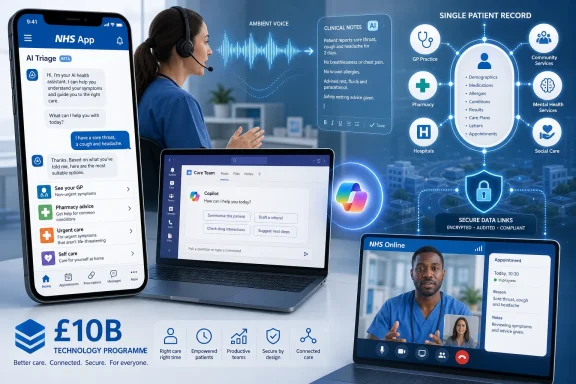
On 4 July 2026, NHS England said a £10 billion technology, digital, and data programme over three years will fund AI triage in the NHS App, ambient voice note-taking, NHS Online appointments, a Single Patient Record, stronger cyber security, and Microsoft Copilot access for more than 500,000 staff. The announcement, echoed by Healthcare Management and set against the government’s 10-Year Health Plan, is not just another digitisation pledge. It is a decision to make software the front door, memory, and clerical workforce of the health service. The bet is that the NHS can buy time with automation faster than it can hire, train, and retain enough humans to recover from years of operational strain.
The most politically useful part of the package is also the most sensitive: AI triage inside the NHS App. According to NHS England, the tool will ask patients questions and direct them toward the most appropriate service, including GP care, pharmacy, urgent and emergency care, community services, or self-care advice. That sounds modest until you remember that access is the NHS’s most visible failure point.
For patients, the front door to care has become a maze of phone queues, e-consult forms, practice-specific rules, NHS 111 pathways, pharmacy referrals, and emergency departments absorbing demand that belongs elsewhere. An AI triage layer promises to rationalise that mess. It can also become the new place where frustration accumulates.
The government’s pitch is that better routing will free clinical capacity and reduce waiting. That is plausible in the narrow sense: if more patients are steered to pharmacies, community services, or self-care when appropriate, GP and hospital pressure may ease. But triage is not merely logistics. It is risk management under uncertainty, and the NHS is now proposing to put more of that uncertainty into a national digital channel.
That distinction matters because a triage system can be “accurate” on average and still fail the people whose symptoms do not fit its assumptions. The hard cases are not the users with textbook presentations. They are the elderly patient with vague deterioration, the non-native English speaker describing pain imprecisely, the neurodivergent user struggling with symptom forms, or the person who knows something is wrong but cannot express it in a way the software recognises.
Anyone who has watched a GP split attention between a patient and a screen understands the appeal. The electronic record solved some problems while creating others, turning healthcare professionals into part-time data-entry workers. If ambient voice tools can genuinely reduce that drag, they could improve both staff morale and the quality of the consultation.
But “ambient” is doing a lot of rhetorical work. This is not a neutral microphone in the room. It is a transcription, summarisation, and clinical-documentation system operating in a setting where small errors can matter. A missed negative, a confused medication name, or a polished but inaccurate summary can travel through the record with more authority than a rough human note.
The safest version of ambient voice is not the one that writes the most fluent note. It is the one that makes uncertainty visible, preserves clinician control, and fits naturally into existing safety checks. The NHS has learned this lesson before: digitising a workflow does not automatically improve it, and automating a bad workflow can make it fail at national scale.
That is a striking claim, and it will be repeated often. In a system where workforce pressure is chronic, “two days a month” sounds like a staffing intervention disguised as software procurement. Multiply it across hundreds of thousands of workers and the productivity arithmetic becomes politically irresistible.
The catch is that Copilot is not a magic NHS product. It is an enterprise AI assistant layered into Microsoft 365, which means its usefulness depends on permissions, data quality, governance, training, and the mundane reality of how documents, emails, calendars, Teams chats, and records are organised. In a well-managed environment, Copilot can summarise, draft, search, and automate useful clerical tasks. In a messy tenant, it can surface the mess faster.
That is why this rollout should be read as a Microsoft 365 governance story as much as an AI story. NHS organisations will need to know what Copilot can access, which data it can process, how prompts and outputs are logged, what retention rules apply, and how staff are trained not to paste sensitive information into the wrong place. The technology may be cloud-native and modern, but the operational questions are old-school sysadmin questions with patient safety consequences.
Yet the phrase “single record” has a long and bruising history in British health IT. The NHS has repeatedly tried to integrate records across organisational boundaries, and the barriers are rarely just technical. They include procurement silos, local customisation, clinical coding differences, legacy systems, privacy concerns, and the stubborn fact that healthcare institutions do not all work the same way.
A single record also changes the stakes of cyber security. Fragmented systems are inefficient, but they can also limit blast radius. A more unified data layer can improve care and analytics, but it also creates a more attractive target. NHS England’s inclusion of enhanced cyber security in the same investment package is therefore not a side note; it is the price of admission.
The ransomware era has already taught healthcare systems that downtime is not abstract. When hospitals lose access to records, appointments are cancelled, tests are delayed, ambulances are diverted, and clinicians revert to paper under pressure. A digital NHS cannot treat security as compliance theatre. It has to treat resilience as a clinical safety requirement.
The appeal is obvious for follow-ups, second opinions, chronic disease management, and specialist advice that does not require a physical examination. The NHS App becoming a place to request follow-up appointments after treatment also shifts some agency to patients. That could reduce missed connections and unnecessary phone traffic if the workflow is designed well.
But virtual care has a habit of exposing inequality while claiming to solve access. Patients need devices, connectivity, digital confidence, language support, and a private space to talk. Some conditions can be managed remotely; others cannot. Some patients will love the convenience; others will experience it as yet another layer between them and a human being.
The lesson from the pandemic-era rush to remote care is not that online appointments are bad. It is that channel shift needs clinical judgement. The future NHS should be digital by default where digital is better, not digital by default because the physical service is overloaded.
A benefits case can include cash savings, staff time released, avoided appointments, reduced duplication, better outcomes, and productivity improvements. Some of those are real but hard to bank. If a clinician saves 20 minutes a day, the system does not automatically receive 20 minutes of usable capacity in the right clinic, at the right time, for the right patient.
The NHS is full of trapped efficiency. A digital tool may save time in one part of the pathway while creating new work elsewhere: reviewing AI-generated notes, correcting triage errors, handling patients routed to the wrong service, managing consent, training staff, or supporting users excluded by digital design. The benefits case only becomes real when workflows change around the technology.
That is why Pritesh Mistry of The King’s Fund, quoted by Healthcare Management, was right to emphasise people, training, leadership, and service redesign. The NHS does not suffer from a shortage of pilots. It suffers from uneven digital maturity and the difficulty of scaling what works without breaking what already functions locally.
Local discretion matters because the NHS is not one machine. A rural integrated care system, a large teaching hospital, a deprived urban borough, and a specialist trust will not have identical digital priorities. Some need basic infrastructure more than AI. Some need interoperability work before Copilot or ambient voice can deliver much value. Some need cyber remediation before expanding access to richer datasets.
At the same time, too much local freedom can recreate the very fragmentation the programme is meant to fix. A Single Patient Record cannot emerge from every organisation buying whatever it prefers. AI triage cannot be safely evaluated if every pathway is locally improvised. Cyber security cannot depend on postcode.
The hardest policy question, then, is not whether the NHS should centralise or decentralise. It is where standardisation is essential and where local variation is healthy. National platforms need common rules; clinical services need room to adapt. Getting that boundary wrong has sunk more than one public-sector IT programme.
But time saved on paper does not automatically become better care. It has to be converted into capacity through scheduling, staffing, supervision, and operational discipline. Otherwise, the system simply absorbs the productivity gain and continues to feel overloaded.
There is also a morale dimension. If staff experience AI as surveillance, box-ticking, or another management fad, adoption will be shallow. If they experience it as genuine relief from clerical burden, uptake could be rapid. The difference will be determined less by speeches from Whitehall than by whether the tools work on a wet Tuesday morning in a clinic running 40 minutes late.
This is where Microsoft’s enterprise footprint cuts both ways. Familiar tools can reduce adoption friction because staff already live in Outlook, Teams, Word, and Excel. But familiarity can also breed complacency. An AI assistant inside everyday productivity software may feel less risky than a standalone medical AI system, even when it is handling sensitive operational context.
The NHS must be especially careful not to confuse lower demand with better demand management. A system can reduce phone calls because it solved the problem, or because people gave up. It can shift work from receptionists to patients, then celebrate administrative efficiency. It can route more people to self-care while missing the minority who needed escalation.
Good triage should be auditable. The NHS should be able to show not only where users were sent, but what happened next. Did pharmacy referrals resolve symptoms? Did self-care users re-present later? Did emergency cases get escalated quickly? Were disabled users, older users, poorer users, and users with limited English served as well as everyone else?
That kind of evaluation is not optional. AI in healthcare earns legitimacy through outcomes, not novelty. The NHS App has become a national platform, and national platforms need national accountability.
The NHS has a stronger trust position than many private technology companies, but it is not invulnerable. Past controversies over data sharing have shown that patients can support data-driven care in principle while objecting to unclear governance in practice. Consent, transparency, and opt-out mechanisms cannot be treated as afterthoughts.
The Copilot rollout adds a familiar concern for IT professionals: vendor dependence. Microsoft is already deeply embedded across public-sector productivity infrastructure. Expanding Copilot across more than half a million NHS workers may be operationally sensible, but it also strengthens reliance on a single commercial ecosystem for administrative AI.
That does not make the decision wrong. It does mean the NHS should be explicit about contractual safeguards, data boundaries, exit options, audit rights, and model governance. “It runs inside Microsoft 365” is not a governance strategy. It is the beginning of one.
This is the classic failure mode of central technology funding. The best-prepared organisations get better, the weakest fall further behind, and national averages conceal widening variation. For a health service founded on equity, that is not a minor implementation detail. It is a test of the whole project.
Training will be decisive. Staff need more than a webinar on prompt writing. They need clear rules for when AI can be used, when it must not be used, how outputs are checked, how errors are reported, and who is accountable. Managers need to understand that a productivity tool can create risk if it encourages staff to move faster than governance allows.
Patients need support too. If the NHS App becomes the preferred front door, digital inclusion becomes part of healthcare access. Libraries, community organisations, carers, pharmacies, and local NHS teams may all become informal support infrastructure for a system that increasingly assumes patients can navigate digital pathways.
 The NHS Is Turning the App Into a Gatekeeper
The most politically useful part of the package is also the most sensitive: AI triage inside the NHS App. According to NHS England, the tool will ask patients questions and direct them toward the most appropriate service, including GP care, pharmacy, urgent and emergency care, community services, or self-care advice. That sounds modest until you remember that access is the NHS’s most visible failure point.For patients, the front door to care has become a maze of phone queues, e-consult forms, practice-specific rules, NHS 111 pathways, pharmacy referrals, and emergency departments absorbing demand that belongs elsewhere. An AI triage layer promises to rationalise that mess. It can also become the new place where frustration accumulates.
The government’s pitch is that better routing will free clinical capacity and reduce waiting. That is plausible in the narrow sense: if more patients are steered to pharmacies, community services, or self-care when appropriate, GP and hospital pressure may ease. But triage is not merely logistics. It is risk management under uncertainty, and the NHS is now proposing to put more of that uncertainty into a national digital channel.
That distinction matters because a triage system can be “accurate” on average and still fail the people whose symptoms do not fit its assumptions. The hard cases are not the users with textbook presentations. They are the elderly patient with vague deterioration, the non-native English speaker describing pain imprecisely, the neurodivergent user struggling with symptom forms, or the person who knows something is wrong but cannot express it in a way the software recognises.
Ambient Voice Is the Most Human-Sounding Automation in the Package
Ambient voice technology may prove more immediately popular with clinicians than patient-facing triage. NHS England says ambient note-taking tools can reduce the administrative burden on staff, and it points to evidence that clinicians using the tools can spend more of their time with patients rather than typing. The concept is simple: software listens during a consultation, drafts notes, and lets the clinician review and approve them.Anyone who has watched a GP split attention between a patient and a screen understands the appeal. The electronic record solved some problems while creating others, turning healthcare professionals into part-time data-entry workers. If ambient voice tools can genuinely reduce that drag, they could improve both staff morale and the quality of the consultation.
But “ambient” is doing a lot of rhetorical work. This is not a neutral microphone in the room. It is a transcription, summarisation, and clinical-documentation system operating in a setting where small errors can matter. A missed negative, a confused medication name, or a polished but inaccurate summary can travel through the record with more authority than a rough human note.
The safest version of ambient voice is not the one that writes the most fluent note. It is the one that makes uncertainty visible, preserves clinician control, and fits naturally into existing safety checks. The NHS has learned this lesson before: digitising a workflow does not automatically improve it, and automating a bad workflow can make it fail at national scale.
Microsoft Copilot Gives the Plan Its WindowsForum Angle
For WindowsForum readers, the Copilot element is the clearest sign that this is not a boutique health-tech experiment. NHS England announced in June that 505,000 clinicians and support staff would receive access to Microsoft 365 Copilot, with rollout expected by October 2026. In the July announcement, NHS England again framed Copilot as a way to cut administrative work, saying a trial reduced time spent on admin by an average of two days a month.That is a striking claim, and it will be repeated often. In a system where workforce pressure is chronic, “two days a month” sounds like a staffing intervention disguised as software procurement. Multiply it across hundreds of thousands of workers and the productivity arithmetic becomes politically irresistible.
The catch is that Copilot is not a magic NHS product. It is an enterprise AI assistant layered into Microsoft 365, which means its usefulness depends on permissions, data quality, governance, training, and the mundane reality of how documents, emails, calendars, Teams chats, and records are organised. In a well-managed environment, Copilot can summarise, draft, search, and automate useful clerical tasks. In a messy tenant, it can surface the mess faster.
That is why this rollout should be read as a Microsoft 365 governance story as much as an AI story. NHS organisations will need to know what Copilot can access, which data it can process, how prompts and outputs are logged, what retention rules apply, and how staff are trained not to paste sensitive information into the wrong place. The technology may be cloud-native and modern, but the operational questions are old-school sysadmin questions with patient safety consequences.
The Single Patient Record Is the Prize and the Risk
The proposed Single Patient Record is the deepest structural reform in the package. If done well, it could solve one of the NHS’s most stubborn failures: the fragmentation of patient information across trusts, GP systems, community services, mental health providers, and social care boundaries. A specialist seeing a full, current picture of a patient’s history is not a luxury. It is basic infrastructure for modern medicine.Yet the phrase “single record” has a long and bruising history in British health IT. The NHS has repeatedly tried to integrate records across organisational boundaries, and the barriers are rarely just technical. They include procurement silos, local customisation, clinical coding differences, legacy systems, privacy concerns, and the stubborn fact that healthcare institutions do not all work the same way.
A single record also changes the stakes of cyber security. Fragmented systems are inefficient, but they can also limit blast radius. A more unified data layer can improve care and analytics, but it also creates a more attractive target. NHS England’s inclusion of enhanced cyber security in the same investment package is therefore not a side note; it is the price of admission.
The ransomware era has already taught healthcare systems that downtime is not abstract. When hospitals lose access to records, appointments are cancelled, tests are delayed, ambulances are diverted, and clinicians revert to paper under pressure. A digital NHS cannot treat security as compliance theatre. It has to treat resilience as a clinical safety requirement.
NHS Online Extends the Hospital Beyond the Building
NHS Online, described as a virtual hospital service allowing App users to join online appointments with expert clinicians across England, is another attempt to uncouple care from geography. In theory, this is exactly what a national health service should be able to do. If capacity exists in one region and demand is overwhelming in another, digital access should help smooth the imbalance.The appeal is obvious for follow-ups, second opinions, chronic disease management, and specialist advice that does not require a physical examination. The NHS App becoming a place to request follow-up appointments after treatment also shifts some agency to patients. That could reduce missed connections and unnecessary phone traffic if the workflow is designed well.
But virtual care has a habit of exposing inequality while claiming to solve access. Patients need devices, connectivity, digital confidence, language support, and a private space to talk. Some conditions can be managed remotely; others cannot. Some patients will love the convenience; others will experience it as yet another layer between them and a human being.
The lesson from the pandemic-era rush to remote care is not that online appointments are bad. It is that channel shift needs clinical judgement. The future NHS should be digital by default where digital is better, not digital by default because the physical service is overloaded.
The £41 Billion Benefits Claim Needs More Than a Spreadsheet
NHS England says the improvements are expected to generate £41 billion in total benefits over the next decade and deliver around half of the commitments in the government’s 10-Year Health Plan. Big benefits figures are common in public-sector technology announcements because they turn complexity into a headline. They are also where scrutiny should begin.A benefits case can include cash savings, staff time released, avoided appointments, reduced duplication, better outcomes, and productivity improvements. Some of those are real but hard to bank. If a clinician saves 20 minutes a day, the system does not automatically receive 20 minutes of usable capacity in the right clinic, at the right time, for the right patient.
The NHS is full of trapped efficiency. A digital tool may save time in one part of the pathway while creating new work elsewhere: reviewing AI-generated notes, correcting triage errors, handling patients routed to the wrong service, managing consent, training staff, or supporting users excluded by digital design. The benefits case only becomes real when workflows change around the technology.
That is why Pritesh Mistry of The King’s Fund, quoted by Healthcare Management, was right to emphasise people, training, leadership, and service redesign. The NHS does not suffer from a shortage of pilots. It suffers from uneven digital maturity and the difficulty of scaling what works without breaking what already functions locally.
Local Leaders Are Being Asked to Deliver a National Vision
Sir Ciarán Devane of the NHS Alliance, also quoted by Healthcare Management, put his finger on the governance problem: how will £10 billion translate into practical support and funding for local leaders? That question is not bureaucratic nitpicking. It is the difference between a national technology strategy and another round of central announcements landing on overstretched organisations.Local discretion matters because the NHS is not one machine. A rural integrated care system, a large teaching hospital, a deprived urban borough, and a specialist trust will not have identical digital priorities. Some need basic infrastructure more than AI. Some need interoperability work before Copilot or ambient voice can deliver much value. Some need cyber remediation before expanding access to richer datasets.
At the same time, too much local freedom can recreate the very fragmentation the programme is meant to fix. A Single Patient Record cannot emerge from every organisation buying whatever it prefers. AI triage cannot be safely evaluated if every pathway is locally improvised. Cyber security cannot depend on postcode.
The hardest policy question, then, is not whether the NHS should centralise or decentralise. It is where standardisation is essential and where local variation is healthy. National platforms need common rules; clinical services need room to adapt. Getting that boundary wrong has sunk more than one public-sector IT programme.
The NHS Is Buying Time, but Time Is Not the Same as Capacity
The central promise of the package is time: time saved by Copilot, time returned by ambient voice, time protected by triage, time recovered through virtual appointments, time gained from records that follow the patient. This is the right unit of analysis because the NHS’s crisis is often experienced as time scarcity. Patients wait. Staff rush. Administrators chase. Clinicians document after hours.But time saved on paper does not automatically become better care. It has to be converted into capacity through scheduling, staffing, supervision, and operational discipline. Otherwise, the system simply absorbs the productivity gain and continues to feel overloaded.
There is also a morale dimension. If staff experience AI as surveillance, box-ticking, or another management fad, adoption will be shallow. If they experience it as genuine relief from clerical burden, uptake could be rapid. The difference will be determined less by speeches from Whitehall than by whether the tools work on a wet Tuesday morning in a clinic running 40 minutes late.
This is where Microsoft’s enterprise footprint cuts both ways. Familiar tools can reduce adoption friction because staff already live in Outlook, Teams, Word, and Excel. But familiarity can also breed complacency. An AI assistant inside everyday productivity software may feel less risky than a standalone medical AI system, even when it is handling sensitive operational context.
The Front Door Must Not Become a Digital Bouncer
The AI triage tool will be judged by what happens to the patients it redirects. If it reduces unnecessary GP demand while safely escalating urgent cases, it will be hailed as a practical success. If it becomes a barrier that patients must defeat before reaching care, it will become a political liability.The NHS must be especially careful not to confuse lower demand with better demand management. A system can reduce phone calls because it solved the problem, or because people gave up. It can shift work from receptionists to patients, then celebrate administrative efficiency. It can route more people to self-care while missing the minority who needed escalation.
Good triage should be auditable. The NHS should be able to show not only where users were sent, but what happened next. Did pharmacy referrals resolve symptoms? Did self-care users re-present later? Did emergency cases get escalated quickly? Were disabled users, older users, poorer users, and users with limited English served as well as everyone else?
That kind of evaluation is not optional. AI in healthcare earns legitimacy through outcomes, not novelty. The NHS App has become a national platform, and national platforms need national accountability.
The Privacy Bargain Is Becoming Harder to Explain
Every part of this programme depends on public trust in data use. AI triage requires patients to disclose symptoms to software. Ambient voice requires consultations to be captured and processed. Copilot requires staff to trust enterprise AI with administrative context. A Single Patient Record requires citizens to accept broader availability of their medical history across care settings.The NHS has a stronger trust position than many private technology companies, but it is not invulnerable. Past controversies over data sharing have shown that patients can support data-driven care in principle while objecting to unclear governance in practice. Consent, transparency, and opt-out mechanisms cannot be treated as afterthoughts.
The Copilot rollout adds a familiar concern for IT professionals: vendor dependence. Microsoft is already deeply embedded across public-sector productivity infrastructure. Expanding Copilot across more than half a million NHS workers may be operationally sensible, but it also strengthens reliance on a single commercial ecosystem for administrative AI.
That does not make the decision wrong. It does mean the NHS should be explicit about contractual safeguards, data boundaries, exit options, audit rights, and model governance. “It runs inside Microsoft 365” is not a governance strategy. It is the beginning of one.
The Technology Is Arriving Before the Culture Has Settled
The NHS’s digital maturity is uneven, as The King’s Fund’s Pritesh Mistry warned. That unevenness will shape who benefits first. Digitally mature organisations will integrate new tools into redesigned pathways. Less mature ones may receive the same products but lack the capacity to make them work.This is the classic failure mode of central technology funding. The best-prepared organisations get better, the weakest fall further behind, and national averages conceal widening variation. For a health service founded on equity, that is not a minor implementation detail. It is a test of the whole project.
Training will be decisive. Staff need more than a webinar on prompt writing. They need clear rules for when AI can be used, when it must not be used, how outputs are checked, how errors are reported, and who is accountable. Managers need to understand that a productivity tool can create risk if it encourages staff to move faster than governance allows.
Patients need support too. If the NHS App becomes the preferred front door, digital inclusion becomes part of healthcare access. Libraries, community organisations, carers, pharmacies, and local NHS teams may all become informal support infrastructure for a system that increasingly assumes patients can navigate digital pathways.
The £10 Billion Bet Comes Down to Five Tests
The NHS’s AI programme should not be dismissed as hype, but neither should it be accepted as transformation by announcement. The practical test is whether the tools reduce friction without hiding risk, and whether national ambition is matched by local capability.- The AI triage tool must be judged by patient outcomes after redirection, not just by reduced call volumes or app usage.
- Ambient voice technology must keep clinicians responsible for the record while making errors easy to spot and correct.
- Microsoft Copilot will deliver value only where NHS organisations have strong data governance, permissions hygiene, and staff training.
- The Single Patient Record will improve care only if interoperability, cyber resilience, and patient trust are treated as core infrastructure.
- NHS Online should expand access where remote care is clinically suitable, not become a substitute for unavailable in-person services.
- The £41 billion benefits claim will matter only if saved time is converted into real capacity for patients and staff.
References
- Primary source: Healthcare Management Magazine
Published: 2026-07-07T10:55:15.064836
Loading…
www.healthcare-management.uk - Related coverage: ailoop.tech
Loading…
www.ailoop.tech - Related coverage: futurehealthintelligence.com
Loading…
futurehealthintelligence.com - Related coverage: thenextweb.com
Loading…
thenextweb.com