

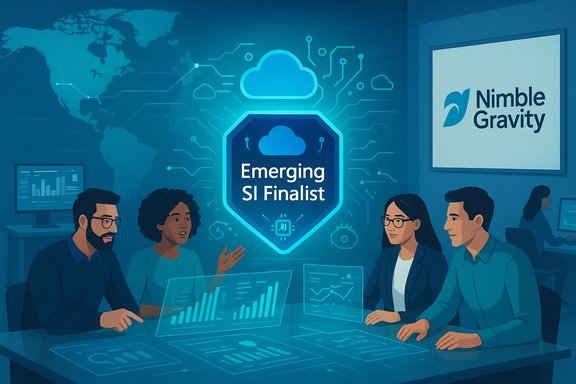
From startup to standout, Nimble Gravity says it has been named a finalist for the Microsoft Americas Partner of the Year Awards in the Emerging SI (Systems Integrator) category — a recognition that, if independently confirmed, would mark a significant milestone for a young, Azure‑focused consultancy scaling rapidly across the Americas.
Nimble Gravity is a Denver‑headquartered consultancy founded in recent years that has positioned itself around data, AI, analytics, and software engineering services. The firm has been active on acquisition and expansion moves — for example, its 2023 acquisition of Buenos Aires‑based mDEVZ expanded its data science and software engineering bench and was reported via PRNewswire. The Microsoft Partner of the Year Awards are an annual, high‑visibility program that recognizes partner achievements across global and regional categories. Microsoft publicly publishes winners and finalists across global and Americas regional lists; these announcements are used widely as shortlisting signals by enterprise buyers and the press. This piece summarises the Nimble Gravity announcement as reported in a distributed press release, places the claim in context within Microsoft’s Partner ecosystem, evaluates what the recognition would mean commercially and technically, and provides a practical, risk‑aware checklist for procurement teams and buyers who might consider Nimble Gravity as a partner. Where independent verification was not available in public Microsoft finalist lists or major trade coverage at the time of writing, that absence is flagged and explained.
Nimble Gravity’s narrative — from startup to standout — is believable and well aligned with the dynamics of Microsoft’s partner ecosystem, but corporate announcements and awards are the start of a procurement conversation, not the end. For buyers, the smart path is to treat the finalist status as a positive short‑listing signal, then insist on the objective, auditable evidence that turns recognition into reliable vendor selection.
Source: KWKT - FOX 44 https://www.fox44news.com/business/...he-year-finalist-in-the-emerging-si-category/
 Background / Overview
Nimble Gravity is a Denver‑headquartered consultancy founded in recent years that has positioned itself around data, AI, analytics, and software engineering services. The firm has been active on acquisition and expansion moves — for example, its 2023 acquisition of Buenos Aires‑based mDEVZ expanded its data science and software engineering bench and was reported via PRNewswire. The Microsoft Partner of the Year Awards are an annual, high‑visibility program that recognizes partner achievements across global and regional categories. Microsoft publicly publishes winners and finalists across global and Americas regional lists; these announcements are used widely as shortlisting signals by enterprise buyers and the press. This piece summarises the Nimble Gravity announcement as reported in a distributed press release, places the claim in context within Microsoft’s Partner ecosystem, evaluates what the recognition would mean commercially and technically, and provides a practical, risk‑aware checklist for procurement teams and buyers who might consider Nimble Gravity as a partner. Where independent verification was not available in public Microsoft finalist lists or major trade coverage at the time of writing, that absence is flagged and explained.What the announcement says (summary)
- Nimble Gravity’s press release asserts the company is an official finalist in the Microsoft Americas Partner of the Year Awards in the Emerging Systems Integrator (Emerging SI) category.
- The release frames this recognition as a validation of Nimble Gravity’s rapid growth, Azure‑centric delivery capabilities, and client outcomes in analytics, AI and cloud‑native engineering.
- The company positions the finalist status as a milestone in its transition from startup to a scalable systems integrator with international delivery capability and industry vertical traction.
Why a Microsoft Americas Partner of the Year finalist slot matters
Being named a Microsoft Partner of the Year finalist is more than a marketing headline. Microsoft’s awards process and regional partner programs are tightly woven into partner GTM (go‑to‑market) mechanics:- Microsoft awards partners through global and regional processes that highlight solution impact, scale, and strategic alignment with Microsoft Cloud and AI priorities. Finalists and winners gain higher visibility on Microsoft partner channels and often unlock co‑sell conversations and marketing amplification.
- The Emerging SI category typically recognises smaller or rapidly scaling systems integrators that demonstrate strong technical delivery on Microsoft platforms and the commercial outcomes to match. While Microsoft’s category names and exact criteria evolve year to year, the core yardsticks are customer impact, technical innovation on Microsoft stack (for example Azure, Microsoft 365, Copilot integrations), and replicable delivery models. Coverage of previous Partner of the Year award cycles makes clear that system integrators winning or short‑listed in these categories see measurable reputational and pipeline benefits.
The strengths that underpin Nimble Gravity’s claim
Based on the company’s public profile and prior announcements, several strengths support the narrative that Nimble Gravity could be competitive for an Emerging SI finalist slot:- Focused Azure and data practice: Nimble Gravity’s acquisitions and hires have emphasized data science, analytics, and cloud engineering, which match Microsoft’s current partner award focus on AI, Copilot, and data‑driven transformation. That alignment is a material strength when Microsoft assesses partner entries.
- Regional delivery footprint: The firm’s offices and delivery presence across North and Latin America (as described in prior corporate filings and announcements) create the cross‑border capability Microsoft looks for in regional awards that aim to highlight impact across Americas geographies.
- Productised IP and repeatable delivery patterns: Emerging SIs that reach finalist status often demonstrate repeatable, measurable outcomes — e.g., production AI deployments, consumption‑driven Azure workloads, and named client references. Nimble Gravity’s public statements emphasize delivery accelerators and domain templates that could meet these gates.
- Startup agility and scale ambition: Judges often reward innovation and speed. Smaller partners that combine startup agility with emerging delivery scale can attract attention in Emerging SI categories, especially where innovative use of Copilot / Azure AI or vertical accelerators is demonstrated.
What this recognition does not guarantee (risks and caveats)
Awards and finalist badges are useful signals, but they are not procurement substitutes. The following are important caveats for IT leaders and purchasing teams:- Finalist status ≠ contractually guaranteed capability. Awards are curated recognitions based on submission materials, judged entries, and Microsoft review; they do not replace technical due diligence, independent security assessments, or examination of production references.
- Claims vs. auditable evidence. Microsoft’s partner designations and awards are often supported by metrics in Partner Center (e.g., Azure Consumed Revenue, certified practitioners, validated deployments). Those internal figures are not publicly published in detail; buyers should request verifiable artifacts (Partner Center snapshots, named certified practitioners, audit results or references) when finalist claims are material to procurement decisions.
- Sponsorship and perception risk. Industry awards are sometimes perceived as promotional. While Microsoft explicitly documents award transparency and judging controls, buyers should still convert awards into proofs: live demos, measurable pilot KPIs, security attestations and contractual SLAs. Independent reporting on awards shows sponsorship is common; perception management remains a practical risk to consider.
How buyers should evaluate Nimble Gravity now: a pragmatic checklist
If your procurement or architecture team is considering Nimble Gravity because of the finalist announcement, follow a structured validation and onboarding approach. Below are sequential, recommended steps:- Request official verification:
- Ask Nimble Gravity for the Microsoft award nomination confirmation (official Microsoft notification, partner portal screenshot, or the entry reference number).
- Validate Partner Center metrics:
- Request Partner Center screenshots or partner‑provided redacted summaries showing Azure Consumed Revenue (ACR) tied to eligible workloads, named certified practitioners (role and exam ID), and any audit validation used for the award submission.
- Check references and production evidence:
- Obtain two or three customer references for projects similar in scope and scale, and ask for before/after KPIs (costs, latency, MTTR, throughput).
- Conduct a targeted technical PoC:
- Run a 4–12 week proof of concept with measurable success criteria (latency, throughput, accuracy, cost).
- Demand security and compliance artifacts:
- Require SOC2 Type II, penetration test summaries, or a recent third‑party audit; verify data residency, encryption and incident response runbooks.
- Define contractual SLAs and exit clauses:
- Include data export and portability provisions, rollback and incident response SLAs, and named resource commitments.
- Run a financial and commercial check:
- Evaluate pricing models, expected Azure consumption, and a FinOps plan. Ask how the partner handles cloud cost governance.
- Assess delivery and support model:
- Confirm onshore/offshore resource splits, named local delivery leads, and escalation contacts.
Market context: what the Microsoft Partner awards actually measure
Microsoft’s Partner of the Year awards and the parallel Solutions Partner / Microsoft AI Cloud Partner Program (MAICPP) metrics increasingly emphasise measurable outcomes:- Performance (ACR and net customer adds): Judges look for evidence the partner is driving billable Azure consumption through production deployments.
- Skilling (certified practitioners): Role‑based certifications mapped to solution areas are scored; partners must show named and trained personnel.
- Customer success (validated deployments / audits): Some categories require third‑party audits or validated customer references to confirm production security, governance and operational maturity.
Critical analysis: opportunities and strategic implications
Opportunities for Nimble Gravity
- Go‑to‑market amplification: Even a finalist placement can unlock Microsoft GTM channels, co‑sell introductions, and heightened discovery in Microsoft partner listings — advantages for pipeline acceleration.
- Recruiting momentum: Awards recognition materially helps startups recruit senior engineering and sales talent who want to work at growth organisations with recognized Microsoft alignment.
- Commercial validation: For customers and investors, finalist recognition is a shorthand signal of business momentum and credibility, potentially easing procurement friction in early conversations.
Risks and executional gaps to watch
- Scaling delivery without governance debt: Rapid growth driven by award signals can strain governance, security and repeatable delivery patterns if not preemptively managed — buyers should look for documented runbooks and operational playbooks.
- Overreliance on marketing claims: Awards sometimes amplify positive narratives; buyers must ensure claims translate into demonstrable, auditable outcomes (especially for regulated sectors).
- Vendor lock and cloud dependency: Deep Azure integration brings benefits but also commercial and operational dependencies; buyers should insist on data portability and documented exit strategies.
Practical recommendations for Nimble Gravity (if the company wants to convert the award signal into sustained growth)
- Publicly publish verifiable artifacts that reassure buyers: named certified practitioners, sanitized Partner Center snapshots, and customer case studies with quantifiable KPIs.
- Package referenceable, vertical‑specific offerings (e.g., retail analytics on Azure, manufacturing predictive maintenance) with fixed‑scope PoCs and defined ROI metrics.
- Invest in security and compliance transparency: make SOC2 reports, penetration test finding summaries, and runbooks available under NDA.
- Formalise a FinOps and cost governance service offering to help customers manage cloud consumption — a common buyer pain point for Azure projects.
- Leverage Microsoft GTM programs proactively: co‑sell readiness, Marketplace listings, and joint case studies translate recognition into pipeline.
Final verdict and verification note
The Nimble Gravity announcement — published via corporate press channels — positions the company as a rising Systems Integrator aligned tightly with Azure, data and AI services. That narrative fits known success patterns for firms that make Microsoft’s Emerging SI finalist lists: focused technical capability, repeatable IP, and measurable customer outcomes. However, the public Microsoft Partner of the Year pages and mainstream trade coverage used to confirm finalist lists for prior years are the canonical sources for final confirmation. At the time of writing, Microsoft's published finalists and winners archives (used historically to verify regional award recipients) did not show Nimble Gravity on the widely‑indexed lists we reviewed; buyers and partners should therefore request formal verification (Microsoft notification or Partner Center evidence) from Nimble Gravity and confirm entries on Microsoft’s official regional award pages before making procurement decisions.Quick reference: two‑minute checklist for procurement teams
- Ask for the Microsoft award notification or Partner Center screenshot.
- Verify two client references with measurable KPIs.
- Obtain SOC2/pen test evidence and an incident response runbook.
- Run a short, instrumented PoC with clear success criteria.
- Negotiate SLAs, portability and exit clauses in the contract.
Nimble Gravity’s narrative — from startup to standout — is believable and well aligned with the dynamics of Microsoft’s partner ecosystem, but corporate announcements and awards are the start of a procurement conversation, not the end. For buyers, the smart path is to treat the finalist status as a positive short‑listing signal, then insist on the objective, auditable evidence that turns recognition into reliable vendor selection.
Source: KWKT - FOX 44 https://www.fox44news.com/business/...he-year-finalist-in-the-emerging-si-category/
