

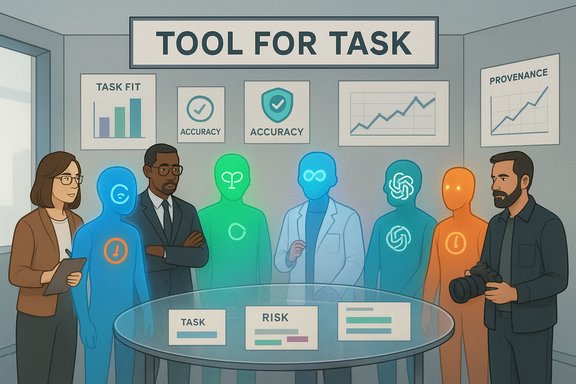
There is no single “best” AI chatbot — and that’s the most important takeaway from a year of head‑to‑head testing that put Claude, ChatGPT, Gemini, Copilot, Perplexity and others through dozens of real‑world tasks judged by humans. The practical winner is not one model but a tool‑for‑task approach: pick the assistant that matches the job. That was the headline from a hands‑on “chatbot fight club” series that used human experts (authors, librarians, lawyers, a scientist and a Pulitzer Prize–winning photographer) to score outputs across writing, research, contract analysis, image editing and more — and the results expose both notable strengths and persistent, sometimes dangerous, failure modes.
By late 2025 the AI assistant market is no longer a two‑horse race. OpenAI’s ChatGPT remains the most widely used interface, with the company reporting hundreds of millions of weekly users, but challengers have narrowed the practical gaps by specializing in distinct use cases: Anthropic Claude for long‑form writing and safety‑aware editing, Google Gemini / AI Mode for multimodal image work and web‑grounded research, Microsoft Copilot for Microsoft 365/Windows workflows, and Perplexity for citation‑forward research queries. These differences show up repeatedly in hands‑on tests: some models score highest on creative composition, others on image fidelity, and still others on source‑backed answers. Several public audits and newsroom projects echo the same core lesson: conversational fluency does not equal factual reliability. Independent consumer tests found significant error rates on everyday legal, financial and health queries — with smaller or niche assistants sometimes outscoring household names on reliability metrics. That means adoption decisions should be driven by how you plan to use an assistant, not by brand alone.
AI is a toolkit, not a replacement for judgment. The 2025 chatbot fight club shows those tools are powerful and imperfect in equal measure — brilliantly useful when matched to the right job, perilous when trusted beyond their demonstrated limits. Stay skeptical, pick the right tool for the task, and keep humans at the center of decisions that matter.
Source: IOL In the battle of AI chatbots, who comes out on top?
 Background / Overview
By late 2025 the AI assistant market is no longer a two‑horse race. OpenAI’s ChatGPT remains the most widely used interface, with the company reporting hundreds of millions of weekly users, but challengers have narrowed the practical gaps by specializing in distinct use cases: Anthropic Claude for long‑form writing and safety‑aware editing, Google Gemini / AI Mode for multimodal image work and web‑grounded research, Microsoft Copilot for Microsoft 365/Windows workflows, and Perplexity for citation‑forward research queries. These differences show up repeatedly in hands‑on tests: some models score highest on creative composition, others on image fidelity, and still others on source‑backed answers. Several public audits and newsroom projects echo the same core lesson: conversational fluency does not equal factual reliability. Independent consumer tests found significant error rates on everyday legal, financial and health queries — with smaller or niche assistants sometimes outscoring household names on reliability metrics. That means adoption decisions should be driven by how you plan to use an assistant, not by brand alone. How the hands‑on tests were run (methodology that matters)
These real‑world comparisons depart from automated benchmarks. Instead of feeding standardized exam questions, testers ran dozens of practical prompts that mirror how people actually use chatbots — drafting breakup texts, editing photos, decoding rental agreements, answering medical triage questions, planning trips, and solving research queries. Human experts judged outputs for:- Accuracy and factual grounding
- Usefulness (would a human rely on this?
- Tone and situational fit (is the reply appropriate?
- Safety and ethical responsibility
- Provenance and ability to cite or link sources
What the tests found — winners by task
Writing and editing: Claude often leads
- Strengths: Nuanced tone, coherent long‑form output, safer phrasing, and an editorial voice that judges described as emotionally credible for sensitive prompts (apologies, breakups, nuanced rewrites). Claude’s output tended to avoid stock phrases that break rapport with recipients.
- Weaknesses: Cost and rate limits on pro tiers can constrain heavy users; some long‑context modes are priced steeply depending on account type.
Research and quick answers: Google’s AI Mode and citation‑forward engines
- Strengths: Google’s AI Mode (the chat‑style search experience distinct from the simpler “AI Overview” box) can run multiple web retrievals before answering, which helped it in tests that required up‑to‑date guidance and current medical recommendations. In that category it outperformed many closed‑knowledge models.
- Caveat: Even AI Mode can confuse ambiguous queries (e.g., different film versions) and may present a confident single answer without asking clarification questions.
Document analysis and legal drafting: Claude stands out for conservatism
- Strengths: In rental‑agreement and contract summarization tasks, Claude was notable for refusing to invent facts and for offering conservative, lawyer‑friendly redlines — close enough to be described by a legal judge as “a good substitute for a lawyer” in some routine contexts.
- Risk: No chatbot is a licensed practitioner. Outputs should be reviewed by qualified humans before acting on legal or high‑stakes financial advice.
Images and editing: Gemini dominates image fidelity tests
- Strengths: Google’s Gemini produced the most convincing image edits across multiple tests — removing subjects, preserving complex light interactions (sequins, reflections), and producing results even photojournalists found hard to distinguish from untouched images. In one image‑edit test Gemini scored an 84% judge rating — the only passing grade above the informal 70% cutoff used by testers.
- Weakness: Multimodal power is often gated behind premium tiers, and heavy use can be costly.
Trivia and factual recall: all models stumble on ambiguous, image‑dependent or narrow facts
- Example: “How many buttons does an iPhone have?” produced conflicting answers: ChatGPT said four, Claude and Meta AI said three, Copilot said six — the correct modern answer being five for recent high‑end iPhones. The misfires underline that models often over‑rely on textual signals and struggle with up‑to‑date, device‑specific or visually referenced facts.
Strengths that make chatbots valuable today
- Speed and convenience: Chatbots compress hours of brainstorming, first‑draft writing, or surface research into seconds. For ideation and first drafts they are unmatched for speed.
- Specialization wins: When matched to tasks (imaging with Gemini, long‑form with Claude, citation‑first research with Perplexity), assistants materially improve productivity in narrow domains. Independent hands‑on tests and market data both show that use‑case fit matters more than brand popularity.
- Tooling and integrations: Copilot’s tight Microsoft 365 integration and Gemini’s hooks into Google Workspace make them powerful for enterprise workflows where governance and single‑sign‑on matter. These integrations are often decisive for IT buyers.
Key failure modes and safety risks
- Hallucinations: confident‑sounding but false statements remain the most consistent danger. Models can invent dates, numbers, or legal clauses that read plausibly. Independent consumer tests found non‑trivial error rates on everyday queries.
- Overconfidence and lack of uncertainty signaling: chatbots often present single answers rather than reflecting ambiguity or prompting clarifying questions. That’s especially risky in medical or legal contexts. Judges repeatedly flagged the lack of follow‑ups as a core design flaw.
- Sourcing and provenance: some assistants surface weak or outdated sources (forum posts, Reddit threads). Citation presence does not guarantee trustworthiness; independent audits found assistants linking to questionable pages in multiple cases.
- Safety gaps in sensitive contexts: public tests and academic audits show assistants can propagate misinformation or fail to debunk conspiracies; regulators and consumer groups have taken notice. The FTC has opened inquiries into several major vendors over their consumer‑facing assistants’ practices.
- Privacy and training risks: some consumer services have unclear data‑use or training policies unless enterprise contracts specify “non‑training” clauses. Sensitive data should not be pasted into public chat instances without contractual protections.
Cross‑checking claims: what the data actually supports
- “ChatGPT is used by 800 million people each week.” That figure is reported in company statements and repeated by major news outlets; multiple independent outlets covered OpenAI’s release of internal usage metrics consistent with that scale. Use the 800M figure as a corporate usage snapshot, but remember metrics vary by measurement method and timeframe.
- “Gemini scored 84% on image tasks.” The newsroom tests that awarded Gemini an 84% image‑task score were human‑judged, not automated — a critical distinction. Image‑editing is a domain where multimodal models that use pixel‑level refinements show clear, repeatable advantages in perceptual quality. Treat the 84% as a task‑specific, judge‑scored outcome rather than a universal performance metric.
- “Perplexity outranks household bots for reliability in consumer tests.” Consumer‑group audits (Which? and similar tests summarized across outlets) gave Perplexity top marks for reliability in at least one controlled consumer test, but that ranking depends heavily on question set and scoring rubric; other domain‑specific medical or scientific studies can report different winners. Cross‑domain results vary; always interpret leaderboards as context‑specific.
Practical guidance: which assistant to use for common tasks
- For first drafts, creative copy, and tone‑sensitive messages — try Claude or a large OpenAI GPT (if you prefer ChatGPT’s plugin ecosystem). Claude frequently scored highest for human‑feeling tone in sensitive writing.
- For on‑the‑fly research that needs up‑to‑date sources — run queries in Google AI Mode or citation‑forward engines like Perplexity, then verify the primary sources yourself. AI Mode’s multiple‑search grounding helped it on medical updates in tests.
- For document review, summarization and redlines — use Claude or enterprise Copilot (if you need tenant grounding and contract guarantees). Claude’s conservative behavior reduced hallucination risk in contract prompts.
- For image editing and generative visuals — Gemini leads in judge‑rated fidelity and realism for edits. If image realism matters (e.g., product photography touch‑ups), Gemini’s edits were the most convincing in tests.
- For code snippets and quick prototyping — evaluate both ChatGPT (its codex lineage) and Gemini/DeepSeek variants; performance depends on prompt engineering and the model variant you access. Cross‑validate with unit tests and linters.
A decision checklist for responsible use
- Identify the task and the real harm if the answer is wrong (low/medium/high).
- Choose a model optimized for the task (images → Gemini; long‑form legal drafting → Claude; source‑backed research → Perplexity/AI Mode).
- Provide detailed context up front (location, role, constraints) and insist the model ask clarifying questions before answering ambiguous prompts.
- Treat outputs as drafts: verify facts, confirm sources, and run safety checks for medical/legal content.
- Use enterprise contracts with non‑training clauses and audit logs for sensitive or regulated data.
- Keep humans in the loop — have subject‑matter experts review outputs for publication or operational use.
Governance, regulation and the bigger picture
Regulators are watching. The FTC and other agencies have signaled interest in how vendors test, monitor and disclose risks around consumer‑facing chatbots. Independent audits have found error rates and sourcing issues inherent to many assistants, prompting inquiries into consumer protection, deceptive practices, and data handling. For enterprise buyers, this raises two operational necessities: insist on contractual clarity around data training usage and demand auditability and provenance for answers used in decision pipelines. Academic and clinical evaluations emphasize the same caution: even high scores in research settings do not guarantee safe deployment in clinical or high‑stakes real‑world environments. Multiple peer‑reviewed studies show different assistants leading in different clinical subdomains — again underscoring that fit‑for‑purpose matters more than a single leaderboard.What to watch next (near‑term trends)
- Multimodal refinement: image and video editing will continue to be a battleground; models with tight pixel‑level control and robust refinements (currently Gemini‑class systems) are likely to widen their lead in perceptual quality.
- Retrieval and provenance improvements: assistants that combine strong web retrieval with conservative synthesis and explicit citations (Perplexity‑style) will be favored for research workflows.
- Enterprise governance features: tenant grounding, data non‑training guarantees, and auditable logs will decide many large contracts — expect Microsoft, Anthropic and OpenAI to push harder on contractual assurances.
- Regulatory pressure: expect more structured oversight, disclosure rules, and possibly third‑party audits for consumer‑facing assistants in 2026 and beyond.
Critical analysis — strengths, blind spots and the real risk picture
- Strength: Chatbots are mature enough to be useful across creative, drafting and exploratory research tasks. They accelerate workflows and lower friction for ideation, formatting and first drafts. When used with domain knowledge and human review, they save real time.
- Blind spot: Many evaluations still treat assistants as generalists; the most actionable evaluations are task‑specific and human‑judged. Relying on a single general‑purpose assistant for all workflows is a false economy that increases error risk.
- Real risk: harm arises when confident but incorrect counsel guides decisions in health, finance, or legal matters — particularly when users over‑trust conversational tone. Regulators are beginning to treat that as a consumer‑protection problem rather than a narrow tech issue.
Final verdict — practical headline for Windows users and IT managers
- There is no single champion. The right approach is task specialization and sensible governance. For Windows and Microsoft 365 environments that require tenant control and compliance, Copilot and enterprise offerings are the pragmatic pick. For best human‑feeling writing and document work, Claude consistently outperformed rivals in tone and conservatism. For image editing and multimodal fidelity, Gemini led human‑judged tests. For citation‑focused research, consider AI Mode or Perplexity and verify sources independently.
AI is a toolkit, not a replacement for judgment. The 2025 chatbot fight club shows those tools are powerful and imperfect in equal measure — brilliantly useful when matched to the right job, perilous when trusted beyond their demonstrated limits. Stay skeptical, pick the right tool for the task, and keep humans at the center of decisions that matter.
Source: IOL In the battle of AI chatbots, who comes out on top?
