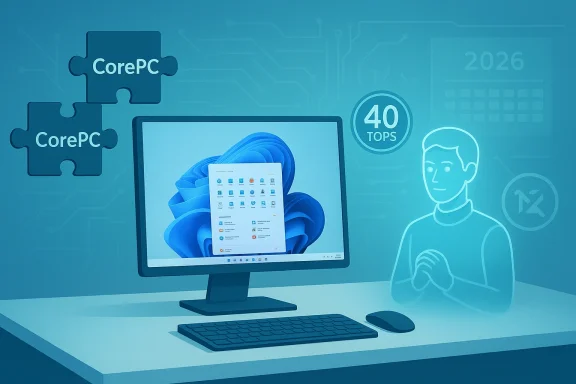
A surge of social-media fury over a single report has reignited the perennial Windows question: is Microsoft quietly preparing an AI-first “Windows 12” this year — or is that rumor simply wrong? The short answer, based on public Microsoft communications and reporting from long-standing Windows reporters, is that a full, branded Windows 12 release is not scheduled for 2026. What’s actually happening is far more mundane and, in many ways, healthier: Microsoft appears focused on stabilizing and evolving Windows 11, addressing user feedback, and pushing AI capabilities via incremental updates and a new hardware tier rather than by shipping a wholesale new OS this year.
Rumors of a “Windows 12” have circulated intermittently since at least 2023. The core elements that keep reappearing include three interlocking ideas:
CorePC rumors describe compatibility layers (sometimes codenamed things like “Neon” in leak paraphrases) that would run Win32 apps where needed. However, the practical implication is that legacy compatibility will be a first-class engineering challenge — not an automatic win — and will likely require careful testing, virtualization, and OEM collaboration.
Instead, expect a multi-year, pragmatic evolution:
Source: Windows Central No, an AI-focused "Windows 12" is not coming this year — here's the plan
 Background: where the Windows 12 noise came from
Rumors of a “Windows 12” have circulated intermittently since at least 2023. The core elements that keep reappearing include three interlocking ideas:- A modular OS architecture (often referenced as CorePC or “Win3”), inspired by earlier efforts like Windows Core OS and Windows 10X, that separates OS state into partitions for easier updates and tighter security.
- A deep, system-level integration of Copilot-style AI — sometimes imagined as an always-on assistant with local NPU acceleration and features such as instant search, screen-aware “recall,” and generative UI elements.
- A branding shift or new release cadence (e.g., “Windows 12”) that would mark the jump from Windows 11 to a fresh major version explicitly optimized for AI and modern silicon.
Overview: what has been confirmed (and what hasn’t)
Confirmed facts you can trust
- Windows 10 end of support: Microsoft publicly set October 14, 2025 as the end-of-support date for consumer Windows 10. After this date, routine security and feature updates ceased for Home and Pro editions, and Microsoft outlined options including Windows 11 upgrades and a short Extended Security Updates (ESU) path. This is a concrete lifecycle milestone that shapes migration pressure across the PC market.
- Microsoft driving AI into Windows 11: Microsoft has repeatedly described its roadmap as AI-first for Windows, embedding Copilot features, local model support, and new capabilities into ongoing Windows 11 updates. The company is aligning many advanced features to a new “Copilot+” hardware tier that includes on-device neural acceleration.
- CorePC and state separation are real design concepts: Reporting from multiple outlets in 2023 and subsequent analysis made public a technical approach called CorePC (or related internal project names) that aims to separate system state, use read-only partitions, and enable quicker, more reliable OS swaps and updates. The idea traces back to Windows Core OS and Windows 10X design work.
Claims that are unverified or speculative
- A Windows 12 launch in 2026: There is no verifiable plan from Microsoft to ship a Windows 12 in 2026. Multiple reporting strands and Microsoft spokespeople have indicated that the company is not announcing a new major, numbered release this year.
- Specific hardware thresholds such as “40 TOPS” NPU requirement: Some outlets and translations of leaks have floated concrete numerical thresholds for local AI (for example, citing NPUs capable of around 40 trillion operations per second). These figures are sometimes repeated in rumor posts but lack authoritative confirmation from Microsoft or major silicon vendors as a hard requirement for next-gen Windows features.
- Branding and timeline for CorePC shipping: CorePC-like platform work has been discussed internally for years, but whether it will ship as a distinct OS, be folded into Windows 11, or be shelved altogether has not been publicly confirmed in a way that supports the “Windows 12 later this year” narrative.
Why the confusion matters: the anatomy of a rumor
Rumors about a modular, AI-first Windows 12 tick lots of boxes that attract attention: they promise a neat solution to long-standing Windows problems (fragmentation, bulky updates, Win32 compatibility headaches) and they feed a cultural anxiety about AI being forced onto consumers. But the mechanics of how the rumor spread explain why it gained momentum:- Tech sites and leakers published early reports on CorePC and internal codenames in 2023–2024. These stories framed CorePC as the successor to Windows Core OS and linked it to future releases.
- Community amplification — Reddit and other forums — then recirculated older reporting without always preserving dates and context. That makes old rumors look fresh.
- Some repeat articles appear to have mixed together multiple timelines (a 2023 leak, a 2024 concept, a 2025 hardware push), producing a narrative that looks like a single new leak rather than a stale mosaic.
Technical deep dive: what CorePC/state separation purports to solve
The problem set: why Microsoft would want modular Windows
Windows historically installs as one massive writable state that mixes system files, user data, and applications. That monolithic layout causes several practical headaches:- Updates are large, error-prone, and often require reboots.
- System corruption and malware have broad attack surface.
- Recovery and rollback are slow and fragile.
- Enforcing platform invariants across many OEMs and configurations is costly.
State separation and read-only OS partitions
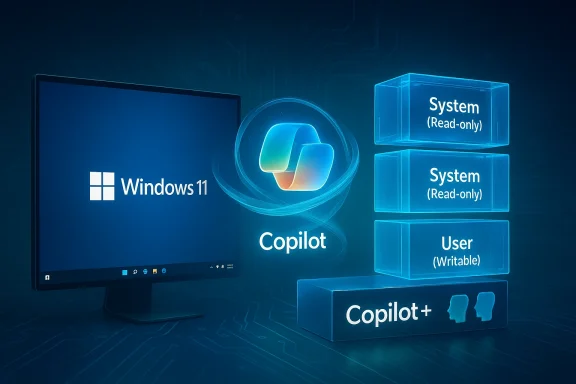
At its heart, state separation would divide Windows into distinct layers:- A read-only, signed system image containing kernel and system frameworks.
- A writable user layer for profiles and per-user customizations.
- A compatibility layer for legacy Win32 workloads, possibly implemented as a managed compatibility sandbox or a selective compatibility shim.
Compatibility: the Win32 dilemma
A modular OS that isolates system state inherently complicates legacy Win32 compatibility. Microsoft’s earlier attempt with Windows 10X stumbled on this point; the company learned that enterprise and power users expect long, stable Win32 behavior.CorePC rumors describe compatibility layers (sometimes codenamed things like “Neon” in leak paraphrases) that would run Win32 apps where needed. However, the practical implication is that legacy compatibility will be a first-class engineering challenge — not an automatic win — and will likely require careful testing, virtualization, and OEM collaboration.
AI integration: Copilot, local models, and the hardware gating dilemma
Two-tier approach: Windows 11 + Copilot+ hardware
Microsoft’s public direction favors evolving Windows 11 with AI features while gating the most advanced local experiences to machines that include dedicated neural processing (NPUs). That lets Microsoft deliver the best possible experience on modern silicon while preserving a fallback experience for existing PCs via cloud-assisted features or software-only modes.Benefits of local AI on-device
- Lower latency for interactive features like live transcription, image understanding, or real-time “Recall.”
- Privacy advantages for sensitive content that need not be uploaded to the cloud.
- Offline capability and consistent experience on unreliable networks.
Risks of hardware gating and monetization
- Fragmentation by capability: If Microsoft reserves premium AI features for Copilot+ devices, many users with otherwise capable PCs could be shut out, creating a perception that features are paywalled behind hardware.
- Upgrade pressure and e-waste: Strict on-device requirements push consumers toward buying new hardware sooner, raising sustainability and economic fairness questions.
- Subscription creep: There’s a real concern that Microsoft could tie high-value AI features to subscription services, creating recurring revenue incentives to limit free functionality.
The enterprise angle: why businesses care even more
Enterprises are the most sensitive stakeholders when it comes to OS shifts. For IT teams, the critical questions are:- Will corporate apps continue to work unchanged?
- What is the management and update model (SCCM, Intune, LTSC equivalents)?
- How will security patches and zero-day responses be delivered across mixed estate?
- What are the hardware procurement implications if Copilot-level NPUs become a security or compliance requirement?
Why shipping a Windows 12 this year would be a mistake
There are strategic reasons Microsoft should not release a full-numbered Windows 12 in 2026:- Fragmentation risk: Windows 10 only recently reached EOL; a brand-new Windows 12 release would further splinter the ecosystem just as Windows 11 adoption is still catching up.
- Quality vs. novelty trade-off: Windows 11 has accumulated user frustration around UX regressions, unstable updates, and what some describe as “AI bloat.” Shipping an entirely new OS rather than fixing perception and reliability would be tone-deaf.
- Hardware mismatch: A rapid move to an AI-first OS that requires modern NPUs would exclude a massive installed base, generating negative publicity and slowing enterprise adoption.
What a responsible path forward looks like (for Microsoft)
If Microsoft’s goal is to modernize Windows while avoiding fragmentation and backlash, here’s a practical roadmap it could follow — and why it would work:- Continue shipping major Windows 11 annual feature updates while:
- Prioritizing stability and rollback robustness.
- Reintroducing key user customizations (for example, making the Taskbar more flexible again).
- Gradually introduce modular components:
- Make the separation of OS state opt-in or available on qualifying devices at first.
- Offer migration tooling for enterprises and OEMs.
- Keep advanced AI features optional and transparent:
- Clearly state hardware requirements when features are toggled on.
- Offer cloud-based or software-based fallbacks for older devices.
- Provide clear, consumer-friendly choices:
- Let users opt into AI features and show what data is processed locally vs. in the cloud.
- Avoid surprise paywalls by bundling a useful baseline of functionality into the OS.
Strengths of the CorePC / modular idea — and the real trade-offs
Strengths
- Faster, safer updates: Atomic, image-based updates reduce bricking and long reboots.
- Improved security posture: Read-only system partitions are harder for malware to compromise.
- Customization and OEM flexibility: Microsoft could ship lighter variants for education, tablets, or gaming machines.
Trade-offs and costs
- Developer and compatibility pain: The Win32 ecosystem is enormous; any change must preserve compatibility for legacy apps, or Microsoft risks fracturing developer trust.
- Complexity in management: Enterprises will need robust migration tools and clear servicing lifecycles to adopt any new platform variant.
- User confusion: Multiple Windows images and capability tiers may be hard to communicate to mass-market customers.
Reader-facing recommendations: what to do if you see a Windows 12 rumor
- Check the date and the context of any story. Many “new” leaks are rehashed material from 2023 or 2024.
- Look for official Microsoft lifecycle statements for the hard facts (for example, Windows 10 end-of-support dates).
- Treat specific hardware thresholds and price/subscription claims as provisional until Microsoft or silicon vendors publish specs.
- For enterprises: don’t take any Windows 12 rumor as a migration schedule. Continue planning for Windows 11 servicing and evaluate any announced Copilot+ device certifications when Microsoft publishes them.
Final verdict: not this year, and probably not as described
The kernel of truth behind the viral report is simple: Microsoft and its partners have been experimenting with modular platform designs and stronger AI integration for several years. Those engineering efforts are real. What is not real — at least not based on available evidence and public Microsoft posture — is the idea that Microsoft will ship a polished, AI-first Windows 12 to consumers en masse in 2026.Instead, expect a multi-year, pragmatic evolution:
- Microsoft will keep improving Windows 11, addressing stability, usability, and the most visible complaints.
- The company will continue to roll AI experiences into Windows — but many of the highest-end features will be tied to new silicon tiers and incremental platform upgrades.
- Any new platform branding (if it happens) is likely to arrive only after Microsoft proves the engineering approach in hardware and in long-term enterprise tests. If a Windows 12 ever ships en masse, it’s more plausibly a 2027+ proposition rather than a 2026 surprise.
What to watch next
- Watch Microsoft’s official Windows roadmap and Windows Insider releases for concrete feature gating and hardware certification details.
- Track OEM announcements about Copilot+-certified devices and any silicon vendor claims about NPU capability targets.
- Monitor enterprise guidance from Microsoft (Intune, SCCM, ESU channels) for migration tools and timeline signals.
- Expect reporters to revisit CorePC and related projects — but treat older leaks as historical context, not proof of a 2026 launch.
Source: Windows Central No, an AI-focused "Windows 12" is not coming this year — here's the plan