

The HTTP parser in Node.js historically accepted spaces inside the numeric value of the Content-Length header — for example, treating "Content-Length: 1 2" as the decimal value 12 — a behavior that contradicts the HTTP specification and was catalogued as CVE‑2018‑7159; Node.js maintainers adjusted the parser to enforce the spec, and the practical security risk for most deployments was assessed as very low, but the correctness change exposed a class of fragile assumptions in application code that relied on the parser’s permissiveness.
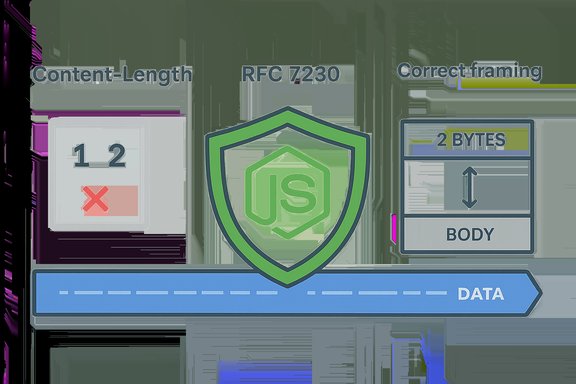
Content-Length is one of the core headers used to frame HTTP messages: when present (and when Transfer-Encoding is not used), the header’s field value is defined as a sequence of decimal digits that exactly describes the number of octets in the message body. The HTTP/1.1 specification (RFC 7230, section 3.3.2) specifies the grammar as Content-Length = 1DIGIT — that is, only contiguous ASCII digits are valid in the header value. This strict definition ensures interoperability and prevents confusing or ambiguous framing interpretations in message parsers. Despite this, the Node.js core HTTP parser historically tolerated spaces embedded inside the Content-Length value* and treated the resulting token as if the spaces were simply removed. In practice that meant headers like:
Content-Length: 1 2
were parsed as the integer 12, rather than rejected as malformed. The discrepancy between the parser implementation and the RFC was documented as CVE‑2018‑7159; the Node.js project subsequently updated the parser to align with the formal specification.
Realistic scenarios where this bug could matter:
Conclusion
CVE‑2018‑7159 is not a sensational exploit story; it’s a useful reminder that protocol correctness matters. When runtimes or libraries relax parsing rules, they may conceal brittle assumptions in downstream code. Conversely, when vendors tighten behavior to match standards, that change can reveal problems developers should fix. Maintain patched runtimes, add defensive checks at the application boundary, and audit any low-level HTTP utilities for assumptions about header integrity — these straightforward steps eliminate the low residual risk this class of bug can cause.
Source: MSRC Security Update Guide - Microsoft Security Response Center
 Background / Overview
Content-Length is one of the core headers used to frame HTTP messages: when present (and when Transfer-Encoding is not used), the header’s field value is defined as a sequence of decimal digits that exactly describes the number of octets in the message body. The HTTP/1.1 specification (RFC 7230, section 3.3.2) specifies the grammar as Content-Length = 1DIGIT — that is, only contiguous ASCII digits are valid in the header value. This strict definition ensures interoperability and prevents confusing or ambiguous framing interpretations in message parsers. Despite this, the Node.js core HTTP parser historically tolerated spaces embedded inside the Content-Length value* and treated the resulting token as if the spaces were simply removed. In practice that meant headers like:Content-Length: 1 2
were parsed as the integer 12, rather than rejected as malformed. The discrepancy between the parser implementation and the RFC was documented as CVE‑2018‑7159; the Node.js project subsequently updated the parser to align with the formal specification.
The technical problem, explained
At first glance this looks trivial: a space inside a numeric literal. But in HTTP message framing, small differences in parsing behavior can cascade into larger correctness and security issues.- The specification: RFC 7230 requires that Content-Length field-values be one or more digits, with no internal spaces or delimiters. A recipient relies on that exact number to decide when the body ends and whether to reuse the underlying TCP connection.
- The Node.js behavior: Node.js’s HTTP parser accepted spaces embedded inside the numeric token and concatenated the digit runs, producing a valid decimal number from the sanitized string. That permissive behavior deviated from the spec and was identified as a correctness bug and recorded as CVE‑2018‑7159.
- The fix: Node.js maintainers modified the HTTP parser so that Content-Length values containing non‑digit characters (including embedded spaces) are now treated as invalid — the parser no longer silently ignores spaces inside the value and will follow the correct error handling behavior when a malformed value is encountered. The change was issued as part of the March 2018 security updates for affected release lines.
Practical risk: why this CVE was rated “very low” and what that means
Public vulnerability records and many vendors classify the security impact of CVE‑2018‑7159 as very low or low-to-medium depending on CVSS vectors. That assessment rests on a few core observations:- The bug is essentially a parsing/leniency discrepancy rather than a memory corruption, arbitrary code execution, or direct data leak. It results in misinterpretation of a header value.
- An attacker who can control Content-Length could already supply an incorrect Content-Length value to create many classes of trouble (truncated reads, premature framing, or length mismatches). Because the attacker can already feed wrong values, the unique weaponization advantage offered by the “space‑tolerance” behavior is limited. Public advisories therefore judged it hard (and in many cases impossible) to craft an attack that would meaningfully gain beyond what an attacker could already accomplish with a deliberately wrong Content-Length.
- There were no widely published proof‑of‑concept exploits that turned the permissiveness into a practical, new remote impact at scale. Multiple vendor trackers mirrored the conclusion that this was primarily a correctness issue with limited exploit novelty.
Exploitation scenarios — realistic and hypothetical
It’s important to separate theoretical attacks from practical ones.Realistic scenarios where this bug could matter:
- Custom HTTP servers or microservices that parse Content-Length themselves and do not re‑verify that the bytes received match the header. If the server trusts the parsed integer and uses it to allocate buffers, count reads, or decide connection reuse, an attacker could craft malformed headers that change perceived lengths and induce incorrect application behavior.
- In-path proxies or load balancers that normalize or combine headers differently. A tolerant upstream component might present one interpretation to a backend and another to a client; where parsing semantics differ across a stack, request‑smuggling or request-splitting style inconsistencies can appear. While not unique to this bug, permissive digit parsing increases the risk surface for those classes of attacks if other conditions hold.
- Remote code execution or direct credential theft as a consequence of this specific parsing difference is not supported by public advisories; the bug does not directly expose memory safety primitives or injection vectors that would yield RCE by itself. Claims that the defect leads directly to RCE should be treated as speculative unless a concrete exploit chain is demonstrated and verified.
Detection: how to hunt for this class of problem
Short checklist to detect fragile handling of Content-Length in your environment:- Search logs and source for code that reads and trusts Content-Length without validating actual message length. Typical keywords: Content-Length, contentLength, request.headers['content-length'], req.headers['content-length'].
- Instrument HTTP endpoints to assert that the actual number of bytes read equals the parsed Content-Length. Add a debug assertion or a soft-fail that logs a mismatch and the request context.
- Look for repeated parse errors, unexpected 4xx responses, or connection reuse anomalies in HTTP servers that have been running older Node.js releases prior to the March 2018 fixes.
- If you run internal proxies, perform an interoperability test suite that sends intentionally malformed headers (for example: Content-Length: "1 2", "12, 12", or non-digit characters) and observe whether intermediaries normalize, reject, or reinterpret these headers; measure whether different layers disagree.
Mitigation and remediation (developer & operator guidance)
- Patch and update Node.js runtimes
- Install Node.js builds that include the March 2018 security fix. The change was applied across affected release lines and surfaced in the Node.js security release notes; upgrade to patched versions for your supported release stream. If you cannot immediately upgrade, treat affected services as higher risk until they are rebuilt with the patched runtime.
- Recheck message length at application level
- For lower-level HTTP utilities, file-upload endpoints, certificate upload endpoints, or any service that makes critical decisions based on content length, always verify the length of the received payload after parsing is complete. Use explicit read loops or streaming APIs that count bytes and compare to the parsed Content-Length; reject mismatches with a 400-series response.
- Harden ingress and middleboxes
- Configure WAFs, API gateways, and reverse proxies to reject malformed Content-Length headers (non-digit characters, comma-lists, embedded whitespace). Normalizing headers at the edge reduces the risk of differing interpretations between components.
- Add defensive code paths
- Wrap trust boundaries: when a client-supplied Content-Length is used to allocate buffers or to perform security-sensitive validation, prefer safe bounding (reject exceedingly large values) and defensive parsing (treat non-digit characters as invalid). Log and monitor any rejection patterns for potential probing.
- Test interoperability before toggling strict parsers
- Some networks or legacy clients might have relied on lenient implementations. If enabling stricter parsing at a proxy layer, roll it out gradually and monitor HTTP error rates for regressions. Ensure production test traffic covers major client types and older integrations.
- For Windows admins and packaged apps
- If Node.js is embedded in vendor appliances or Windows desktop apps (for example, Electron apps) rebuilds may be necessary. Coordinate with vendors for patched binaries. Inventory all places where Node.js runtimes are present on Windows hosts and confirm versions with a scripted check (for Node installed as a runtime) or with vendor-supplied update notes for embedded products.
Developer checklist — concrete steps to harden code
- Validate header syntax explicitly:
- Example (pseudo-JavaScript): validate that /^\d+$/.test(req.headers['content-length']) before trusting the value.
- Read and count bytes from the stream:
- Use streaming APIs; accumulate a counter and compare to Content-Length when the stream ends. If they differ, treat as error and log details.
- Use high‑quality frameworks and platform TLS stacks:
- Many frameworks and native TLS stacks (OpenSSL, SChannel) parse TLS and certificate data more robustly than ad-hoc JavaScript utilities. Prefer native validation for critical crypto operations.
- Avoid re-implementing low-level parsers:
- Where possible, rely on vetted libraries that conform to protocol standards or platform codecs. If you must write a parser, include explicit unit tests for malformed headers and aggressive fuzzing.
- Add monitoring for unexpected header formats:
- Log anomalous header values for offline analysis and create SIEM rules to spot repeated malformed Content-Length probes.
Timeline & patching history (concise)
- Discovery and public recording: the Content-Length parsing discrepancy was catalogued in 2018 and assigned CVE‑2018‑7159; the Node.js project released security updates addressing the issue as part of the March 2018 security release cycle. Several downstream OS vendors (Debian, Ubuntu, Red Hat/CentOS, Alpine, SUSE) issued advisories and packaging updates to reflect the fix.
- Vendor tracking: NVD and multiple package maintainers have entries that describe the issue and the low exploitability assessment. OSV and other vulnerability indexes list the Git commits that introduced and fixed the behavior for traceability. If you require exact fixed commit IDs or release numbers for an embedded product, refer to the Node.js release notes corresponding to your release line and the vendor/packager advisory that applies to your distribution.
- Exploitation: there are no widely-cited, reliable reports that CVE‑2018‑7159 produced a sustained, automated exploitation campaign in the wild. However, the absence of public weaponization is not a substitute for remediation when the bug affects components in critical paths; correct parsing is a foundational property for secure HTTP-based systems.
Special considerations for Windows-focused deployments
- Node.js is widely used in Windows environments for management tooling, CI agents, Electron apps, and server-side services. Where Node.js is embedded inside vendor products, Windows admins should:
- Inventory applications that bundle Node.js runtimes or ship native Electron binaries.
- Confirm vendor-supplied updates reference the Node.js security fixes or provide rebuilt installers.
- For internal tooling, update the Node.js runtime and repackage any scripts, extensions, or services that rely on older Node.js cores.
- Check firewall and edge proxy rules to ensure malformed headers are blocked at the perimeter for internet-facing services.
- A common operational pitfall is partial remediation: updating a system Node.js package while leaving frozen container images, CI cache artifacts, or statically linked vendor binaries unchanged. Treat any artifact that includes the older runtime as an item requiring rebuild and redeployment.
Red-team considerations and defensive testing
- As a defensive exercise, craft interoperability tests that send deliberately malformed Content-Length headers to a staging stack and validate each layer’s behavior: client, edge proxy, application server, and storage gateway. Compare responses, connection closures, and logs.
- Add fuzzing of header values to continuous integration tests for HTTP-facing services. Detect regressions where changed parsing behavior in a dependency might unexpectedly alter application logic.
Final assessment and journalistic take
CVE‑2018‑7159 is a classic example of a small protocol-correctness bug with outsized operational implications for a narrow set of use cases. Node.js’s parser accepted a syntactically invalid Content-Length value with embedded spaces and silently normalized it, which violated the HTTP standard. The Node.js project responsibly corrected the parser to conform to RFC 7230, and vendors documented the change and published updates in early 2018. The practical security risk for most users was — and remains — very low, because attackers could already send incorrect Content-Length values to create many of the same failure modes. That assessment is consistent across public vulnerability trackers and vendor advisories. However, the core lesson is significant: lenient implementations can mask fragile assumptions in application code. Applications and middleware should not rely on permissive parsing as a substitute for validating the actual data they consume. Where trust and integrity depend on message framing, add explicit validation and keep runtimes up to date. Developers and administrators should:- Verify that Node.js runtimes in their environment are patched.
- Rebuild any artifacts that bundle Node.js.
- Add runtime checks that validate Content-Length against observed payload length.
- Harden ingress components to reject malformed headers.
Conclusion
CVE‑2018‑7159 is not a sensational exploit story; it’s a useful reminder that protocol correctness matters. When runtimes or libraries relax parsing rules, they may conceal brittle assumptions in downstream code. Conversely, when vendors tighten behavior to match standards, that change can reveal problems developers should fix. Maintain patched runtimes, add defensive checks at the application boundary, and audit any low-level HTTP utilities for assumptions about header integrity — these straightforward steps eliminate the low residual risk this class of bug can cause.
Source: MSRC Security Update Guide - Microsoft Security Response Center
