

Nous Research’s open-source Nomos-1 crushing the Putnam, new telemetry from Microsoft about how Copilot is actually used, Slack-first coding assistants like Claude Code, prototype “external memory” wearables, and a wave of no-code and community workflows together represent a pivotal week for AI — one in which open models, embedded copilots, and workflow agents all moved from promising demos into demonstrable, product-ready influence.
The last 24 months have been defined by two overlapping trends: the democratization of powerful AI models through open-source releases and the deep embedding of AI into day-to-day work tools. Open models have advanced from academic curiosities into specialized systems that can rival human experts in narrow domains. At the same time, platform vendors have folded generative AI into enterprise products (Copilot in Microsoft 365 being the prime example), turning model outputs into real work artifacts inside Word, Excel, Teams, and developer tools. These parallel shifts are changing where AI value is captured — not just in models, but in connectors, governance, telemetry, and the orchestration that turns raw capability into reliable business workflows.
For practitioners, the immediate mandate is pragmatic: pilot with controls, require provenance for every AI decision, and invest in the integration pieces that turn cutting-edge models into reliable, auditable workflows. The models are getting smarter; the business challenge now is making their outputs trustworthy, maintainable, and aligned with the regulatory and ethical constraints of real-world systems.
Source: Blockchain News Top 5 AI Industry Breakthroughs: Nous Research's Math Exam Win, Microsoft Copilot Insights, AI-Driven Workflow Tools | AI News Detail
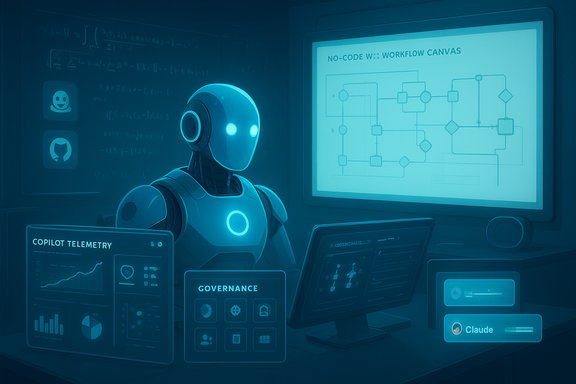 Background
The last 24 months have been defined by two overlapping trends: the democratization of powerful AI models through open-source releases and the deep embedding of AI into day-to-day work tools. Open models have advanced from academic curiosities into specialized systems that can rival human experts in narrow domains. At the same time, platform vendors have folded generative AI into enterprise products (Copilot in Microsoft 365 being the prime example), turning model outputs into real work artifacts inside Word, Excel, Teams, and developer tools. These parallel shifts are changing where AI value is captured — not just in models, but in connectors, governance, telemetry, and the orchestration that turns raw capability into reliable business workflows. 1) Nous Research’s Nomos-1: open-source reaches elite math
What happened
Nous Research open-sourced Nomos-1, a 30B-parameter model specialized for mathematical reasoning that — when wrapped in a reasoning harness — scored 87/120 on the 2025 Putnam competition, a performance the team says would place it among the very top human contestants. The release included the model weights and the “Nomos Reasoning Harness,” an orchestration stack that runs parallel worker solves, self-critique, and tournament-style selection of final answers. The Hugging Face model page and Nous Research material describe the score and provide the harness code and usage guidance.Why it matters
- Domain mastery at small scale: Nomos-1 shows that a focused 30B model plus purpose-built orchestration can close gaps once thought to require much larger parameter counts. That has direct implications for cost, deployment, and democratization.
- Reproducibility and tooling: Open-sourcing the harness as well as the weights accelerates independent verification, reproduction, and third‑party innovation — crucial for trustworthy adoption in research and education.
- Education and edtech: Accurate, interpretable mathematical reasoning unlocks advanced tutoring, automated problem verification, and proof assistants that could transform STEM education and research workflows.
Technical snapshot and verification
Nomos-1 is distributed on the Hugging Face hub and the project materials describe the harness and benchmark conditions, including direct comparisons to Qwen3 under the same harness, where Qwen3 scored substantially lower on the same exam runs. Independent discussion and social verification (developers, community posts) corroborate the release and the reported Putnam score; however, independent academic benchmarking (peer-reviewed replication) is not yet available beyond the Hugging Face release and related community testing.Strengths and immediate use-cases
- Research acceleration: Automated theorem-checking, literature triage, and hypothesis drafting.
- Tutor-level assistance: Step-by-step solution generation with explainable traces.
- Verification tooling: Cross-checking student work, grading assistance, and exam-proctoring support when combined with reliable grounding and provenance.
Risks and caveats
- Overclaim risk: Exam success under specific harness conditions doesn’t automatically mean the model generalizes to all advanced math problems. Benchmarks are important but are not proofs of universal reasoning ability.
- Hallucination in proofs: Even top-scoring reasoning models can produce plausible-sounding but incorrect steps; human verification is still essential.
- Compute and ops: Although 30B is smaller than many modern giants, high-quality inference and the multi‑worker harness still require significant memory and orchestration. Typical 30B-class models can require tens of gigabytes of GPU memory, and production deployments commonly use quantization and KV-cache optimization to reduce VRAM demands. Industry best practices show 8-bit or 4-bit quantization often reduces memory usage by 50–75% depending on method and hardware, but results vary by model and task.
2) Microsoft Copilot: telemetry, agent mode, and where value is captured
What’s new
Recent industry summaries and reporting synthesize Microsoft’s internal work on mapping Copilot usage patterns across enterprises: those summaries highlight that large fractions of Copilot interactions concentrate on coding and data tasks, and that Microsoft’s agent and Copilot Studio efforts are turning Copilot from a passive assistant into an orchestrator of business processes. Microsoft’s evolving Azure AI Foundry / Copilot Studio vision — which blends assistant and agent capabilities, telemetry, governance, and model choice — is intended to make Copilot a managed platform for enterprise AI agents. These initiatives are visible in Microsoft’s product updates and in industry coverage that highlights agentic Excel workflows, Copilot Pages, and governance tooling.What the telemetry indicates — and what’s not public
Summaries circulating in newsletters and analysis pieces quote internal percentages (for example, that "over 70% of enterprise Copilot usage is for code generation and data analysis") and describe peaks during business hours and a high share of natural‑language driven queries. Those numbers are valuable heuristics for planning and product design, but the underlying datasets, segmentation, and sampling methodology are Microsoft-internal and not fully published; treat headline percentages as informed indicators rather than audited metrics. Where Microsoft has published research and product docs, the trend is consistent: Copilot adoption centers on productivity workflows and domain‑specific assistants, with strong emphasis on governance and telemetry.Business impact and opportunities
- SaaS bundling: Copilot-style agents let ISVs embed AI without building models from scratch. Observed enterprise use converging on data analysis and code generation suggests a large addressable market for AI‑enabled analytics, dev tools, and low‑code/no‑code pipelines.
- Agent Mode in finance and operations: Agent-mode automation inside Excel and other M365 surfaces changes the calculus for finance and operations tooling — pilots should instrument accuracy and audit trails before scaling.
Governance, risk, and technical recommendations
- Pilot with telemetry and sign‑offs: Start with closed pilots; capture exact prompts, outputs, confidence signals, and human sign-offs.
- Enforce model and data separation: Use conditional access and Entra identities for agent authentication; keep sensitive data out of unaudited agent contexts.
- Human-in-the-loop checks for high‑risk outputs: For financial, legal, or scientific outputs, require an explicit human verification step and immutable logs.
- Measure drift and degradation: Copilot usage patterns change with prompt libraries and adapters; run periodic red-teaming and unit benchmarks.
3) Fix bugs and ship from Slack: coding assistants enter the flow
New workflows
Tools such as Anthropic’s Claude Code and other coding agents are now integrated into collaboration platforms (Slack, mobile clients, web IDEs) and into project trackers via Model Context Protocol (MCP) connectors. Tutorials and vendor docs show simple flows: connect the agent to GitHub, add the agent to a Slack channel, @mention a bug ticket, and allow the agent to propose code changes or PRs. The practicality of these flows is visible across vendor blogs, product changelogs, and developer documentation.Real productivity gains — and real problems
- Reported developer studies and vendor metrics show meaningful speedups for routine edits and simple bug fixes; some internal studies claim deployment-cycle reductions (figures vary by vendor).
- Counterpoints from developer communities show fragmentation, reduced code comprehension, and a rise in brittle patches when teams accept generated code without proper review. The “vibe coding” backlash and community threads document both rapid wins and later maintenance pain when AI-generated changes aren’t well-understood.
Implementation checklist for engineering leads
- Limit agent scope and grant least privilege: Allow agents to operate only on specific repos and branches; require approvals for production merges.
- Instrument PRs with provenance: Every change must attach the generation context and the prompt used, and signal whether the change was human-reviewed.
- Automate security scans: Run SAST/DAST and dependency checks on AI-generated code as a mandatory CI step.
- Measure tech debt: Track bug reopens and time-to-fix for agent-created patches to detect coding-quality regressions.
4) The “external memory” ring: wearable AI — promise, prototypes, and privacy
What was reported
News summaries highlighted an "AI ring" concept that provides external memory: a ring-shaped wearable that records small context, stores it in a personal vector store, and exposes it through voice or a companion app so users can recall facts, names, or recent conversations. The idea aligns with broader projects in multimodal and persistent memory research. Early prototypes from startups and conceptual demos from large vendors are circulating, but public product specs are thin and independent test reports are sparse.Why the idea is powerful
- Cognitive augmentation: Persistent, recallable memory for daily tasks (names, appointments, ephemeral facts).
- Assistive tech: Potentially transformative for people with mild cognitive impairment if combined with robust privacy and medical-grade safety validation.
- Cross-device continuity: A tiny wearable that surfaces memory via LLMs and integrates across phones and PCs could change information ergonomics.
Hard technical and ethical problems
- Privacy and consent: Persistent capture and indexing of private interactions raises immediate consent, storage, and jurisdictional issues. Design must default to explicit user control and local-first storage where possible.
- Battery and latency: On-device models and edge inference reduce latency but increase compute and battery demands. Published prototype claims (e.g., “24+ hour battery life”) should be treated cautiously until independent lab tests verify them.
- False recall and hallucination: LLM-based recall must include provenance and confidence signals; users should be shown where information came from and how certain the system is.
5) No‑code builders, community workflows, and the open‑model ecosystem
The surge in community-first tools
This week’s reporting called out four new AI tools and a spike in community workflows and no-code builders — an extension of a longer trend where ecosystems (Hugging Face, GitHub, community model hubs) create network effects and lower entry barriers for startups and in-house teams. The open-source model ecosystem now includes specialized models (math, code, vision) and orchestration patterns (agents, MCP), accelerating composition and iteration.Commercial models of capture
- Freemium + enterprise connectors: Startups build free components (builders, templates) and sell enterprise connectors, governance layers, and paid compute.
- API marketplaces and model stitches: A growing market for “glue” that stitches multiple models for value (retrieval models + reasoning models + safety filters).
- Managed inference: Many organizations prefer managed inference (serverless GPUs, private endpoints) to reduce ops burden and to enforce enterprise controls.
What enterprises should do now
- Inventory and prioritize: Identify high-value workflows where agents and no-code connectors reduce clearly measured manual steps.
- Govern every layer: Apply data governance to prompts, connectors, and model outputs. Include DLP, access control, and audit logging as baseline features.
- Measure outcomes, not buzzwords: Track actual time saved, error rates introduced, and post-deployment maintenance cost.
Cross-cutting analysis: strengths, systemic risks, and how to govern adoption
Notable strengths
- Specialization beats size in many domains: Nomos-1 and other focused SLMs (small language models) show that targeted training and orchestration can outperform generalist giants for specific tasks — a more sustainable path for many organizations.
- Workflow embedding drives value capture: Embedding AI where people already work — Office, Slack, IDEs — amplifies adoption more than model-centric releases alone.
- Open-source releases accelerate innovation: Public weights and harnesses mean faster independent verification, reproducibility, and community-driven robustness improvements.
Systemic risks and red flags
- Automation without guardrails: Rapid adoption of agentic workflows increases the risk of silent errors, security regressions, and regulatory noncompliance. Evidence from developer communities shows a real incidence of brittle patches and degraded code comprehension when teams over-rely on AI.
- Provenance and auditability gaps: Generated answers and model-assisted code require traceable provenance and explicit human sign-off in regulated contexts.
- Concentration of memory and narrative power: Wearables and persistent memory services concentrate who decides what is “remembered” — design must resist centralization and include user control and portability safeguards.
Practical guidance for IT leaders, product owners, and developers
For IT leaders and CIOs
- Start with a risk‑aware pilot: pick one domain (reconciliations, code triage, help desk) and instrument accuracy, latency, and governance.
- Build a compliance playbook: map agent capabilities to regulatory risk (GDPR, EU AI Act, sector rules) and require model cards + recorded decision trails for “high‑risk” agents.
For product managers
- Productize the harness not just the model: product value comes from connectors, UI, and audit trails — allocate roadmap to these integration pieces.
- Measure downstream costs: track technical debt and maintenance overhead introduced by AI suggestions.
For developers and engineering managers
- Make code reviews mandatory on AI-created PRs and attach generation context to PR metadata.
- Use automated scanning and test harnesses to validate generated changes before merge.
Verification notes and claims to watch
- The claim that Nomos‑1 scored 87/120 on Putnam is published by Nous Research on Hugging Face and summarized in multiple industry newsletters; the release includes the model and harness enabling independent review. Independent academic replication may follow as the community validates reproducibility.
- Percentages quoted for Copilot usage (e.g., "over 70% of enterprise interactions are for code generation and data analysis") are derived from industry reporting and newsletter summaries; those figures are useful directional signals but should be treated as vendor‑reported or journalist‑sourced unless Microsoft publishes raw telemetry methodology. Organizations should request the underlying segmentation and sampling methods when using such figures for strategic planning.
- Prototype claims for wearables (battery life, on-device LLM latency) are early and should be validated via independent lab testing before being treated as product capabilities. Design and privacy considerations should lead over hype when evaluating early hardware-LLM integrations.
Looking ahead: six strategic bets for the next 18 months
- Specialized models + harnesses will proliferate. Expect more domain‑specific open models with orchestration layers for law, medicine, math, and engineering.
- Copilot-style agents will become governance battlegrounds. The race will be about governance, connectors, and telemetry more than raw model size.
- On-device and edge inference will expand for privacy-sensitive wearables and agents. But production-grade reliability will require better quantization, KV-cache tricks, and new hardware-software co-design.
- Developer tooling will split into safe and experimental lanes. Mature CI‑gated AI flows will coexist with experimental agent sandboxes; organizations must separate them.
- Regulation will shape enterprise adoption. The EU AI Act and emerging sectoral rules will force audits, model cards, and traceability for many deployments.
- Community ecosystems will accelerate capabilities faster than closed vendors alone. Open weights + community testing create a feedback loop that drives rapid improvements and spawns novel commercial services.
Conclusion
This week’s developments are not incremental; they show a system-level shift. Open, specialized reasoning models like Nomos‑1 demonstrate that domain excellence can be achieved without monolithic parameter growth. Meanwhile, the commercialization vector is clear: embed AI into the tools people already use, instrument it with telemetry and governance, and sell the connectors and compliance. That combination — open capability plus enterprise orchestration — is what will define winners and losers over the next two years.For practitioners, the immediate mandate is pragmatic: pilot with controls, require provenance for every AI decision, and invest in the integration pieces that turn cutting-edge models into reliable, auditable workflows. The models are getting smarter; the business challenge now is making their outputs trustworthy, maintainable, and aligned with the regulatory and ethical constraints of real-world systems.
Source: Blockchain News Top 5 AI Industry Breakthroughs: Nous Research's Math Exam Win, Microsoft Copilot Insights, AI-Driven Workflow Tools | AI News Detail
