

A carefully controlled classroom experiment involving 405 secondary‑school students finds that old‑fashioned note‑taking still wins for long‑term reading comprehension and memory, while large language models (LLMs) — when used thoughtfully and paired with note‑taking — can broaden engagement and clarify difficult material without replacing the cognitive work that builds durable understanding.
The rapid spread of generative AI in schools has outpaced rigorous evaluation. Students routinely use chatbots to summarize, paraphrase, and explain curriculum materials, but until recently there were few randomized, in‑classroom trials that measure how LLM use affects actual learning outcomes rather than just user sentiment or task completion. A collaborative study led by Cambridge University Press & Assessment and Microsoft Research provides one of the first randomized classroom experiments testing LLM use against traditional study strategies in ecological school settings. The trial’s headline result is straightforward: note‑taking alone, and note‑taking combined with LLM use, produced better retention and comprehension three days later than using an LLM alone. The trial used curriculum‑relevant history passages — one on apartheid in South Africa and one on the Cuban Missile Crisis — and measured both factual recall and conceptual understanding with an unannounced test administered three days after study. Students were 14–15 years old and were recruited across seven schools in England; the aggregated sample size reported was 405 participants. Those design choices — curriculum alignment, delayed testing, and randomized assignment within real classrooms — make the study unusually policy‑relevant compared with lab studies or surveys.
Source: Phys.org https://phys.org/news/2025-12-traditional-ai-chatbots-comprehension-combined.html
 Background
The rapid spread of generative AI in schools has outpaced rigorous evaluation. Students routinely use chatbots to summarize, paraphrase, and explain curriculum materials, but until recently there were few randomized, in‑classroom trials that measure how LLM use affects actual learning outcomes rather than just user sentiment or task completion. A collaborative study led by Cambridge University Press & Assessment and Microsoft Research provides one of the first randomized classroom experiments testing LLM use against traditional study strategies in ecological school settings. The trial’s headline result is straightforward: note‑taking alone, and note‑taking combined with LLM use, produced better retention and comprehension three days later than using an LLM alone. The trial used curriculum‑relevant history passages — one on apartheid in South Africa and one on the Cuban Missile Crisis — and measured both factual recall and conceptual understanding with an unannounced test administered three days after study. Students were 14–15 years old and were recruited across seven schools in England; the aggregated sample size reported was 405 participants. Those design choices — curriculum alignment, delayed testing, and randomized assignment within real classrooms — make the study unusually policy‑relevant compared with lab studies or surveys. What the experiment did (methods at a glance)
- Participants: 405 secondary‑school students (14–15 years old) across seven English schools.
- Materials: Two curriculum‑aligned history texts (apartheid / the Cuban Missile Crisis).
- Conditions:
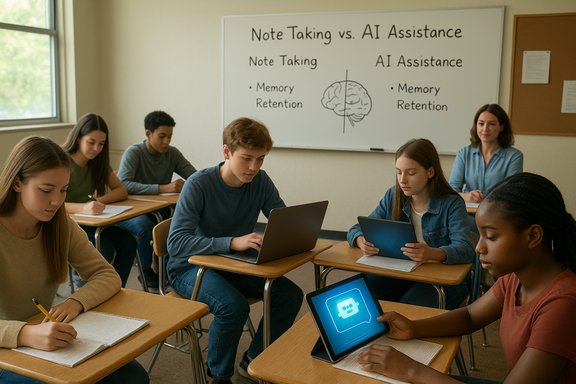
- Note‑taking only (students read and took notes by hand).
- LLM only (students used an LLM as an interactive aid).
- LLM + note‑taking (students used the LLM for exploration and also took notes separately).
- Procedure: Brief tutorial on LLM use where applicable; students could interact freely with the tool; tests were administered unexpectedly three days later to probe retention.
- Measures: Delayed comprehension and memory tests (factual and explanatory questions); self‑report enjoyment and perceived helpfulness; qualitative coding of LLM prompts and behaviours.
Key findings — the data and what it means
Note‑taking preserves durable learning
Quantitative analyses showed that students who engaged in note‑taking — either alone or in combination with LLM use — scored significantly higher on the three‑day delayed tests than students who relied on the LLM alone. In short, the generative cognitive work of selecting, summarizing, and paraphrasing matters more for retention than merely receiving explanations from an external system. This result lines up with a long cognitive‑science literature on generative processing, retrieval practice, and the testing effect.LLMs increase engagement and lower initial cognitive load
Most students reported that the chat interface felt more engaging and subjectively more helpful for exploring background, clarifying vocabulary, and unpacking significance. Qualitative analysis of prompts revealed archetypal behaviours — clarification questions, context‑seeking, and requests for elaboration — that suggest students used the model as a tutor to make difficult passages more accessible. That affective and accessibility benefit matters: increased motivation and lowered entry barriers can make materials approachable for struggling learners.Hybrid use preserves the best of both worlds — but only with discipline
When students combined LLM use with separate note‑taking, learning outcomes matched the note‑taking‑only group. That indicates the hybrid approach does not damage retention and may deliver both comprehension scaffolding and generative practice — provided students do not simply copy the model’s output into their notes. The authors recommend explicit instruction: take notes separately from asking the LLM, practice paraphrasing, and build prompt literacy so students use the tool to support rather than replace generative effort.Strengths of the study
- Randomized, in‑class design. Conducting a randomized trial inside real classrooms reduces the artificiality of lab studies and captures realistic student behaviour under time and attention constraints.
- Delayed testing. Measuring comprehension after three days focuses on retention rather than immediate recall, which is the relevant outcome for durable learning.
- Mixed methods. Combining quantitative outcomes with qualitative prompt analysis gives teachers and product teams actionable insight into how students actually interact with LLMs.
- Curriculum alignment. Using national‑curriculum history passages improves ecological validity for K‑12 education stakeholders.
Limitations and open questions (what to watch for)
- Model and interface ambiguity. Press reports sometimes name ChatGPT 3.5‑turbo as the tool used, but the authors’ summaries refer to “an LLM.” The exact model version, system prompts, and any guardrails used materially shape outputs; replication and interpretation require those protocol details. Treat specific model attributions in coverage as provisional until confirmed by the published methods.
- Domain and age generalizability. The trial focused on 14–15‑year‑olds and on history passages. STEM problem solving, mathematics, foreign languages, or creative writing may produce very different interactions between LLMs and generative study strategies. Further randomized replications across subjects and age groups are essential.
- Short‑term snapshot. The study measured retention at three days. It leaves open longer‑term effects (weeks, months), cumulative effects of repeated LLM use across a semester, and whether habitual reliance reshapes study habits and skill acquisition. There is reason to test for skill erosion across longer timelines.
- Copy‑and‑paste risk and assessment design. If students copy LLM outputs directly into notes or assessments, hybrid benefits disappear. Without changes to classroom rules, rubrics, and assessment design to reward process (note quality, paraphrase fidelity, oral synthesis), incentives will favour delegation. The authors explicitly recommend separate handwritten notes and prompt literacy instruction.
- Equity and access. Not all schools have device access, consistent connectivity, or managed, privacy‑aware LLM deployments. Rolling out hybrid workflows at scale requires managed enterprise configurations, privacy defaults for minors, and teacher professional development.
Practical recommendations for teachers and schools
- Teach and test note‑taking strategies before introducing LLMs: Cornell notes, concept maps, and self‑explanation prompts all encourage generative encoding.
- Require separate notes when students use LLMs: a two‑step rule — read and take handwritten notes; then query the LLM and record any new insights in a clearly labeled LLM section. This prevents unreflective copying.
- Build prompt literacy into lessons: show students how to ask clarifying, evidence‑seeking prompts and how to request the model’s confidence or sources. Encourage verification against reliable texts.
- Redesign assessments to value process: include graded tasks on note quality, reflection entries, and short oral syntheses to ensure students internalize material rather than delegating it.
- Use LLM logs as formative data, with privacy safeguards: anonymized prompt patterns can highlight common misconceptions and guide targeted instruction. Deploy managed, auditable LLM access where available.
Implications for ed‑tech product design (and Windows users)
The study’s results point directly to product opportunities that align with learning science:- Integrate scaffolding that forces reflection: tools can nudge users to paraphrase before saving machine outputs, or require a brief student summary before allowing export. Such UI nudges protect generative processing.
- Combine chat interfaces with note workflows: the most useful tools will let students ask an LLM for clarifications and then generate a prompt for the student to answer or paraphrase into their notebook. This hybrid workflow could be built into OneNote, digital notebooks, or LMS integrations.
- Surface provenance and confidence: LLM outputs should include traceable provenance or evidence links, and product teams should expose model identity and filters so educators understand behaviour. Grounded agents (notebook‑constrained assistants) reduce hallucination risk and support academic use cases.
Broader cognitive perspective: why note‑taking still matters
Note‑taking is not merely a clerical habit; it is an active cognitive process that forces learners to:- select what’s important,
- summarize in their own words,
- create personal retrieval cues, and
- generate connections that support later recall.
Risks and ethical considerations
- Model hallucinations and misinformation. LLM outputs are not guarantees of factual accuracy. Students must be taught verification strategies and teachers must remain final arbiters for factual claims. Institutional deployments should prefer grounded or source‑constrained models when accuracy matters.
- Data governance and minors’ privacy. Managed, enterprise or education editions that limit data retention and prevent model training on student inputs are preferable. Deployments without guardrails risk exposing sensitive information and violating local privacy rules.
- Equity. Schools with inconsistent device access risk creating a two‑tier system where some students benefit from AI scaffolds and others remain reliant solely on teacher support. Districts should prioritize managed rollouts with teacher PD and device provisioning.
- Skill erosion. Without curricular redesign, repeated outsourcing can hollow out generative skills over time. The solution is not prohibition but instructional integration that preserves practice opportunities and rewards process.
Where we go from here — research and policy priorities
- Replication across subjects and ages. Randomized classroom trials should expand into STEM, languages, and project‑based work to map domain‑specific interactions.
- Longitudinal studies. Track students over months and semesters to detect cumulative effects on skill acquisition, study habits, and assessment outcomes.
- Interface experiments. Test UI nudges such as forced paraphrase, provenance displays, and “reflect before you copy” flows to measure whether product‑level scaffolds preserve retention gains while keeping LLMs useful.
- Teacher professional development. Invest in PD and curriculum materials that show how to embed hybrid LLM + note‑taking workflows into regular instruction.
Conclusion
The new randomized classroom evidence is clarifying: traditional note‑taking continues to outperform unsanctioned LLM use for delayed comprehension and memory, but well‑designed hybrid workflows preserve learning while harnessing AI’s strengths for accessibility and curiosity. Pragmatic, evidence‑aligned policy is straightforward: preserve and teach generative study skills, integrate LLMs as explanatory tutors rather than substitutes, redesign assessments to reward process, and deploy model‑aware, privacy‑safe tools that nudge students toward reflection rather than copying. The experiment’s mix of robust design and actionable recommendations should make it required reading for teachers, ed‑tech teams, and school IT leaders planning AI deployments.Source: Phys.org https://phys.org/news/2025-12-traditional-ai-chatbots-comprehension-combined.html
