

Intel’s rumored 52-core Nova Lake-S desktop flagship is now being linked to a 474-watt PL2 turbo power target for high-end Z990 motherboards, with reports published June 27, 2026, saying some LGA1954 boards may need three 8-pin power inputs to sustain it. That number is not a retail spec sheet, and it is not proof that every Nova Lake gaming PC will behave like a space heater. But it is a useful warning flare: Intel’s next enthusiast desktop platform appears to be moving the high end closer to workstation-class electrical assumptions, whether the branding says “desktop” or not.
The important part is not merely the wattage. PC builders have lived through scary-looking power numbers before, especially in the era of unlocked CPUs, aggressive motherboard defaults, and GPUs that can consume more than an entire mainstream system used to. The real story is that Intel’s next desktop comeback bid may depend on a platform that asks users, motherboard vendors, cooler makers, and power-supply buyers to treat the CPU socket as a much more serious load than they have for most of the consumer PC era.
Nova Lake-S has been circulating in leaks for months as Intel’s next big desktop swing after Arrow Lake and its follow-on refreshes. The headline configuration is easy to understand and hard to ignore: up to 52 cores, reportedly arranged as a hybrid design with performance cores, efficiency cores, and low-power efficiency cores spread across a more complex package than today’s mainstream desktop parts. If those reports hold, Intel is no longer trying to win the enthusiast argument by nudging clocks and cache alone.
That shift matters because Intel’s recent desktop story has been uneven. Raptor Lake delivered brute-force performance but also became associated with high power draw and, later, stability drama around voltage and motherboard behavior. Arrow Lake tried to reset the efficiency narrative, but for many enthusiasts it did not land as the clean gaming knockout Intel needed against AMD’s X3D lineup. Nova Lake is therefore being framed, fairly or not, as the architecture that must prove Intel can scale again without simply turning the socket into a furnace.
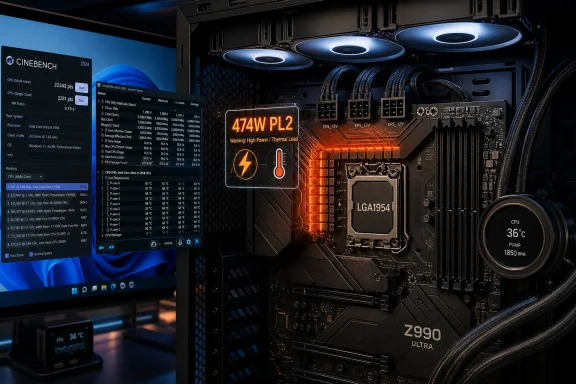
The leaked 474W PL2 figure fits that broader anxiety. PL2 is the familiar short-duration turbo power budget, not necessarily the processor’s steady-state draw in every workload. But modern desktop boards have often blurred the practical difference between temporary turbo and sustained behavior, especially when vendors compete on out-of-the-box benchmark results. A power target that high becomes more than an engineering footnote when it drives motherboard power connector layouts, VRM design, cooling guidance, and the kind of PSU a buyer feels compelled to install.
The reported LGA1954 socket also signals that this is not just another drop-in CPU generation. Intel users have long been conditioned to expect motherboard churn, but a new socket with a new chipset family and a new electrical envelope raises the cost of entry. If Intel wants Nova Lake to be seen as a platform worth buying into, it will need to sell not only performance but confidence.
Reports describe high-end Z990 designs with multiple power tiers, and the most capable boards may need two EPS 8-pin connectors plus an additional 8-pin auxiliary connector to feed the CPU power plane. That is the kind of detail that turns a rumor into a platform discussion. Connectors are not marketing copy; they are physical commitments on a board layout.
For years, premium motherboards have carried dual 8-pin CPU power connectors even when one was more than enough for ordinary operation. Enthusiasts often treated the second connector as a symbol of overclocking seriousness, a reassurance for liquid nitrogen sessions, or simply a sign that the board was not bargain-bin hardware. A third CPU-adjacent power input, if it becomes common on flagship Nova Lake boards, changes the visual language. It says the board is being designed around an assumption that peak CPU-side demand could be both high and relevant.
That does not mean midrange Nova Lake systems will require absurd cabling. It also does not mean a 52-core chip will constantly pull nearly 500W while browsing the web, playing a game, or idling at the desktop. But it does mean the high-end motherboard market is preparing for a desktop CPU class where the socket itself may be treated more like a GPU-class power consumer during heavy multicore bursts.
This is where WindowsForum readers should pay attention. Power delivery is not an abstract spec; it shows up in system stability, case airflow, fan curves, VRM temperatures, BIOS defaults, and the ugly troubleshooting sessions where a machine passes light tests but fails under shader compilation, rendering, code builds, or synthetic stress loads. The motherboard is where Intel’s ambition becomes the user’s electrical reality.
Intel knows this. The alleged Nova Lake configuration is not merely “more of the same”; it is a hybrid design meant to allocate different kinds of work to different kinds of cores. The challenge is that hybrid architecture only pays off when firmware, the Windows scheduler, drivers, and applications cooperate well enough that users feel speed rather than complexity. Intel and Microsoft have already spent years tuning Thread Director-era behavior, but bigger and more heterogeneous designs raise the stakes.
For gamers, the 52-core number may be less important than cache, latency, memory support, and how well the CPU avoids scheduling sensitive game threads onto the wrong resources. AMD’s X3D processors have shown that gaming leadership can come from giving games more of the cache they want, not from maximizing core count. Intel’s rumored use of a large last-level cache strategy for Nova Lake is therefore as important as the wattage leak, because it suggests Intel understands the gaming fight is not won by task-manager screenshots alone.
For creators and developers, the calculus is different. A 52-core Nova Lake chip could be genuinely attractive if it delivers workstation-like throughput without pushing buyers into Xeon, Threadripper, or a much more expensive platform. The problem is that power, cooling, and motherboard cost can quietly erase the value proposition. A consumer-branded workstation chip still needs workstation-class support around it.
That is the tension at the center of Nova Lake. Intel may be trying to collapse two markets into one socket: the gamer who wants peak frame rates and the prosumer who wants massive multicore throughput. The leaked power guidance suggests the top SKU may satisfy the second audience only by making the first audience buy into infrastructure it does not always need.
The problem is not that a halo CPU exists. The problem is when halo behavior leaks into mainstream expectations. Intel’s previous desktop generations taught users to be suspicious of motherboard defaults that silently remove limits, chase benchmark wins, or redefine “stock” in ways that make reviews harder to compare and systems harder to cool. If Nova Lake arrives with a clear split between sane defaults and enthusiast unlocks, the 474W figure can be understood as headroom. If it arrives as another round of “auto” settings that vary wildly by board vendor, the number becomes a warning label.
AMD has benefited from looking disciplined by comparison, especially with X3D chips that deliver excellent gaming performance without requiring the user to build the rest of the PC around extreme CPU draw. Intel does not need to copy AMD’s exact design choices, but it does need to avoid giving buyers the sense that every comeback requires a bigger cooler and a higher electric bill. Performance per watt is no longer a laptop-only argument; it is part of desktop credibility.
There is also a practical thermal ceiling. Removing 400-plus watts from a CPU package is not the same as handling a GPU with a large board area and multiple fans. The heat is concentrated, the cold plate matters, the paste or contact frame matters, and case airflow must carry away what the liquid loop or tower cooler transfers. A flagship Nova Lake system may be perfectly manageable for expert builders, but it will not be forgiving.
That may push the top-end consumer desktop further toward boutique builds, 360mm or 420mm liquid coolers, premium power supplies, and cases designed around airflow rather than glass-box aesthetics. The chip may be sold as a desktop CPU, but the surrounding build discipline may look far more like a workstation.
That is manageable at today’s scale, but Nova Lake’s rumored design raises harder questions. If the flagship contains multiple compute tiles, large cache structures, and three categories of cores, Windows will need to make good decisions not only between P-cores and E-cores but potentially across tile boundaries and cache domains. The wrong scheduling behavior may not show up in a simple all-core benchmark; it may show up as inconsistent frame pacing, uneven compile times, or mysterious dips when background processes interfere with foreground work.
This is where Intel’s platform story must be unusually tight. BIOS firmware, chipset drivers, Windows updates, power plans, and application behavior all become part of the delivered product. Enthusiasts can tolerate some early adopter roughness, but sysadmins and IT pros cannot build around “wait three BIOS revisions” as a deployment strategy.
Nova Lake may also arrive into a Windows ecosystem increasingly shaped by AI features, background indexing, virtualization-based security, and more aggressive use of NPUs where available. That makes power management more complex, not less. A modern desktop is rarely doing only one thing, and the scheduler’s ability to keep small tasks off expensive cores can affect both responsiveness and thermals.
Intel has the advantage of deep Microsoft collaboration and years of hybrid CPU experience behind it. But with a 52-core desktop flagship, the software layer will be judged more harshly. If performance depends on perfect orchestration, any visible scheduling mistake becomes part of the CPU review.
Power supplies are the obvious starting point. A high-end GPU can already demand 300W to 600W depending on class and generation, and adding a CPU that can spike toward 474W under heavy loads pushes total system sizing into serious territory. The PSU does not merely need enough rated wattage; it needs quality transient handling, enough native connectors, and a cabling layout that does not encourage dubious adapters or daisy chains.
Cooling is the second pressure point. Intel’s current unlocked desktop chips already reward strong coolers, but a further jump in turbo power could make top-end air cooling feel increasingly niche for flagship use. Large liquid coolers may become the assumed pairing, not an exotic upgrade. That has downstream consequences for case selection, radiator placement, pump noise, long-term reliability, and serviceability.
Motherboard VRM thermals deserve equal attention. Enthusiast boards often advertise enormous power stages, but real-world performance depends on heatsink design, airflow, and firmware behavior. A board that can technically feed the CPU may still run hot in a quiet case with weak top exhaust. Builders who have spent the last few years focusing almost entirely on GPU thermals may need to relearn CPU-side airflow discipline.
This is especially relevant for WindowsForum’s sysadmin-minded audience because “desktop” does not always mean “one gaming tower under a desk.” Labs, small studios, engineering teams, and power users often run high-performance desktops for long unattended workloads. In those environments, stability under sustained load matters more than a screenshot of a peak benchmark score.
Nova Lake appears to be Intel’s answer to several AMD advantages at once. More cores address creator throughput. A new platform addresses I/O and memory modernization. Large cache rumors address gaming. The high PL2 number addresses the possibility that Intel is willing to spend power aggressively to ensure the flagship does not lose benchmark charts that matter to perception.
That last point is uncomfortable but important. Halo CPUs are not sold in massive volumes, yet they shape brand identity. If Intel can say its top Nova Lake part beats AMD across enough gaming and creator benchmarks, the win will cast a glow over the rest of the stack. If it can only do so by leaning on extreme power envelopes, reviewers and buyers will ask whether the victory is elegant or merely expensive.
This is where Intel’s messaging will matter. A 474W PL2 target can be presented as optional headroom for elite boards and unlocked users. Or it can become the number everyone remembers because it confirms a suspicion that Intel still solves hard problems by increasing power. The facts may be more nuanced, but perception will not wait for nuance.
AMD, meanwhile, does not have to win every benchmark to benefit from that perception. If competing chips deliver most of the performance at much lower power, the argument becomes less about raw leadership and more about the total platform. Intel must therefore make Nova Lake feel not just fast, but rational.
If Z990 boards arrive with formalized power tiers, the market could become easier to understand. Buyers may see clearer segmentation between boards designed for ordinary Nova Lake SKUs, boards intended for high-end unlocked chips, and flagship models built for the full 52-core part under aggressive turbo behavior. That would be a welcome improvement over vague claims of “extreme power delivery” attached to nearly every premium board.
But segmentation can also become a trap. If the top CPU technically works in a lower-tier board but cannot sustain its advertised behavior, users may blame Intel, the board vendor, the cooler, or themselves. If reviewers test with flagship boards while buyers use midrange boards, performance expectations may drift away from reality. This already happens today; a more power-hungry flagship would amplify it.
The third connector detail is symbolic because it may make those tiers visible. A board with three CPU-side power inputs is telling the buyer what class of build it expects. That can be useful if vendors are honest. It can be misleading if the connector becomes another marketing badge attached to boards whose cooling, firmware, or trace design cannot truly make use of it.
Intel should want restraint here. The company needs partners to build impressive boards, but it also needs the platform to feel predictable. After the instability controversies that haunted earlier high-end desktop parts, “it depends on your motherboard defaults” is not an answer Intel can afford to let dominate another generation.
For those buyers, the leaked power target affects procurement in boring but important ways. A system that requires a premium PSU, high-airflow chassis, robust cooling, and careful BIOS configuration is not just more expensive to buy; it is more expensive to standardize and support. The gap between a stable workstation and an enthusiast science project is often documentation, validation, and vendor support.
There is also a management issue. High-power desktops generate heat, noise, and electrical load that matter when many systems share a room. One 474W turbo CPU is a curiosity. Ten systems with high-end GPUs and high-power CPUs in a small lab become an HVAC and circuit planning issue. IT departments that allow custom high-end desktops into professional environments will want clear power policies and firmware profiles.
Security-minded users should also remember that Windows performance features do not exist in isolation. Virtualization-based security, memory integrity, endpoint agents, backup tools, and development environments can all add background load. On a hybrid, high-core-count CPU, the difference between a well-tuned and poorly tuned system may be more visible than it is on a simpler processor.
None of this makes Nova Lake a bad fit for professional power users. It simply means the top SKU should be treated like a workstation-class component even if it arrives in a consumer box. That is not an insult; it is the honest way to buy hardware at this level.
A few concrete points already stand out from the reporting and the surrounding platform rumors:
That distinction will define the Nova Lake launch if these leaks are close to reality. A 474W PL2 ceiling may be perfectly defensible for a halo part on a flagship board with explicit enthusiast settings. It may even be exciting for users who want mainstream-socket access to workstation-class throughput. But if the platform arrives with confusing defaults, inconsistent board behavior, or cooling requirements buried beneath marketing slides, Intel will have turned a technical achievement into another trust problem.
The company has a path through this. It can publish clear power definitions, require sane default behavior from board partners, separate official operation from overclocked profiles, and make sure Windows scheduling is mature before reviewers get final systems. It can also let the lower-power Nova Lake SKUs carry the mainstream story while the 52-core part serves as the unapologetic halo. That would be a grown-up platform strategy.
For now, the leaked 474W figure should be read less as a scandal than as a specification-shaped question: what kind of desktop does Intel think the high end should become? If Nova Lake delivers exceptional performance with transparent limits and stable platform behavior, the answer may be “a workstation hiding in an enthusiast tower.” If not, the next Intel flagship may be remembered less for its 52 cores than for the three power cables it needed to make its point.
The important part is not merely the wattage. PC builders have lived through scary-looking power numbers before, especially in the era of unlocked CPUs, aggressive motherboard defaults, and GPUs that can consume more than an entire mainstream system used to. The real story is that Intel’s next desktop comeback bid may depend on a platform that asks users, motherboard vendors, cooler makers, and power-supply buyers to treat the CPU socket as a much more serious load than they have for most of the consumer PC era.
 Nova Lake Looks Less Like a CPU Refresh and More Like a Platform Reset
Nova Lake-S has been circulating in leaks for months as Intel’s next big desktop swing after Arrow Lake and its follow-on refreshes. The headline configuration is easy to understand and hard to ignore: up to 52 cores, reportedly arranged as a hybrid design with performance cores, efficiency cores, and low-power efficiency cores spread across a more complex package than today’s mainstream desktop parts. If those reports hold, Intel is no longer trying to win the enthusiast argument by nudging clocks and cache alone.That shift matters because Intel’s recent desktop story has been uneven. Raptor Lake delivered brute-force performance but also became associated with high power draw and, later, stability drama around voltage and motherboard behavior. Arrow Lake tried to reset the efficiency narrative, but for many enthusiasts it did not land as the clean gaming knockout Intel needed against AMD’s X3D lineup. Nova Lake is therefore being framed, fairly or not, as the architecture that must prove Intel can scale again without simply turning the socket into a furnace.
The leaked 474W PL2 figure fits that broader anxiety. PL2 is the familiar short-duration turbo power budget, not necessarily the processor’s steady-state draw in every workload. But modern desktop boards have often blurred the practical difference between temporary turbo and sustained behavior, especially when vendors compete on out-of-the-box benchmark results. A power target that high becomes more than an engineering footnote when it drives motherboard power connector layouts, VRM design, cooling guidance, and the kind of PSU a buyer feels compelled to install.
The reported LGA1954 socket also signals that this is not just another drop-in CPU generation. Intel users have long been conditioned to expect motherboard churn, but a new socket with a new chipset family and a new electrical envelope raises the cost of entry. If Intel wants Nova Lake to be seen as a platform worth buying into, it will need to sell not only performance but confidence.
The 474-Watt Number Is a Motherboard Story First
The temptation is to read 474W as “the CPU uses 474 watts,” full stop. That is not the right way to understand the leak. The more interesting interpretation is that Intel and its partners may be preparing for a top-end Nova Lake-S configuration whose turbo behavior requires board-level power delivery well beyond normal mainstream desktop expectations.Reports describe high-end Z990 designs with multiple power tiers, and the most capable boards may need two EPS 8-pin connectors plus an additional 8-pin auxiliary connector to feed the CPU power plane. That is the kind of detail that turns a rumor into a platform discussion. Connectors are not marketing copy; they are physical commitments on a board layout.
For years, premium motherboards have carried dual 8-pin CPU power connectors even when one was more than enough for ordinary operation. Enthusiasts often treated the second connector as a symbol of overclocking seriousness, a reassurance for liquid nitrogen sessions, or simply a sign that the board was not bargain-bin hardware. A third CPU-adjacent power input, if it becomes common on flagship Nova Lake boards, changes the visual language. It says the board is being designed around an assumption that peak CPU-side demand could be both high and relevant.
That does not mean midrange Nova Lake systems will require absurd cabling. It also does not mean a 52-core chip will constantly pull nearly 500W while browsing the web, playing a game, or idling at the desktop. But it does mean the high-end motherboard market is preparing for a desktop CPU class where the socket itself may be treated more like a GPU-class power consumer during heavy multicore bursts.
This is where WindowsForum readers should pay attention. Power delivery is not an abstract spec; it shows up in system stability, case airflow, fan curves, VRM temperatures, BIOS defaults, and the ugly troubleshooting sessions where a machine passes light tests but fails under shader compilation, rendering, code builds, or synthetic stress loads. The motherboard is where Intel’s ambition becomes the user’s electrical reality.
Intel’s Core Count Gamble Is Really a Workload Gamble
A 52-core desktop CPU sounds spectacular, but desktop software remains uneven in how well it uses large core counts. Some workloads scale beautifully: rendering, encoding, compiling, scientific tools, virtual machines, local AI experimentation, and certain professional content pipelines. Others remain latency-sensitive, cache-sensitive, or lightly threaded enough that more cores sit idle while a few cores and the memory subsystem determine the experience.Intel knows this. The alleged Nova Lake configuration is not merely “more of the same”; it is a hybrid design meant to allocate different kinds of work to different kinds of cores. The challenge is that hybrid architecture only pays off when firmware, the Windows scheduler, drivers, and applications cooperate well enough that users feel speed rather than complexity. Intel and Microsoft have already spent years tuning Thread Director-era behavior, but bigger and more heterogeneous designs raise the stakes.
For gamers, the 52-core number may be less important than cache, latency, memory support, and how well the CPU avoids scheduling sensitive game threads onto the wrong resources. AMD’s X3D processors have shown that gaming leadership can come from giving games more of the cache they want, not from maximizing core count. Intel’s rumored use of a large last-level cache strategy for Nova Lake is therefore as important as the wattage leak, because it suggests Intel understands the gaming fight is not won by task-manager screenshots alone.
For creators and developers, the calculus is different. A 52-core Nova Lake chip could be genuinely attractive if it delivers workstation-like throughput without pushing buyers into Xeon, Threadripper, or a much more expensive platform. The problem is that power, cooling, and motherboard cost can quietly erase the value proposition. A consumer-branded workstation chip still needs workstation-class support around it.
That is the tension at the center of Nova Lake. Intel may be trying to collapse two markets into one socket: the gamer who wants peak frame rates and the prosumer who wants massive multicore throughput. The leaked power guidance suggests the top SKU may satisfy the second audience only by making the first audience buy into infrastructure it does not always need.
The Return of the Monster Desktop Is Not Automatically Bad
It is easy to mock a 474W CPU turbo target as a sign that efficiency has lost the argument. That would be too simple. Enthusiast desktops have always had a maximalist streak, and there is still a legitimate place for hardware that prioritizes performance over restraint. A buyer running local builds, Blender renders, AI inference tests, virtual labs, and high-refresh gaming on the same tower may gladly trade watts for time.The problem is not that a halo CPU exists. The problem is when halo behavior leaks into mainstream expectations. Intel’s previous desktop generations taught users to be suspicious of motherboard defaults that silently remove limits, chase benchmark wins, or redefine “stock” in ways that make reviews harder to compare and systems harder to cool. If Nova Lake arrives with a clear split between sane defaults and enthusiast unlocks, the 474W figure can be understood as headroom. If it arrives as another round of “auto” settings that vary wildly by board vendor, the number becomes a warning label.
AMD has benefited from looking disciplined by comparison, especially with X3D chips that deliver excellent gaming performance without requiring the user to build the rest of the PC around extreme CPU draw. Intel does not need to copy AMD’s exact design choices, but it does need to avoid giving buyers the sense that every comeback requires a bigger cooler and a higher electric bill. Performance per watt is no longer a laptop-only argument; it is part of desktop credibility.
There is also a practical thermal ceiling. Removing 400-plus watts from a CPU package is not the same as handling a GPU with a large board area and multiple fans. The heat is concentrated, the cold plate matters, the paste or contact frame matters, and case airflow must carry away what the liquid loop or tower cooler transfers. A flagship Nova Lake system may be perfectly manageable for expert builders, but it will not be forgiving.
That may push the top-end consumer desktop further toward boutique builds, 360mm or 420mm liquid coolers, premium power supplies, and cases designed around airflow rather than glass-box aesthetics. The chip may be sold as a desktop CPU, but the surrounding build discipline may look far more like a workstation.
Windows Will Be Part of the Performance Story Whether Intel Likes It or Not
For Windows users, hybrid CPUs are not just silicon products. They are operating-system products. The scheduler has to understand which cores should receive latency-sensitive tasks, which cores can absorb background work, and how to avoid performance cliffs when a workload moves across core types.That is manageable at today’s scale, but Nova Lake’s rumored design raises harder questions. If the flagship contains multiple compute tiles, large cache structures, and three categories of cores, Windows will need to make good decisions not only between P-cores and E-cores but potentially across tile boundaries and cache domains. The wrong scheduling behavior may not show up in a simple all-core benchmark; it may show up as inconsistent frame pacing, uneven compile times, or mysterious dips when background processes interfere with foreground work.
This is where Intel’s platform story must be unusually tight. BIOS firmware, chipset drivers, Windows updates, power plans, and application behavior all become part of the delivered product. Enthusiasts can tolerate some early adopter roughness, but sysadmins and IT pros cannot build around “wait three BIOS revisions” as a deployment strategy.
Nova Lake may also arrive into a Windows ecosystem increasingly shaped by AI features, background indexing, virtualization-based security, and more aggressive use of NPUs where available. That makes power management more complex, not less. A modern desktop is rarely doing only one thing, and the scheduler’s ability to keep small tasks off expensive cores can affect both responsiveness and thermals.
Intel has the advantage of deep Microsoft collaboration and years of hybrid CPU experience behind it. But with a 52-core desktop flagship, the software layer will be judged more harshly. If performance depends on perfect orchestration, any visible scheduling mistake becomes part of the CPU review.
The PSU and Cooling Advice Is Going to Get Less Casual
For ordinary users, the most immediate consequence of a high-power Nova Lake flagship will be buying advice. A premium CPU already pushes users toward premium boards, but a 474W turbo target changes the tone of the recommendation. The question stops being “is your motherboard compatible?” and becomes “is the entire platform designed for the electrical and thermal behavior you are about to unleash?”Power supplies are the obvious starting point. A high-end GPU can already demand 300W to 600W depending on class and generation, and adding a CPU that can spike toward 474W under heavy loads pushes total system sizing into serious territory. The PSU does not merely need enough rated wattage; it needs quality transient handling, enough native connectors, and a cabling layout that does not encourage dubious adapters or daisy chains.
Cooling is the second pressure point. Intel’s current unlocked desktop chips already reward strong coolers, but a further jump in turbo power could make top-end air cooling feel increasingly niche for flagship use. Large liquid coolers may become the assumed pairing, not an exotic upgrade. That has downstream consequences for case selection, radiator placement, pump noise, long-term reliability, and serviceability.
Motherboard VRM thermals deserve equal attention. Enthusiast boards often advertise enormous power stages, but real-world performance depends on heatsink design, airflow, and firmware behavior. A board that can technically feed the CPU may still run hot in a quiet case with weak top exhaust. Builders who have spent the last few years focusing almost entirely on GPU thermals may need to relearn CPU-side airflow discipline.
This is especially relevant for WindowsForum’s sysadmin-minded audience because “desktop” does not always mean “one gaming tower under a desk.” Labs, small studios, engineering teams, and power users often run high-performance desktops for long unattended workloads. In those environments, stability under sustained load matters more than a screenshot of a peak benchmark score.
The Leak Also Reveals Intel’s Competitive Anxiety
Intel does not pursue a 52-core consumer flagship because the market politely asked for one. It does so because AMD has changed the shape of the desktop CPU argument. Ryzen normalized chiplets, high core counts, and platform longevity, while X3D models made cache a mainstream gaming weapon. Intel’s old playbook of monolithic bravado, clock speed, and platform turnover no longer guarantees enthusiasm.Nova Lake appears to be Intel’s answer to several AMD advantages at once. More cores address creator throughput. A new platform addresses I/O and memory modernization. Large cache rumors address gaming. The high PL2 number addresses the possibility that Intel is willing to spend power aggressively to ensure the flagship does not lose benchmark charts that matter to perception.
That last point is uncomfortable but important. Halo CPUs are not sold in massive volumes, yet they shape brand identity. If Intel can say its top Nova Lake part beats AMD across enough gaming and creator benchmarks, the win will cast a glow over the rest of the stack. If it can only do so by leaning on extreme power envelopes, reviewers and buyers will ask whether the victory is elegant or merely expensive.
This is where Intel’s messaging will matter. A 474W PL2 target can be presented as optional headroom for elite boards and unlocked users. Or it can become the number everyone remembers because it confirms a suspicion that Intel still solves hard problems by increasing power. The facts may be more nuanced, but perception will not wait for nuance.
AMD, meanwhile, does not have to win every benchmark to benefit from that perception. If competing chips deliver most of the performance at much lower power, the argument becomes less about raw leadership and more about the total platform. Intel must therefore make Nova Lake feel not just fast, but rational.
Motherboard Vendors May Decide the User Experience Before Intel Does
One of the awkward truths of the enthusiast PC market is that motherboard vendors often shape CPU behavior as much as the CPU vendor does. Default power limits, voltage curves, memory training, auto-overclocking features, and “enhancement” toggles can create large differences between boards that technically support the same processor. That flexibility is useful for enthusiasts, but it is also a source of confusion.If Z990 boards arrive with formalized power tiers, the market could become easier to understand. Buyers may see clearer segmentation between boards designed for ordinary Nova Lake SKUs, boards intended for high-end unlocked chips, and flagship models built for the full 52-core part under aggressive turbo behavior. That would be a welcome improvement over vague claims of “extreme power delivery” attached to nearly every premium board.
But segmentation can also become a trap. If the top CPU technically works in a lower-tier board but cannot sustain its advertised behavior, users may blame Intel, the board vendor, the cooler, or themselves. If reviewers test with flagship boards while buyers use midrange boards, performance expectations may drift away from reality. This already happens today; a more power-hungry flagship would amplify it.
The third connector detail is symbolic because it may make those tiers visible. A board with three CPU-side power inputs is telling the buyer what class of build it expects. That can be useful if vendors are honest. It can be misleading if the connector becomes another marketing badge attached to boards whose cooling, firmware, or trace design cannot truly make use of it.
Intel should want restraint here. The company needs partners to build impressive boards, but it also needs the platform to feel predictable. After the instability controversies that haunted earlier high-end desktop parts, “it depends on your motherboard defaults” is not an answer Intel can afford to let dominate another generation.
The Enterprise Angle Is Small but Not Irrelevant
Nova Lake-S is not an enterprise platform in the Xeon sense, and the 52-core flagship is unlikely to become standard corporate desktop fare. Still, WindowsForum’s IT pro readership should not dismiss it as pure gaming theater. High-end consumer desktops routinely appear in developer workstations, media departments, test labs, research groups, and small businesses that need performance without workstation procurement overhead.For those buyers, the leaked power target affects procurement in boring but important ways. A system that requires a premium PSU, high-airflow chassis, robust cooling, and careful BIOS configuration is not just more expensive to buy; it is more expensive to standardize and support. The gap between a stable workstation and an enthusiast science project is often documentation, validation, and vendor support.
There is also a management issue. High-power desktops generate heat, noise, and electrical load that matter when many systems share a room. One 474W turbo CPU is a curiosity. Ten systems with high-end GPUs and high-power CPUs in a small lab become an HVAC and circuit planning issue. IT departments that allow custom high-end desktops into professional environments will want clear power policies and firmware profiles.
Security-minded users should also remember that Windows performance features do not exist in isolation. Virtualization-based security, memory integrity, endpoint agents, backup tools, and development environments can all add background load. On a hybrid, high-core-count CPU, the difference between a well-tuned and poorly tuned system may be more visible than it is on a simpler processor.
None of this makes Nova Lake a bad fit for professional power users. It simply means the top SKU should be treated like a workstation-class component even if it arrives in a consumer box. That is not an insult; it is the honest way to buy hardware at this level.
The Numbers That Matter Before Anyone Preorders a Z990 Board
The 474W leak is useful, but it is not enough to judge Nova Lake. The real evaluation will require retail silicon, final BIOS revisions, Windows scheduler maturity, and independent testing across more than a handful of showcase benchmarks. Until then, the sane position is neither panic nor hype.A few concrete points already stand out from the reporting and the surrounding platform rumors:
- The reported 474W PL2 target applies to the high-end 52-core Nova Lake-S class, not necessarily to the entire Nova Lake desktop lineup.
- The rumored LGA1954 platform means buyers should expect a new motherboard, with Z990 likely serving as the enthusiast-class chipset family.
- Some flagship motherboards may use three 8-pin power inputs to support the highest CPU power tiers, but that does not prove every system will need all three connectors populated for normal operation.
- Cooling and PSU selection will matter more than usual if the top Nova Lake SKU is allowed to run at aggressive turbo limits.
- The most important launch-day reviews will be the ones that test stock limits, motherboard defaults, gaming power, sustained multicore loads, and Windows scheduling behavior separately.
Intel Can Win the Benchmark and Still Lose the Argument
The risk for Intel is not that a 52-core CPU exists. The risk is that the flagship becomes a caricature of Intel’s worst habits at the exact moment the company needs to prove it has learned from them. Enthusiasts will forgive high power when it buys clear, repeatable, well-explained performance. They are less forgiving when power looks like a substitute for architectural grace.That distinction will define the Nova Lake launch if these leaks are close to reality. A 474W PL2 ceiling may be perfectly defensible for a halo part on a flagship board with explicit enthusiast settings. It may even be exciting for users who want mainstream-socket access to workstation-class throughput. But if the platform arrives with confusing defaults, inconsistent board behavior, or cooling requirements buried beneath marketing slides, Intel will have turned a technical achievement into another trust problem.
The company has a path through this. It can publish clear power definitions, require sane default behavior from board partners, separate official operation from overclocked profiles, and make sure Windows scheduling is mature before reviewers get final systems. It can also let the lower-power Nova Lake SKUs carry the mainstream story while the 52-core part serves as the unapologetic halo. That would be a grown-up platform strategy.
For now, the leaked 474W figure should be read less as a scandal than as a specification-shaped question: what kind of desktop does Intel think the high end should become? If Nova Lake delivers exceptional performance with transparent limits and stable platform behavior, the answer may be “a workstation hiding in an enthusiast tower.” If not, the next Intel flagship may be remembered less for its 52 cores than for the three power cables it needed to make its point.
References
- Primary source: Tom's Hardware
Published: Sat, 27 Jun 2026 14:05:30 GMT
Loading…
www.tomshardware.com - Independent coverage: TechPowerUp
Published: Fri, 26 Jun 2026 17:03:45 GMT
Loading…
www.techpowerup.com - Related coverage: tweaktown.com
Intel's dual-tile Nova Lake-S CPUs reportedly carry a 474W PL2 target, according to leaked Z990 power guidance
The 474W PL2 applies to dual tile Nova Lake-S chips with up to 52 cores, with Z990 boards segmented into power tiers to manage performance profiles. www.tweaktown.com
- Related coverage: pcworld.com
Loading…
www.pcworld.com - Related coverage: notebookcheck.net
Loading…
www.notebookcheck.net - Related coverage: techpathy.com
Loading…
techpathy.com
- Related coverage: download.intel.com
Loading…
download.intel.com - Related coverage: intel.com
Loading…
www.intel.com - Related coverage: techradar.com
Rumor suggests Intel's next-gen flagship CPU could eat your PC's power supply for breakfast — but don't panic yet | TechRadar
Intel's Nova Lake flagship CPU spotted with 700W power usagewww.techradar.com - Related coverage: pcgamer.com
Loading…
www.pcgamer.com - Related coverage: nanoreview.net
Intel Core Ultra 9 285K: benchmarks and specs | NR
Performance tests in benchmarks and full specifications of Intel Core Ultra 9 285K with 24 cores, 3700 MHz.nanoreview.net - Related coverage: newsroom.intel.com
Loading…
newsroom.intel.com - Related coverage: as.com
Loading…
as.com - Related coverage: windowscentral.com
Intel Core Ultra 5 250K and 270K Plus review: CPUs for creators | Windows Central
Intel's Arrow Lake Refresh is a duo of refreshed processors with the Core Ultra 200S series, and they're refreshingly cheap with gaming benefits on the side.www.windowscentral.com - Related coverage: laptopmag.com
Loading…
www.laptopmag.com