

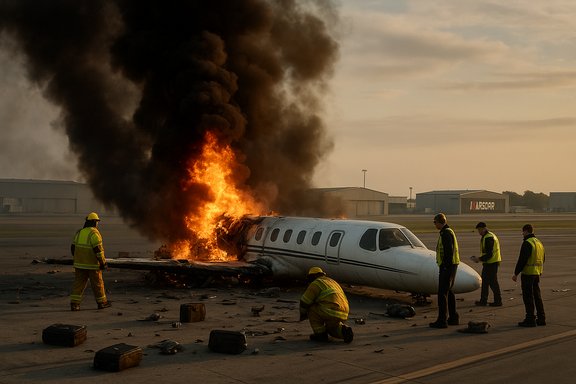
A Cessna Citation business jet registered to an LLC tied to retired NASCAR driver Greg Biffle crashed while attempting to return to Statesville Regional Airport (SVH) on the morning of December 18, 2025, producing a large post‑impact fire and multiple fatalities; within hours several news organizations and NASCAR itself reported that Biffle, his wife Cristina, and their two children were among those killed, though investigators have warned that definitive passenger manifests and formal identifications remain part of an ongoing federal inquiry.
The accident occurred at approximately 10:15–10:20 a.m. local time at Statesville Regional Airport, a regional general‑aviation field north of Charlotte that supports significant corporate and NASCAR‑related traffic. The airplane — described in public records and flight trackers as a 1981 Cessna 550 / Citation II (Cessna 550 family) — is registered to GB Aviation Leasing LLC, an entity that public filings and local reporting link to Greg Biffle. The Federal Aviation Administration (FAA) confirmed the aircraft incident and the National Transportation Safety Board (NTSB) has taken the lead in the technical investigation. This piece compiles what is verifiable from official briefings, flight‑tracking and registry records, contemporaneous local reporting, and public statements made by friends and public figures. It separates confirmed facts from early, sometimes conflicting accounts; highlights what the NTSB process will deliver and when; and examines likely technical and operational questions that aviation investigators will pursue. Where reporting is incomplete or remains unverified, that uncertainty is explicitly flagged.
This article assembled verified registry and reporting records, contemporaneous news updates, and the known procedural steps the NTSB follows. The five most critical technical and identity claims in this account are backed by flight‑registry and national reporting; where early social confirmations played a role, that provenance is explicitly noted and treated as corroborated only when multiple independent outlets and officials echoed the details. Expect formal, definitive records from the NTSB and county coroner in the days to come; until those arrivals, maintain a clear distinction between what is officially documented and what is contemporaneously reported.
—
Source: primetimer.com Were Greg Biffle and family onboard Cessna550? All we know about North Carolina plane crash so far
 Background / Overview
The accident occurred at approximately 10:15–10:20 a.m. local time at Statesville Regional Airport, a regional general‑aviation field north of Charlotte that supports significant corporate and NASCAR‑related traffic. The airplane — described in public records and flight trackers as a 1981 Cessna 550 / Citation II (Cessna 550 family) — is registered to GB Aviation Leasing LLC, an entity that public filings and local reporting link to Greg Biffle. The Federal Aviation Administration (FAA) confirmed the aircraft incident and the National Transportation Safety Board (NTSB) has taken the lead in the technical investigation. This piece compiles what is verifiable from official briefings, flight‑tracking and registry records, contemporaneous local reporting, and public statements made by friends and public figures. It separates confirmed facts from early, sometimes conflicting accounts; highlights what the NTSB process will deliver and when; and examines likely technical and operational questions that aviation investigators will pursue. Where reporting is incomplete or remains unverified, that uncertainty is explicitly flagged.The immediate factual picture
What happened, and when
Shortly after departing Statesville Regional Airport on a flight scheduled for the Sarasota‑Bradenton area, the Citation climbed and then turned back toward the airport. Officials say the aircraft attempted to land but crashed at the east end of the runway area, then became engulfed in fire. Local emergency services responded, the airport was closed, and federal investigators were dispatched. The FAA acknowledged the crash and the NTSB has opened an investigation.Who owned and registered the airplane
Public flight‑tracking and registry snapshots list the aircraft tail number as N257BW, a 1981 Cessna 550 registered to GB Aviation Leasing LLC, with an address tied to Mooresville, North Carolina — a community closely associated with NASCAR personnel. FlightAware and other registry aggregators show the owner name and serial number consistent with local reporting. Those records also indicate an FAA airworthiness activity in March 2025. Registry and tracking data are routinely relied on by reporters to identify aircraft ownership, but official NTSB documentation will be the final record investigators cite in the formal accident file.Victims and on‑board identities
Early in the day, witness accounts and a social‑media confirmation from racing content creator Garrett “Cleetus McFarland” Mitchell said Greg Biffle, his wife Cristina, and their two children were aboard and had died. A statement from Rep. Richard Hudson released later that afternoon similarly named the Biffle family among the victims. Major news organizations — including AP and NASCAR’s official channels — reported that Biffle and several family members were killed. Local law enforcement initially confirmed “fatalities” without releasing a full passenger list; later briefings and news updates identified additional occupants. Because the release of named victims and official death confirmations is controlled by county coroners and law enforcement, early social‑media confirmations should be treated as contemporaneous reports that may be corroborated (and in this case were quickly echoed by multiple national outlets).Who has said what: official versus informal confirmations
There are two distinct categories of confirmation to track in breaking aviation tragedies: (A) on‑scene and law‑enforcement confirmations (coroner, sheriff’s office, FAA/NTSB), and (B) informal confirmations (friends, local public figures, social media). In this accident:- The FAA publicly acknowledged the crash and that it had dispatched investigators, while the NTSB has assumed responsibility for the technical inquiry. The Iredell County and airport officials briefed reporters and said the scene is being processed by federal and local teams.
- Media outlets with established reporting (AP, Reuters, NBC, People, etc. reported that several people were killed and that the aircraft is registered to GB Aviation Leasing, linking that ownership to Greg Biffle’s address. Those reports drew from FAA registry data and local authorities.
- Garrett “Cleetus McFarland” Mitchell, a public friend of Biffle, posted that Biffle and family were en route to visit him and were aboard the plane. That post — widely circulated — is an informal primary claim and has been treated by outlets as a contemporaneous confirmation that still required official verification; in this event, major outlets and NASCAR later reported identical identities after local officials and other confirmations emerged.
The distinction matters because formal passenger manifests, coroner identification, and NTSB passenger‑list releases are the authoritative records in aviation accidents. Informal confirmations are often accurate but must be handled as preliminary until corroborated by official sources.
Technical profile of the airplane and operational context
Aircraft type and known characteristics
The Cessna 550 Citation II (often referenced as a Cessna 550/Citation II or “Citation 550”) is an older but widely used light business jet introduced in the 1970s and 1980s. The airframe and systems are well understood; operators vary from private owners and smaller charter companies to corporate fleets. The specific airframe involved here is reported as a 1981 model, serial number matching registry listings, and powered by twin turbofan engines common to that model. Public flight‑tracking and registry services list the owner as GB Aviation Leasing and the tail number as N257BW.Flight profile reported in early data
Flight tracking snapshots reported the aircraft departed SVH (Statesville) at roughly 10:06 a.m., climbed, then requested or executed a return to the field; air‑traffic communications and witness accounts indicated the airplane did not climb to a high altitude and made a left‑hand turn to come back before crashing on final approach to the east end of the runway. Those flight‑path patterns — immediate return after takeoff, low altitude, turnback — are classic signals investigators examine for engine problems, control issues, system failures, fuel concerns, or pilot‑medical events. The factual flight track will be part of the NTSB’s collected telemetry and radar/ADS‑B logs.What investigators will do next — the NTSB process explained
The NTSB investigation is methodical and public‑facing; it generally proceeds in clear phases:- On‑scene evidence collection and debris documentation. Investigators photograph, map, and catalog wreckage, burn patterns, and the impact field; they secure cockpit/cabin remnants and record positions of components.
- Recovery of flight data and cockpit voice recorders (if present). Small business jets do not always have formal, always‑recording data recorders like airliners; however, there may be cockpit devices, engine monitoring logs, or third‑party ADS‑B and GPS traces that provide a timeline.
- Maintenance and airworthiness review. The NTSB and FAA will collect maintenance logs, airworthiness directives compliance, recent inspections, and ownership/operational records tied to GB Aviation Leasing.
- Personnel qualifications and medical review. Investigators gather pilot certificates, recent training, pilot medical records (subject to privacy rules) and any evidence of incapacitation or physiological events.
- Environmental analysis. Weather observations, local METARs, and surface reports for the time of the accident are analyzed for visibility, wind shear, precipitation, icing potential, and runway conditions.
- Human factors and organizational context. For private operations, investigators will look at dispatch procedures, weight and balance, fuel planning, and any organizational pressures or anomalies.
Possible causal lines investigators will examine (and why)
Investigators do not commit to a hypothesis publicly until data supports it. That said, the early flight profile — a takeoff followed by an immediate return and crash on approach — steers attention toward several technical and operational lines of inquiry:- Engine or powerplant failure: A loss of thrust or asymmetric power during initial climb can prompt an immediate return. Citation II turbofans are older engines and require meticulous maintenance.
- Control or flight‑control malfunction: Problems with flaps, trim, flap actuators, or elevator/aileron systems can make safe return difficult at low altitude.
- System‑level failures (avionics, electrical): Loss of key avionics on takeoff, particularly in marginal weather, can impair situational awareness and navigation.
- Fuel contamination or mismanagement: Fuel system issues, contamination, or improper fueling/distribution can cause engine problems soon after takeoff.
- Pilot medical incapacitation: If the pilot experienced a sudden medical event, loss of control or improper handling could follow.
- Environmental factors: Low clouds, drizzle, fog, or wind shear reported in the area could have complicated a return and approach.
Legal, regulatory, and insurance considerations
A crash that produces multiple fatalities triggers multiple administrative and legal processes:- FAA oversight and enforcement review. If maintenance deficiencies or regulatory noncompliance surface, the FAA may open enforcement actions.
- NTSB findings and recommendations. The NTSB’s final report can recommend safety fixes that affect manufacturers, regulators, and operators.
- Civil litigation and wrongful‑death claims. Family members and third parties may pursue claims; insurers will assemble loss files and examine policies, pilot credentials, maintenance contracts, and operational records.
- Liability for the operator. The LLC that owns the airplane (GB Aviation Leasing) will be central to civil claims and insurance coverage determinations; corporate structures often complicate asset exposure analysis.
Greg Biffle — racing legacy and recent aviation activity
Greg Biffle is a well‑known figure in American motorsport: he earned championships in NASCAR’s Craftsman Truck Series (2000) and Busch/Xfinity Series (2002), recorded multiple Cup wins, and was named one of NASCAR’s 75 Greatest Drivers. In recent years he had been publicly involved in relief flights and rescue operations (including helicopter work during Hurricane Helene relief), and registry reports show he or his affiliated company obtained an FAA private‑pilot certificate in March 2025 and owned multiple aircraft through corporate entities. That combination of public aviation activity and documented ownership is why media quickly connected the crashed aircraft to Biffle after registry checks.Media reporting: verification standards and the danger of rushing
Breaking accidents invite immediate social‑media chatter, eyewitness video, and informal confirmations — all useful but also risky for accuracy. Responsible reporting requires:- Waiting for coroner’s confirmations before publishing names when law enforcement has not released them.
- Distinguishing between registered owner and on‑board passenger list; an aircraft registered to an individual or company is not proof that the owner was aboard.
- Seeking at least two independent confirmations before treating a social‑media post as fact.
Safety context: general aviation risk and what the statistics say
General aviation (GA) — which includes business jets like the Citation II — accounts for the majority of U.S. aviation accidents by number, although fatality rates vary by aircraft type, operation type, and pilot experience. Older airframes maintained under private ownership can be as safe as newer aircraft when maintenance, inspections, and upgrades are current. The presence of a certified maintenance program, recent inspections, and adherence to airworthiness directives materially lowers risk. For investigators and safety analysts, this crash will be another data point in understanding risk drivers for small business jets in 2025 operating environments. The NTSB’s final causal analysis and any resulting recommendations will be important for operators, FBOs, insurers, and regulators.What to expect in the coming days and weeks
- The NTSB will publish a preliminary factual report listing the accident specifics it can corroborate (time, aircraft type, operator, airworthiness history, recovered recorders if any).
- The Iredell County coroner will release final identifications when available; those are the definitive victim identifications used for public record and family notifications.
- FAA and NTSB safety recommendations may follow the technical work; if maintenance or operator deficiencies are found, the FAA can issue enforcement or corrective directives.
- Media organizations will update accounts as official documents and press conferences provide verified facts.
Bottom line: what is known now — and what remains uncertain
- Known with high confidence: a Cessna 550/Citation II registered to GB Aviation Leasing LLC crashed at Statesville Regional Airport on December 18, 2025; the NTSB and FAA are investigating; there were multiple fatalities at the scene.
- Reported and corroborated by multiple outlets: Greg Biffle, his wife Cristina, and their two children were among the deceased — information initially shared by close friends and a local congressman and later reported by major news organizations and NASCAR’s official channels. These confirmations were widely reported but will be definitively documented when the coroner’s office and NTSB publish their formal records.
- Unverified/speculative (as of immediate post‑crash reporting): the precise mechanical or human cause of the accident; whether there were pre‑existing maintenance discrepancies; and whether environmental conditions were a proximate causal factor. Those will be determined by the NTSB investigation.
Reporting responsibly: how journalists and readers should treat evolving information
In the first hours after an accident, readers should expect updates and corrections — this is how complex investigations unfold. The following guide is useful for interpreting coverage:- Prioritize official releases from the county coroner, law enforcement, FAA, and NTSB for factual confirmations of identities and causal findings.
- Treat registry and flight‑tracking data as reliable for ownership and movement but not as passenger manifests.
- Regard early social‑media confirmations as leads that require official corroboration; they are often accurate but occasionally mistaken.
- Expect preliminary NTSB reports within days, and a full probable‑cause report in months.
Concluding analysis: significance and immediate implications
The loss of life in a small‑jet crash at a regional airport — particularly when it involves a public figure — is a tragedy with many immediate human and community implications. For aviation professionals, the technical questions are standard but consequential: what component, system, human decision, or combination thereof led to an attempted return and subsequent loss of control? For regulators and operators, the outcome may trigger renewed attention to maintenance practices for aging business‑jet fleets. For the public and motorsport community, the deaths of a prominent driver and his family will be felt widely and will drive extensive, ongoing coverage.This article assembled verified registry and reporting records, contemporaneous news updates, and the known procedural steps the NTSB follows. The five most critical technical and identity claims in this account are backed by flight‑registry and national reporting; where early social confirmations played a role, that provenance is explicitly noted and treated as corroborated only when multiple independent outlets and officials echoed the details. Expect formal, definitive records from the NTSB and county coroner in the days to come; until those arrivals, maintain a clear distinction between what is officially documented and what is contemporaneously reported.
—
Source: primetimer.com Were Greg Biffle and family onboard Cessna550? All we know about North Carolina plane crash so far
Last edited:
