

Nudge Security’s latest platform expansion bluntly acknowledges a truth many security teams have been ignoring: AI risk is not confined to isolated model endpoints — it lives everywhere SaaS and AI touch the enterprise, from chatbots and browser extensions to OAuth grants and Model Control Plane integrations. The company’s Dec. 9 announcement positions a suite of conversational monitoring, browser-delivered policy guardrails, OAuth/connector discovery and workforce-facing playbooks as a single control plane for detecting and reducing AI-driven data exposure while preserving employee productivity.
AI adoption across enterprise SaaS has exploded in the last two years, creating a new attack surface that blends human behavior, integration sprawl, and non-human identities. Security teams now face dozens — often hundreds — of AI-enabled tools and embedded AI features inside existing productivity apps; each introduces potential data access paths, persistent OAuth grants, and model-facing connectors that may ingest or leak sensitive information. Nudge Security’s platform expansion is framed as a response to that reality, aiming to provide discovery, monitoring, and real-time workforce nudges to prevent risky interactions at the moment they occur. Industry coverage and third‑party writeups echo the core claims in Nudge’s announcement while emphasizing the product’s behavioral angle: rather than solely blocking or remediating, the platform tries to “nudge” employees toward safer choices via browser interventions and integrated playbooks. Help Net Security summarized the same feature set, confirming the key headline capabilities Nudge is promoting.
Source: The Malaysian Reserve https://themalaysianreserve.com/202...omprehensive-ai-security-governance-platform/
 Background
AI adoption across enterprise SaaS has exploded in the last two years, creating a new attack surface that blends human behavior, integration sprawl, and non-human identities. Security teams now face dozens — often hundreds — of AI-enabled tools and embedded AI features inside existing productivity apps; each introduces potential data access paths, persistent OAuth grants, and model-facing connectors that may ingest or leak sensitive information. Nudge Security’s platform expansion is framed as a response to that reality, aiming to provide discovery, monitoring, and real-time workforce nudges to prevent risky interactions at the moment they occur. Industry coverage and third‑party writeups echo the core claims in Nudge’s announcement while emphasizing the product’s behavioral angle: rather than solely blocking or remediating, the platform tries to “nudge” employees toward safer choices via browser interventions and integrated playbooks. Help Net Security summarized the same feature set, confirming the key headline capabilities Nudge is promoting. What Nudge announced: features and stated capabilities
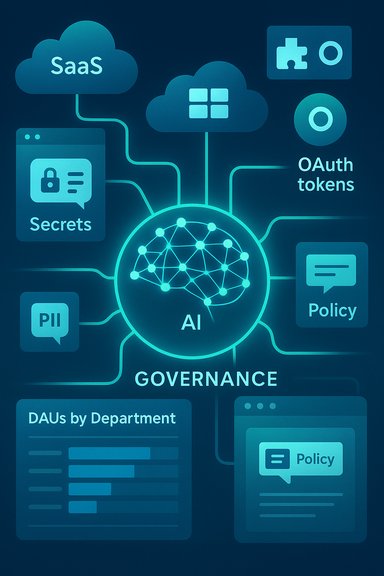
Nudge’s communication — both the formal press release and blog post — describe an expansion that bundles several discrete capabilities into a single governance layer aimed at the “Workforce Edge.” The new offerings, as presented by the vendor, include:- AI Conversation Monitoring to detect when employees share secrets, PII, credentials or other sensitive content in chatbot sessions and file uploads across popular AI chat services such as ChatGPT, Gemini, Microsoft Copilot, and Perplexity.
- Policy Enforcement via the Browser, including in‑moment Acceptable Use Policy (AUP) nudges, redirecting users away from unsanctioned apps and surfacing policy text at the sign-up or login point.
- AI Usage Monitoring with dashboards that track Daily Active Users (DAUs) by department, individual, and tool — intended to help IT and compliance teams quantify adoption and spot risky behavior.
- Risky Integration Detection that finds OAuth/API grants and other integration pathways granting AI tools access to corporate data stores or MCP servers.
- Data Training Policy Summaries — condensed, analyst-style overviews of vendor data handling and training policies to speed vendor risk assessments.
- Workforce Playbooks & Automated Remediation — orchestration workflows to enforce AUP acknowledgements, revoke risky permissions, and automate offboarding tasks when required.
Verifying the claims: cross-checking the public record
Several core claims in Nudge’s release are corroborated by independent trade coverage and the vendor’s own product blog, which helps validate the existence of the features described. Help Net Security and industry aggregator sites reproduced the press release and feature list, confirming consistent messaging across outlets. However, the most consequential numerical claims — for example, that Nudge’s telemetry finds over 1,500 unique AI tools discovered, an average of 39 unique AI tools per organization, and about 70 OAuth grants per employee — originate in vendor telemetry and are not independently audited in public sources. These are plausible directional signals about scale and exposure, but they should be treated as company-reported statistics until validated by third‑party studies or independent datasets. Caveat emptor: procurement teams should ask for raw telemetry definitions, sampling methods and anonymization guarantees before treating these numbers as operational baselines. The technical claims about support for detecting conversations across ChatGPT, Gemini, Copilot and Perplexity are repeated across the vendor blog and press distribution, and the browser extension support (Chrome, Edge, Firefox, Brave, ChatGPT Atlas and Perplexity Comet, per the product blog) is a verifiable feature the company documents. Still, the precise detection fidelity (false positive/negative rates, latency, payload scope) is not publicly published and should be validated in pilots.Why this matters: the operational problem Nudge aims to solve
The problem statement driving the product is straightforward: AI expands existing SaaS risk in three connected ways:- AI features embedded inside mainstream SaaS apps turn formerly inert workflows into model-accessible surfaces that can read and summarize sensitive content.
- OAuth/API grants and persistent connectors create continuous data egress channels that can be exploited intentionally or accidentally.
- Employees, in the flow of work, will often choose convenience over compliance; interventions at the point of decision can be far more effective than post‑incident remediation.
Technical analysis: how the pieces fit together (and what’s unclear)
Discovery & Inventory
Nudge’s “day-one” inventory claims align with a feasible architecture that aggregates SaaS connectors, SSO logs, app directories and browser extension telemetry to build a shadow catalog of AI tools and integrations. Such discovery is technically straightforward if connectors to identity and SaaS management APIs are in place and browser telemetry is enabled. The real test is completeness: agentic flows, server-to-server MCP integrations, and ephemeral connectors (like ad-hoc webhooks) can be harder to detect without deep SaaS or network instrumentation.Conversation Monitoring and Browser Enforcement
Detecting sensitive content in chat sessions requires client-side instrumentation (browser extension) or web-proxying with content inspection. The browser-extension route provides immediate in-situ nudges and has lower latency, but it raises deployment questions (extension permissions, enterprise extension management, and end-user privacy). Nudge documents multi‑browser support, which broadens coverage but also increases the operational matrices for IT to manage. What the company has not published are metrics on detection accuracy, data retention, and whether content is processed on-device or sent to vendor systems — all critical for compliance and privacy reviews.OAuth/API Grant & MCP Detection
Visibility of OAuth grants and API integrations often requires access to identity provider logs (e.g., Okta, Azure AD) or API gateway telemetry. Nudge’s emphasis on surfacing “risky integrations” is technically credible but depends on depth of connectors. The bigger challenge is attributing access: an OAuth grant may permit downstream access via chained services, and computing blast radius accurately requires graph-based analysis of entitlements — a non-trivial mapping problem widely discussed in industry analyses of agentic identity security.Playbooks & Automated Remediation
Automated workflows — revoking tokens, requiring AUP acceptance, nudging users — are operationally valuable. The risk is automation that is insufficiently scoped: overly aggressive revocation or errors in user mapping can break business processes. The platform’s value hinges on the quality of remediation guardrails and any human-in-the-loop gating for high-impact actions. Real deployments should validate rollback capabilities and change control flows.Strengths: where Nudge’s approach is sensible
- Workforce-centric control: Delivering policy nudges at the point of decision reduces reliance on retroactive detection and aligns governance with human workflows, which increases the likelihood of adoption.
- Holistic SaaS+AI scope: Focusing on AI wherever it lives across the SaaS ecosystem — not just on isolated LLM endpoints — addresses realistic enterprise complexity and supply‑chain exposures that many single-purpose tools miss.
- Fast on-ramp for visibility: A free trial that claims a fast “shadow AI inventory” can accelerate risk discovery and create a prioritized remediation backlog without lengthy protracted installs, lowering the barrier to action for security teams.
- Behavioral science baked in: Nudges and inline AUP delivery leverage human factors to change behavior, which is a pragmatic and often cost-effective complement to technical controls.
Risks and limitations: what buyers must validate
- Vendor-reported telemetry vs. independent validation: Key statistics in the announcement come from Nudge’s own telemetry; organizations should request methodology and raw sample sizes before adopting those numbers as benchmarks. Treat these as directional insights, not audited facts.
- Detection fidelity and privacy: The product inspects chat content. Buyers must validate how sensitive content is handled (on‑device vs. sent to vendor), retention policies, encryption, and access controls to ensure compliance with data protection rules and contractual obligations.
- Agentic & server-side visibility gaps: MCP servers, automated agents, and server-to-server connectors can bypass browser-based controls entirely. The platform’s detection surface should explicitly include these telemetry sources; if not, the organization still has blind spots. Independent analyses of agent security emphasize that governance tools must combine graph analysis, runtime monitoring and identity control to be sufficient.
- Operational cost of tuning: Like any telemetry-rich solution, effectiveness depends on tuning, playbook maintenance and integration with SOC workflows. Expect a non-trivial operational investment to reduce false positives and keep policies aligned with business needs.
Competitive landscape and market context
Nudge’s announcement sits alongside a wave of product innovation aimed at securing agentic AI, non‑human identities and AI-augmented SaaS workflows. Security vendors and identity platforms are racing to fill overlapping roles: discovery and entitlement mapping, runtime guardrails, and in‑flow user guidance. Industry analyses show that graph-based access modeling, runtime enforcement (webhooks, inline proxies) and continuous red-teaming are convergent patterns customers should expect from vendors in this category. Nudge differentiates via a workforce-behavior focus and a self-service inventory on-ramp, but enterprises evaluating options should compare integration completeness and runtime enforcement guarantees across providers.Deployment considerations and a pragmatic pilot checklist
For IT and security teams considering a trial or pilot of Nudge Security’s expanded platform, the following phased checklist condenses recommended validation steps:- Inventory Validation:
- Run the free trial and export the initial shadow AI inventory.
- Cross-check discovered apps and integrations against known SSO, MDM and app catalog lists to measure false negative rates.
- Privacy & Data Handling Review:
- Request the vendor’s data processing agreement and ask how conversation text is processed, stored, or retained.
- Confirm on-device vs. cloud processing for chat inspection and the ability to redact sensitive fields.
- Detection Accuracy and Tuning:
- Run a staged set of controlled prompts that include PII and secrets to measure detection sensitivity and false positives.
- Log time-to-alert, triage workflows, and SOC integration points (SIEM/XDR connectors).
- Browser Extension Governance:
- Test extension deployment via enterprise policies; confirm permissions and updating behavior.
- Verify that extension fails-safe behavior doesn’t block legitimate business flows.
- OAuth & Connector Remediation Playbooks:
- Simulate revocation scenarios with a non-production test tenant to validate rollback and impact on dependent systems.
- Audit playbook logs and confirm human-in-loop controls for high-impact revocations.
- Organizational Readiness:
- Define acceptable failure modes (fail open vs. fail closed) and SLA expectations.
- Prepare communications and training to support behavioral nudges and AUP enforcement.
Practical recommendations for procurement and security leadership
- Insist on transparency for vendor telemetry and ask for the methodology behind headline numbers (sample size, timeframe, industry segments represented).
- Require detailed contractual clauses on data use, non‑training guarantees, and deletion semantics for conversational data.
- Demand operational logs that can be exported to an internal SIEM or immutable archive for audit and eDiscovery.
- Plan a short but rigorous pilot that includes representative high-risk workflows (finance, HR, IP-heavy teams) so detection and remediation quality are measured where it matters most.
- Evaluate vendor interoperability: the best governance tooling becomes effective only when it integrates with identity providers, cloud logs, SIEM, and ITSM systems.
Final assessment: realistic value, measured expectations
Nudge Security’s expanded platform addresses a pressing and concrete gap in enterprise defenses: the human-driven pathways by which AI ends up touching sensitive corporate data. The vendor’s combination of discovery, browser-delivered nudges, usage dashboards and remediation playbooks represents a pragmatic, workforce-centered strategy that will appeal to teams trying to balance governance and productivity. Independent trade coverage and the company’s blog corroborate the feature set and product positioning. That said, the most consequential claims are vendor-sourced and require validation in context. Detection fidelity, on-device versus cloud processing of conversational text, and the platform’s ability to map server-side MCP exposures are the three technical questions that will determine whether Nudge’s suite is sufficient, complementary, or merely incremental. Security teams should treat the product as a high-value operational amplifier — a governance and behavior tool — but not a one-stop replacement for identity-hardening, runtime model protections and adversarial testing.Conclusion
Nudge Security’s announcement is an important market signal: enterprise AI risk is now a workforce problem as much as it is a model or cloud issue. The company’s emphasis on in-moment behavioral guardrails, fast discovery and automated playbooks matches a pragmatic defense-in-depth posture that many organizations need. Organizations evaluating this class of solution should run short, focused pilots that validate detection accuracy, privacy posture, and playbook safety before wide deployment — and treat vendor telemetry as directional insight that must be backed by independent verification in their own environments. The promise of safer AI usage in the enterprise is real; realizing it requires both the right tools and disciplined operational validation.Source: The Malaysian Reserve https://themalaysianreserve.com/202...omprehensive-ai-security-governance-platform/
