

Nuvei’s announcement that it will run core payment processing on Microsoft Azure and apply Azure AI to optimize transactions marks a decisive step toward cloud‑native, AI‑driven payments infrastructure—one designed to exceed 10,000 transactions per second and to target an industry‑grade availability goal of 99.999 percent while supporting global scale that Nuvei describes as capable of underpinning more than $1 trillion in annual payment volume.
Nuvei and Microsoft today publicly expanded a multi‑year relationship that moves Nuvei’s core payment processing APIs and services onto Microsoft Azure. The vendor statements emphasize three immediate outcomes: higher throughput (10k+ TPS), AI‑driven transaction optimization in real time, and a resilient multi‑region architecture built with Azure services such as ExpressRoute, Azure Kubernetes Service (AKS), Azure Firewall, Azure Defender for Cloud, and Application Gateway with Web Application Firewall (WAF). This is not Nuvei’s first announcement tied to Microsoft—previous integrations and collaborations (including Microsoft Dynamics 365 and regional implementations) have set the stage—but the 2025 press release frames this expansion as a broader migration of Nuvei’s core processing to Azure, with a stated ambition to improve consistency, latency, and global availability while reducing dependence on third‑party legacy components.
Independent reporting repeats the vendor’s claim, and Nuvei’s own technical collateral highlights a large footprint (local acquiring in many markets and hundreds of APMs) that necessitates high TPS capacity for large enterprise customers and commerce events. These are consistent signals, but the 10k TPS figure should be read as a published target or validated capability under specific test conditions rather than a universal, always‑on guarantee across every regional workload.
Nuvei has grown through acquisitions and integrations (for example, their Paya deal and various platform partnerships) and publicly positions itself as a global processor with local acquiring and broad APM support—facts that support the move to Azure as a step to consolidate and modernize those capabilities. However, this is also a competitive inflection: other processors will likewise pursue cloud and AI advantages, and merchants will weigh vendor feature velocity, geographic coverage, and contractual SLAs when choosing providers.
Nuvei’s announcement is consequential for payments operations—promising higher performance and smarter routing—and it marks a broader inflection point in which cloud hyperscalers and payments processors converge on AI and distributed architectures to solve scale, latency, and resiliency problems that once required bespoke private data centers. Expect follow‑on technical deep dives, independent benchmarks, and contractual clarifications in the coming months as the multi‑year migration unfolds and as Nuvei publishes performance validations tied to live merchant workloads.
Source: 富途牛牛 Nuvei Expands Partnership With Microsoft to Scale Global Payments Infrastructure to Support More Than 10,000 Transactions per Second
 Background / Overview
Nuvei and Microsoft today publicly expanded a multi‑year relationship that moves Nuvei’s core payment processing APIs and services onto Microsoft Azure. The vendor statements emphasize three immediate outcomes: higher throughput (10k+ TPS), AI‑driven transaction optimization in real time, and a resilient multi‑region architecture built with Azure services such as ExpressRoute, Azure Kubernetes Service (AKS), Azure Firewall, Azure Defender for Cloud, and Application Gateway with Web Application Firewall (WAF). This is not Nuvei’s first announcement tied to Microsoft—previous integrations and collaborations (including Microsoft Dynamics 365 and regional implementations) have set the stage—but the 2025 press release frames this expansion as a broader migration of Nuvei’s core processing to Azure, with a stated ambition to improve consistency, latency, and global availability while reducing dependence on third‑party legacy components. What Nuvei announced (the essentials)
- Nuvei will run core payment processing APIs on Microsoft Azure and use Azure AI to optimize authorizations and routing in real time.
- Public performance target: more than 10,000 transactions per second (TPS) and a target availability of 99.999% for enterprise merchants.
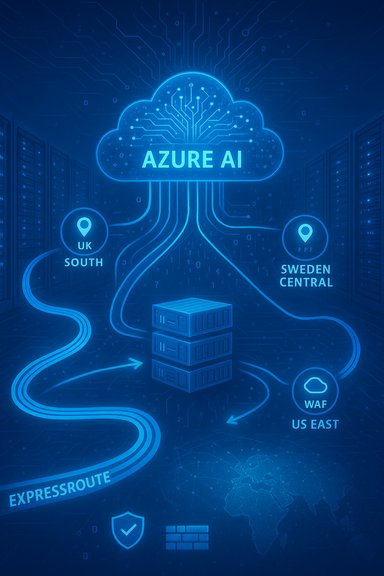
- Infrastructure choices listed: Azure ExpressRoute, Azure Kubernetes Service (AKS) for containerized workloads, Azure Firewall, Azure Defender for Cloud, and Azure Application Gateway with WAF. The architecture is being deployed across four strategic regions identified in the announcement: UK South, Sweden Central, US West, and US East.
- Nuvei frames the move as supporting multi‑regional data residency, improved elasticity, and an AI‑native foundation to accelerate future features—positioning the company to operate among the highest‑volume processors globally and to support scaling to the stated $1 trillion annual volume figure.
Verifying the headline claims: what checks out and what needs context
10,000 TPS: plausible but dependent on architecture and test conditions
Nuvei’s announcement explicitly cites the 10,000+ TPS capability as part of the Azure migration narrative. That number is plausible for a modern, cloud‑native payments stack with container orchestration, autoscaling, private interconnects (ExpressRoute), and tuned data paths—provided the underlying design, network bandwidth, and state management are engineered for that throughput and the measurement is well‑scoped (e.g., authorizations/requests per second vs. end‑to‑end settled transactions per second).Independent reporting repeats the vendor’s claim, and Nuvei’s own technical collateral highlights a large footprint (local acquiring in many markets and hundreds of APMs) that necessitates high TPS capacity for large enterprise customers and commerce events. These are consistent signals, but the 10k TPS figure should be read as a published target or validated capability under specific test conditions rather than a universal, always‑on guarantee across every regional workload.
99.999% availability: a target, not an industry guarantee
Nuvei states a target for 99.999% availability. Azure offers a variety of service‑level guarantees that range from 99.9% to 99.999% depending on the service and deployment pattern (for example, multi‑region Cosmos DB configurations can offer 99.999% availability). Microsoft’s public SLA pages show that some platform components can reach five nines in narrow, service‑specific configurations, but composite, multi‑service workloads require careful design to achieve equivalent end‑to‑end availability. Achieving five nines for a payments platform that spans multiple regions, network fabrics, third‑party acquirers, and external rails is feasible—but it is an architecture and operations discipline, not a self‑evident outcome of moving to Azure. Nuvei’s statement correctly uses “target,” and that phrasing should be treated as a roadmap objective rather than a financial SLA already backed by Microsoft.The $1 trillion annual volume aspiration
Nuvei claims the Azure migration establishes “a resilient, AI‑powered foundation to support more than $1 trillion in annual payment volume as businesses scale internationally.” This should be read as a capacity and positioning statement rather than a historical fact. Public filings, acquisition disclosures and combined volume figures (for example, Nuvei’s Paya acquisition disclosures that reported combined volumes in the low hundreds of billions for certain periods) show that Nuvei is a major processor but do not independently verify a current $1 trillion run‑rate. The press release frames the $1 trillion number as an ambition backed by the platform’s design, so readers should treat it as a growth target supported by improved technical capacity rather than an audited current throughput figure.Nuvei’s product footprint numbers: small inconsistencies across sources
Nuvei’s public pages and press materials repeatedly list coverage metrics such as connections in more than 200 markets, local acquiring in 50 markets, 150+ currencies, and 700+ alternative payment methods (APMs). Different Nuvei releases and partner pages have used slightly different counts (e.g., 700 vs 716 vs ~680 APMs in various statements), which is common when product ecosystems are in active expansion. These are vendor numbers that align in scale across Nuvei communications, but exact counts should be verified directly with Nuvei for procurement or compliance purposes because the catalog of available APMs and local acquiring partners can change rapidly.What Azure brings technically — services called out and why they matter
Azure ExpressRoute
Azure ExpressRoute provides private, dedicated connectivity into the Microsoft global backbone with bandwidth options up to and beyond 10 Gbps (ExpressRoute Direct supports ports up to 100 Gbps), enabling predictable, low‑latency links between Nuvei’s network domains and Azure regions. For payment processing that must minimize variable internet latency and jitter—particularly between on‑premises acquiring partners and cloud endpoints—private connectivity is a standard design choice.Azure Kubernetes Service (AKS)
AKS is the common pattern for containerizing core services and enabling autoscaling, rolling updates, and orchestration. Nuvei’s use of AKS aligns with a microservices and container‑native approach that simplifies horizontal scaling (helpful for meeting TPS targets) and for isolating services by function (routing, fraud scoring, settlement). Note: AKS itself does not always carry a financially backed SLA; the availability of agent nodes is governed by the VM SLA. Proper multi‑zone or multi‑region setup and architecture patterns matter for overall resiliency.Azure Firewall, Application Gateway + WAF, and Azure Defender for Cloud
- Azure Firewall provides centralized network policy enforcement and telemetry to protect east‑west and north‑south traffic flows.
- Azure Application Gateway with WAF protects application‑level traffic against common web exploits (OWASP rulesets) and can be scaled to handle significant request loads; Microsoft documents show the WAF engine has optimization and higher RPS capacity in newer engine versions.
- Azure Defender for Cloud (formerly Azure Security Center / Defender) supplies advanced threat detection and posture management that’s appropriate for a payments platform with regulatory and PCI‑level security considerations.
Global region placement and edge considerations
Nuvei lists UK South, Sweden Central, US West, and US East as strategic deployment regions. These are canonical Azure regions and consistent with Microsoft’s global regions map; deploying across geographically separated Azure regions supports cross‑region failover and regional data residency constraints when properly configured. However, region selection alone does not guarantee five‑nines availability—architects must plan multi‑zone deployments, cross‑region replication for stateful components, and robust traffic orchestration to realize those SLOs.Business implications: what this means for merchants and the payments ecosystem
- For enterprise merchants, the migration promises reduced latency, higher authorizations per second, and more consistent global authorization outcomes—especially when combined with Nuvei’s local acquiring and APM networks. This matters for retailers and subscription platforms where a single percent improvement in authorization rates translates to meaningful revenue.
- The AI‑driven transaction optimization Nuvei describes suggests per‑transaction decisioning for routing, interchange prediction, and authorization strategies. If implemented safely and transparently, that can improve acceptance rates and reduce decline costs. It also implies more complex observability and explainability needs for regulated merchants.
- Strategic advantage: by embedding core processing on Azure, Nuvei reduces some legacy third‑party dependencies and pursues tighter integration between data, routing logic, and AI models—potentially enabling faster feature delivery and centralized operational control.
Risks, caveats, and operational considerations
1. Composite availability is not automatic
Even though some Azure services can be configured with five‑nines SLAs, the end‑to‑end availability of a complex payments system depends on many moving parts: multi‑region replication, external acquirers and their regional availability, network interconnects, external issuer networks, and dependency services (databases, caches, DNS). Nuvei’s 99.999% is a target; customers should request concrete SLA language, measurable SLOs, and runbook commitments as part of commercial terms.2. Vendor concentration and single‑cloud risk
Migrating core processing to a single hyperscaler simplifies operations in some ways but increases concentration risk. A major cloud outage—while rare—can magnify impact. Architects typically mitigate this via multi‑region and multi‑zone designs, cross‑cloud backups, or at least tested disaster recovery plans. Nuvei’s design across multiple Azure regions is positive, but it’s not a full substitute for a multi‑cloud fallback if a merchant requires that level of redundancy.3. Regulatory and data residency complexity
Payments are highly regulated. Running core processing in Azure helps with region‑based residency and security tooling, but merchants and Nuvei must still satisfy PCI DSS, GDPR, local licensing, and regional regulatory requirements for acquiring and settlement. The regional placement of services and the use of private connectivity (ExpressRoute) are important elements, yet regulatory validation remains a business‑level obligation.4. AI model risks: bias, explainability, and operational drift
Applying Azure AI to route and optimize transactions in real time introduces model governance questions: how are models trained, how often are they retrained, and how is model drift detected? Misconfigured decision models can change acceptance rates in ways that have financial and compliance impacts. Merchants should ask for controls, auditability, and safety nets around any automated authorization‑altering logic.5. Cost, telemetry, and operational overhead
Cloud‑native, autoscaling architectures bring variable costs. High TPS throughput, cross‑region replication, DDoS protection, private ExpressRoute circuits, and high‑performance data stores all add to TCO. Nuvei’s migration may lower some legacy costs and accelerate feature velocity, but enterprise buyers should model predictable costs, burst scenarios (peak event load), and data egress/replication charges during procurement.Implementation checklist for enterprise IT teams and payments architects
- Validate SLAs and SLOs
- Get Nuvei’s proposed SLA for your contract (what availability is financially backed?.
- Ask for the component SLOs (API gateway, routing service, database replication) and how composite availability is calculated.
- Confirm data residency and compliance
- Map where transaction data, PII, and logs will reside.
- Confirm PCI DSS scope reduction and any changes to your own cardholder data environment (CDE).
- Review failover and DR playbooks
- Demand runbooks that explain automated failover, degradation modes, and RTO/RPO targets for both regional and cross‑region outages.
- Examine AI governance
- Understand the decision‑path for any AI optimization: inputs, training data provenance, retraining cadence, and rollback controls.
- Test billing and cost controls
- Validate cost caps for peak load tests, private link / ExpressRoute consumption, and data egress worst‑case scenarios.
- Observe and audit telemetry
- Insist on robust, tenant‑segregated metrics and distributed traces (end‑to‑end P95/P99 latencies, authorization success rates, false declines) and ensure access to the logs required for reconciliation.
Competitive and market context
Nuvei’s move aligns with two broader trends: (1) payments platforms becoming cloud‑native and AI‑driven to squeeze more authorization value at scale, and (2) hyperscalers offering specialized primitives (private networking, managed Kubernetes, threat protection, and AI tooling) that accelerate platform modernization.Nuvei has grown through acquisitions and integrations (for example, their Paya deal and various platform partnerships) and publicly positions itself as a global processor with local acquiring and broad APM support—facts that support the move to Azure as a step to consolidate and modernize those capabilities. However, this is also a competitive inflection: other processors will likewise pursue cloud and AI advantages, and merchants will weigh vendor feature velocity, geographic coverage, and contractual SLAs when choosing providers.
Strengths and positives
- Modernization: Migrating core processing to Azure and containerizing with AKS is a modern, maintainable architectural direction that enables rapid scaling and faster deployments.
- Enterprise posture: Use of ExpressRoute, Firewall, Defender, and WAF demonstrates attention to enterprise networking, security, and compliance needs.
- AI potential: Real‑time, per‑transaction intelligence can materially increase authorization rates and reduce false declines when implemented with strong model governance.
- Global footprint alignment: Deploying across multiple Azure regions dovetails with Nuvei’s stated global market coverage and local acquiring footprint.
Final assessment and recommended next steps for readers
Nuvei’s Azure migration is a credible and strategically sound move: it pairs a payments specialist’s global rails and acquirer relationships with Microsoft Azure’s scale, private connectivity options, and security tooling. The announced 10,000+ TPS capability and 99.999% availability target are technically plausible outcomes of a well‑engineered cloud design, but they are not automatically achieved by migration alone—they require careful architecture, multi‑zone and multi‑region replication, robust failover runbooks, and ongoing operational discipline. Nuvei positions the move as a multi‑year modernization that will compound value as transaction intelligence accumulates; that narrative is consistent with the vendor’s recent product trajectory and prior partnerships. For enterprise buyers and IT architects evaluating this new capability, the practical steps are straightforward: obtain concrete SLAs, validate the security and compliance posture (including PCI DSS and local regulatory constraints), require modeled availability and cost scenarios, and insist on transparency around AI decisioning and model governance. Those steps will convert vendor promise into operational assurance.Nuvei’s announcement is consequential for payments operations—promising higher performance and smarter routing—and it marks a broader inflection point in which cloud hyperscalers and payments processors converge on AI and distributed architectures to solve scale, latency, and resiliency problems that once required bespoke private data centers. Expect follow‑on technical deep dives, independent benchmarks, and contractual clarifications in the coming months as the multi‑year migration unfolds and as Nuvei publishes performance validations tied to live merchant workloads.
Source: 富途牛牛 Nuvei Expands Partnership With Microsoft to Scale Global Payments Infrastructure to Support More Than 10,000 Transactions per Second
