

Nuvei’s decision to run its core payment processing APIs on Microsoft Azure marks a deliberate, high-stakes bet that cloud-native infrastructure and Azure’s AI tooling can materially improve authorization rates, latency, and resilience for global enterprise merchants while creating a platform engineered to scale well beyond today’s operational norms.
Nuvei, a Montreal-based payments technology company that has been expanding from regional acquiring into a full-stack global payments platform, announced a major expansion of its strategic partnership with Microsoft to migrate core processing to Azure. The company frames this as a multi-year migration that consolidates core APIs and processing workloads on Azure while enabling real-time, AI-driven transaction optimization. The public announcement highlights three headline targets:
Migrating the transaction core to a hyperscaler like Azure can deliver several important technical levers:
This evolution raises three industry-level implications:
However, the announcement should be treated as the opening of a multi-year validation process rather than a completed performance audit. Key commercial and technical next steps for merchants and partners include demanding independent load testing, explicit SLAs, detailed model governance rules and clear contractual exit/portability terms. The real proof will be sustained, third-party-validated improvements in authorization rates, latency metrics and availability over time—concrete outcomes that turn architecture promises into measurable business value. Nuvei’s move is an important signal in the payments industry: the combination of cloud scale and AI decisioning is now table stakes for players targeting global enterprise customers. The winners will be those who back ambitious engineering with transparent evidence, disciplined governance and procurement-ready SLAs that shift vendor rhetoric into guaranteed operational reality.
Source: FintechNewsSG Nuvei Shifts Core Payment Platform to Microsoft Azure - Fintech Singapore
 Background
Nuvei, a Montreal-based payments technology company that has been expanding from regional acquiring into a full-stack global payments platform, announced a major expansion of its strategic partnership with Microsoft to migrate core processing to Azure. The company frames this as a multi-year migration that consolidates core APIs and processing workloads on Azure while enabling real-time, AI-driven transaction optimization. The public announcement highlights three headline targets:- A throughput capability beyond 10,000 transactions per second (TPS).
- An availability target of 99.999% (commonly called “five nines”) for enterprise merchants.
- An AI-native foundation intended to support more than US$1 trillion in annual payment volume as customers scale internationally.
Why this matters: the technical and commercial stakes
Payments processing combines extreme sensitivity to latency, high availability requirements, and strict security/compliance constraints. Small improvements in authorization success rates translate directly into merchant revenue; reduced latency increases conversion; and stronger resilience reduces outage-driven revenue loss and reputational damage.Migrating the transaction core to a hyperscaler like Azure can deliver several important technical levers:
- Elasticity and burst capacity to absorb traffic spikes during global commerce events.
- Geographic distribution that shortens network distance to issuers and acquirers, improving authorization latency.
- Managed security and compliance primitives that reduce undifferentiated operational burden.
- AI and telemetry at scale to enable adaptive routing, smarter retries, and better fraud decisions in near real time.
Anatomy of the announced architecture
Core components Nuvei named
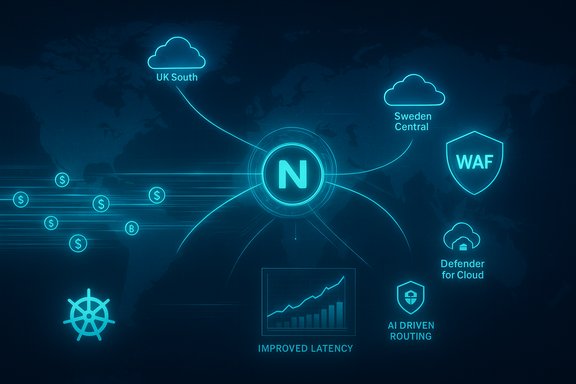
- Azure ExpressRoute for private connectivity and predictable networking between Nuvei and partner/acquirer endpoints.
- Azure Kubernetes Service (AKS) for containerized workloads and microservice orchestration.
- Azure Firewall and Azure Application Gateway with WAF for network and application-layer protection.
- Azure Defender for Cloud for runtime threat detection and posture management.
How the pieces enable payments-specific functions
- Low-latency routing: regional compute nodes reduce round-trip time to local acquirers and issuers.
- Autoscaling API surface: AKS enables fast, automated scaling of stateless API tiers for authorization/clearing flows.
- Security posture: WAF and Defender centralize detections and controls that are vital for PCI-scoped endpoints.
- Private connectivity: ExpressRoute minimizes exposure to public internet variability—important for deterministic authorization windows and SLA commitments.
The AI promise: what “Azure AI-driven transaction optimization” can (and can’t) deliver
Nuvei frames one of the biggest payoffs as real-time, AI-driven optimization of transactions. In practical terms, that covers functions such as:- Dynamic acquirer routing to maximize approval probability and minimize fees.
- Authorization probability prediction to pick the best path for approval.
- Adaptive retry logic that safely retries transient failures.
- Real-time fraud scoring and risk decisions that reduce false declines while controlling chargeback exposure.
- High-quality, representative training data with properly labeled outcomes.
- Low-latency inference that adds negligible delay to the authorization critical path.
- Robust model governance—A/B testing, drift detection, rollback procedures and explainability for dispute resolution and compliance.
Verifying the headline claims — a critical look
Nuvei’s announcement contains three load-bearing claims: 10,000+ TPS, 99.999% availability, and support for >US$1 trillion annual volume. Each deserves scrutiny.1) Throughput: “beyond 10,000 TPS”
The 10,000 TPS figure is technically plausible for a cloud-native, horizontally partitioned payments engine that uses autoscaling containers, high-bandwidth ExpressRoute links, and optimized IO paths. Major card networks and national rails can operate above this level; in context, 10k TPS places Nuvei above many boutique processors while still below the theoretical peaks of the largest card networks. That said, throughput claims depend heavily on:- How TPS is defined (authorization requests/second vs. fully settled end-to-end transactions).
- The scope of the measurement (single-region vs. multi-region, synthetic load vs. mixed-production workloads).
- The behavior of downstream dependencies (acquirers, issuing banks, payment rails).
2) Availability: “99.999% target”
Five-nines availability (~5.26 minutes of downtime per year) is an ambitious engineering and operational commitment. Achieving it end-to-end for a payments platform that touches external acquirers, multiple regional rails, and merchant integrations requires:- True active/active deployments with seamless cross-region failover.
- Synchronous or carefully engineered asynchronous replication for transactional state.
- Tested runbooks, automation for failover, and frequent chaos engineering to validate assumptions.
3) Scale runway: “supporting more than US$1 trillion annual payment volume”
This is a capacity/positioning statement: Nuvei positions the Azure migration as delivering an architecture that could underpin that volume as merchants scale. It does not equate to Nuvei currently processing $1 trillion per year. The number should be read as an architecture headroom claim—ambitious and useful for marketing and sales positioning, but not an audited current throughput or revenue metric. Confirmations through regulator filings or independent audits would be required to call it a present fact.Security, compliance and regional data-residency
Nuvei’s Azure architecture leans on a robust set of managed security controls:- Azure Firewall and Application Gateway + WAF for boundary and application protections.
- Azure Defender for Cloud for posture management and runtime detections.
- ExpressRoute for private network paths that reduce exposure to the public internet.
- PCI DSS attestations and SOC reports for the new cloud tenancy.
- Clear data flow diagrams that show where cardholder data is transiently persisted.
- HSM and key management details (customer-managed vs. provider-managed keys).
- Penetration test reports and evidence of continuous compliance monitoring.
Risks and trade-offs: what architects and procurement teams must watch
Moving core processing to a single hyperscaler introduces both benefits and concentration risks. The main trade-offs include:- Vendor concentration / lock-in: Deep optimization on AKS, ExpressRoute, and Azure-native services increases the effort required to migrate to another cloud. Contracts must include clear exit and data-portability clauses.
- Claims vs. verifiable measurements: Public targets need to be backed by independent load testing and SLAs. Request joint testing and third-party benchmarks.
- Operational complexity: Distributed, high-throughput systems require careful design for state, idempotency, reconciliation and cross-region reconciliation.
- AI governance risk: Real-time ML in the critical path must have defensible governance to prevent inadvertent declines or unexplained routing outcomes that damage merchants’ revenue.
- Cost dynamics: High throughput, frequent cross-region replication and ExpressRoute bandwidth carry substantial operational costs that may shift the vendor’s cost model; seek transparency on who bears egress, replication and burst costs.
Practical recommendations for enterprise buyers
- Request a formal performance pack that includes:
- Third-party load test results with realistic traffic mixes and tail-latency percentiles.
- Definitions of TPS and the exact measurement methodology.
- Evidence of sustained production throughput under mixed workloads.
- Negotiate SLAs tied to the five-nines target with explicit remediation and runbook exercises.
- Validate cryptographic and key management design:
- Confirm HSM usage, key ownership, and whether keys are customer-managed.
- Request penetration test summaries and continuous monitoring dashboards.
- Pilot with representative traffic and run joint chaos and failover tests across the named Azure regions.
- Insist on model governance documentation for real-time AI:
- Training and validation data provenance.
- Drift detection, rollback and explainability procedures.
- Clarify cost models, especially for ExpressRoute, egress and cross-region replication bursts.
Competitive and market context
Nuvei’s migration to Azure follows a broader trend of major processors adopting hyperscalers for the combination of scale, global presence and integrated AI tooling. Hyperscalers offer predictable networking via private interconnects, elastic compute and a large ecosystem of cloud-native services that accelerate feature delivery.This evolution raises three industry-level implications:
- Legacy processors that remain on on-prem stacks face increasing competitive pressure on agility and feature velocity.
- Hyperscaler–payments vendor partnerships consolidate significant parts of the global payments plumbing on a few infrastructure providers, raising questions for resilience and regulatory scrutiny.
- Merchant decisions will increasingly hinge on verified performance, compliance evidence and contractual protection rather than marketing claims alone.
Strengths and notable innovations
- Modernized core: Consolidating core APIs on AKS and leveraging ExpressRoute modernizes the control plane and data paths, enabling autoscaling and faster releases.
- AI-native vision: Embedding real-time AI into routing and fraud decisions can compound value as models learn from more transactions; Nuvei’s focus on this is commercially sensible.
- Security-first tooling: Using WAF, Defender for Cloud and private connectivity creates a strong baseline for PCI and regulatory evidence when implemented responsibly.
Conclusion
Nuvei’s migration of its core payment processing to Microsoft Azure is a substantive, well-framed play: it pairs a payments-engine provider that needs global scale with a hyperscaler offering deterministic networking, container orchestration, managed security and AI tooling. The promised advantages—higher throughput (10k+ TPS), five-nines availability, and an AI-native runway for enormous annual volume—are plausible as targets and represent a credible growth strategy.However, the announcement should be treated as the opening of a multi-year validation process rather than a completed performance audit. Key commercial and technical next steps for merchants and partners include demanding independent load testing, explicit SLAs, detailed model governance rules and clear contractual exit/portability terms. The real proof will be sustained, third-party-validated improvements in authorization rates, latency metrics and availability over time—concrete outcomes that turn architecture promises into measurable business value. Nuvei’s move is an important signal in the payments industry: the combination of cloud scale and AI decisioning is now table stakes for players targeting global enterprise customers. The winners will be those who back ambitious engineering with transparent evidence, disciplined governance and procurement-ready SLAs that shift vendor rhetoric into guaranteed operational reality.
Source: FintechNewsSG Nuvei Shifts Core Payment Platform to Microsoft Azure - Fintech Singapore
