

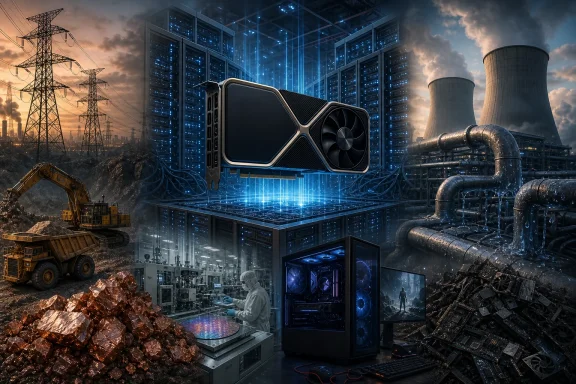
The graphics processing unit has become the engine room of the artificial intelligence boom, transforming a component once associated mainly with video games into one of the world’s most strategically important—and environmentally contentious—technologies. As Nvidia’s data-center revenue surges and hyperscalers prepare facilities capable of hosting hundreds of thousands of AI accelerators, the central question is no longer whether GPUs can deliver more computing power. It is whether the benefits produced by that power justify the electricity, water, minerals, pollution, infrastructure costs, and electronic waste accumulated across the GPU’s increasingly compressed life cycle.
That architecture was ideal for rendering images, where millions of pixels, vertices, textures, shadows, and lighting calculations must be handled at once. It also proved remarkably effective for scientific simulation, cryptocurrency mining, machine learning, and other workloads built around repeated mathematical operations.
The modern GPU story is often tied to Nvidia’s GeForce 256, launched in 1999 and marketed as the world’s first GPU. Graphics acceleration existed long before that product, including specialized hardware in arcade machines, workstations, consoles, and early personal computers, but Nvidia helped turn “GPU” into a recognizable category.
That demand supported the development of programmable shaders and massively parallel architectures. Nvidia’s CUDA platform, introduced in the 2000s, then gave software developers a practical route to use those processors for non-graphical computation.
Neural networks benefited because training involves enormous numbers of matrix operations that can be distributed across parallel hardware. GPUs eventually became essential to the deep-learning breakthroughs behind speech recognition, computer vision, large language models, image generation, and today’s AI assistants.
Nvidia’s quarterly data-center revenue reached roughly $62.3 billion in its fourth quarter of fiscal 2026, compared with less than $1 billion per quarter only several years earlier. Data-center products now dwarf gaming and the company’s other established markets, reflecting the scale at which cloud providers, model developers, governments, and enterprises are acquiring AI infrastructure.
This is not merely a product-cycle shift. It represents the construction of a new industrial layer whose physical demands are becoming visible far beyond Silicon Valley.
Each chip may be more efficient than the architecture it replaces, yet the aggregate footprint can still rise when companies deploy dramatically more chips. This distinction between unit efficiency and total consumption is central to understanding the AI boom.
The US data-center sector consumed an estimated 176 terawatt-hours of electricity in 2023, or approximately 4.4 percent of national electricity use. Depending on deployment and efficiency trends, total consumption could reach between 325 and 580 terawatt-hours in 2028, potentially accounting for 6.7 to 12 percent of US electricity demand.
Inference is the process of running a trained model to answer prompts, generate images, summarize documents, write code, or perform other tasks. One inference request may have a modest footprint, but mass adoption changes the calculation.
Consumer AI features are also moving from optional websites into operating systems, browsers, search engines, productivity suites, customer-service platforms, development tools, and smart-home products. A feature that once required an intentional visit to a chatbot can become an automatically invoked background service.
This can create a supply-driven market in which companies develop new AI features partly to justify infrastructure already purchased or contracted. The resulting services may be genuinely useful, but the economic incentive does not guarantee corresponding social value.
The pertinent question is not whether AI can perform a task. It is whether it performs that task well enough—and creates enough additional value—to warrant the required infrastructure.
Data centers are particularly challenging because large facilities can request hundreds of megawatts of reliable, around-the-clock power. Multi-building campuses may eventually demand electricity on a scale comparable to a city or major industrial complex.
Utilities must decide how quickly to connect these projects, who pays for transmission upgrades, and what happens if anticipated demand fails to materialize. Those decisions affect residential customers, local businesses, and industries that may never directly use the AI services driving the expansion.
Annual renewable-energy contracts do not necessarily mean that a data center receives carbon-free electricity every hour. A company may purchase enough renewable power over a year to match its consumption while relying on fossil-fuel generation during periods when wind and solar production are unavailable.
As AI facilities demand continuous uptime, they can prolong the operation of existing fossil-fuel plants or encourage the construction of new gas generation. Backup generators can create another source of local pollution, especially when facilities use temporary generation while awaiting permanent grid connections.
The complication is the rebound effect: when computation becomes cheaper, organizations tend to consume more of it. A model that is ten times less expensive to run may be embedded into a hundred times as many interactions.
For efficiency to reduce total environmental impact, it must outpace growth in model size, request volume, data-center capacity, and the number of AI-enabled products. Current investment patterns offer no assurance that it will.
Traditional air cooling becomes increasingly difficult as rack densities rise. New AI systems are therefore accelerating the adoption of direct-to-chip liquid cooling, rear-door heat exchangers, immersion systems, and other methods capable of moving heat more effectively.
Liquid cooling does not automatically mean heavy consumption of fresh water. A facility’s footprint depends on the cooling design, climate, water source, electricity supply, and whether water is circulated in a closed loop or lost through evaporation.
This “spiky” profile can be especially difficult for small municipal water systems. A community may need new pumps, pipes, treatment equipment, reservoirs, or wells to accommodate an industrial user whose peak draw is many times its average consumption.
The cost becomes politically explosive if households are asked to finance those upgrades through higher rates. Even a company that replenishes an equivalent volume elsewhere may not address the immediate capacity problem in the affected district.
Communities need more than a global pledge to become “water positive.” Useful disclosure would include:
Researchers have estimated that training a model at the scale of Meta’s Llama 3.1 could produce air pollution comparable to more than 10,000 round-trip car journeys between Los Angeles and New York. That comparison is an estimate rather than a direct measurement, but it illustrates why the location and energy source of AI workloads matter.
One research model suggests that the annual public-health burden associated with US data centers could exceed $20 billion by 2030 under a high-growth scenario. Such projections carry uncertainty, yet they highlight costs that do not appear in the price of a chatbot subscription or cloud-computing contract.
Low-income neighborhoods and communities of color have historically faced disproportionate exposure to industrial pollution. Data-center development can repeat that pattern when facilities and their supporting power infrastructure are placed near communities with less political influence or lower property costs.
Local opposition is therefore not simply resistance to technological progress. Residents may be evaluating whether promised tax revenue and employment outweigh noise, generator emissions, water consumption, transmission construction, and higher utility costs.
That imbalance intensifies the demand for community-benefit agreements. Host communities increasingly expect operators to fund grid and water upgrades, monitor pollution, disclose resource consumption, support emergency services, and create credible pathways to local employment.
A project’s legitimacy will depend not only on what it builds, but on how fairly it distributes costs and benefits.
An analysis of Nvidia’s A100 accelerator found a substantial material contribution from heavy metals, with copper forming one of the largest identifiable components. One device may appear insignificant, but an AI cluster can contain thousands or tens of thousands of accelerators, multiplying demand across the entire bill of materials.
Copper is particularly important because AI expansion also requires cables, busbars, transformers, motors, power lines, cooling equipment, and new electrical generation. Data centers are competing for the same material needed to modernize grids, electrify transportation, and replace fossil-fuel heating.
The exact impact depends on the mine, ore grade, regulation, and waste-management practices. However, rapidly growing demand can increase pressure to approve projects in sensitive locations or exploit deposits with lower concentrations, requiring more material to be excavated and processed.
The AI industry’s environmental disclosures frequently begin with data-center operations. A complete accounting must begin with extraction and include refining, chemical production, component manufacturing, assembly, transportation, operation, and disposal.
Some of these materials are difficult to replace because they perform essential functions in photolithography and other advanced manufacturing steps. Their persistence and potential health effects nevertheless make emissions control, worker protection, wastewater treatment, and public disclosure essential.
The semiconductor industry has a historical pollution legacy in both the United States and Asia. Generative AI is now accelerating fabrication investment, including new capacity in Arizona, where water scarcity and rapid industrial growth make resource planning especially sensitive.
Data-center operators may still replace it because a newer accelerator produces more output per watt or occupies less space for the same performance. At sufficient scale, the savings in electricity, cooling, and floor area can justify retiring hardware that remains operational.
This creates a paradox. Replacing old systems can improve efficiency, but manufacturing replacements adds embodied emissions, mining impacts, chemical use, and waste.
A responsible comparison must consider the complete life cycle rather than assuming that newer hardware is automatically greener.
More conservative studies produce lower estimates, partly because they assume longer server lifetimes or account for supply limitations. The precise number is uncertain, but the direction is not: accelerated computing is creating a substantial stream of complex, material-rich equipment.
Servers contain valuable copper, gold, silver, platinum-group metals, and reusable components. They can also contain lead, chromium, flame retardants, and other substances that become dangerous when equipment is burned, broken apart without protection, or dumped into poorly managed landfills.
Formal recycling is better, but it cannot recover every material at its original purity. Products that are difficult to disassemble may be shredded, mixing materials and reducing their value.
A stronger hierarchy would prioritize:
Gaming still consumes significant electricity, particularly at 4K resolution, high refresh rates, or with uncapped frame rates. The impact depends on the GPU’s power draw, playing time, local grid, and whether the user replaces hardware frequently.
Reasonable measures can reduce consumption without destroying the experience:
Local execution can reduce dependence on data centers, improve privacy, lower latency, and allow AI functions to work without an internet connection. It can also make use of hardware that has already been manufactured and powered for other purposes.
However, local AI does not make computation impact-free. NPUs add silicon and influence upgrade cycles, while large models may still require cloud processing. If “AI PC” marketing convinces users to discard perfectly serviceable computers, some operational savings could be outweighed by additional manufacturing and e-waste.
A well-designed application should select the least expensive computational path capable of completing the task. It should not invoke a giant cloud model to rename a file, classify a simple image, or perform a calculation that conventional code can handle more efficiently and reliably.
Users also need controls. AI features should disclose whether they use local or cloud processing, permit background functions to be disabled, and avoid consuming resources merely to increase engagement.
The problem is that the same infrastructure also powers disposable images, spam, automated engagement, low-quality content, speculative products, and features added mainly because competitors have them. Counting all AI computation as equally valuable obscures this difference.
Environmental debate should therefore focus not only on how efficiently a model operates, but on what it accomplishes. A high-impact medical or climate application deserves a different assessment from an AI-generated novelty that users never requested.
Consumers routinely accept environmental trade-offs when a product offers obvious convenience, savings, entertainment, or utility. If people reject an AI feature, the more immediate explanation may be that it is unreliable, intrusive, expensive, or unnecessary.
Environmental concerns can amplify that resistance because they sharpen the value calculation. Users become less tolerant of waste when the promised benefit is vague.
A model might require substantially more computation to achieve a comparatively small improvement on a benchmark. Whether that improvement matters depends on the application, not the benchmark alone.
Sufficiency asks a different question: When is the model good enough? It encourages developers to consider smaller specialized models, retrieval systems, conventional algorithms, local processing, and human expertise before defaulting to the largest available system.
A meaningful environmental label would need to avoid false precision. Workloads vary by model, hardware, utilization, data-center location, cooling system, and time of day.
Even approximate disclosure could improve decisions if it included:
Site-level information allows local governments to plan infrastructure and enables residents to understand the project they are being asked to host. Confidential business details do not justify withholding basic water, electricity, emissions, and waste data.
Independent audits are equally important. Sustainability reporting loses credibility when companies choose their own boundaries, assumptions, and accounting periods without external verification.
Long-term contracts, minimum-payment requirements, performance bonds, and dedicated industrial rates can reduce the danger of stranded assets. Community-benefit agreements can address local impacts beyond the utility bill.
The guiding principle is straightforward: private investment should not depend on quietly socializing its infrastructure costs.
Task Manager already makes processor utilization visible, but AI-era resource management needs to go further. Users should be able to identify background inference, restrict cloud-dependent features, and understand whether an application is repeatedly invoking costly models.
Enterprise administrators will want policy controls that determine which models employees may use, where data is processed, and when local hardware should be preferred. Energy and carbon reporting may eventually become part of the same management layer as security, licensing, and compliance.
Communities may also impose conditions on construction schedules and long-term operation. Projects that arrive with credible infrastructure funding and transparent environmental plans will face less resistance than those built around confidentiality and optimistic promises.
The data-center industry’s political challenge will be to demonstrate that it is a durable local partner, not simply a global customer consuming local resources.
Customers may begin requesting information about the embodied carbon of rented hardware, its age, expected service life, cooling method, and end-of-life destination. Large enterprises facing sustainability requirements will push for these metrics even if consumer applications remain opaque.
Procurement decisions could then reward providers that reuse equipment, operate in lower-impact regions, and avoid premature replacement.
The industry should also distinguish between benchmark improvement and practical value. A two-percent capability gain may be transformative in one field and irrelevant in another.
Future AI evaluations must answer three questions in order:
The GPU is not a villain, and fear of powerful hardware is not a substitute for serious technology policy. The same parallel-processing architecture that renders imaginative worlds and advances scientific research can also strain electrical grids, consume scarce water, intensify mining, and create mountains of discarded equipment when deployed without restraint. The path forward is neither to abandon accelerated computing nor to accept limitless scaling as inevitable, but to demand that every generation of hardware produce more durable value—not merely more tokens, more benchmarks, and more infrastructure—than the one it replaces.
 Background
From graphics accelerator to general-purpose computer
A GPU was originally designed to complement a computer’s central processing unit. The CPU excels at executing a relatively small number of complex, sequential tasks, while the GPU divides work across many simpler execution units that can process large quantities of data in parallel.That architecture was ideal for rendering images, where millions of pixels, vertices, textures, shadows, and lighting calculations must be handled at once. It also proved remarkably effective for scientific simulation, cryptocurrency mining, machine learning, and other workloads built around repeated mathematical operations.
The modern GPU story is often tied to Nvidia’s GeForce 256, launched in 1999 and marketed as the world’s first GPU. Graphics acceleration existed long before that product, including specialized hardware in arcade machines, workstations, consoles, and early personal computers, but Nvidia helped turn “GPU” into a recognizable category.
Gaming created the economic foundation
Video games financed much of the long-term research that made modern accelerated computing possible. Consumers repeatedly paid for faster hardware to obtain higher resolutions, smoother frame rates, better lighting, more realistic physics, and increasingly complex virtual worlds.That demand supported the development of programmable shaders and massively parallel architectures. Nvidia’s CUDA platform, introduced in the 2000s, then gave software developers a practical route to use those processors for non-graphical computation.
Neural networks benefited because training involves enormous numbers of matrix operations that can be distributed across parallel hardware. GPUs eventually became essential to the deep-learning breakthroughs behind speech recognition, computer vision, large language models, image generation, and today’s AI assistants.
The center of gravity has shifted
The GPU remains critical to Windows gaming, professional visualization, engineering, video production, and local AI. However, its economic center has moved decisively into the data center.Nvidia’s quarterly data-center revenue reached roughly $62.3 billion in its fourth quarter of fiscal 2026, compared with less than $1 billion per quarter only several years earlier. Data-center products now dwarf gaming and the company’s other established markets, reflecting the scale at which cloud providers, model developers, governments, and enterprises are acquiring AI infrastructure.
This is not merely a product-cycle shift. It represents the construction of a new industrial layer whose physical demands are becoming visible far beyond Silicon Valley.
Why AI Infrastructure Is Different
Scale changes the environmental equation
A gaming PC might contain one discrete GPU that operates intensively for a few hours each day. An AI data center can contain tens of thousands of accelerators running continuously, connected through high-speed networking and supported by CPUs, memory, storage, power-conversion equipment, pumps, chillers, and backup generators.Each chip may be more efficient than the architecture it replaces, yet the aggregate footprint can still rise when companies deploy dramatically more chips. This distinction between unit efficiency and total consumption is central to understanding the AI boom.
The US data-center sector consumed an estimated 176 terawatt-hours of electricity in 2023, or approximately 4.4 percent of national electricity use. Depending on deployment and efficiency trends, total consumption could reach between 325 and 580 terawatt-hours in 2028, potentially accounting for 6.7 to 12 percent of US electricity demand.
Training is only part of the workload
Public discussion often focuses on the cost of training a frontier model. Training is highly intensive, but it is a limited event compared with the potentially billions of requests a successful model may handle during its operational life.Inference is the process of running a trained model to answer prompts, generate images, summarize documents, write code, or perform other tasks. One inference request may have a modest footprint, but mass adoption changes the calculation.
Consumer AI features are also moving from optional websites into operating systems, browsers, search engines, productivity suites, customer-service platforms, development tools, and smart-home products. A feature that once required an intentional visit to a chatbot can become an automatically invoked background service.
Utilization creates pressure for constant demand
An advanced accelerator is a costly asset. Operators therefore have a strong financial incentive to keep it busy rather than leave it idle, encouraging more inference workloads and broader integration of generative AI.This can create a supply-driven market in which companies develop new AI features partly to justify infrastructure already purchased or contracted. The resulting services may be genuinely useful, but the economic incentive does not guarantee corresponding social value.
The pertinent question is not whether AI can perform a task. It is whether it performs that task well enough—and creates enough additional value—to warrant the required infrastructure.
The Electricity Problem
Power demand is returning after years of relative stability
US electricity demand remained comparatively flat for much of the 2010s. That era is ending as data centers, semiconductor fabrication, electric vehicles, industrial reshoring, and building electrification compete for new generation and transmission capacity.Data centers are particularly challenging because large facilities can request hundreds of megawatts of reliable, around-the-clock power. Multi-building campuses may eventually demand electricity on a scale comparable to a city or major industrial complex.
Utilities must decide how quickly to connect these projects, who pays for transmission upgrades, and what happens if anticipated demand fails to materialize. Those decisions affect residential customers, local businesses, and industries that may never directly use the AI services driving the expansion.
Grid composition matters as much as consumption
The environmental impact of a GPU depends heavily on where and when it operates. An accelerator supplied by low-carbon electricity has a different emissions profile from the same device running on a grid dominated by coal or natural gas.Annual renewable-energy contracts do not necessarily mean that a data center receives carbon-free electricity every hour. A company may purchase enough renewable power over a year to match its consumption while relying on fossil-fuel generation during periods when wind and solar production are unavailable.
As AI facilities demand continuous uptime, they can prolong the operation of existing fossil-fuel plants or encourage the construction of new gas generation. Backup generators can create another source of local pollution, especially when facilities use temporary generation while awaiting permanent grid connections.
Efficiency cannot guarantee lower total use
New GPU architectures perform more calculations per watt, and that progress matters. Better silicon, lower-precision arithmetic, improved scheduling, liquid cooling, advanced packaging, and more efficient networking can significantly reduce the energy required for a specific workload.The complication is the rebound effect: when computation becomes cheaper, organizations tend to consume more of it. A model that is ten times less expensive to run may be embedded into a hundred times as many interactions.
For efficiency to reduce total environmental impact, it must outpace growth in model size, request volume, data-center capacity, and the number of AI-enabled products. Current investment patterns offer no assurance that it will.
Water Becomes a Local Flashpoint
Cooling high-density hardware
Nearly all electricity consumed by computing equipment becomes heat. Removing that heat is essential because accelerators can lose performance, become unstable, or suffer damage if temperatures exceed operating limits.Traditional air cooling becomes increasingly difficult as rack densities rise. New AI systems are therefore accelerating the adoption of direct-to-chip liquid cooling, rear-door heat exchangers, immersion systems, and other methods capable of moving heat more effectively.
Liquid cooling does not automatically mean heavy consumption of fresh water. A facility’s footprint depends on the cooling design, climate, water source, electricity supply, and whether water is circulated in a closed loop or lost through evaporation.
Annual totals hide peak demand
Water debates frequently rely on annual consumption figures, but local systems are built around peak capacity. A facility may require far more water on a hot afternoon than it does during cooler conditions—the same period when households, agriculture, and other businesses are also increasing demand.This “spiky” profile can be especially difficult for small municipal water systems. A community may need new pumps, pipes, treatment equipment, reservoirs, or wells to accommodate an industrial user whose peak draw is many times its average consumption.
The cost becomes politically explosive if households are asked to finance those upgrades through higher rates. Even a company that replenishes an equivalent volume elsewhere may not address the immediate capacity problem in the affected district.
Transparency remains inadequate
Many data-center operators publish corporate water goals while withholding detailed information about individual sites. That makes it difficult for residents to evaluate whether a proposed facility fits their watershed, particularly in drought-prone regions.Communities need more than a global pledge to become “water positive.” Useful disclosure would include:
- The facility’s expected annual and peak daily water use.
- The source and quality of the water it will consume.
- The cooling technology and its performance during extreme heat.
- The infrastructure improvements required to serve the site.
- The party responsible for paying those costs.
- The operator’s drought-response and emergency-curtailment plans.
Air Pollution and Public Health
Carbon is not the only concern
Climate emissions receive much of the attention, but electricity generation also produces nitrogen oxides, sulfur dioxide, fine particulate matter, and other pollutants. These emissions can worsen respiratory and cardiovascular illnesses even when the power plant is located far from the data center.Researchers have estimated that training a model at the scale of Meta’s Llama 3.1 could produce air pollution comparable to more than 10,000 round-trip car journeys between Los Angeles and New York. That comparison is an estimate rather than a direct measurement, but it illustrates why the location and energy source of AI workloads matter.
One research model suggests that the annual public-health burden associated with US data centers could exceed $20 billion by 2030 under a high-growth scenario. Such projections carry uncertainty, yet they highlight costs that do not appear in the price of a chatbot subscription or cloud-computing contract.
Pollution is unevenly distributed
The person submitting an AI prompt may live hundreds or thousands of miles from the power plant, chip factory, or backup generator responsible for part of its footprint. This separation makes digital activity feel clean while concentrating physical consequences in specific communities.Low-income neighborhoods and communities of color have historically faced disproportionate exposure to industrial pollution. Data-center development can repeat that pattern when facilities and their supporting power infrastructure are placed near communities with less political influence or lower property costs.
Local opposition is therefore not simply resistance to technological progress. Residents may be evaluating whether promised tax revenue and employment outweigh noise, generator emissions, water consumption, transmission construction, and higher utility costs.
The benefits are not equally distributed either
A data center may support globally used AI products while creating relatively few permanent local jobs after construction. The economic value can flow to the operator, shareholders, remote customers, and cloud tenants, while environmental and infrastructure burdens remain local.That imbalance intensifies the demand for community-benefit agreements. Host communities increasingly expect operators to fund grid and water upgrades, monitor pollution, disclose resource consumption, support emergency services, and create credible pathways to local employment.
A project’s legitimacy will depend not only on what it builds, but on how fairly it distributes costs and benefits.
The GPU Supply Chain
A graphics card begins at a mine
The environmental footprint of a GPU starts long before the chip reaches a server rack or gaming PC. Accelerators require copper, silicon, aluminum, tin, nickel, precious metals, specialized substrates, memory, circuit boards, cooling assemblies, and numerous trace materials.An analysis of Nvidia’s A100 accelerator found a substantial material contribution from heavy metals, with copper forming one of the largest identifiable components. One device may appear insignificant, but an AI cluster can contain thousands or tens of thousands of accelerators, multiplying demand across the entire bill of materials.
Copper is particularly important because AI expansion also requires cables, busbars, transformers, motors, power lines, cooling equipment, and new electrical generation. Data centers are competing for the same material needed to modernize grids, electrify transportation, and replace fossil-fuel heating.
Extraction creates persistent risks
Mining can disturb ecosystems, consume large quantities of water, produce tailings, and expose sulfide-bearing rock. When sulfides react with air and water, they can create acidic drainage that releases metals into surrounding waterways.The exact impact depends on the mine, ore grade, regulation, and waste-management practices. However, rapidly growing demand can increase pressure to approve projects in sensitive locations or exploit deposits with lower concentrations, requiring more material to be excavated and processed.
The AI industry’s environmental disclosures frequently begin with data-center operations. A complete accounting must begin with extraction and include refining, chemical production, component manufacturing, assembly, transportation, operation, and disposal.
Semiconductor fabrication is resource-intensive
Modern chips require extraordinarily controlled manufacturing environments. Fabrication plants use electricity, ultra-pure water, process gases, solvents, acids, and per- and polyfluoroalkyl substances, commonly known as PFAS.Some of these materials are difficult to replace because they perform essential functions in photolithography and other advanced manufacturing steps. Their persistence and potential health effects nevertheless make emissions control, worker protection, wastewater treatment, and public disclosure essential.
The semiconductor industry has a historical pollution legacy in both the United States and Asia. Generative AI is now accelerating fabrication investment, including new capacity in Arizona, where water scarcity and rapid industrial growth make resource planning especially sensitive.
From Manufacturing to Electronic Waste
Rapid replacement is an economic choice
A GPU does not become physically useless when a new architecture arrives. It may remain capable of gaming, visualization, research, inference, or smaller-scale training for many years.Data-center operators may still replace it because a newer accelerator produces more output per watt or occupies less space for the same performance. At sufficient scale, the savings in electricity, cooling, and floor area can justify retiring hardware that remains operational.
This creates a paradox. Replacing old systems can improve efficiency, but manufacturing replacements adds embodied emissions, mining impacts, chemical use, and waste.
A responsible comparison must consider the complete life cycle rather than assuming that newer hardware is automatically greener.
AI could become a major new waste stream
Research published in 2024 estimated that generative AI could create a cumulative 1.2 million to 5 million metric tons of electronic waste between 2020 and 2030, depending on growth and replacement patterns. Circular-economy strategies could reduce that waste by as much as 86 percent under favorable conditions.More conservative studies produce lower estimates, partly because they assume longer server lifetimes or account for supply limitations. The precise number is uncertain, but the direction is not: accelerated computing is creating a substantial stream of complex, material-rich equipment.
Servers contain valuable copper, gold, silver, platinum-group metals, and reusable components. They can also contain lead, chromium, flame retardants, and other substances that become dangerous when equipment is burned, broken apart without protection, or dumped into poorly managed landfills.
Recycling is not a complete answer
Only a minority of global e-waste is formally collected and recycled. Informal processing often takes place in countries where workers dismantle devices by hand, burn insulation, or use hazardous chemicals to recover valuable metals.Formal recycling is better, but it cannot recover every material at its original purity. Products that are difficult to disassemble may be shredded, mixing materials and reducing their value.
A stronger hierarchy would prioritize:
- Extending the useful life of functioning hardware.
- Reusing complete servers or accelerators in less demanding roles.
- Refurbishing and repairing replaceable components.
- Recovering reusable modules, metals, and cooling equipment.
- Recycling the remaining material through audited facilities.
- Disposing only of fractions that cannot be safely recovered.
What This Means for Windows Users
A gaming GPU is not equivalent to an AI cluster
Consumers should avoid treating every GPU as environmentally identical. A graphics card used for years in a gaming PC has a very different life-cycle profile from an accelerator replaced after a short period in a continuously operating data center.Gaming still consumes significant electricity, particularly at 4K resolution, high refresh rates, or with uncapped frame rates. The impact depends on the GPU’s power draw, playing time, local grid, and whether the user replaces hardware frequently.
Reasonable measures can reduce consumption without destroying the experience:
- Frame-rate limits can prevent a GPU from rendering unnecessary frames.
- Adaptive-sync technologies can maintain smoothness without maximizing power at all times.
- Undervolting can reduce consumption and heat while preserving most performance.
- Balanced graphics settings often deliver better efficiency than indiscriminately selecting “ultra.”
- Keeping a graphics card for another product generation avoids the manufacturing footprint of an early replacement.
Local AI changes where computation happens
Windows PCs increasingly include neural processing units alongside CPUs and GPUs. Microsoft and its hardware partners are promoting on-device AI for features such as image processing, transcription, translation, search, accessibility, and assistant functions.Local execution can reduce dependence on data centers, improve privacy, lower latency, and allow AI functions to work without an internet connection. It can also make use of hardware that has already been manufactured and powered for other purposes.
However, local AI does not make computation impact-free. NPUs add silicon and influence upgrade cycles, while large models may still require cloud processing. If “AI PC” marketing convinces users to discard perfectly serviceable computers, some operational savings could be outweighed by additional manufacturing and e-waste.
Software design will determine the outcome
Windows developers can choose whether an AI feature runs automatically, locally, in the cloud, or only after explicit user action. Those decisions affect both privacy and resource consumption.A well-designed application should select the least expensive computational path capable of completing the task. It should not invoke a giant cloud model to rename a file, classify a simple image, or perform a calculation that conventional code can handle more efficiently and reliably.
Users also need controls. AI features should disclose whether they use local or cloud processing, permit background functions to be disabled, and avoid consuming resources merely to increase engagement.
The Value Question
Useful AI exists, but usefulness is contextual
AI can assist with scientific modeling, weather forecasting, drug discovery, accessibility, coding, fraud detection, conservation, and industrial optimization. These applications may deliver benefits that justify substantial computation, especially when they replace slower or more resource-intensive methods.The problem is that the same infrastructure also powers disposable images, spam, automated engagement, low-quality content, speculative products, and features added mainly because competitors have them. Counting all AI computation as equally valuable obscures this difference.
Environmental debate should therefore focus not only on how efficiently a model operates, but on what it accomplishes. A high-impact medical or climate application deserves a different assessment from an AI-generated novelty that users never requested.
Consumer skepticism is not simply environmental anxiety
Some investors and executives have suggested that negative coverage of AI’s environmental impact is slowing adoption. That explanation risks mistaking criticism for the underlying problem.Consumers routinely accept environmental trade-offs when a product offers obvious convenience, savings, entertainment, or utility. If people reject an AI feature, the more immediate explanation may be that it is unreliable, intrusive, expensive, or unnecessary.
Environmental concerns can amplify that resistance because they sharpen the value calculation. Users become less tolerant of waste when the promised benefit is vague.
Sufficiency challenges the scaling doctrine
Frontier AI development is dominated by the idea that larger models, larger clusters, and more data will produce better capabilities. Scaling has delivered real improvements, but the relationship is not unlimited or cost-free.A model might require substantially more computation to achieve a comparatively small improvement on a benchmark. Whether that improvement matters depends on the application, not the benchmark alone.
Sufficiency asks a different question: When is the model good enough? It encourages developers to consider smaller specialized models, retrieval systems, conventional algorithms, local processing, and human expertise before defaulting to the largest available system.
Accountability and Better Measurement
AI needs a resource label
Digital services hide their physical footprint. A user can see a laptop’s battery level or a car’s fuel economy, but not the energy, water, or hardware allocation behind an AI request.A meaningful environmental label would need to avoid false precision. Workloads vary by model, hardware, utilization, data-center location, cooling system, and time of day.
Even approximate disclosure could improve decisions if it included:
- The model and approximate computational class used.
- Whether processing occurred locally or in a data center.
- The region and carbon intensity of the electricity supply.
- The facility’s cooling and water characteristics.
- The expected hardware lifetime and reuse policy.
- The methodology used to calculate emissions and resource consumption.
Operators should report site-level impacts
Corporate averages can conceal problematic facilities. A global company may report declining emissions intensity while opening a data center in a water-stressed region or relying on polluting temporary generators at a specific site.Site-level information allows local governments to plan infrastructure and enables residents to understand the project they are being asked to host. Confidential business details do not justify withholding basic water, electricity, emissions, and waste data.
Independent audits are equally important. Sustainability reporting loses credibility when companies choose their own boundaries, assumptions, and accounting periods without external verification.
Costs should follow the project
Utilities and municipalities should protect existing customers from speculative infrastructure expenses. If an AI campus requires a new substation, transmission corridor, pipeline, or water-treatment expansion, the operator should bear the risk that projected demand changes.Long-term contracts, minimum-payment requirements, performance bonds, and dedicated industrial rates can reduce the danger of stranded assets. Community-benefit agreements can address local impacts beyond the utility bill.
The guiding principle is straightforward: private investment should not depend on quietly socializing its infrastructure costs.
Strengths and Opportunities
The GPU remains an extraordinarily productive technology, and environmental scrutiny should lead to better deployment rather than reflexive rejection.- Accelerated computing can replace less efficient approaches. A GPU may complete suitable scientific or engineering workloads faster and with less total energy than a CPU-only system.
- Smaller and specialized models can preserve much of AI’s utility. Developers can match model size to the task instead of routing every request to frontier-scale infrastructure.
- On-device processing can improve privacy and reduce network dependence. NPUs and consumer GPUs may handle transcription, image enhancement, search, and accessibility features without a cloud round trip.
- Waste heat can become a resource. Data centers produce large quantities of predictable heat that may support district heating, industrial processes, or nearby buildings where geography and economics permit.
- Circular hardware programs can extend equipment life. Retired training accelerators may remain valuable for inference, research, education, rendering, or less demanding enterprise workloads.
- Flexible scheduling can reduce grid strain. Non-urgent training and batch-processing jobs can be shifted toward periods with abundant renewable electricity or lower demand.
- Transparent metrics can improve competition. Customers could reward cloud providers and model developers that deliver comparable results with less energy, water, and hardware.
Risks and Concerns
The largest dangers arise when rapid deployment outruns planning, disclosure, and democratic oversight.- Efficiency gains may be overwhelmed by growth. More efficient chips will not lower total consumption if model size and usage expand even faster.
- Residential customers may subsidize industrial expansion. Poorly designed utility rates can shift grid and water infrastructure costs from data-center operators to households.
- Water demand may peak during periods of scarcity. Annual replenishment pledges do not necessarily protect a community during a heat wave or drought.
- Pollution may be exported to less visible communities. Mining, chip fabrication, electricity generation, and informal recycling often occur far from the end user.
- Rapid replacement can create avoidable e-waste. Financial incentives may favor disposing of functional hardware before its technical life ends.
- AI marketing can accelerate unnecessary PC upgrades. Consumers may replace capable Windows machines for features that could have run on existing hardware or in ordinary software.
- Opaque accounting can enable greenwashing. Renewable-energy certificates and corporate averages may hide hourly fossil-fuel use or local environmental stress.
- Infrastructure may become stranded. Communities could be left with expensive upgrades if AI demand, chip architectures, or corporate strategies change.
- Scarce materials may be diverted from decarbonization. Copper and electrical equipment needed for AI campuses are also required for renewable generation, transportation, and grid modernization.
What to Watch Next
The rise of power-aware Windows software
Microsoft, PC manufacturers, and application developers will increasingly decide whether AI runs on the CPU, GPU, NPU, or cloud. Windows users should watch for operating-system tools that expose these choices and allow workloads to be governed by power, privacy, and cost preferences.Task Manager already makes processor utilization visible, but AI-era resource management needs to go further. Users should be able to identify background inference, restrict cloud-dependent features, and understand whether an application is repeatedly invoking costly models.
Enterprise administrators will want policy controls that determine which models employees may use, where data is processed, and when local hardware should be preferred. Energy and carbon reporting may eventually become part of the same management layer as security, licensing, and compliance.
Data-center regulation will become more local
National targets matter, but zoning boards, public-utility commissions, water districts, and state environmental agencies will shape many of the decisive rules. Expect more disputes over rate structures, generation contracts, generator permits, noise, water rights, and disclosure.Communities may also impose conditions on construction schedules and long-term operation. Projects that arrive with credible infrastructure funding and transparent environmental plans will face less resistance than those built around confidentiality and optimistic promises.
The data-center industry’s political challenge will be to demonstrate that it is a durable local partner, not simply a global customer consuming local resources.
Hardware life-cycle reporting will mature
Cloud providers can already measure accelerator utilization, power draw, and workload placement in great detail. The next step is connecting that operational data to manufacturing and disposal records.Customers may begin requesting information about the embodied carbon of rented hardware, its age, expected service life, cooling method, and end-of-life destination. Large enterprises facing sustainability requirements will push for these metrics even if consumer applications remain opaque.
Procurement decisions could then reward providers that reuse equipment, operate in lower-impact regions, and avoid premature replacement.
Performance comparisons will need new metrics
Traditional GPU benchmarks emphasize throughput, frame rate, latency, and raw computational performance. AI infrastructure needs broader measures, including useful output per watt, per liter of water, per dollar, and per kilogram of embodied material.The industry should also distinguish between benchmark improvement and practical value. A two-percent capability gain may be transformative in one field and irrelevant in another.
Future AI evaluations must answer three questions in order:
- Does the system perform the intended task reliably?
- Does it outperform a smaller model or conventional approach by a meaningful margin?
- Does that improvement justify the additional resources and social costs?
The GPU is not a villain, and fear of powerful hardware is not a substitute for serious technology policy. The same parallel-processing architecture that renders imaginative worlds and advances scientific research can also strain electrical grids, consume scarce water, intensify mining, and create mountains of discarded equipment when deployed without restraint. The path forward is neither to abandon accelerated computing nor to accept limitless scaling as inevitable, but to demand that every generation of hardware produce more durable value—not merely more tokens, more benchmarks, and more infrastructure—than the one it replaces.
References
- Primary source: The Verge
Published: 2026-07-21T10:00:01+00:00
The cost of GPUs goes far beyond AI data centers | The Verge
AI data centers are increasingly sparking backlash, but we don’t have a good way to talk about the many other uses of GPUs.www.theverge.com