

NVIDIA has released GeForce Hotfix Display Driver 610.82 for Windows PCs, delivering two narrowly targeted but timely fixes: improved stability for Halo: Campaign Evolved on GeForce RTX 50-series graphics cards, and a repair for disruptive pauses in Path of Exile 2 when running in DirectX 12 mode after extended sessions. The release arrives as Halo’s premium-edition early-access window begins on July 23, making it a particularly relevant update for PC players preparing to revisit the ringworld.
Unlike a broad new Game Ready release, version 610.82 is an optional hotfix based on the recently issued GeForce Game Ready Driver 610.74. That distinction matters. NVIDIA positions hotfix drivers as expedited, limited-scope updates designed to place specific remedies in players’ hands before they are folded into a later, fully certified driver package.
For affected users, the update is straightforward: it is intended to correct the exact issues named in its changelog. For everyone else, especially those with stable systems and no immediate plans to play either game, waiting for the next WHQL-certified release remains the more conservative choice.
The headline fix in NVIDIA’s 610.82 hotfix concerns Halo: Campaign Evolved, the modern remake of the original Halo: Combat Evolved campaign. The problem is explicitly tied to GeForce RTX 50-series GPUs using the 610.xx driver branch, where users may encounter stability problems.
That wording leaves some important technical details unstated. NVIDIA has not publicly categorized the instability as a particular crash type, rendering fault, memory issue, or gameplay-triggered failure. It also does not specify whether every RTX 50-series model is affected, how frequently the fault occurs, or which in-game settings may be involved.
Still, the timing strongly suggests that NVIDIA wants RTX 50-series owners to install the hotfix before committing to a long Halo session. Early access for eligible Premium and Collector’s Edition owners begins July 23, while the broader launch is scheduled for July 28. A driver correction arriving at this point is far more useful than one delivered after the launch rush has begun.
The second correction targets a familiar kind of PC gaming frustration: an issue that may not reveal itself during a brief benchmark or a quick trip through a tutorial. Path of Exile 2 players using DirectX 12 may experience intermittent, lengthy pauses only after playing for an extended period. NVIDIA says version 610.82 fixes this behavior.
That makes the update particularly meaningful for action RPG players. Path of Exile 2 is built around sustained play, dense combat, long character-progression sessions, and content that can punish interruptions. A pause occurring after hours of gameplay is more than an annoyance; it can interrupt a map, obscure combat feedback, undermine trust in a system’s reliability, and create anxiety around high-stakes encounters.
The scope is important. This is not a blanket statement that Halo: Campaign Evolved is unstable across all PC configurations. Nor is it evidence that every GPU in the latest GeForce family will fail under the game. It is a focused correction for a detected interaction between the game, the latest driver branch, and NVIDIA’s current-generation RTX 50-series hardware.
For players with an RTX 50-series card, the practical interpretation is simple:
This is a more precise description than the Halo item because it identifies both the rendering API and the approximate usage pattern. The problem occurs in DX12 mode, and it emerges after long play sessions rather than necessarily at startup or during the first few minutes of gameplay.
That detail is valuable when validating the fix. A player who installs 610.82, logs in for ten minutes, and sees no stuttering has not necessarily tested the scenario NVIDIA addressed. The meaningful test is a sustained DX12 session in the types of content that previously led to the pauses.
It also means that players using an alternative renderer should avoid assuming this hotfix changes their experience. The official description is limited to DirectX 12. A bug fix in one graphics API path can be highly beneficial without being a universal cure for all frame-time spikes, asset-streaming stalls, or server-related hitches.
In this case, 610.82 is built on Game Ready Driver 610.74. That means it is not a wholly separate software branch packed with a new architectural feature set. Instead, it takes the 610.74 foundation and adds the two identified corrections.
This approach has clear advantages. It can get an urgent repair to players much faster than waiting for the next larger driver release, especially when an issue overlaps with a major game’s early-access or launch period.
However, it also has an unavoidable trade-off: NVIDIA states that hotfix releases go through a more abbreviated quality-assurance process than its ordinary WHQL-certified drivers. They are beta and provided as-is, even if they are published directly through NVIDIA’s own support infrastructure.
A hotfix is most appropriate when all of the following apply:
That does not make a hotfix inherently unreliable. It simply reflects the realities of driver development. GPU drivers are extraordinarily complex software packages that must work across large combinations of:
The remake rebuilds the classic campaign with updated visuals, refined gameplay, enhanced cinematics, expanded combat options, new enemies, additional weapons and vehicles, and a new three-mission story arc called Operation: METEORITE. It also supports cross-play and cross-progression across Windows PC, Xbox Series X|S, Steam, and PlayStation 5.
For the Windows gaming audience, the PC version carries more than ordinary nostalgia. It places an iconic campaign within a modern cross-platform release, at a time when players are likely to scrutinize performance, stability, input response, ultrawide behavior, display settings, and co-op reliability from the opening hours.
The appearance of 610.82 does not by itself mean Halo: Campaign Evolved has a systemic PC problem. In fact, the precision of the fix suggests the opposite: NVIDIA has identified a specific affected segment and is moving to address it before the general release date.
That is good news for RTX 50-series owners. The company is not telling users to revert to a much older driver, avoid a particular game setting, or wait indefinitely for a future patch. It has published an update aimed directly at the affected condition.
Long pauses after extended gameplay are difficult faults to diagnose because several different issues can create a similar symptom. A pause may appear related to shader caching, memory pressure, storage activity, overlay conflicts, background processes, server communication, game-engine behavior, or a GPU-driver interaction.
NVIDIA’s changelog identifies a specific driver-level remedy for intermittent long pauses in DX12 mode after extended sessions. That will be welcome news to players who have struggled to isolate the cause through settings changes or repeated reinstalls.
When that coordination breaks down, the resulting problem does not always look like a clean crash. It may present as a sudden freeze, a multi-second hitch, an apparent loss of responsiveness, or a long frame-time spike.
For an ARPG, those moments can be especially punishing. Combat continues to demand awareness, visual clarity, and rapid reaction. Even if the game eventually resumes, a prolonged interruption can make the outcome of an encounter feel arbitrary.
A more useful process is:
A clean installation can be useful if the current driver environment has become unstable, settings are corrupted, or multiple previous updates have introduced unexplained behavior. But it should not be treated as mandatory for every hotfix.
A clean install resets some configuration choices. Users relying on custom display color settings, application-specific NVIDIA Control Panel profiles, frame-rate caps, or other tailored preferences should be prepared to review them afterward.
For Halo: Campaign Evolved, the immediate goal is stability: launch the game, progress through normal gameplay, and test the settings and display mode normally used on that PC. For Path of Exile 2, the test should include enough play time to reach the conditions that previously triggered the lengthy pauses.
This release officially addresses two items. It does not establish that all RTX 50-series instability is driver-related, that all Path of Exile 2 stutters are fixed, or that unrelated games will benefit.
That limitation is not a weakness in NVIDIA’s response. It is an appropriate boundary for a hotfix. Precision is more useful than a vague claim of “general stability improvements” that gives players little guidance about whether they should update.
Games now arrive with complex engines, multiple rendering APIs, dynamic asset streaming, cross-platform features, high-refresh-rate display support, sophisticated upscaling pipelines, and an enormous variety of PC hardware configurations. Even a well-tested game can expose a graphics-driver edge case when it reaches a new audience at scale.
NVIDIA’s hotfix model is valuable because it provides a middle route between two imperfect alternatives: leaving a verified issue untouched until the next full driver release, or rushing a broad driver package with many changes into distribution. A small optional update can be the right tool when a problem is understood and a fix is ready.
For Windows gamers, the key is disciplined adoption. Read the exact release notes. Match the listed issue to the hardware and game configuration in use. Keep expectations limited to the stated fix. And retain a known-good rollback option if the system has a specialized workload beyond gaming.
The update’s greatest strength is its clarity. It is not marketed as a sweeping performance overhaul or a cure-all for the 610.xx branch. It identifies two problems, names the affected scenarios, and offers a fast path to remediation on Windows 10 and Windows 11.
For the players directly affected, installing the NVIDIA 610.82 hotfix is a sensible launch-week move. For everyone else, the best decision remains equally clear: keep the system stable, wait for the next WHQL Game Ready driver, and update when the fix matches a real need.
Unlike a broad new Game Ready release, version 610.82 is an optional hotfix based on the recently issued GeForce Game Ready Driver 610.74. That distinction matters. NVIDIA positions hotfix drivers as expedited, limited-scope updates designed to place specific remedies in players’ hands before they are folded into a later, fully certified driver package.
For affected users, the update is straightforward: it is intended to correct the exact issues named in its changelog. For everyone else, especially those with stable systems and no immediate plans to play either game, waiting for the next WHQL-certified release remains the more conservative choice.
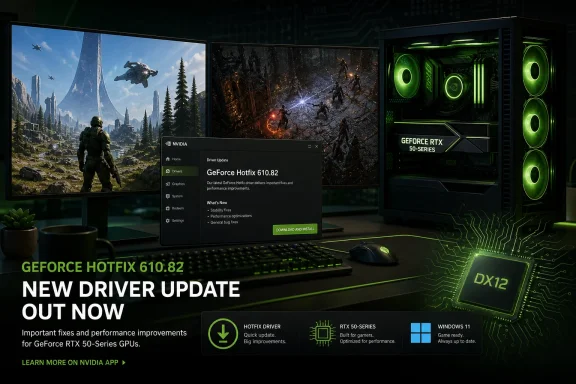 Overview: A Small Driver Update With Major Launch-Week Relevance
The headline fix in NVIDIA’s 610.82 hotfix concerns Halo: Campaign Evolved, the modern remake of the original Halo: Combat Evolved campaign. The problem is explicitly tied to GeForce RTX 50-series GPUs using the 610.xx driver branch, where users may encounter stability problems.That wording leaves some important technical details unstated. NVIDIA has not publicly categorized the instability as a particular crash type, rendering fault, memory issue, or gameplay-triggered failure. It also does not specify whether every RTX 50-series model is affected, how frequently the fault occurs, or which in-game settings may be involved.
Still, the timing strongly suggests that NVIDIA wants RTX 50-series owners to install the hotfix before committing to a long Halo session. Early access for eligible Premium and Collector’s Edition owners begins July 23, while the broader launch is scheduled for July 28. A driver correction arriving at this point is far more useful than one delivered after the launch rush has begun.
The second correction targets a familiar kind of PC gaming frustration: an issue that may not reveal itself during a brief benchmark or a quick trip through a tutorial. Path of Exile 2 players using DirectX 12 may experience intermittent, lengthy pauses only after playing for an extended period. NVIDIA says version 610.82 fixes this behavior.
That makes the update particularly meaningful for action RPG players. Path of Exile 2 is built around sustained play, dense combat, long character-progression sessions, and content that can punish interruptions. A pause occurring after hours of gameplay is more than an annoyance; it can interrupt a map, obscure combat feedback, undermine trust in a system’s reliability, and create anxiety around high-stakes encounters.
What NVIDIA Fixed in Version 610.82
NVIDIA’s release notes identify exactly two fixes in this hotfix. There are no advertised feature additions, no performance claims, and no wider compatibility promises attached to the package.Halo: Campaign Evolved stability on RTX 50-series GPUs
The first item addresses stability issues in Halo: Campaign Evolved on GeForce RTX 50-series graphics cards when using 610.xx drivers.The scope is important. This is not a blanket statement that Halo: Campaign Evolved is unstable across all PC configurations. Nor is it evidence that every GPU in the latest GeForce family will fail under the game. It is a focused correction for a detected interaction between the game, the latest driver branch, and NVIDIA’s current-generation RTX 50-series hardware.
For players with an RTX 50-series card, the practical interpretation is simple:
- If Halo: Campaign Evolved has already crashed, frozen, or behaved erratically on a 610.xx driver, 610.82 is the logical first troubleshooting step.
- If the game has not yet been installed, updating before early-access or launch-day play is a sensible preventative measure.
- If the system is stable on an older driver branch, users should weigh the benefits of the targeted Halo fix against the normal caution required when changing graphics drivers close to a game launch.
- Owners of earlier GeForce generations should not assume this exact hotfix resolves unrelated Halo issues, because the stated correction is specifically for RTX 50-series products.
Path of Exile 2 extended-session pauses in DirectX 12
The second entry fixes intermittent long pauses after extended gameplay sessions in DirectX 12 mode in Path of Exile 2.This is a more precise description than the Halo item because it identifies both the rendering API and the approximate usage pattern. The problem occurs in DX12 mode, and it emerges after long play sessions rather than necessarily at startup or during the first few minutes of gameplay.
That detail is valuable when validating the fix. A player who installs 610.82, logs in for ten minutes, and sees no stuttering has not necessarily tested the scenario NVIDIA addressed. The meaningful test is a sustained DX12 session in the types of content that previously led to the pauses.
It also means that players using an alternative renderer should avoid assuming this hotfix changes their experience. The official description is limited to DirectX 12. A bug fix in one graphics API path can be highly beneficial without being a universal cure for all frame-time spikes, asset-streaming stalls, or server-related hitches.
Why Hotfix Drivers Are Different From Game Ready Drivers
Understanding NVIDIA’s hotfix policy is essential before installing version 610.82. The company describes these packages as optional, accelerated releases that carry a small number of targeted fixes beyond the most recent standard driver.In this case, 610.82 is built on Game Ready Driver 610.74. That means it is not a wholly separate software branch packed with a new architectural feature set. Instead, it takes the 610.74 foundation and adds the two identified corrections.
This approach has clear advantages. It can get an urgent repair to players much faster than waiting for the next larger driver release, especially when an issue overlaps with a major game’s early-access or launch period.
However, it also has an unavoidable trade-off: NVIDIA states that hotfix releases go through a more abbreviated quality-assurance process than its ordinary WHQL-certified drivers. They are beta and provided as-is, even if they are published directly through NVIDIA’s own support infrastructure.
What “optional” means in real-world Windows gaming
Optional does not mean suspicious, unofficial, or unsafe by default. It means the driver is not necessarily the best blanket recommendation for every GeForce owner.A hotfix is most appropriate when all of the following apply:
- The player has the hardware and game combination named in the fix.
- The player has experienced the reported issue, or is about to play the affected title during a sensitive launch window.
- The player is comfortable installing a driver that has not yet completed the broader WHQL release process.
- The player understands that the hotfix may later be superseded by a regular Game Ready release.
WHQL certification still matters
A WHQL-certified driver has completed Microsoft’s Windows Hardware Quality Labs certification process and is generally the safer default for users who prioritize broad validation over immediate access to a narrowly scoped fix.That does not make a hotfix inherently unreliable. It simply reflects the realities of driver development. GPU drivers are extraordinarily complex software packages that must work across large combinations of:
- GPU architectures and board designs
- Windows 10 and Windows 11 builds
- Display configurations and refresh rates
- HDR, VRR, and multi-monitor environments
- Game engines and graphics APIs
- Overlays, capture tools, mods, and monitoring utilities
- Laptop power profiles, docking arrangements, and hybrid graphics systems
Halo: Campaign Evolved Raises the Stakes
The Halo fix is particularly notable because Halo: Campaign Evolved is not a routine back-catalog release. It is a major modernization of the campaign that introduced the original Halo universe to a generation of Xbox and PC players.The remake rebuilds the classic campaign with updated visuals, refined gameplay, enhanced cinematics, expanded combat options, new enemies, additional weapons and vehicles, and a new three-mission story arc called Operation: METEORITE. It also supports cross-play and cross-progression across Windows PC, Xbox Series X|S, Steam, and PlayStation 5.
For the Windows gaming audience, the PC version carries more than ordinary nostalgia. It places an iconic campaign within a modern cross-platform release, at a time when players are likely to scrutinize performance, stability, input response, ultrawide behavior, display settings, and co-op reliability from the opening hours.
A launch-window driver fix is not unusual—but it is revealing
Game launches frequently expose edge cases that are hard to reproduce in pre-release testing. Different combinations of GPU driver revisions, Windows builds, pre-release game content, shaders, overlays, and individual system configurations can surface problems only when the title reaches a wider audience.The appearance of 610.82 does not by itself mean Halo: Campaign Evolved has a systemic PC problem. In fact, the precision of the fix suggests the opposite: NVIDIA has identified a specific affected segment and is moving to address it before the general release date.
That is good news for RTX 50-series owners. The company is not telling users to revert to a much older driver, avoid a particular game setting, or wait indefinitely for a future patch. It has published an update aimed directly at the affected condition.
What players should not infer
The hotfix should not be interpreted as a performance optimization package for all Halo players. NVIDIA’s notes do not promise:- Higher average frame rates
- Better ray tracing performance
- Reduced shader-compilation time
- Broader improvements for RTX 40-series or earlier GPUs
- Fixes for multiplayer, networking, controller input, audio, or progression issues
- A remedy for every potential crash in the game
Why the Path of Exile 2 Fix May Matter Just as Much
Although Halo is the high-profile launch-week attraction, the Path of Exile 2 correction could have the greater day-to-day impact for players already entrenched in the ARPG.Long pauses after extended gameplay are difficult faults to diagnose because several different issues can create a similar symptom. A pause may appear related to shader caching, memory pressure, storage activity, overlay conflicts, background processes, server communication, game-engine behavior, or a GPU-driver interaction.
NVIDIA’s changelog identifies a specific driver-level remedy for intermittent long pauses in DX12 mode after extended sessions. That will be welcome news to players who have struggled to isolate the cause through settings changes or repeated reinstalls.
DX12 is powerful, but it places more responsibility on the software stack
DirectX 12 gives developers closer access to modern GPU capabilities and can help games make better use of multicore CPUs and advanced rendering features. But it also increases the importance of careful coordination among the game engine, the graphics driver, Windows, and hardware-level scheduling.When that coordination breaks down, the resulting problem does not always look like a clean crash. It may present as a sudden freeze, a multi-second hitch, an apparent loss of responsiveness, or a long frame-time spike.
For an ARPG, those moments can be especially punishing. Combat continues to demand awareness, visual clarity, and rapid reaction. Even if the game eventually resumes, a prolonged interruption can make the outcome of an encounter feel arbitrary.
Validation should be patient and methodical
Players who want to confirm whether 610.82 improves their Path of Exile 2 experience should avoid changing several variables at once. Updating the driver, changing the renderer, modifying Windows power settings, disabling overlays, and changing in-game settings simultaneously makes it difficult to determine what actually solved the issue.A more useful process is:
- Record the current driver version and the game’s renderer setting.
- Install GeForce Hotfix Driver 610.82.
- Confirm that Path of Exile 2 is still set to DirectX 12 if that is the configuration previously affected.
- Play a representative long session rather than a short loading test.
- Observe whether the specific extended-session pauses recur.
- If problems persist, note the timing, activity, and any other running software before making additional changes.
Installation Guidance for Windows 10 and Windows 11
NVIDIA offers the 610.82 hotfix for 64-bit versions of Windows 10 and Windows 11. As with any display-driver update, the most important rule is to obtain it from NVIDIA’s official support channels rather than a third-party driver repository.Before installing
A few minutes of preparation can prevent unnecessary complications:- Save work and close games, launchers, and creative applications.
- Finish any important downloads or game updates before restarting the PC.
- If the system is currently stable, make a note of the installed driver version in case a rollback becomes necessary.
- Avoid stacking unrelated Windows updates, BIOS updates, game patches, and driver changes into the same testing session.
- On laptops, connect AC power before starting the installation.
Standard installation versus clean installation
For most users, the normal in-place driver installation is appropriate. It preserves existing NVIDIA settings and is usually the quickest path to testing whether the targeted game issue has been fixed.A clean installation can be useful if the current driver environment has become unstable, settings are corrupted, or multiple previous updates have introduced unexplained behavior. But it should not be treated as mandatory for every hotfix.
A clean install resets some configuration choices. Users relying on custom display color settings, application-specific NVIDIA Control Panel profiles, frame-rate caps, or other tailored preferences should be prepared to review them afterward.
After the reboot
Once the system restarts, verify the installed version through the NVIDIA App, NVIDIA Control Panel, or Windows’ graphics-driver information. Then test the game that prompted the update.For Halo: Campaign Evolved, the immediate goal is stability: launch the game, progress through normal gameplay, and test the settings and display mode normally used on that PC. For Path of Exile 2, the test should include enough play time to reach the conditions that previously triggered the lengthy pauses.
Benefits, Risks, and the Sensible Upgrade Decision
NVIDIA’s 610.82 hotfix offers a good example of when an optional graphics driver can be worth installing. Its benefits are clear for the users named in the notes, but its narrow scope should keep expectations realistic.The strongest reasons to install 610.82
The hotfix is compelling for:- RTX 50-series owners playing Halo: Campaign Evolved
- Path of Exile 2 players using DirectX 12 who have seen long pauses after lengthy sessions
- Windows gamers who value an immediate targeted fix more than waiting for the next certified release
- Players entering Halo’s early-access period and wanting the latest available NVIDIA remedy in place
Reasons to wait
Waiting for the next standard Game Ready driver may be wiser for:- Users unaffected by either named issue
- Players who prioritize WHQL certification above all else
- Systems that are currently stable in the games and applications that matter most
- Business, production, or school PCs where even a small driver-regression risk is unacceptable
- Users who do not have RTX 50-series hardware and do not use Path of Exile 2 in DX12 mode
A warning against overgeneralizing the update
Driver releases can quickly become the center of online speculation, particularly when they overlap with a major game launch. It is important to avoid treating version 610.82 as confirmation that every issue in a particular driver family, game, or GPU generation shares the same cause.This release officially addresses two items. It does not establish that all RTX 50-series instability is driver-related, that all Path of Exile 2 stutters are fixed, or that unrelated games will benefit.
That limitation is not a weakness in NVIDIA’s response. It is an appropriate boundary for a hotfix. Precision is more useful than a vague claim of “general stability improvements” that gives players little guidance about whether they should update.
The Bigger Picture for PC Gaming Reliability
The release of GeForce Hotfix Driver 610.82 reinforces an important reality of modern PC gaming: driver support is no longer a passive, occasional maintenance task. It is part of the launch ecosystem.Games now arrive with complex engines, multiple rendering APIs, dynamic asset streaming, cross-platform features, high-refresh-rate display support, sophisticated upscaling pipelines, and an enormous variety of PC hardware configurations. Even a well-tested game can expose a graphics-driver edge case when it reaches a new audience at scale.
NVIDIA’s hotfix model is valuable because it provides a middle route between two imperfect alternatives: leaving a verified issue untouched until the next full driver release, or rushing a broad driver package with many changes into distribution. A small optional update can be the right tool when a problem is understood and a fix is ready.
For Windows gamers, the key is disciplined adoption. Read the exact release notes. Match the listed issue to the hardware and game configuration in use. Keep expectations limited to the stated fix. And retain a known-good rollback option if the system has a specialized workload beyond gaming.
A Targeted Fix at the Right Time
GeForce Hotfix Display Driver 610.82 is a modest release by changelog length, but it arrives at a strategically important moment. RTX 50-series owners entering Halo: Campaign Evolved early access now have a specific NVIDIA-provided stability fix to install, while dedicated Path of Exile 2 players in DX12 mode receive a potential solution for an issue that becomes most frustrating precisely when a gaming session runs long.The update’s greatest strength is its clarity. It is not marketed as a sweeping performance overhaul or a cure-all for the 610.xx branch. It identifies two problems, names the affected scenarios, and offers a fast path to remediation on Windows 10 and Windows 11.
For the players directly affected, installing the NVIDIA 610.82 hotfix is a sensible launch-week move. For everyone else, the best decision remains equally clear: keep the system stable, wait for the next WHQL Game Ready driver, and update when the fix matches a real need.
References
- Primary source: Neowin
Published: 2026-07-22T17:32:01+00:00
Loading…
www.neowin.net - Independent coverage: Wccftech
Published: 2026-07-23T11:12:07+00:00
Loading…
wccftech.com - Related coverage: windowscentral.com
Halo: Campaign Evolved is the star of Xbox Game Pass' 2nd July wave of new games, alongside an original RPG by Game Freak and a classic id Software FPS | Windows Central
Halo: Campaign Evolved, Beast of Reincarnation, id Software's Heretic + Hexen games, and more will make their Xbox Game Pass debuts later this monthwww.windowscentral.com - Related coverage: news.xbox.com
Halo: Campaign Evolved Launches July 28, Pre-Orders Available Now - XBOX Wire
Halo: Campaign Evolved launches July 28, 2026, with early access beginning July 23. Find out more, and pre-order today.news.xbox.com - Related coverage: halowaypoint.com
Loading…
www.halowaypoint.com - Related coverage: gamespot.com
Halo: Campaign Evolved Release Date And Global Launch Times Revealed - GameSpot
Here we go.www.gamespot.com