

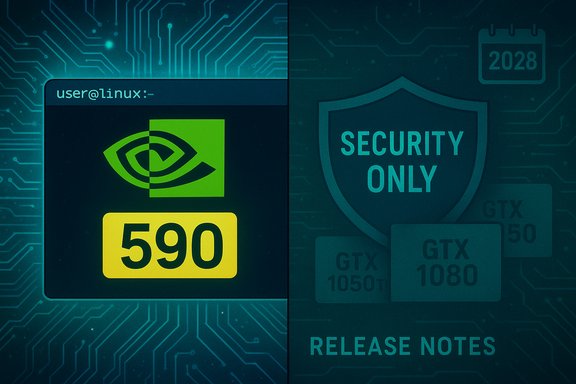
Nvidia’s freshly published Linux 590 driver branch has effectively moved Pascal- and Maxwell-era GeForce cards out of the Game Ready spotlight — with community reports that cards such as the GTX 1050 Ti and other GTX 900/10-series boards no longer register under the 590 build — while Nvidia reiterates that these architectures will continue to receive security-only updates on an extended maintenance cadence.
Nvidia’s driver support plan for older architectures has been a rolling, public process throughout 2025. The company signalled months ago that the 580-series driver family would be the last branch to provide full Game Ready coverage for Maxwell (GTX 700/900), Pascal (GTX 10-series), and consumer Volta cards; after that point those architectures were to be moved into a maintenance path focused on security and critical fixes rather than new-game optimization. The official UNIX/Unix-like (Linux) deprecation schedule and Nvidia’s release notes for the 580 family document that shift. What changed this week is practical: Nvidia released the first public 590-series driver for Linux (identified in community reporting as 590.44.01), and multiple users immediately observed that several Pascal-/Maxwell-based GPUs no longer enumerate or function with that package — a divergence between the listed compatibility and the delivered behaviour that has sparked confusion in the Linux and retro‑GPU communities. Independent outlets and community threads corroborate the same pattern: 590 is shipping on Linux and appears to start driver support with GPUs beginning at the GTX 16-series/Turing era, excluding many GTX 900/10-series cards from feature support.
Nvidia’s shift is predictable on engineering grounds: focus finite development resources on current architectures where new features (hardware‑accelerated ray tracing, modern upscalers, driver‑assisted optimizations) provide meaningful returns for the company and its partners. Security maintenance for legacy silicon remains important; Nvidia’s quarterly patching promise (security-only updates through October 2028) maintains that baseline while reducing the breadth of feature work.
For Linux users running GTX 900/GTX 10-series cards, the prudent path is conservative: avoid 590 on production machines, pin to the 580 family where you need full functionality, and plan for a hardware refresh if access to the latest Game Ready features is a priority. For everyone else — admins, distributors, and end users — this moment is a reminder that driver lifecycles matter and that the intersection of kernel evolution, distro packaging, and vendor deprecation schedules must be managed proactively to avoid disruptive surprises.
Source: TechRadar Linux 590 driver drops older Pascal and Maxwell GPUs
 Background / Overview
Nvidia’s driver support plan for older architectures has been a rolling, public process throughout 2025. The company signalled months ago that the 580-series driver family would be the last branch to provide full Game Ready coverage for Maxwell (GTX 700/900), Pascal (GTX 10-series), and consumer Volta cards; after that point those architectures were to be moved into a maintenance path focused on security and critical fixes rather than new-game optimization. The official UNIX/Unix-like (Linux) deprecation schedule and Nvidia’s release notes for the 580 family document that shift. What changed this week is practical: Nvidia released the first public 590-series driver for Linux (identified in community reporting as 590.44.01), and multiple users immediately observed that several Pascal-/Maxwell-based GPUs no longer enumerate or function with that package — a divergence between the listed compatibility and the delivered behaviour that has sparked confusion in the Linux and retro‑GPU communities. Independent outlets and community threads corroborate the same pattern: 590 is shipping on Linux and appears to start driver support with GPUs beginning at the GTX 16-series/Turing era, excluding many GTX 900/10-series cards from feature support. What the 590 release actually does (technical summary)
590-series: Linux-first, feature-focused branch
- The public Linux 590 build (reported as 590.44.01 in initial coverage) is a new driver branch that prioritizes feature updates and Game Ready optimizations for more recent architectures while excluding many earlier GTX 900/GTX 10-series cards from receiving those new features.
- Nvidia’s deprecation plan made clear the technical intent: the 580 branch would be the last full‑feature branch to carry Maxwell/Pascal/Volta support; subsequent branches shift those devices into a legacy/maintenance mode. Where maintenance equals receiving security patches and critical fixes rather than new-game tuning.
Community findings vs release notes
- Multiple community reports — forum threads and Reddit posts where users installed 590 on Linux — show device non-enumeration or severe functional regressions for cards such as the GTX 1050 Ti. Those reports note that while release documents may still list legacy compatibility in broad strokes, the shipped 590 binary does not recognize or load the same stack for those GPUs in practice. This is an important operational detail that Nvidia has not publicly clarified with an immediate patch-note addendum.
Windows timeline: still a variable
- Nvidia’s prior public messaging made the 580/581 family the last to offer Game Ready updates for Maxwell/Pascal, and Nvidia published 580.105.08 (Linux) / 581.80 (Windows) release artifacts in November 2025 that were widely referenced as the closing major driver for full support. That release canonicalized a transition to security‑only maintenance for those GPUs; nonetheless, a 590 Windows build has not been broadly rolled out or announced to match the Linux 590 release at time of writing. This means the Linux branch is leading Windows for now — an inversion of the typical pattern where Windows drivers arrive in step or first.
Verification of key claims (cross-references)
- The fundamental claim that Maxwell and Pascal are moving out of Game Ready support and into a maintenance/security cadence is supported by Nvidia’s Unix/legacy documentation and driver-family notes, and multiple independent reporting outlets summarized the plan and timeline. Nvidia’s UNIX deprecation documentation explains the legacy branch approach; TechPowerUp and Tom’s Hardware tracked the Q4 cutoff announcement and the subsequent maintenance window through October 2028.
- The concrete observation that the Linux 590 build does not reliably recognize certain GTX 900/GTX 10-series devices comes from community testing and early coverage (PC Guide, WccfTech, and forum/Reddit reporting). Those community reports include hands‑on notes about model-level failures (GTX 1050 Ti called out repeatedly) and driver enumeration errors after installing 590. Because this is driven by first‑wave user installs, it should be considered a verified field observation rather than a vendor-issued changelog entry — and Nvidia had not, at time of reporting, issued a direct counter-statement that would change that picture.
- The Windows 581.80 / Linux 580.105.08 release artifacts and their dates are available in Nvidia’s driver notes and were widely mirrored in the press, confirming that the 580 family shipped in November 2025 — which matches the claim that the 580 driver was the final full‑feature branch for Maxwell/Pascal. That release history matters because it sets the formal boundary for Game Ready support in Nvidia’s public schedule.
Why Nvidia is doing this (analysis)
Engineering economics and platform churn
Supporting a dozen discrete GPU microarchitectures across multiple OS kernels, X/Wayland stacks, and rapidly evolving graphics APIs is expensive. Each new Game Ready update must be validated against drivers, firmwares, OS kernel versions, compositor stacks, and anti-cheat hooks — and the engineering cost grows if the vendor must maintain identical feature parity for a decade‑old architecture while also optimizing for brand‑new silicon.Nvidia’s shift is predictable on engineering grounds: focus finite development resources on current architectures where new features (hardware‑accelerated ray tracing, modern upscalers, driver‑assisted optimizations) provide meaningful returns for the company and its partners. Security maintenance for legacy silicon remains important; Nvidia’s quarterly patching promise (security-only updates through October 2028) maintains that baseline while reducing the breadth of feature work.
Product lifecycle and market messaging
Maxwell and Pascal powered mainstream gaming for the better part of a decade. Unlike ephemeral mobile SoCs, discrete GPUs have long tails — they remain useful and valuable, particularly in secondary systems, miners, and as NVENC-capable cards for encoders. Nvidia’s messaging — keep security patches coming while ending Game Ready feature work — is an attempt to balance customer goodwill with product lifecycle realities. That said, how that balance plays out in practice (e.g., whether a driver binary actually detects a card) is what matters to end users.Risks, pain points, and real-world impact
For Linux desktop gamers
- Expect reduced compatibility and fewer performance refinements in new titles. New Game Ready optimizations will not be back‑ported to Maxwell/Pascal, so newer engines and art pipelines could run worse on older GPUs over time as driver tuning halts. Early community reports show practical driver non-recognition in 590 builds, meaning gamers who update to 590 on Linux without testing risk breakage or degraded functionality.
For users who rely on NVENC / hardware encoders
- Maxwell and Pascal cards remain valuable for NVENC-enabled encoding and offloading tasks. Nvidia’s security-only policy preserves the drivers’ ability to build against kernels and apply critical fixes — so NVENC functionality is unlikely to go away immediately — but there is a long‑term risk that newer OS kernels, compositor changes, or runtime dependencies will complicate driver compatibility for legacy binaries if distributions move past the kernel ABI levels those legacy drivers target. Community workarounds (freezing kernels, pinning driver packages) will become more common.
For Linux distributions and packaging
- Distros that track bleeding-edge stacks may find their package sets diverging: those who update to kernels and Mesa stacks aligned with 590 may inadvertently force users of older Nvidia GPUs to either run older distro releases (LTS snapshots) or maintain their own pinned driver kernels. This is a maintenance burden for system admins and hobbyists.
For Windows users
- The 590 branch has not yet landed widely on Windows; the last fully featured Windows driver identified for Maxwell/Pascal was 581.80 (November 2025). The Windows timeline for a 590 release — and whether that release will mirror Linux’s hardware filtering — remains uncertain. Windows users should take the Linux rollout as a signal but not an immediate certainty; vendor cross-platform plans can diverge in subtle but consequential ways.
Practical guidance: short-term and medium-term actions
Short-term (what to do now)
- If you rely on a GTX 900/GTX 10-series card in a production Linux system, do not install Nvidia 590 builds on those machines without testing on a non‑critical system first. Early reports show enumeration failures for some card models.
- Pin the 580 driver branch if you need stable Game Ready or multi‑title compatibility. The 580 family (580.105.08 Linux / 581.80 Windows) is the documented last full-feature branch for Maxwell/Pascal; you can remain on that branch for continued functional parity and security updates as described by Nvidia.
- If you must upgrade the kernel or compositor, test compatibility with the 580 driver first, and be prepared to use LTS kernels or distribution snapshots that maintain ABI support for the legacy driver.
Medium-term (planning)
- Consider hardware refresh if continued access to the latest Game Ready optimizations, driver features, and newer API support is essential. For users focused on modern AAA gaming on Linux, migrating to Turing/RTX‑class or later cards will avoid the maintenance friction inherent to legacy deprecation.
- For encoding/streaming rigs where NVENC is the key feature, evaluate whether a dedicated low‑end modern card (e.g., an entry-level Turing or Ampere card) provides better long-term support and energy/performance efficiency than continuing to chase legacy driver support.
How to check your system and roll back safely (Linux-focused checklist)
- Check installed Nvidia driver and kernel compatibility:
- Use nvidia-smi and lsmod to inspect loaded modules.
- Verify the exact driver package version (e.g., 580.105.08) from your packaging system or the Nvidia runfile metadata.
- If you have upgraded to 590 and need to revert:
- Boot into a recovery target or runlevel that does not load the X server.
- Use your distro’s package manager to roll back or reinstall the 580‑series driver package (or the last known-working release).
- If necessary, use the official Nvidia runfile uninstaller with the --uninstall flag, then reinstall the target 580 runfile and reboot.
- On Debian/Ubuntu derivatives, consider marking the 580 package hold to prevent accidental upgrades (apt-mark hold). For RPM-based distros, use dnf/yum package lock semantics.
- If you need to move temporarily to Nouveau:
- Be aware Nouveau may not provide full reclocking/accelerated performance on Pascal/Maxwell without vendor firmware. The open driver is steadily improving but often lacks parity with Nvidia’s proprietary stack for older architectures. Weigh the trade-offs (stability vs. performance).
Strengths and weaknesses of Nvidia’s approach
Notable strengths
- Security-first maintenance: continuing quarterly security updates through October 2028 reduces exposure to critical vulnerabilities for hardware still in production use. That’s an industry-friendly compromise that limits immediate risk for long‑tail devices.
- Engineering focus: reallocating engineering cycles toward modern architectures allows Nvidia to accelerate features and optimizations that rely on newer hardware capabilities (ray tracing, DLSS family, AV1 encoders, etc..
Key weaknesses and risks
- Operational surprise: the 590 Linux rollout shows how a vendor-led branch cut can produce a mismatch between documentation and actual driver behaviour, creating fragile upgrade paths for users who rely on distro channel updates. Community reports of non‑enumeration are concrete examples of this risk.
- Fragmentation cost: distributions, system administrators, and users now must choose between staying on older driver branches (and possibly older kernels) or accepting degraded function. This imposes hidden costs in time and complexity.
- Perception and lifecycle messaging: long-standing cards like the GTX 1060 and GTX 1080 still form substantial installed bases; removing feature work decreases perceived longevity and may accelerate upgrade cycles in ways that annoy or surprise customers.
What vendors and distros should do (recommendations)
- Vendors: provide clearer guardrails in release notes and package metadata when a branch will drop feature support but claim “legacy compatibility” in documentation. Explicit device-level tables indicating tested/validated devices per branch would reduce accidental breakages.
- Linux distributions: add driver channeling and clear upgrade prompts when a new Nvidia branch is in the repo that does not include legacy feature support for installed devices. Provide easy roll-back tooling and a meta‑package to pin driver family lines.
- Nvidia: consider a small “compatibility” advisory or remediation path that clarifies which device IDs the 590 binary intentionally drops; community-driven reporting should not be the primary discovery mechanism for breakages.
Conclusion
The Linux 590 release is a watershed moment for Nvidia’s driver lifecycle: it codifies a practical end to Game Ready feature work for Maxwell and Pascal GPUs and makes visible the operational pain of long‑tail hardware support. Nvidia’s decision to preserve quarterly security updates until October 2028 softens the blow from a security standpoint, but the immediate reality for many Linux users is a tougher upgrade path and potential breakage when moving to 590-series drivers. The Linux release arriving before a corresponding Windows 590 increases uncertainty about how the final Windows driver family will behave.For Linux users running GTX 900/GTX 10-series cards, the prudent path is conservative: avoid 590 on production machines, pin to the 580 family where you need full functionality, and plan for a hardware refresh if access to the latest Game Ready features is a priority. For everyone else — admins, distributors, and end users — this moment is a reminder that driver lifecycles matter and that the intersection of kernel evolution, distro packaging, and vendor deprecation schedules must be managed proactively to avoid disruptive surprises.
Source: TechRadar Linux 590 driver drops older Pascal and Maxwell GPUs
