

On June 1, 2026, NVIDIA and Microsoft announced RTX Spark, a Grace-Blackwell Arm superchip platform for Windows laptops and compact desktops designed to run local AI agents, with first systems due in fall 2026 from Surface, ASUS, Dell, HP, Lenovo, and MSI. The pitch is not merely that Windows PCs will become faster at AI workloads. It is that the PC itself will be reorganized around agents that can understand intent, operate software, and keep more private data local. That is a big claim, and it lands at the exact point where Microsoft’s AI PC story needs both better silicon and more trust.
The most important thing about RTX Spark is not the CUDA core count, impressive though that number is. It is that NVIDIA is walking into the Windows PC market as a platform company, not as an add-in graphics vendor.
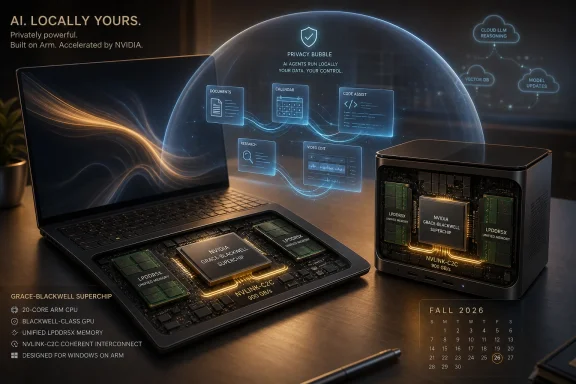
For decades, NVIDIA’s role in the PC was easy to understand. Intel or AMD supplied the CPU, Microsoft supplied Windows, OEMs built the machines, and NVIDIA sold the high-margin accelerator that made games, rendering, and later AI workloads faster. RTX Spark bends that old division of labor. The chip combines a Blackwell-class RTX GPU with a 20-core Grace CPU, joined by NVIDIA’s NVLink-C2C interconnect and backed by up to 128GB of LPDDR5X unified memory.
That makes RTX Spark feel less like a traditional laptop part and more like a PC-shaped descendant of NVIDIA’s Grace Blackwell systems. The company has spent the last few years training the market to think of compute as a stack: silicon, interconnects, libraries, models, tools, and developer frameworks. Now it is trying to bring that stack down from the data center and workstation into a premium Windows laptop.
This is why Microsoft’s presence matters. NVIDIA can build dazzling chips, but Windows remains the default environment for much of the world’s commercial desktop computing. If AI agents are going to manipulate files, launch apps, summarize local documents, alter media projects, and interact with enterprise data, they need operating-system-level permissions, containment, identity, and policy. That is Microsoft’s territory.
The RTX Spark announcement is therefore less a chip launch than a proposed new constitutional arrangement for the PC. NVIDIA gets a route around the old x86 center of gravity. Microsoft gets a hardware partner with unmatched AI credibility. OEMs get a premium story in a laptop market that has spent years fighting over thinness, battery life, and incremental CPU gains.
RTX Spark is a more direct answer to the obvious question: what changes if the AI hardware is actually powerful? NVIDIA claims top configurations can run large language models with up to 120 billion parameters locally, support 12K video editing, generate 4K video with built-in AI, and drive RTX gaming workloads at 1440p with ray tracing. Even allowing for vendor-friendly benchmarks and best-case demos, that is a very different class of ambition from “your webcam background blur is better now.”
The 128GB unified memory figure is especially important. Local AI is often less constrained by raw arithmetic than by memory capacity and bandwidth. A machine that can keep a serious model resident while also running creative applications, browser sessions, Windows services, and agent frameworks begins to look like a credible development and production environment rather than a toy demo box.
That does not mean NVIDIA has solved the AI PC. It means the company has identified the missing ingredient in Microsoft’s story. A PC that supposedly runs personal agents cannot be built around hardware that only handles small models, narrow tasks, or marketing demos. The machine has to feel like it has enough headroom to make local AI worth the additional cost.
This is also where the comparison with Apple becomes unavoidable. Apple Silicon changed expectations because the hardware, memory architecture, operating system, and developer tools moved together. Qualcomm’s Snapdragon X chips pushed Windows closer to that model, particularly around efficiency and battery life. RTX Spark is NVIDIA and Microsoft’s attempt to say that Windows can have its own integrated moment — not by copying the Mac, but by making local AI and RTX acceleration the defining features.
That is why Jensen Huang’s framing matters. The old PC model was application-first: launch the tool, learn its interface, perform the task. The new model NVIDIA wants to sell is intent-first: describe the outcome and let software assemble the steps. If that works, the productivity gain is obvious. If it fails, the blast radius is also obvious.
An agent running locally on a Windows PC is not just another app with a cute icon. It may need access to documents, credentials, browser sessions, media libraries, calendars, project files, enterprise repositories, and cloud services. It may need to inspect sensitive information in order to be useful. It may also need to send some requests to remote models when local capability is not enough.
That is why the security claims around RTX Spark deserve more attention than the benchmark claims. Microsoft says new Windows primitives will provide isolation, policy management, and end-to-end protection for agents. NVIDIA is bringing OpenShell to Windows as a way to define what agents can and cannot do, with automatic redaction of sensitive data when requests move to the cloud.
The idea is sensible: agents need a permissions model that is more granular than “this app can access your files.” But the history of desktop security is full of abstractions that sounded good until real users, real enterprises, and real malware got involved. If an agent can read, reason, and act across applications, then the difference between helpful automation and automated data leakage becomes a policy boundary. That boundary has to be visible, manageable, auditable, and hard to bypass.
Windows on Arm has improved dramatically, but it still carries baggage. Compatibility, driver support, anti-cheat systems, obscure utilities, enterprise agents, VPN clients, and old line-of-business software have all been pressure points. Qualcomm’s Snapdragon X push improved the category’s credibility, but it did not erase every admin’s memory of earlier Windows RT and Windows on Arm disappointments.
NVIDIA changes the conversation because its software ecosystem is not marginal. CUDA is not just a developer API; it is a gravitational field. Creative tools, scientific software, AI frameworks, game engines, and professional workflows already orbit NVIDIA acceleration. If RTX Spark can bring enough of that stack to thin Windows machines, it may give developers a stronger reason to care about Arm Windows than battery life alone.
But the compatibility question does not go away just because the GPU is formidable. Enterprise buyers will ask whether their endpoint tools work. Gamers will ask which anti-cheat systems support the platform. Creators will ask whether plug-ins, codecs, capture devices, color tools, and storage workflows behave normally. Developers will ask whether local AI toolchains run cleanly without spending half a day in dependency hell.
Microsoft and NVIDIA can win those arguments, but not with a keynote. They need shipping devices, stable drivers, clear compatibility lists, and boringly reliable updates. The most successful platform transitions are not the ones with the loudest launch claims. They are the ones where users stop thinking about the transition.
The companies say Adobe is reworking Photoshop and Premiere around RTX Spark, including GPU-accelerated compositing, live filters, HDR support, unified-memory-aware video pipelines, real-time editing, and color grading. That is exactly the kind of workload where unified memory and a strong GPU can matter. It is also the kind of workload where creators already pay for hardware that saves time.
This is where RTX Spark may find its earliest audience. The first buyers may not be ordinary consumers asking an agent to tidy up their inbox. They may be video editors, 3D artists, AI developers, researchers, and technical creators who understand local compute constraints and can justify premium pricing. For them, a thin laptop that handles large media projects, local models, and RTX rendering without immediately collapsing on battery could be compelling.
The gaming angle is more complicated. NVIDIA is promising support across a broad ecosystem of games and apps, and RTX branding still carries enormous weight among PC gamers. But Windows on Arm gaming is not just about GPU horsepower. It is about translation layers, drivers, store support, anti-cheat compatibility, and developer optimization.
If RTX Spark can deliver real 1440p ray-traced gaming in a thin laptop while also serving as a local AI workstation, it becomes an unusual hybrid machine. If game compatibility is inconsistent, the gaming pitch becomes a halo feature rather than a reason to buy. NVIDIA’s challenge is that PC gamers are both loyal and unforgiving. They will admire the silicon and still roast the platform if their library does not work.
The stated power range, from very low idle draw up to around 80 watts, suggests a platform designed to scale aggressively. That is essential if RTX Spark laptops are going to be as thin as 14mm and as light as 1.3kg. A chip that can run large models and RTX workloads is only useful in a portable machine if it can also behave politely while browsing, writing, attending meetings, and sleeping in a bag.
Apple’s success with MacBooks has trained users to expect consistent performance, low fan noise, instant wake, and long battery life. Windows laptops have improved, but the high-performance segment still often asks buyers to accept heat, noise, and battery compromises. Qualcomm’s Snapdragon X machines attacked that problem from the efficiency side. NVIDIA is attacking it from the “what if the efficient machine were also a monster” side.
That is an attractive story, but physics will still get a vote. Running a large local model, rendering a scene, or generating video is not the same as editing a document. Thin chassis have thermal limits. Small batteries have energy limits. OEM tuning will matter enormously, and two laptops with the same RTX Spark branding may behave very differently under sustained load.
The smart move for buyers is to treat launch numbers as directional rather than definitive. The promise is clear: workstation-class AI and graphics in premium portable Windows machines. The proof will come from independent testing, fan curves, battery rundown under real creative workloads, and whether performance remains stable after 20 minutes rather than 20 seconds.
RTX Spark gives Microsoft a more coherent hardware foundation for the claim that Windows is becoming agentic. If the OS has new containment primitives, if NVIDIA supplies OpenShell, if local models can run with meaningful capability, and if flagship devices ship from Surface and the major OEMs, then Copilot’s role can become less ornamental. It can become the visible layer of a deeper system.
That is also why the Surface Laptop Ultra matters. Microsoft’s own hardware line has always served as both product and message. A Surface built around RTX Spark tells OEMs, developers, and enterprise customers that Microsoft is willing to put its brand behind this architecture. It also gives Microsoft a controlled showcase for the best-case version of the platform.
But Microsoft has to be careful. Windows users have become sensitive to AI features that feel imposed rather than useful. The backlash to intrusive prompts, privacy concerns, and unclear data handling is real. An AI PC that constantly markets itself will irritate people. An AI PC that quietly saves time while giving users control might actually change habits.
For administrators, the manageability story will be decisive. If agents become first-class Windows actors, then they need first-class enterprise controls. IT teams will want to restrict which agents can run, what data they can touch, when cloud escalation is allowed, how logs are retained, and how policy integrates with existing identity and endpoint management. Without that, RTX Spark becomes a premium creator machine, not an enterprise platform.
That is not a weakness by itself. New PC categories often begin at the top. Ultrabooks, gaming laptops, mobile workstations, and creator notebooks all started as expensive machines before the ideas spread downward. The question is whether RTX Spark introduces capabilities that can eventually reshape mainstream PCs or whether it remains a powerful niche for people who already buy expensive hardware.
The OEM lineup suggests NVIDIA and Microsoft want both outcomes. ASUS, Dell, HP, Lenovo, Surface, and MSI cover creators, business users, gamers, and prosumers. Acer and GIGABYTE following later would broaden the ecosystem. Compact desktops are also important because they remove some of the thermal anxiety around thin laptops while preserving the local AI workstation pitch.
This could put pressure on Intel, AMD, and Qualcomm from different directions. Intel and AMD will have to defend the x86 PC not only on compatibility but on local AI capability and GPU integration. Qualcomm will have to show that efficiency-first Arm PCs can compete as AI workloads get heavier. Apple will continue to benefit from its mature integrated platform, but RTX Spark gives Windows a more aggressive high-end response.
NVIDIA, meanwhile, gains leverage. If RTX Spark succeeds, it becomes a central supplier not just for data centers and gaming rigs but for a new class of Windows machines. That would deepen NVIDIA’s reach into the client market at a time when AI software is still being written around its tools.
That is the lesson every grand PC reinvention eventually relearns. The tablet PC, Windows RT, Windows 8, mixed reality, and early AI PC campaigns all had kernels of truth. Each ran into some combination of timing, software readiness, user expectation, and ecosystem friction. The PC is not hard to reinvent because people lack imagination. It is hard to reinvent because people depend on it.
RTX Spark has a better shot than many previous efforts because it is attached to real compute demand. Local AI is not a decorative feature for developers and creators wrestling with model size, privacy constraints, latency, and cloud costs. A laptop that can run serious models offline, accelerate media work, and still behave like a premium Windows machine has a clear audience.
But agents raise the trust bar. A faster GPU can fail gracefully; a bad agent can delete the wrong file, expose the wrong document, send the wrong summary, or automate the wrong workflow. The more capable the system becomes, the less acceptable vague consent dialogs become. Users need to understand what is happening without needing to become security engineers.
That is where Microsoft’s new security primitives and NVIDIA’s OpenShell will either become the foundation of the category or another layer of branding. Policy must be legible. Redaction must be dependable. Local processing must be clear. Cloud handoff must be explicit enough for regulated environments. The agent PC cannot be a black box that asks for trust while hiding the mechanisms that justify it.
 NVIDIA Is Not Just Supplying a GPU This Time
The most important thing about RTX Spark is not the CUDA core count, impressive though that number is. It is that NVIDIA is walking into the Windows PC market as a platform company, not as an add-in graphics vendor.For decades, NVIDIA’s role in the PC was easy to understand. Intel or AMD supplied the CPU, Microsoft supplied Windows, OEMs built the machines, and NVIDIA sold the high-margin accelerator that made games, rendering, and later AI workloads faster. RTX Spark bends that old division of labor. The chip combines a Blackwell-class RTX GPU with a 20-core Grace CPU, joined by NVIDIA’s NVLink-C2C interconnect and backed by up to 128GB of LPDDR5X unified memory.
That makes RTX Spark feel less like a traditional laptop part and more like a PC-shaped descendant of NVIDIA’s Grace Blackwell systems. The company has spent the last few years training the market to think of compute as a stack: silicon, interconnects, libraries, models, tools, and developer frameworks. Now it is trying to bring that stack down from the data center and workstation into a premium Windows laptop.
This is why Microsoft’s presence matters. NVIDIA can build dazzling chips, but Windows remains the default environment for much of the world’s commercial desktop computing. If AI agents are going to manipulate files, launch apps, summarize local documents, alter media projects, and interact with enterprise data, they need operating-system-level permissions, containment, identity, and policy. That is Microsoft’s territory.
The RTX Spark announcement is therefore less a chip launch than a proposed new constitutional arrangement for the PC. NVIDIA gets a route around the old x86 center of gravity. Microsoft gets a hardware partner with unmatched AI credibility. OEMs get a premium story in a laptop market that has spent years fighting over thinness, battery life, and incremental CPU gains.
The AI PC Needed Something More Convincing Than a Badge
Microsoft has already tried to sell the AI PC as a category. The first wave, built heavily around neural processing units and Copilot branding, was real enough as hardware but fuzzy as a consumer proposition. It promised local AI, but many users saw a laptop with a new sticker, a Copilot key, and a collection of features that still leaned heavily on the cloud.RTX Spark is a more direct answer to the obvious question: what changes if the AI hardware is actually powerful? NVIDIA claims top configurations can run large language models with up to 120 billion parameters locally, support 12K video editing, generate 4K video with built-in AI, and drive RTX gaming workloads at 1440p with ray tracing. Even allowing for vendor-friendly benchmarks and best-case demos, that is a very different class of ambition from “your webcam background blur is better now.”
The 128GB unified memory figure is especially important. Local AI is often less constrained by raw arithmetic than by memory capacity and bandwidth. A machine that can keep a serious model resident while also running creative applications, browser sessions, Windows services, and agent frameworks begins to look like a credible development and production environment rather than a toy demo box.
That does not mean NVIDIA has solved the AI PC. It means the company has identified the missing ingredient in Microsoft’s story. A PC that supposedly runs personal agents cannot be built around hardware that only handles small models, narrow tasks, or marketing demos. The machine has to feel like it has enough headroom to make local AI worth the additional cost.
This is also where the comparison with Apple becomes unavoidable. Apple Silicon changed expectations because the hardware, memory architecture, operating system, and developer tools moved together. Qualcomm’s Snapdragon X chips pushed Windows closer to that model, particularly around efficiency and battery life. RTX Spark is NVIDIA and Microsoft’s attempt to say that Windows can have its own integrated moment — not by copying the Mac, but by making local AI and RTX acceleration the defining features.
The Agent Story Is Powerful Because It Is Dangerous
NVIDIA and Microsoft are using the language of agents because it is the one AI concept that plausibly changes how people use PCs. A chatbot answers. An agent acts. It opens the spreadsheet, edits the file, queries the database, books the meeting, renders the clip, commits the code, or files the ticket.That is why Jensen Huang’s framing matters. The old PC model was application-first: launch the tool, learn its interface, perform the task. The new model NVIDIA wants to sell is intent-first: describe the outcome and let software assemble the steps. If that works, the productivity gain is obvious. If it fails, the blast radius is also obvious.
An agent running locally on a Windows PC is not just another app with a cute icon. It may need access to documents, credentials, browser sessions, media libraries, calendars, project files, enterprise repositories, and cloud services. It may need to inspect sensitive information in order to be useful. It may also need to send some requests to remote models when local capability is not enough.
That is why the security claims around RTX Spark deserve more attention than the benchmark claims. Microsoft says new Windows primitives will provide isolation, policy management, and end-to-end protection for agents. NVIDIA is bringing OpenShell to Windows as a way to define what agents can and cannot do, with automatic redaction of sensitive data when requests move to the cloud.
The idea is sensible: agents need a permissions model that is more granular than “this app can access your files.” But the history of desktop security is full of abstractions that sounded good until real users, real enterprises, and real malware got involved. If an agent can read, reason, and act across applications, then the difference between helpful automation and automated data leakage becomes a policy boundary. That boundary has to be visible, manageable, auditable, and hard to bypass.
Windows on Arm Gets Its Most Serious Test Yet
RTX Spark is also a Windows on Arm story, whether Microsoft emphasizes that or not. NVIDIA’s Grace CPU is Arm-based, and MediaTek’s involvement points to the long-running effort to build more efficient non-x86 Windows machines. That makes RTX Spark part of a broader campaign to loosen Intel and AMD’s historical grip on the PC.Windows on Arm has improved dramatically, but it still carries baggage. Compatibility, driver support, anti-cheat systems, obscure utilities, enterprise agents, VPN clients, and old line-of-business software have all been pressure points. Qualcomm’s Snapdragon X push improved the category’s credibility, but it did not erase every admin’s memory of earlier Windows RT and Windows on Arm disappointments.
NVIDIA changes the conversation because its software ecosystem is not marginal. CUDA is not just a developer API; it is a gravitational field. Creative tools, scientific software, AI frameworks, game engines, and professional workflows already orbit NVIDIA acceleration. If RTX Spark can bring enough of that stack to thin Windows machines, it may give developers a stronger reason to care about Arm Windows than battery life alone.
But the compatibility question does not go away just because the GPU is formidable. Enterprise buyers will ask whether their endpoint tools work. Gamers will ask which anti-cheat systems support the platform. Creators will ask whether plug-ins, codecs, capture devices, color tools, and storage workflows behave normally. Developers will ask whether local AI toolchains run cleanly without spending half a day in dependency hell.
Microsoft and NVIDIA can win those arguments, but not with a keynote. They need shipping devices, stable drivers, clear compatibility lists, and boringly reliable updates. The most successful platform transitions are not the ones with the loudest launch claims. They are the ones where users stop thinking about the transition.
The Creative Workstation Is Being Folded Into the Laptop
The Adobe partnership is one of the most commercially important pieces of the announcement. NVIDIA and Microsoft can talk about agents all day, but Photoshop and Premiere are where many premium laptop buyers experience hardware acceleration in daily work. If those apps get substantially faster, the pitch becomes concrete.The companies say Adobe is reworking Photoshop and Premiere around RTX Spark, including GPU-accelerated compositing, live filters, HDR support, unified-memory-aware video pipelines, real-time editing, and color grading. That is exactly the kind of workload where unified memory and a strong GPU can matter. It is also the kind of workload where creators already pay for hardware that saves time.
This is where RTX Spark may find its earliest audience. The first buyers may not be ordinary consumers asking an agent to tidy up their inbox. They may be video editors, 3D artists, AI developers, researchers, and technical creators who understand local compute constraints and can justify premium pricing. For them, a thin laptop that handles large media projects, local models, and RTX rendering without immediately collapsing on battery could be compelling.
The gaming angle is more complicated. NVIDIA is promising support across a broad ecosystem of games and apps, and RTX branding still carries enormous weight among PC gamers. But Windows on Arm gaming is not just about GPU horsepower. It is about translation layers, drivers, store support, anti-cheat compatibility, and developer optimization.
If RTX Spark can deliver real 1440p ray-traced gaming in a thin laptop while also serving as a local AI workstation, it becomes an unusual hybrid machine. If game compatibility is inconsistent, the gaming pitch becomes a halo feature rather than a reason to buy. NVIDIA’s challenge is that PC gamers are both loyal and unforgiving. They will admire the silicon and still roast the platform if their library does not work.
The Battery-Life Claim Is the One to Watch
NVIDIA is reportedly positioning RTX Spark systems as thin, premium machines that can deliver the same performance on battery as they do when plugged in. That is a provocative claim because it attacks one of the oldest weaknesses of powerful Windows laptops: the dramatic falloff when the power cable comes out.The stated power range, from very low idle draw up to around 80 watts, suggests a platform designed to scale aggressively. That is essential if RTX Spark laptops are going to be as thin as 14mm and as light as 1.3kg. A chip that can run large models and RTX workloads is only useful in a portable machine if it can also behave politely while browsing, writing, attending meetings, and sleeping in a bag.
Apple’s success with MacBooks has trained users to expect consistent performance, low fan noise, instant wake, and long battery life. Windows laptops have improved, but the high-performance segment still often asks buyers to accept heat, noise, and battery compromises. Qualcomm’s Snapdragon X machines attacked that problem from the efficiency side. NVIDIA is attacking it from the “what if the efficient machine were also a monster” side.
That is an attractive story, but physics will still get a vote. Running a large local model, rendering a scene, or generating video is not the same as editing a document. Thin chassis have thermal limits. Small batteries have energy limits. OEM tuning will matter enormously, and two laptops with the same RTX Spark branding may behave very differently under sustained load.
The smart move for buyers is to treat launch numbers as directional rather than definitive. The promise is clear: workstation-class AI and graphics in premium portable Windows machines. The proof will come from independent testing, fan curves, battery rundown under real creative workloads, and whether performance remains stable after 20 minutes rather than 20 seconds.
Microsoft Finally Has a Hardware Story Big Enough for Copilot
Microsoft has spent the last few years putting Copilot into everything. The problem is that distribution is not the same as transformation. A button on the taskbar does not redefine the PC. A cloud chatbot living beside Windows does not automatically make Windows an AI-native operating system.RTX Spark gives Microsoft a more coherent hardware foundation for the claim that Windows is becoming agentic. If the OS has new containment primitives, if NVIDIA supplies OpenShell, if local models can run with meaningful capability, and if flagship devices ship from Surface and the major OEMs, then Copilot’s role can become less ornamental. It can become the visible layer of a deeper system.
That is also why the Surface Laptop Ultra matters. Microsoft’s own hardware line has always served as both product and message. A Surface built around RTX Spark tells OEMs, developers, and enterprise customers that Microsoft is willing to put its brand behind this architecture. It also gives Microsoft a controlled showcase for the best-case version of the platform.
But Microsoft has to be careful. Windows users have become sensitive to AI features that feel imposed rather than useful. The backlash to intrusive prompts, privacy concerns, and unclear data handling is real. An AI PC that constantly markets itself will irritate people. An AI PC that quietly saves time while giving users control might actually change habits.
For administrators, the manageability story will be decisive. If agents become first-class Windows actors, then they need first-class enterprise controls. IT teams will want to restrict which agents can run, what data they can touch, when cloud escalation is allowed, how logs are retained, and how policy integrates with existing identity and endpoint management. Without that, RTX Spark becomes a premium creator machine, not an enterprise platform.
The Premium PC Market Gets a New Center of Gravity
Pricing has not been disclosed, but nobody should expect RTX Spark systems to be cheap. The hardware bill is too ambitious, the memory configurations are too large, and the launch partners are already positioning early devices as premium products. This is a flagship play.That is not a weakness by itself. New PC categories often begin at the top. Ultrabooks, gaming laptops, mobile workstations, and creator notebooks all started as expensive machines before the ideas spread downward. The question is whether RTX Spark introduces capabilities that can eventually reshape mainstream PCs or whether it remains a powerful niche for people who already buy expensive hardware.
The OEM lineup suggests NVIDIA and Microsoft want both outcomes. ASUS, Dell, HP, Lenovo, Surface, and MSI cover creators, business users, gamers, and prosumers. Acer and GIGABYTE following later would broaden the ecosystem. Compact desktops are also important because they remove some of the thermal anxiety around thin laptops while preserving the local AI workstation pitch.
This could put pressure on Intel, AMD, and Qualcomm from different directions. Intel and AMD will have to defend the x86 PC not only on compatibility but on local AI capability and GPU integration. Qualcomm will have to show that efficiency-first Arm PCs can compete as AI workloads get heavier. Apple will continue to benefit from its mature integrated platform, but RTX Spark gives Windows a more aggressive high-end response.
NVIDIA, meanwhile, gains leverage. If RTX Spark succeeds, it becomes a central supplier not just for data centers and gaming rigs but for a new class of Windows machines. That would deepen NVIDIA’s reach into the client market at a time when AI software is still being written around its tools.
The Agent PC Will Be Judged by Boring Things
The most futuristic part of RTX Spark is the least important thing to get right first. Before users trust a PC to execute complex tasks from prompts, they need the ordinary parts to work. The keyboard, sleep states, drivers, displays, thermals, app compatibility, updates, docks, printers, VPNs, and browser behavior all have to be boring.That is the lesson every grand PC reinvention eventually relearns. The tablet PC, Windows RT, Windows 8, mixed reality, and early AI PC campaigns all had kernels of truth. Each ran into some combination of timing, software readiness, user expectation, and ecosystem friction. The PC is not hard to reinvent because people lack imagination. It is hard to reinvent because people depend on it.
RTX Spark has a better shot than many previous efforts because it is attached to real compute demand. Local AI is not a decorative feature for developers and creators wrestling with model size, privacy constraints, latency, and cloud costs. A laptop that can run serious models offline, accelerate media work, and still behave like a premium Windows machine has a clear audience.
But agents raise the trust bar. A faster GPU can fail gracefully; a bad agent can delete the wrong file, expose the wrong document, send the wrong summary, or automate the wrong workflow. The more capable the system becomes, the less acceptable vague consent dialogs become. Users need to understand what is happening without needing to become security engineers.
That is where Microsoft’s new security primitives and NVIDIA’s OpenShell will either become the foundation of the category or another layer of branding. Policy must be legible. Redaction must be dependable. Local processing must be clear. Cloud handoff must be explicit enough for regulated environments. The agent PC cannot be a black box that asks for trust while hiding the mechanisms that justify it.
The Fall 2026 Test Is Bigger Than One Superchip
The concrete details are enough to make RTX Spark one of the most important Windows hardware announcements in years, but the unresolved questions are just as significant.- RTX Spark moves NVIDIA from being a premium PC component supplier toward being a full Windows platform architect.
- The strongest early case is for creators, developers, researchers, and technical users who can benefit immediately from local AI and RTX-class acceleration.
- Windows on Arm compatibility remains the practical risk that could separate impressive demos from satisfying daily use.
- Microsoft’s agent security model will need to be understandable, enforceable, and enterprise-manageable if local agents are to become more than consumer curiosities.
- Battery life, sustained performance, thermals, and pricing will decide whether RTX Spark feels like a new PC category or a spectacular niche machine.
- The first Surface, Dell, HP, Lenovo, ASUS, and MSI systems will be judged less by keynote promises than by how normally they handle abnormal amounts of local compute.
References
- Primary source: incrypted
Published: Mon, 01 Jun 2026 12:38:47 GMT
Loading…
incrypted.com - Related coverage: axios.com

Microsoft debuts Nvidia-powered Microsoft Surface Ultra laptop
Microsoft is trying again to redefine the PC for the AI era.www.axios.com
- Related coverage: nvidianews.nvidia.com

NVIDIA and Microsoft Reinvent Windows PCs for the Age of Personal AI
NVIDIA today unveiled NVIDIA RTX Spark™, a new superchip that reinvents Windows PCs for the era of personal AI agents — offering a new class of computer that moves from tool to teammate.nvidianews.nvidia.com
- Related coverage: nvidia.com

NVIDIA RTX Spark — Slim Laptops & Small Desktops
The fusion of NVIDIA AI and RTX graphics.www.nvidia.com - Related coverage: tomshardware.com

Nvidia unveils RTX Spark Superchip for laptops and desktop PCs at Computex 2026 – new platform promises to turn Windows into an agentic AI OS with Arm CPU, Blackwell GPU, and 128GB unified memory
Over 30 laptops and 10 desktops coming this fall with "the most efficent platform ever built"www.tomshardware.com
- Related coverage: investor.nvidia.com

NVIDIA and Microsoft Reinvent Windows PCs for the Age of Personal AI
RTX Spark — a 1-Petaflop Superchip, the Full CUDA and RTX Ecosystem, and Windows-Native Agents — a New Beginning for Personal Computers News Summary: NVIDIA RTX Spark powers the world’s first Windows PCs purpose-built for personal agents, featuring 1 petaflop of AI performance, industry-leading...investor.nvidia.com
- Related coverage: techrepublic.com

Nvidia, Microsoft Launch RTX Spark PCs for AI Agents
Nvidia and Microsoft unveiled RTX Spark Windows PCs built for local AI agents, with systems expected from major PC makers this fall.www.techrepublic.com
- Related coverage: business-standard.com
Loading…
www.business-standard.com - Related coverage: theguardian.com

Nvidia launches ‘superchip’ putting AI power into laptops and PCs
Firm says its RTX Spark PC chip for Microsoft Windows will let AI agents replace the mouse and keyboardwww.theguardian.com
- Related coverage: banklesstimes.com
Loading…
www.banklesstimes.com - Official source: blogs.windows.com

Introducing a powerful new chapter for Windows PCs, accelerated by NVIDIA RTX Spark
Today at NVIDIA GTC, Microsoft and NVIDIA announced the world’s most powerful and efficient thin-and-light Windows PCs ever. Accelerated by NVIDIA RTX Spark blogs.windows.com
- Related coverage: techtimes.com
Loading…
www.techtimes.com - Related coverage: techmymoney.com
Loading…
techmymoney.com - Related coverage: pcworld.com

Nvidia's RTX Spark chip 'reinvents' laptops for agentic AI
Nvidia launched its RTX Spark platform, "purpose-built for personal agents," in advance of Computex Sunday night, pairing an N1X CPU along with its own Blackwell RTX GPU. Does it reinvent the PC for agentic AI, or is it just another gaming laptop? www.pcworld.com
- Related coverage: elpais.com
Loading…
elpais.com - Related coverage: images.nvidia.com
Loading…
images.nvidia.com