

Nvidia is quietly shifting course on a plan that once read like a direct challenge to the cloud giants: rather than push DGX Cloud as a public hyperscale competitor to Amazon Web Services, Google Cloud and Microsoft Azure, the company is reorganising the unit to prioritise internal model development and chip engineering — a strategic retreat shaped by thorny technical, commercial and political realities.
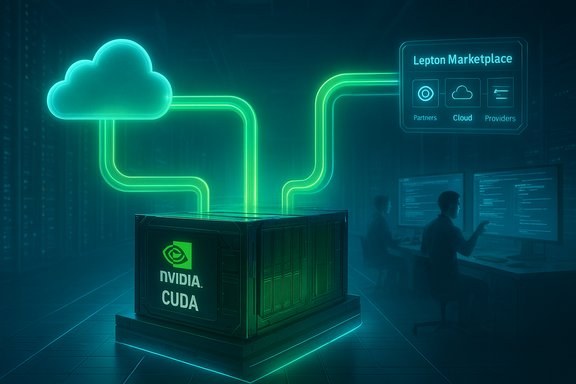
When Nvidia launched DGX Cloud it pitched a different path into the AI infrastructure market: a managed, Nvidia‑branded environment that bundled the company’s leading GPU hardware, optimized software stack and managed services into a “white‑glove” cloud offering for enterprises that needed frontier training and inference capabilities without building their own clusters. The vision combined hardware, system‑level engineering (DGX servers) and Nvidia’s AI software to deliver predictable, high‑performance model training. Alongside the original DGX Cloud product Nvidia also introduced DGX Cloud Lepton, recasting part of the company’s cloud play into a compute marketplace and orchestration layer that would route workloads to a network of cloud partners rather than force Nvidia to be the landlord of datacenter racks. Lepton was explicitly sold as a way to give developers unified access to Nvidia‑powered GPUs across multiple providers — an attempt to keep Nvidia in the stack without owning every piece of the underlying infrastructure.
Source: Firstpost https://www.firstpost.com/world/nvi...ith-amazon-google-and-microsoft-13962853.html
 Background: what DGX Cloud was supposed to be
When Nvidia launched DGX Cloud it pitched a different path into the AI infrastructure market: a managed, Nvidia‑branded environment that bundled the company’s leading GPU hardware, optimized software stack and managed services into a “white‑glove” cloud offering for enterprises that needed frontier training and inference capabilities without building their own clusters. The vision combined hardware, system‑level engineering (DGX servers) and Nvidia’s AI software to deliver predictable, high‑performance model training. Alongside the original DGX Cloud product Nvidia also introduced DGX Cloud Lepton, recasting part of the company’s cloud play into a compute marketplace and orchestration layer that would route workloads to a network of cloud partners rather than force Nvidia to be the landlord of datacenter racks. Lepton was explicitly sold as a way to give developers unified access to Nvidia‑powered GPUs across multiple providers — an attempt to keep Nvidia in the stack without owning every piece of the underlying infrastructure. What changed: the pivot from public cloud to internal R&D
In recent reporting, multiple outlets — citing people familiar with the situation — described a meaningful shift: Nvidia has integrated much of the DGX Cloud team into its core engineering organisation and is using the platform primarily to accelerate internal chip design, model development and research rather than aggressively pursuing enterprise cloud customers. That reorganisation reportedly places DGX Cloud capacity behind Nvidia’s own product and research pipelines rather than marketing it as a broad, customer‑facing hyperscale cloud alternative. This pivot is not framed as an abandonment so much as a re‑prioritisation. Public materials and Nvidia’s ongoing pushes around Lepton and partner programs remain live, but the emphasis in practice has moved toward internal compute usage and marketplace orchestration instead of direct retailing of a Nvidia‑run public cloud. Industry commentary that tracked the change frames it as a pragmatic response to operational difficulties and political friction with major cloud customers.Why Nvidia stepped back: three core reasons
1) Multi‑cloud operational complexity and support fragility
Running a single, tightly tuned DGX experience across data centres owned and operated by different cloud providers proved operationally costly. Fixes and firmware tweaks that worked on one provider’s hardware or networking stack often did not translate cleanly to another’s; coordinating low‑level troubleshooting across multiple hosts increased support complexity and slowed response times for customers running expensive, time‑sensitive training jobs. The overlay‑on‑hyperscaler approach multiplied the number of teams, logs and escalation paths — a serious liability for an offering that promised predictable white‑glove service.2) Economics: price compression by hyperscalers removed DGX Cloud’s premium
DGX Cloud originally commanded a premium price that relied in part on scarcity of H100‑class hardware. As supply tightened up and hyperscalers aggressively cut prices for GPU instances, the arbitrage DGX Cloud targeted began to evaporate. Public reporting shows hyperscalers trimmed H100/A100 pricing substantially, narrowing the gap between a hyperscaler instance and Nvidia’s premium managed stack — a dynamic that undercut the commercial case for a high‑priced, Nvidia‑run public cloud.3) Strategic politics: you don’t sell a public cloud to the firms that buy most of your chips
Most consequentially, Nvidia’s biggest cloud customers are also its biggest chip customers. Executives reportedly grew cautious about pressing into a retail cloud role that might antagonize Amazon, Microsoft or Google — companies that collectively buy vast quantities of GPUs from Nvidia. The strategic calculus was stark: winning cloud market share could mean alienating the very buyers who fund Nvidia’s core hardware business, with the attendant risk of accelerated hyperscaler investment in proprietary silicon. That political line of risk weighed heavily on the company’s decision making.The $150 billion headline — what it meant and where it came from
At one point Nvidia and its supporters discussed very large upside for cloud and agent‑driven AI markets. Some internal estimates cited in reporting suggested the company once modelled DGX Cloud and adjacent opportunities as potentially capturing up to tens of billions — in some descriptions framed as a path to as much as $150 billion of future revenue if Nvidia captured a slice of a very large agentic AI market. That figure appeared in later coverage as part of an investor‑facing narrative about the scale of the AI opportunity, but it is important to treat it as an aspirational market‑share extrapolation rather than a contracted pipeline item. The $150 billion figure traces back to speculative projections about agentic AI markets and to Investor/analyst math that assumes even a small share of a multi‑trillion‑dollar AI services market. Caution is warranted: the $150 billion number is projection‑level thinking, not a guaranteed revenue stream, and recent operational shifts show Nvidia is reframing how it expects to capture that opportunity (software, marketplace orchestration and hardware ecosystem control rather than operating a full public cloud).Alternative route: Lepton, marketplaces and orchestration
Rather than operate a traditional public cloud, Nvidia appears to be accelerating an alternative where the company controls the software, orchestration and developer experience while aggregating partner capacity through a marketplace model. DGX Cloud Lepton is the visible expression of that strategy: a marketplace and control plane that connects developers with GPUs offered by a broad set of partners — from hyperscalers to specialist GPU clouds — while keeping Nvidia’s stack (software, telemetry, performance tooling) as the glue. This lets Nvidia influence workload routing and retain vendor lock‑in through software and APIs, without carrying the same capital, operational or partner‑political burdens that come with running a public cloud. Advantages of this approach include:- Reduced capital exposure and balance‑sheet risk versus owning and operating datacenters.
- Preservation of cooperative relationships with hyperscalers by avoiding direct competition on infrastructure economics.
- Continued control of the developer experience (CUDA stack, model tooling, NIM/NeMo microservices), which remains Nvidia’s strategic moat.
Market context: Nvidia’s dominance and the rising alternatives
Nvidia continues to command a dominant share of the AI accelerator market, a structural reality that shapes the choices of hyperscalers and enterprises alike. Independent market research and industry trackers place Nvidia’s share of the AI‑focused data‑center GPU market in the high‑60s to 80%+ range, depending on the metric and period analysed — a level of dominance that gives Nvidia extraordinary leverage but also invites regulatory and competitive responses. Those numbers help explain why hyperscalers can safely push down prices: they run at scale and buy GPUs by the tens of thousands. At the same time, hyperscalers are not idle. Amazon has developed Trainium and Inferentia chips to reduce inference and training costs; Google continues to invest in TPUs; AMD, Intel and other vendors are pressing into GPU/accelerator markets with MI300‑class and Gaudi-series devices. These trends create an environment where cloud providers can both compete on price and experiment with hardware diversification to reduce dependence on a single supplier. The marketplace model allows Nvidia to stay central to the software and orchestration layer while hyperscalers pursue selective verticalisation.Case study: CoreWeave and Nvidia’s capacity guarantees
Nvidia’s business model has also leaned on partnerships with specialist providers. A high‑profile example: an amended agreement with CoreWeave requires Nvidia to purchase any unsold CoreWeave capacity through April 13, 2032 — a commitment reported to be initially valued at $6.3 billion. That deal functions as a backstop for capacity, enabling CoreWeave to scale data centre investments with reduced utilisation risk, and gives Nvidia optional access to large pools of GPU racks without the company owning the data centres outright. The CoreWeave arrangement illustrates how Nvidia has shifted towards underwriting capacity through partners and commercial commitments rather than building a retail cloud business.What Nvidia’s pivot means for cloud providers, developers and enterprises
For hyperscalers (AWS, Azure, GCP)
Hyperscalers benefit in the short term: a reduced direct retail challenge from Nvidia means less margin pressure from an insurgent competitor that could have eroded long‑term infrastructure economics. It also preserves the existing supplier dynamics, allowing hyperscalers to continue negotiating bulk purchases and to develop proprietary silicon where it makes sense. But it increases the incentive for hyperscalers to continue verticalising — building Trainium, TPUs or other in‑house accelerators — as a hedge against supplier concentration.For smaller GPU cloud providers and “neoclouds”
Specialist providers (CoreWeave, Lambda, Crusoe and others) stand to benefit from Nvidia’s marketplace approach because Lepton can surface their capacity to a larger developer base. But these firms also face concentration risk: long‑dated capacity commitments, potential pricing pressure and the reality that Nvidia can buy unsold capacity — all of which can create circular commercial dynamics that require careful governance.For enterprises and developers
Short term, enterprises win on price as hyperscalers compete aggressively for GPU hours. Tech teams should:- Validate heavy training runs against multiple clouds to capture the best price/performance.
- Design for portability and containerised pipelines to avoid lock‑in.
- Evaluate Lepton and similar orchestration layers to simplify multi‑cloud routing — but insist on concrete SLAs, data locality, and security guarantees before shifting production workloads.
Critical analysis: smart move or missed opportunity?
Strengths of Nvidia’s repositioning
- Capital efficiency: shifting from running a retail cloud to operating a marketplace dramatically reduces the need for Nvidia to bear datacenter capex and operational risk.
- Moat preservation: by focusing on software, orchestration and the developer experience, Nvidia protects the high‑value layer of the stack where its CUDA ecosystem and AI libraries create stickiness.
- Partner architecture: the strategy enables better alignment with cloud partners by reducing direct competition and allowing hyperscalers to remain core customers for bulk GPU purchases.
Real risks and what remains unresolved
- Lost direct revenue: if the market for public cloud services and AI agents grows as some forecasts suggest, forgoing an aggressive public cloud play could mean Nvidia misses a substantial revenue tranche — even if $150 billion is an aspirational number, the opportunity is material.
- Regulatory attention: Nvidia’s dominant position in AI accelerators combined with new orchestration/control layers may draw antitrust scrutiny in multiple jurisdictions, especially if marketplace routing creates opaque advantages.
- Reliance on partner cooperation: the marketplace depends on hyperscalers and specialist providers participating and exposing consistent APIs and SLAs. If major clouds restrict participation or prioritise their own channels, Lepton’s promise will be limited.
- Geopolitical and export restrictions: broader trade or export controls (e.g., the U.S. decisions around GPU exports to China) can remove whole markets from Nvidia’s addressable base and complicate long‑term capacity planning. Enterprise plans and vendor strategies must assume variable regional access.
Short, practical takeaways for WindowsForum readers and IT buyers
- Shop hyperscalers first for large training jobs — competitive pricing and extensive availability make AWS, Azure and Google Cloud the logical first stop for many workloads today.
- Build portability into your pipelines — containerised training workloads and infrastructure‑as‑code will reduce migration friction if you need to shift providers for price or capacity reasons.
- Watch Lepton and similar orchestration offers — they could simplify multi‑cloud GPU procurement but verify SLAs, pricing transparency and data locality before production adoption.
- Reassess procurement timelines for on‑prem vs cloud — if you plan to buy or build GPU racks, account for lifecycle, thermal and performance tradeoffs; sometimes hybrid burst models remain the best economic choice.
Final verdict: pragmatic pivot, credible risks
Nvidia’s decision to down‑shift the customer‑facing ambitions of DGX Cloud and reorient resources toward internal R&D and marketplace orchestration is a pragmatic response to a complex set of forces: operational difficulty running a single tuned stack across multiple hyperscaler environments, rapid price competition from cloud providers, the political risk of upsetting hyperscaler chip purchasers, and strategic preference for owning software and developer tooling rather than datacenter real estate. That pivot preserves Nvidia’s most durable strengths — silicon leadership and software ecosystem control — while trimming exposure to the capital and partner‑political burdens of running a public cloud. At the same time, the move cedes a potential direct revenue path in an expanding market to hyperscalers and other cloud players. Whether Nvidia recaptures that opportunity through marketplace orchestration, software‑plus‑services or licensing deals will be one of the industry’s most consequential strategic contests over the next several years. The question for customers and competitors alike is simple: can a company that dominates GPUs sustain that dominance without also owning the full stack, and will regulators and partners let it do so on terms that benefit the broader market?Source: Firstpost https://www.firstpost.com/world/nvi...ith-amazon-google-and-microsoft-13962853.html
