

Microsoft and Nvidia are expected in early June 2026 to unveil the first Windows PCs using Nvidia chips as the main processor, with the debut reportedly tied to Computex in Taiwan and Microsoft Build in San Francisco. The announcement, if it lands as described, would mark Nvidia’s most direct challenge yet to Intel, AMD, and Qualcomm in the Windows client market. It would also give Microsoft another chance to sell the AI PC story after the first Copilot+ wave arrived with more controversy than conviction.
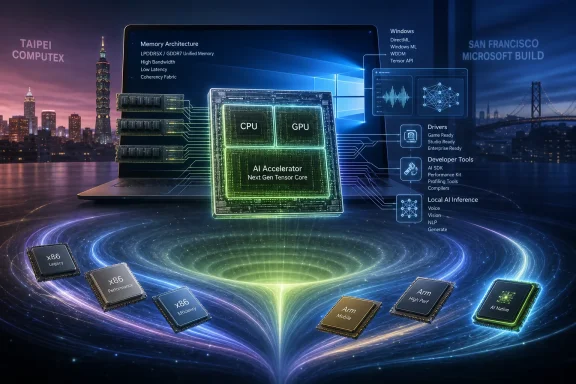
The important phrase is not “Nvidia graphics.” Windows users have lived with Nvidia GPUs for decades. The shift is Nvidia moving into the system processor role: CPU, GPU, AI accelerator, memory architecture, drivers, developer stack, and Windows integration all wrapped into a new class of PC silicon. That makes this less like another laptop launch and more like a referendum on whether Windows can finally absorb the kind of vertically integrated hardware strategy that made Apple Silicon so disruptive.
For most of PC history, Nvidia’s power came from being indispensable without being foundational. Intel or AMD supplied the CPU, Microsoft supplied Windows, OEMs built the chassis, and Nvidia supplied the performance part that gamers, creators, engineers, and increasingly AI developers actually cared about. That arrangement made Nvidia enormously profitable, but it also left the company outside the most strategic layer of the PC.
AI changed the center of gravity. The GPU stopped being a peripheral accelerator and became the main engine of modern computing. In the data center, Nvidia already turned that shift into a platform business: chips, networking, software libraries, developer tools, and procurement gravity all reinforcing one another. A Windows PC powered by Nvidia silicon is the same argument scaled down to the desk, the laptop bag, and eventually the enterprise refresh cycle.
That is why this move matters even if the first machines are expensive, limited, or aimed at developers. Nvidia does not need to win the entire PC market on day one. It needs to prove that the Windows ecosystem can support a PC where Nvidia is not merely the graphics brand on the sticker, but the architect of the machine’s performance identity.
Microsoft has its own reason to welcome the intrusion. The first Copilot+ PCs showed that Windows could define an AI hardware baseline, but they did not yet prove that AI PCs were a must-buy category. Nvidia brings a stronger performance halo, a developer story, and a brand that consumers already associate with serious compute. For Microsoft, that is oxygen.
Instead, Recall swallowed the launch. The feature’s promise was simple and unsettling: Windows would remember what you had seen and done so you could search your own past activity. Microsoft later moved to make it opt-in and reworked the security and privacy model, but the damage was already done. The public conversation drifted away from “new AI workflows” and toward “why is my operating system taking snapshots of my life?”
That left Microsoft with a category problem. Copilot+ PCs could be good laptops, especially on battery life, but the signature AI use case became a trust crisis. For many buyers, the NPU was invisible unless Windows put it in their face. And when Windows did put it in their face, the result was often suspicion rather than desire.
Nvidia’s arrival gives Microsoft a more familiar story to tell: performance first, AI second, productivity third. That order matters. PC buyers understand why a faster GPU, better local model performance, and stronger creative workloads might be valuable. They are more skeptical when the operating system leads with ambient surveillance-adjacent features and asks users to believe the privacy architecture is safe this time.
For ordinary users, the issue is application compatibility. Microsoft has made major progress with emulation, native Arm64 apps, and developer tooling, but the Windows ecosystem remains messier than Apple’s. Legacy utilities, drivers, shell extensions, VPN clients, anti-cheat systems, creative plugins, and obscure business apps can still turn an elegant hardware story into a help-desk ticket.
For enterprises, that uncertainty is the tax on every Arm Windows pitch. A laptop that benchmarks beautifully is not a deployment win if one department’s line-of-business software fails, one security agent behaves oddly, or one printer driver becomes a week-long archaeology project. IT departments do not buy architectures; they buy predictable support boundaries.
That is why Nvidia’s brand cuts both ways. It can make Windows on Arm feel more credible to enthusiasts and developers, but it will also raise expectations. If these machines are positioned as premium AI PCs, buyers will not forgive the sort of compatibility caveats they tolerated in earlier experimental Windows on Arm devices. The standard will be MacBook-level polish, not “better than last time.”
If Nvidia joins the party, Arm-based Windows PCs stop looking like a Qualcomm side bet and start looking like a platform shift. Developers have more reason to compile native Arm64 builds. Peripheral vendors have more reason to care about drivers. Microsoft has more incentive to harden the rough edges because the opportunity now includes not just one chip partner, but multiple strategic silicon suppliers.
This is how ecosystems change: not by one heroic launch, but by the accumulation of reasons to stop ignoring the new target. Apple forced developers to move because it controlled the Mac. Microsoft cannot force the Windows ecosystem with the same elegance, but it can create gravity through OEM volume, silicon diversity, and platform incentives.
Still, Qualcomm will not be celebrating without anxiety. Nvidia does not enter markets politely. If Nvidia can combine competitive CPU performance, strong battery life, GeForce-class graphics credibility, and a superior local AI stack, Qualcomm’s first-mover advantage could compress quickly. The best outcome for Microsoft is a three-way fight among Qualcomm, Nvidia, and the x86 incumbents. The worst outcome for any one chipmaker is being the transitional vendor that proved the market for someone else.
But the threat from Nvidia is not simply another CPU competitor. It is a competitor arriving with the strongest AI hardware narrative in the industry and a software ecosystem that developers already use. CUDA, TensorRT, RTX, DLSS, and Nvidia’s broader AI tooling are not just product names. They are habits, workflows, and assumptions.
Intel’s problem is that “good enough x86 plus an NPU” may not be emotionally compelling in a market being sold as the beginning of the AI era. AMD’s problem is similar but sharper: it has strong CPU and GPU engineering, yet it lacks Nvidia’s near-mythic AI brand. Both companies can deliver excellent PCs, but they must now defend the premise that continuity is better than reinvention.
That defense may still work. Enterprises often prefer continuity. Gamers care about compatibility and discrete GPU roadmaps. Many buyers will choose x86 because it runs everything they already own without a second thought. But if AI workloads become local, persistent, and user-visible, Nvidia can argue that the PC’s center of value has moved onto terrain where it is strongest.
The most important tests will not be synthetic TOPS numbers. The AI PC market is already drowning in abstract performance claims. What matters is whether a user can run a local model without wrecking battery life, transcribe and summarize meetings without sending everything to the cloud, generate media in useful time, search files intelligently, and switch between legacy Windows apps without thinking about the instruction set.
Nvidia also has to solve the laptop problem, not just the chip problem. Apple Silicon succeeded because the whole machine improved: speed, battery, thermals, sleep, video, and silence. Windows buyers will expect the same leap if Nvidia is selling a new architecture. A hot, loud AI laptop with great demos and mediocre everyday behavior will not reset the market.
OEM execution will matter enormously. Dell, HP, Lenovo, Asus, MSI, and Microsoft Surface all know how to build Windows PCs, but they do not all make the same tradeoffs. A great chip can disappear inside a compromised chassis. A merely decent chip can look better than it is inside a carefully tuned premium machine. Nvidia and Microsoft will need the first wave to feel intentional, not like a spec-sheet scramble.
The challenge is that local AI must be useful without feeling creepy. A machine that can summarize documents, index personal files, enhance video calls, run coding assistants, and process images locally has an obvious appeal. A machine that continuously observes user activity and asks for trust after the fact invites backlash.
Nvidia can help here because its developer ecosystem is already oriented around doing real work with accelerated compute. If the Windows AI PC becomes a place where developers can run compact models, prototype agents, build local inference apps, and ship GPU-accelerated experiences, the category gains substance. It becomes less about Microsoft sprinkling AI into Windows and more about Windows becoming a viable local AI platform.
That distinction is critical. Users may not buy a new PC because Windows has another assistant panel. They might buy one because the apps they already use become faster, smarter, and less dependent on subscriptions or round trips to a server. The AI PC only works if the intelligence shows up inside workflows, not just inside marketing.
These are not edge concerns. Microsoft spent the last few years telling enterprises it was recommitting to security after a series of bruising incidents and public criticism. If Windows is now going to host more local AI agents, more semantic indexes, and more background inference, the security model cannot be a white paper stapled to a launch event.
Nvidia brings additional complexity. GPU drivers already sit in a privileged and performance-sensitive part of the system. AI runtimes, model execution layers, and hardware acceleration paths expand the attack surface. That does not make the platform unsafe by default, but it does make transparency and manageability essential.
The best version of this launch would give administrators clear controls from day one. The worst version would repeat the familiar Windows pattern: consumer-first features, enterprise controls later, and admins left to reverse-engineer what needs to be blocked. If Microsoft wants AI PCs in serious fleets, it has to treat manageability as a launch feature, not a quarterly cleanup item.
Nvidia knows this playbook. Its data-center dominance was built not only on silicon but on developer lock-in through software. If it can bring a credible version of that stack to Windows PCs, it may create a new tier of machines aimed at AI developers who want local inference, GPU acceleration, and Windows compatibility in one box.
That could be especially interesting for small teams. Not every developer wants to rent cloud GPUs for every experiment. Not every business wants sensitive prompts, documents, or prototypes leaving the device. A powerful local Windows AI machine could become a useful middle ground between ordinary laptops and remote workstations.
But Microsoft must avoid fragmenting the developer target. If Copilot+ features use one path, Nvidia tools another, Qualcomm another, and x86 NPUs yet another, developers will route around the whole mess and keep targeting cloud APIs. The promise of local AI depends on abstraction layers that are performant enough to matter and stable enough to trust.
Yet the PC market is also exhausted by branding. “AI PC,” “Copilot+ PC,” “NPU,” “TOPS,” “RTX,” “Arm,” and “local agents” can blur into a fog of stickers. Microsoft and Nvidia need to explain what these machines do better in language that survives contact with a retail shelf and a procurement spreadsheet.
The danger is a repeat of past Windows hardware transitions where the category was technically meaningful but commercially muddy. Windows RT taught users to fear compatibility exceptions. Early Windows on Arm devices taught reviewers to ask what did not work. The first Copilot+ wave taught Microsoft that AI features can become liabilities if trust is not established before the demo.
Nvidia’s best chance is to make the machines obviously good before they are philosophically interesting. Fast browsing, long battery life, quiet thermals, strong creative performance, credible gaming behavior, and useful local AI would do more for the category than any keynote claim. The PC buyer’s first question is not whether the architecture is elegant. It is whether the machine makes yesterday’s laptop feel old.
The important phrase is not “Nvidia graphics.” Windows users have lived with Nvidia GPUs for decades. The shift is Nvidia moving into the system processor role: CPU, GPU, AI accelerator, memory architecture, drivers, developer stack, and Windows integration all wrapped into a new class of PC silicon. That makes this less like another laptop launch and more like a referendum on whether Windows can finally absorb the kind of vertically integrated hardware strategy that made Apple Silicon so disruptive.
 Nvidia Is No Longer Content to Sit in the Expansion Slot
For most of PC history, Nvidia’s power came from being indispensable without being foundational. Intel or AMD supplied the CPU, Microsoft supplied Windows, OEMs built the chassis, and Nvidia supplied the performance part that gamers, creators, engineers, and increasingly AI developers actually cared about. That arrangement made Nvidia enormously profitable, but it also left the company outside the most strategic layer of the PC.AI changed the center of gravity. The GPU stopped being a peripheral accelerator and became the main engine of modern computing. In the data center, Nvidia already turned that shift into a platform business: chips, networking, software libraries, developer tools, and procurement gravity all reinforcing one another. A Windows PC powered by Nvidia silicon is the same argument scaled down to the desk, the laptop bag, and eventually the enterprise refresh cycle.
That is why this move matters even if the first machines are expensive, limited, or aimed at developers. Nvidia does not need to win the entire PC market on day one. It needs to prove that the Windows ecosystem can support a PC where Nvidia is not merely the graphics brand on the sticker, but the architect of the machine’s performance identity.
Microsoft has its own reason to welcome the intrusion. The first Copilot+ PCs showed that Windows could define an AI hardware baseline, but they did not yet prove that AI PCs were a must-buy category. Nvidia brings a stronger performance halo, a developer story, and a brand that consumers already associate with serious compute. For Microsoft, that is oxygen.
Microsoft’s AI PC Pitch Needed a Second Act
The original Copilot+ PC launch in 2024 was supposed to be Microsoft’s clean break from the incremental laptop cycle. A neural processing unit capable of at least 40 TOPS became the new entry ticket. Local AI features such as Recall, Cocreator, Live Captions, and enhanced Windows search were meant to make the NPU feel like a new organ in the PC, not a benchmark footnote.Instead, Recall swallowed the launch. The feature’s promise was simple and unsettling: Windows would remember what you had seen and done so you could search your own past activity. Microsoft later moved to make it opt-in and reworked the security and privacy model, but the damage was already done. The public conversation drifted away from “new AI workflows” and toward “why is my operating system taking snapshots of my life?”
That left Microsoft with a category problem. Copilot+ PCs could be good laptops, especially on battery life, but the signature AI use case became a trust crisis. For many buyers, the NPU was invisible unless Windows put it in their face. And when Windows did put it in their face, the result was often suspicion rather than desire.
Nvidia’s arrival gives Microsoft a more familiar story to tell: performance first, AI second, productivity third. That order matters. PC buyers understand why a faster GPU, better local model performance, and stronger creative workloads might be valuable. They are more skeptical when the operating system leads with ambient surveillance-adjacent features and asks users to believe the privacy architecture is safe this time.
The Arm Question Is Still the Windows Question
The reported Nvidia Windows chips are widely expected to lean on Arm technology, the same instruction-set family behind Qualcomm’s Snapdragon X chips and Apple Silicon. That puts them in the middle of the oldest unresolved Windows hardware argument of the modern era. Windows on Arm is no longer a science project, but it is not yet boring infrastructure either.For ordinary users, the issue is application compatibility. Microsoft has made major progress with emulation, native Arm64 apps, and developer tooling, but the Windows ecosystem remains messier than Apple’s. Legacy utilities, drivers, shell extensions, VPN clients, anti-cheat systems, creative plugins, and obscure business apps can still turn an elegant hardware story into a help-desk ticket.
For enterprises, that uncertainty is the tax on every Arm Windows pitch. A laptop that benchmarks beautifully is not a deployment win if one department’s line-of-business software fails, one security agent behaves oddly, or one printer driver becomes a week-long archaeology project. IT departments do not buy architectures; they buy predictable support boundaries.
That is why Nvidia’s brand cuts both ways. It can make Windows on Arm feel more credible to enthusiasts and developers, but it will also raise expectations. If these machines are positioned as premium AI PCs, buyers will not forgive the sort of compatibility caveats they tolerated in earlier experimental Windows on Arm devices. The standard will be MacBook-level polish, not “better than last time.”
Qualcomm Finally Gets the Validation It Didn’t Ask For
One of the more ironic consequences of Nvidia’s entry is that it may help Qualcomm. Snapdragon X laptops carried much of the first Copilot+ push, and Qualcomm had to absorb the burden of explaining Windows on Arm, NPU metrics, battery claims, and app compatibility all at once. That was too much for one vendor to normalize alone.If Nvidia joins the party, Arm-based Windows PCs stop looking like a Qualcomm side bet and start looking like a platform shift. Developers have more reason to compile native Arm64 builds. Peripheral vendors have more reason to care about drivers. Microsoft has more incentive to harden the rough edges because the opportunity now includes not just one chip partner, but multiple strategic silicon suppliers.
This is how ecosystems change: not by one heroic launch, but by the accumulation of reasons to stop ignoring the new target. Apple forced developers to move because it controlled the Mac. Microsoft cannot force the Windows ecosystem with the same elegance, but it can create gravity through OEM volume, silicon diversity, and platform incentives.
Still, Qualcomm will not be celebrating without anxiety. Nvidia does not enter markets politely. If Nvidia can combine competitive CPU performance, strong battery life, GeForce-class graphics credibility, and a superior local AI stack, Qualcomm’s first-mover advantage could compress quickly. The best outcome for Microsoft is a three-way fight among Qualcomm, Nvidia, and the x86 incumbents. The worst outcome for any one chipmaker is being the transitional vendor that proved the market for someone else.
Intel and AMD Are Being Attacked From the Future and the Past
Intel and AMD are not standing still. Both have moved NPUs into mainstream processors, both are chasing Copilot+ eligibility, and both have decades of compatibility advantage behind them. The x86 PC remains the default for gaming, enterprise fleets, workstations, and the vast gray market of Windows software that nobody wants to audit too closely.But the threat from Nvidia is not simply another CPU competitor. It is a competitor arriving with the strongest AI hardware narrative in the industry and a software ecosystem that developers already use. CUDA, TensorRT, RTX, DLSS, and Nvidia’s broader AI tooling are not just product names. They are habits, workflows, and assumptions.
Intel’s problem is that “good enough x86 plus an NPU” may not be emotionally compelling in a market being sold as the beginning of the AI era. AMD’s problem is similar but sharper: it has strong CPU and GPU engineering, yet it lacks Nvidia’s near-mythic AI brand. Both companies can deliver excellent PCs, but they must now defend the premise that continuity is better than reinvention.
That defense may still work. Enterprises often prefer continuity. Gamers care about compatibility and discrete GPU roadmaps. Many buyers will choose x86 because it runs everything they already own without a second thought. But if AI workloads become local, persistent, and user-visible, Nvidia can argue that the PC’s center of value has moved onto terrain where it is strongest.
The First Machines Will Be Judged Like Developer Kits, Even If They Look Like Laptops
The first Nvidia-powered Windows PCs may arrive with the polish of retail products, but the market will treat them like proof-of-concept machines. Reviewers will test battery life, fan noise, app compatibility, gaming behavior, local AI performance, thermals, standby reliability, and whether Windows itself feels native or negotiated. That is a brutal checklist.The most important tests will not be synthetic TOPS numbers. The AI PC market is already drowning in abstract performance claims. What matters is whether a user can run a local model without wrecking battery life, transcribe and summarize meetings without sending everything to the cloud, generate media in useful time, search files intelligently, and switch between legacy Windows apps without thinking about the instruction set.
Nvidia also has to solve the laptop problem, not just the chip problem. Apple Silicon succeeded because the whole machine improved: speed, battery, thermals, sleep, video, and silence. Windows buyers will expect the same leap if Nvidia is selling a new architecture. A hot, loud AI laptop with great demos and mediocre everyday behavior will not reset the market.
OEM execution will matter enormously. Dell, HP, Lenovo, Asus, MSI, and Microsoft Surface all know how to build Windows PCs, but they do not all make the same tradeoffs. A great chip can disappear inside a compromised chassis. A merely decent chip can look better than it is inside a carefully tuned premium machine. Nvidia and Microsoft will need the first wave to feel intentional, not like a spec-sheet scramble.
Local AI Is the Only AI PC Argument That Makes Sense
The cloud is still where the largest models live, and that will remain true for the foreseeable future. But a PC with serious local AI capability makes a different promise: lower latency, more privacy, offline operation, lower marginal cost, and more personalized workflows. That is the argument Microsoft should have led with more carefully from the beginning.The challenge is that local AI must be useful without feeling creepy. A machine that can summarize documents, index personal files, enhance video calls, run coding assistants, and process images locally has an obvious appeal. A machine that continuously observes user activity and asks for trust after the fact invites backlash.
Nvidia can help here because its developer ecosystem is already oriented around doing real work with accelerated compute. If the Windows AI PC becomes a place where developers can run compact models, prototype agents, build local inference apps, and ship GPU-accelerated experiences, the category gains substance. It becomes less about Microsoft sprinkling AI into Windows and more about Windows becoming a viable local AI platform.
That distinction is critical. Users may not buy a new PC because Windows has another assistant panel. They might buy one because the apps they already use become faster, smarter, and less dependent on subscriptions or round trips to a server. The AI PC only works if the intelligence shows up inside workflows, not just inside marketing.
Security Will Decide Whether IT Lets the New Platform In
For sysadmins, the Nvidia-Microsoft pitch will immediately raise governance questions. What data do local models access? How are model files updated? Which features are manageable through policy? Can Recall-like capabilities be disabled, audited, or scoped? How do endpoint detection tools inspect AI-assisted workflows without becoming performance bottlenecks?These are not edge concerns. Microsoft spent the last few years telling enterprises it was recommitting to security after a series of bruising incidents and public criticism. If Windows is now going to host more local AI agents, more semantic indexes, and more background inference, the security model cannot be a white paper stapled to a launch event.
Nvidia brings additional complexity. GPU drivers already sit in a privileged and performance-sensitive part of the system. AI runtimes, model execution layers, and hardware acceleration paths expand the attack surface. That does not make the platform unsafe by default, but it does make transparency and manageability essential.
The best version of this launch would give administrators clear controls from day one. The worst version would repeat the familiar Windows pattern: consumer-first features, enterprise controls later, and admins left to reverse-engineer what needs to be blocked. If Microsoft wants AI PCs in serious fleets, it has to treat manageability as a launch feature, not a quarterly cleanup item.
Developers Are the Real Launch Audience
The consumer story will get the glossy demos, but developers are the audience that can make or break this transition. Windows needs native Arm64 software. It needs AI frameworks that behave well across NPUs, GPUs, and CPUs. It needs packaging, deployment, debugging, and performance tools that make the new hardware feel like an opportunity rather than a compatibility chore.Nvidia knows this playbook. Its data-center dominance was built not only on silicon but on developer lock-in through software. If it can bring a credible version of that stack to Windows PCs, it may create a new tier of machines aimed at AI developers who want local inference, GPU acceleration, and Windows compatibility in one box.
That could be especially interesting for small teams. Not every developer wants to rent cloud GPUs for every experiment. Not every business wants sensitive prompts, documents, or prototypes leaving the device. A powerful local Windows AI machine could become a useful middle ground between ordinary laptops and remote workstations.
But Microsoft must avoid fragmenting the developer target. If Copilot+ features use one path, Nvidia tools another, Qualcomm another, and x86 NPUs yet another, developers will route around the whole mess and keep targeting cloud APIs. The promise of local AI depends on abstraction layers that are performant enough to matter and stable enough to trust.
The PC Market Is Ready for Disruption, but Not for Confusion
The timing is favorable. Windows 10’s support deadline pushed many organizations and consumers toward hardware decisions. The pandemic PC boom has aged into a replacement cycle. AI has given vendors a new reason to argue that old laptops are not merely slower, but structurally obsolete.Yet the PC market is also exhausted by branding. “AI PC,” “Copilot+ PC,” “NPU,” “TOPS,” “RTX,” “Arm,” and “local agents” can blur into a fog of stickers. Microsoft and Nvidia need to explain what these machines do better in language that survives contact with a retail shelf and a procurement spreadsheet.
The danger is a repeat of past Windows hardware transitions where the category was technically meaningful but commercially muddy. Windows RT taught users to fear compatibility exceptions. Early Windows on Arm devices taught reviewers to ask what did not work. The first Copilot+ wave taught Microsoft that AI features can become liabilities if trust is not established before the demo.
Nvidia’s best chance is to make the machines obviously good before they are philosophically interesting. Fast browsing, long battery life, quiet thermals, strong creative performance, credible gaming behavior, and useful local AI would do more for the category than any keynote claim. The PC buyer’s first question is not whether the architecture is elegant. It is whether the machine makes yesterday’s laptop feel old.
The Launch That Has to Prove More Than a Chip
The Nvidia-Microsoft launch is best understood as a platform audition. It is a test of Windows on Arm, a test of local AI, a test of OEM discipline, and a test of whether Microsoft can turn Copilot+ from a label into a reason to upgrade.- The first Nvidia-powered Windows PCs are expected to use Nvidia silicon as the main processor, not merely as a discrete graphics option.
- The launch gives Microsoft a stronger second act for Copilot+ PCs after Recall complicated the original AI PC rollout.
- Arm compatibility remains the practical barrier that will determine whether enthusiasts praise these systems while enterprises wait.
- Intel and AMD retain the x86 compatibility advantage, but Nvidia brings the AI performance brand Microsoft has been missing.
- The most important benchmarks will be everyday behavior: battery life, thermals, app reliability, local AI usefulness, and manageability.
- IT adoption will depend on clear controls for AI features, model access, data retention, driver behavior, and endpoint security.
References
- Primary source: world.infonasional.com
Published: 2026-05-31T09:52:06.647667
Loading…
world.infonasional.com - Related coverage: axios.com

Scoop: First Windows PCs powered by Nvidia chips to debut next week
The chips will appear in Microsoft Surface computers and PCs from other manufacturers.www.axios.com
- Related coverage: techradar.com
10 products that launched at Microsoft Build — and what happened to them
From Windows 8 to Copilot, here’s everything that was born at Buildwww.techradar.com
- Related coverage: tomsguide.com
Loading…
www.tomsguide.com - Related coverage: investing.com

First Windows PC powered by Nvidia chips to debut next week, Axios reports By Reuters
First Windows PC powered by Nvidia chips to debut next week, Axios reportswww.investing.com
- Related coverage: m.investing.com
First Windows PC powered by Nvidia chips to debut next week, Axios reports By Reuters
First Windows PC powered by Nvidia chips to debut next week, Axios reportsm.investing.com
- Related coverage: ca.investing.com
First Windows PC powered by Nvidia chips to debut next week, Axios reports By Reuters
First Windows PC powered by Nvidia chips to debut next week, Axios reportsca.investing.com
- Related coverage: thestar.com.my
Loading…
www.thestar.com.my - Related coverage: au.investing.com
First Windows PC powered by Nvidia chips to debut next week, Axios reports By Reuters
First Windows PC powered by Nvidia chips to debut next week, Axios reportsau.investing.com
- Related coverage: ktwb.com
Loading…
ktwb.com - Related coverage: marketscreener.com

First Windows PC powered by Nvidia chips to debut next week, Axios reports
AI chip firm Nvidia and Microsoft are expected next week to debut the first Windows PCs that use Nvidia's chips as the main processor, Axios reported on Saturday, citing sources. ...www.marketscreener.com
- Related coverage: techxplore.com
Loading…
techxplore.com - Official source: blogs.microsoft.com
Introducing Copilot+ PCs - The Official Microsoft Blog
An on-demand recording of our May 20 event is available. Today, at a special event on our new Microsoft campus, we introduced the world to a new category of Windows PCs designed for AI, Copilot+ PCs. Copilot+ PCs are the fastest, most intelligent Windows PCs ever built. With powerful new... blogs.microsoft.com
- Official source: blogs.windows.com
Loading…
blogs.windows.com - Related coverage: forbes.com
Loading…
www.forbes.com - Related coverage: windowslatest.com
Loading…
www.windowslatest.com - Official source: support.microsoft.com
Loading…
support.microsoft.com - Related coverage: geekwire.com

Microsoft will let Windows Copilot+ PC users completely uninstall new Recall AI feature
Opting in to Recall. (Microsoft Image, Click to Enlarge) In its latest attempt to address AI security and privacy concerns, Microsoft provided new details www.geekwire.com
- Related coverage: arstechnica.com
Loading…
arstechnica.com - Official source: microsoft.com
Loading…
www.microsoft.com - Official source: 9to5google.com
Loading…
9to5google.com - Related coverage: windowscentral.com
Loading…
www.windowscentral.com - Related coverage: tomshardware.com
Loading…
www.tomshardware.com - Related coverage: time.com
Loading…
time.com