

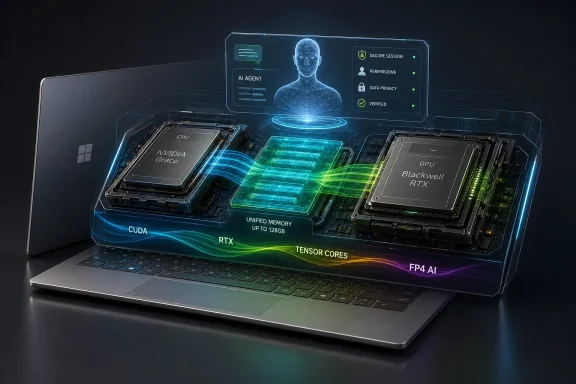
NVIDIA and Microsoft announced RTX Spark on May 31, 2026, as an Arm-based Windows 11 PC platform combining a 20-core NVIDIA Grace CPU, a Blackwell RTX GPU, up to 128GB of unified memory, and up to 1 petaflop of FP4 AI performance. The announcement is not merely another laptop chip reveal; it is NVIDIA’s most direct attempt yet to move from being the discrete GPU supplier inside Windows PCs to being the architectural center of the PC itself. For Microsoft, it is another swing at Windows on Arm, this time with the CUDA ecosystem and AI-agent narrative doing the work Qualcomm alone could not. For users and IT departments, the real question is less whether RTX Spark is fast, and more whether Windows is ready for a third great PC platform after x86 and Apple Silicon.
The old PC bargain was simple: Intel or AMD supplied the CPU, NVIDIA supplied the GPU if the buyer needed graphics horsepower, and Microsoft made Windows abstract away the mess. RTX Spark rearranges that map. NVIDIA is pitching a complete compute substrate for Windows, with CPU, GPU, memory architecture, AI stack, developer tooling, graphics features, and agent runtime all presented as a single platform.
That matters because NVIDIA’s leverage in PCs has historically come from optionality. Gamers, creators, researchers, and workstation buyers selected an RTX GPU when the integrated graphics or standard CPU could not carry the workload. RTX Spark changes the posture from “add NVIDIA where needed” to “build the Windows PC around NVIDIA from the start.”
The company has been inching toward this for years. CUDA made NVIDIA indispensable in AI development, RTX made it central to modern graphics, DLSS gave it a software moat in gaming, and Grace Blackwell moved its CPU ambitions into credible territory. RTX Spark packages those threads into something much more provocative: a Windows system-on-chip that treats AI, graphics, memory, and CPU scheduling as one integrated problem.
Microsoft has every reason to entertain the idea. Windows PCs have spent the last few years absorbing pressure from Apple’s Arm-based Macs, which showed that thin laptops could be fast, quiet, long-lived, and architecturally coherent. Qualcomm’s Snapdragon X systems brought Windows closer to that model, but the remaining compatibility and performance gaps reminded everyone that Windows is not macOS and the PC ecosystem is not Apple’s walled garden. NVIDIA arrives with a different weapon: not merely Arm efficiency, but the developer gravity of CUDA and RTX.
But the interesting number may be memory rather than raw compute. Unified memory is what lets NVIDIA talk about running local models with up to 120 billion parameters and context windows reaching one million tokens. In the AI PC race, memory capacity and bandwidth are often the difference between a flashy demo and a useful local workflow. A fast neural processing unit is not much help if the workload immediately spills into the cloud or collapses under model-size limits.
That is why RTX Spark feels closer in spirit to a miniaturized AI workstation than to a typical consumer laptop platform. The 128GB ceiling is not there so Outlook opens faster. It is there so developers can run larger local models, creators can keep enormous assets resident, and agent frameworks can operate across richer local contexts without treating the cloud as the default scratchpad.
NVIDIA is also careful to keep gaming and creative work in the pitch. The company says RTX Spark can drive AAA games at 1440p and over 100 frames per second with ray tracing, DLSS, Reflex, and the broader RTX stack. It also says creators can work with ultralarge 3D scenes, edit 12K 4:2:2 video, generate AI video, and use Adobe applications being reworked for the platform. This is not being sold as a developer board. It is being sold as a premium Windows PC class.
That is ambitious, and maybe deliberately so. If RTX Spark were framed only as an AI developer machine, it would sit in a profitable but narrow lane. By attaching it to gaming, creativity, Surface hardware, and mainstream OEMs including ASUS, Dell, HP, Lenovo, MSI, Acer, and GIGABYTE, NVIDIA and Microsoft are saying the platform belongs in the PC conversation, not just the lab.
NVIDIA changes that incentive structure. The company has deep relationships with game studios, creative software vendors, AI developers, PC makers, and driver teams. If NVIDIA says RTX Spark matters, many companies that once treated Windows on Arm as a curiosity will at least have to evaluate it. That does not guarantee support, but it does make indifference more expensive.
Still, the compatibility question is not a footnote; it is the fault line under the whole announcement. Windows users have decades of expectations baked into the platform. They expect old applications, obscure utilities, anti-cheat systems, plug-ins, drivers, peripherals, and enterprise agents to keep working. Apple could break things during its Arm transition because it controlled the hardware stack, the operating system, and much of the customer expectation. Microsoft does not have that luxury.
NVIDIA reportedly says it is working with Microsoft, Adobe, and others to make applications run well, including games. That is necessary, but it is also the kind of claim Windows veterans know to treat cautiously. “Runs” can mean native Arm code, x86 or x64 emulation, cloud-assisted behavior, compatibility shims, vendor-specific patches, or simply a demo path that avoids the ugly cases.
The most important compatibility tests will not be staged keynote demos. They will be the ordinary annoyances that define whether people keep a machine: VPN clients, printer drivers, DAW plug-ins, game launchers, anti-cheat frameworks, capture tools, CAD extensions, browser plug-ins, old Win32 utilities, and line-of-business software with installers that assume an x86 world. RTX Spark may be the most capable Windows-on-Arm platform yet, but Windows compatibility is a sociology problem as much as a silicon problem.
That is why the announcement spends so much time on local execution, security primitives, containment, identity, manageability, and NVIDIA OpenShell. The companies know the agent pitch immediately raises alarm bells. An agent that can read files, act across apps, write code, manipulate documents, and route queries between local and cloud models is not just a productivity feature. It is a security boundary with a cheerful user interface.
Microsoft’s language around control is doing a lot of work here. The company wants users to believe they will choose when and how agents act, with visibility into what agents can access. NVIDIA’s OpenShell is positioned as a policy and runtime layer that helps define what agents may do, what data they may see, and whether sensitive queries stay local or move to the cloud.
That framing is smart because the industry’s first wave of AI PC marketing was too often satisfied with vague claims about TOPS and copilots. RTX Spark is more coherent. It says: local models require memory and GPU compute; local agents require OS-level containment and policy; and Windows needs a hardware platform that can make those experiences feel native instead of bolted on.
But coherent does not mean proven. Agents remain a bet on user behavior, developer adoption, trust, and reliability. Most people do not yet have a clear sense of what they want a personal agent to do every day, and many administrators have a very clear sense of what they do not want: autonomous software roaming through user data with insufficient guardrails. RTX Spark gives Microsoft and NVIDIA a stronger stage for that debate, not an escape from it.
That will make OEMs pay attention. ASUS, Dell, HP, Lenovo, MSI, Acer, and GIGABYTE do not need convincing that AI PCs are marketable; they need a reason to believe buyers will pay for differentiated AI hardware beyond today’s thin NPU story. RTX Spark offers a premium hook: CUDA, RTX, large unified memory, local agents, and high-end creative workloads in machines thinner and smaller than the old workstation stereotype.
The risk is that RTX Spark becomes a halo product rather than a category. If early systems cost workstation money, they may be beloved by developers and YouTubers while remaining irrelevant to mainstream PC refresh cycles. The source material’s warning about “tens of thousands of ringgit” is plausible in spirit even if exact pricing remains the missing piece. This is not likely to be the chip that powers the next cheap student laptop.
That may be acceptable. NVIDIA’s first job is not to replace every Intel or AMD notebook; it is to establish a new high-margin tier where local AI, RTX graphics, and Arm efficiency can coexist. Apple did not begin its Mac transition by winning every enterprise desktop. It began by making the integrated-platform argument feel inevitable. NVIDIA appears to be trying something similar inside the much messier Windows universe.
Intel’s challenge is especially awkward. The company has spent years arguing that the PC is being reinvented around local AI, while trying to defend CPU relevance, integrated graphics progress, and manufacturing credibility all at once. NVIDIA is now saying the local AI PC should be built around a Blackwell-class GPU, CUDA, unified memory, and Arm CPU cores. That does not make Intel obsolete, but it does make the “AI PC” branding contest much harder.
AMD has a different problem. It has strong CPU and GPU IP, consoles, APUs, and increasingly serious AI ambitions. But it lacks NVIDIA’s CUDA moat and the same degree of developer default status in local AI tooling. RTX Spark’s appeal to developers is not just performance; it is the promise that the same NVIDIA software universe they already use in the cloud, workstation, or lab can now sit inside a Windows laptop.
Qualcomm may feel the most immediate pressure in Windows on Arm. Snapdragon X systems helped prove that Arm Windows laptops could be credible daily drivers, but they were never going to satisfy the high-end GPU and CUDA crowd. RTX Spark reframes Windows on Arm from a battery-life story into a performance-and-AI story. That does not erase Qualcomm’s advantages in thin, efficient client devices, but it narrows the space where Qualcomm can be seen as the default Arm answer for Windows.
This is why the platform politics matter as much as the silicon. NVIDIA is not merely entering the Windows PC market. It is forcing every other chip vendor to explain what kind of AI PC they are building and why developers should care.
That does not make the number meaningless. FP4 performance is relevant because the AI industry is aggressively chasing lower precision to make large models cheaper and faster to run. If RTX Spark can deliver useful local inference at large context sizes with good efficiency, that is genuinely important. The danger is consumer shorthand: petaflop equals supercomputer equals everything is instant.
Real-world AI performance will depend on model architecture, memory bandwidth, thermals, drivers, frameworks, and whether the workload is dense, sparse, quantized, supported, or awkwardly translated through immature tooling. Anyone who has followed early AI accelerator launches knows the pattern. The hardware arrives first, the demos look clean, and the community then spends months discovering which workloads are truly accelerated and which still need custom builds, patches, or patience.
NVIDIA has an advantage here because it controls much of the stack and has enormous developer mindshare. But RTX Spark systems will still be Windows PCs, not sealed appliances. Their success will depend on the boring layers: drivers, firmware updates, framework builds, package managers, app certification, thermal profiles, and OEM implementation quality.
That is where early reviews will matter. Battery life claims, plugged-in versus unplugged performance, fan noise, sustained GPU clocks, memory configurations, storage options, display choices, and dock behavior will decide whether RTX Spark feels like a breakthrough or a brilliant chip trapped in uneven first-generation machines.
Adobe’s involvement is therefore significant. Creative apps have historically benefited from GPU acceleration, but the work is often uneven across features, plug-ins, codecs, and vendors. If Photoshop and Premiere are being deeply reworked for RTX Spark, NVIDIA gets a prestige software partner and Microsoft gets a practical reason for professionals to consider Arm Windows hardware despite compatibility anxiety.
The same logic applies to 3D artists and video creators. A 90GB scene or 12K 4:2:2 workflow is not mainstream, but those examples communicate a broader point: unified memory can let compact systems handle assets that would normally require bulkier workstations or cloud workflows. For freelancers, studios, and technical artists, local capability still matters when bandwidth, privacy, cost, or latency makes the cloud unattractive.
Gaming is more complicated. NVIDIA can bring DLSS, Reflex, G-SYNC, ray tracing, and Game Ready branding, but Windows on Arm gaming must pass through the compatibility minefield of launchers, anti-cheat systems, engines, drivers, overlays, and older APIs. Newer titles shown in controlled demos will not settle the issue. The gaming community will judge RTX Spark by the messy Steam library, not by the one game that looked great on stage.
Still, NVIDIA’s presence gives Windows on Arm gaming its best shot yet. Qualcomm could promise compatibility; NVIDIA can pressure the ecosystem that already depends on its GPUs. That difference may not guarantee success, but it raises the ceiling.
But the management burden is nontrivial. Enterprises will need to understand how OpenShell interacts with Windows security primitives, how agents are permissioned, how data is classified, how local models are updated, how telemetry is handled, and how cloud routing decisions are enforced. They will also need to validate endpoint protection, VPNs, DLP tools, EDR agents, device control, and compliance software on Arm-based NVIDIA Windows systems.
This is where Microsoft’s role is decisive. NVIDIA can build the compute platform, but enterprise trust lives in Windows management, Intune, Defender, Entra, Group Policy remnants, configuration baselines, and the accumulated habits of IT operations. If RTX Spark becomes yet another special-case device class, enterprises will slow-roll it. If it fits into familiar deployment and governance patterns, it has a real chance in developer, executive, design, and research fleets.
The security story also needs proof beyond architecture diagrams. Agents that act across applications need more than sandboxing. They need explainable permissions, revocation, logging, policy inheritance, safe failure modes, and user interfaces that do not train people to click through consent prompts. The history of Windows is full of powerful features that became attack surfaces because convenience outran containment.
That does not mean enterprises should reject the idea. It means RTX Spark should be evaluated less like a fancy laptop and more like a new endpoint category with local AI execution as a first-class risk domain.
Pricing will shape perception. If RTX Spark systems land at luxury workstation levels, buyers will forgive some first-generation rough edges if the machines deliver unique local AI and creative performance. If they are marketed as premium mainstream laptops, compatibility hiccups and app gaps will feel less acceptable. The higher the price, the more the device must behave like a professional instrument rather than a developer preview with a nice chassis.
OEM differentiation will also matter. A compact desktop with ample cooling, full-power behavior, and 128GB of unified memory may be a much better showcase than a thin laptop constrained by thermals and battery targets. Conversely, a genuinely portable RTX Spark laptop with strong battery life and consistent performance would be a far more powerful symbol of architectural change.
Microsoft’s timing is important, too. Build 2026 is expected to put more detail around Windows agent capabilities, security primitives, and developer pathways. If Microsoft can show real APIs, real management controls, and real applications, RTX Spark will feel like part of a platform transition. If the story remains mostly aspirational, it will look like another AI PC branding wave waiting for software to catch up.
 NVIDIA Is No Longer Content to Ride Shotgun in the PC
The old PC bargain was simple: Intel or AMD supplied the CPU, NVIDIA supplied the GPU if the buyer needed graphics horsepower, and Microsoft made Windows abstract away the mess. RTX Spark rearranges that map. NVIDIA is pitching a complete compute substrate for Windows, with CPU, GPU, memory architecture, AI stack, developer tooling, graphics features, and agent runtime all presented as a single platform.That matters because NVIDIA’s leverage in PCs has historically come from optionality. Gamers, creators, researchers, and workstation buyers selected an RTX GPU when the integrated graphics or standard CPU could not carry the workload. RTX Spark changes the posture from “add NVIDIA where needed” to “build the Windows PC around NVIDIA from the start.”
The company has been inching toward this for years. CUDA made NVIDIA indispensable in AI development, RTX made it central to modern graphics, DLSS gave it a software moat in gaming, and Grace Blackwell moved its CPU ambitions into credible territory. RTX Spark packages those threads into something much more provocative: a Windows system-on-chip that treats AI, graphics, memory, and CPU scheduling as one integrated problem.
Microsoft has every reason to entertain the idea. Windows PCs have spent the last few years absorbing pressure from Apple’s Arm-based Macs, which showed that thin laptops could be fast, quiet, long-lived, and architecturally coherent. Qualcomm’s Snapdragon X systems brought Windows closer to that model, but the remaining compatibility and performance gaps reminded everyone that Windows is not macOS and the PC ecosystem is not Apple’s walled garden. NVIDIA arrives with a different weapon: not merely Arm efficiency, but the developer gravity of CUDA and RTX.
The Spec Sheet Is Designed to Make Old Categories Look Small
On paper, RTX Spark is easy to oversimplify: 20 Arm CPU cores, a Blackwell RTX GPU with 6,144 CUDA cores, fifth-generation Tensor Cores, FP4 support, NVLink-C2C between CPU and GPU, and up to 128GB of LPDDR5X unified memory. That reads like a workstation spec compressed into a laptop or compact desktop form factor. NVIDIA’s headline number, up to 1 petaflop of FP4 AI performance, is meant to make conventional TOPS comparisons feel quaint.But the interesting number may be memory rather than raw compute. Unified memory is what lets NVIDIA talk about running local models with up to 120 billion parameters and context windows reaching one million tokens. In the AI PC race, memory capacity and bandwidth are often the difference between a flashy demo and a useful local workflow. A fast neural processing unit is not much help if the workload immediately spills into the cloud or collapses under model-size limits.
That is why RTX Spark feels closer in spirit to a miniaturized AI workstation than to a typical consumer laptop platform. The 128GB ceiling is not there so Outlook opens faster. It is there so developers can run larger local models, creators can keep enormous assets resident, and agent frameworks can operate across richer local contexts without treating the cloud as the default scratchpad.
NVIDIA is also careful to keep gaming and creative work in the pitch. The company says RTX Spark can drive AAA games at 1440p and over 100 frames per second with ray tracing, DLSS, Reflex, and the broader RTX stack. It also says creators can work with ultralarge 3D scenes, edit 12K 4:2:2 video, generate AI video, and use Adobe applications being reworked for the platform. This is not being sold as a developer board. It is being sold as a premium Windows PC class.
That is ambitious, and maybe deliberately so. If RTX Spark were framed only as an AI developer machine, it would sit in a profitable but narrow lane. By attaching it to gaming, creativity, Surface hardware, and mainstream OEMs including ASUS, Dell, HP, Lenovo, MSI, Acer, and GIGABYTE, NVIDIA and Microsoft are saying the platform belongs in the PC conversation, not just the lab.
Windows on Arm Gets Its Most Serious Hardware Partner Yet
Windows on Arm has always had two problems: the one Microsoft can solve, and the one only the ecosystem can solve. Microsoft can improve emulation, scheduling, drivers, app compatibility layers, and developer tooling. It cannot, by itself, make every vendor care enough to optimize, test, and support a new architecture.NVIDIA changes that incentive structure. The company has deep relationships with game studios, creative software vendors, AI developers, PC makers, and driver teams. If NVIDIA says RTX Spark matters, many companies that once treated Windows on Arm as a curiosity will at least have to evaluate it. That does not guarantee support, but it does make indifference more expensive.
Still, the compatibility question is not a footnote; it is the fault line under the whole announcement. Windows users have decades of expectations baked into the platform. They expect old applications, obscure utilities, anti-cheat systems, plug-ins, drivers, peripherals, and enterprise agents to keep working. Apple could break things during its Arm transition because it controlled the hardware stack, the operating system, and much of the customer expectation. Microsoft does not have that luxury.
NVIDIA reportedly says it is working with Microsoft, Adobe, and others to make applications run well, including games. That is necessary, but it is also the kind of claim Windows veterans know to treat cautiously. “Runs” can mean native Arm code, x86 or x64 emulation, cloud-assisted behavior, compatibility shims, vendor-specific patches, or simply a demo path that avoids the ugly cases.
The most important compatibility tests will not be staged keynote demos. They will be the ordinary annoyances that define whether people keep a machine: VPN clients, printer drivers, DAW plug-ins, game launchers, anti-cheat frameworks, capture tools, CAD extensions, browser plug-ins, old Win32 utilities, and line-of-business software with installers that assume an x86 world. RTX Spark may be the most capable Windows-on-Arm platform yet, but Windows compatibility is a sociology problem as much as a silicon problem.
The AI-Agent Pitch Is the Real Product
NVIDIA and Microsoft are not presenting RTX Spark as a faster way to run today’s PC workloads. They are presenting it as hardware for personal agents, the latest attempt to define what comes after app-centric computing. The idea is that a Windows PC should not simply launch programs; it should host agents that reason across files, applications, workflows, images, video, code, and web contexts while remaining under user control.That is why the announcement spends so much time on local execution, security primitives, containment, identity, manageability, and NVIDIA OpenShell. The companies know the agent pitch immediately raises alarm bells. An agent that can read files, act across apps, write code, manipulate documents, and route queries between local and cloud models is not just a productivity feature. It is a security boundary with a cheerful user interface.
Microsoft’s language around control is doing a lot of work here. The company wants users to believe they will choose when and how agents act, with visibility into what agents can access. NVIDIA’s OpenShell is positioned as a policy and runtime layer that helps define what agents may do, what data they may see, and whether sensitive queries stay local or move to the cloud.
That framing is smart because the industry’s first wave of AI PC marketing was too often satisfied with vague claims about TOPS and copilots. RTX Spark is more coherent. It says: local models require memory and GPU compute; local agents require OS-level containment and policy; and Windows needs a hardware platform that can make those experiences feel native instead of bolted on.
But coherent does not mean proven. Agents remain a bet on user behavior, developer adoption, trust, and reliability. Most people do not yet have a clear sense of what they want a personal agent to do every day, and many administrators have a very clear sense of what they do not want: autonomous software roaming through user data with insufficient guardrails. RTX Spark gives Microsoft and NVIDIA a stronger stage for that debate, not an escape from it.
The Surface Angle Turns a Chip Launch Into a Platform Signal
The inclusion of Microsoft Surface in the first wave is more than a brand flourish. Surface has often served as Microsoft’s way of telling OEMs what kind of Windows PC it wants to exist. A Surface Laptop Ultra powered by RTX Spark signals that Microsoft is not treating this as an exotic NVIDIA workstation experiment. It is willing to put its own hardware credibility behind the platform.That will make OEMs pay attention. ASUS, Dell, HP, Lenovo, MSI, Acer, and GIGABYTE do not need convincing that AI PCs are marketable; they need a reason to believe buyers will pay for differentiated AI hardware beyond today’s thin NPU story. RTX Spark offers a premium hook: CUDA, RTX, large unified memory, local agents, and high-end creative workloads in machines thinner and smaller than the old workstation stereotype.
The risk is that RTX Spark becomes a halo product rather than a category. If early systems cost workstation money, they may be beloved by developers and YouTubers while remaining irrelevant to mainstream PC refresh cycles. The source material’s warning about “tens of thousands of ringgit” is plausible in spirit even if exact pricing remains the missing piece. This is not likely to be the chip that powers the next cheap student laptop.
That may be acceptable. NVIDIA’s first job is not to replace every Intel or AMD notebook; it is to establish a new high-margin tier where local AI, RTX graphics, and Arm efficiency can coexist. Apple did not begin its Mac transition by winning every enterprise desktop. It began by making the integrated-platform argument feel inevitable. NVIDIA appears to be trying something similar inside the much messier Windows universe.
Intel, AMD, and Qualcomm Are Suddenly Fighting Different Battles
It would be premature to say RTX Spark threatens Intel and AMD across the PC market. The overwhelming majority of Windows devices will still ship with x86 processors for the foreseeable future, and enterprises do not abandon validated platforms because a keynote looked impressive. But RTX Spark does attack the highest-visibility parts of the PC value chain: premium laptops, creator systems, developer workstations, compact desktops, and AI-focused machines.Intel’s challenge is especially awkward. The company has spent years arguing that the PC is being reinvented around local AI, while trying to defend CPU relevance, integrated graphics progress, and manufacturing credibility all at once. NVIDIA is now saying the local AI PC should be built around a Blackwell-class GPU, CUDA, unified memory, and Arm CPU cores. That does not make Intel obsolete, but it does make the “AI PC” branding contest much harder.
AMD has a different problem. It has strong CPU and GPU IP, consoles, APUs, and increasingly serious AI ambitions. But it lacks NVIDIA’s CUDA moat and the same degree of developer default status in local AI tooling. RTX Spark’s appeal to developers is not just performance; it is the promise that the same NVIDIA software universe they already use in the cloud, workstation, or lab can now sit inside a Windows laptop.
Qualcomm may feel the most immediate pressure in Windows on Arm. Snapdragon X systems helped prove that Arm Windows laptops could be credible daily drivers, but they were never going to satisfy the high-end GPU and CUDA crowd. RTX Spark reframes Windows on Arm from a battery-life story into a performance-and-AI story. That does not erase Qualcomm’s advantages in thin, efficient client devices, but it narrows the space where Qualcomm can be seen as the default Arm answer for Windows.
This is why the platform politics matter as much as the silicon. NVIDIA is not merely entering the Windows PC market. It is forcing every other chip vendor to explain what kind of AI PC they are building and why developers should care.
The Petaflop Number Needs Context Before It Becomes a Sticker
The phrase “1 petaflop” will sell machines, but WindowsForum readers should be careful with it. NVIDIA’s claim is tied to FP4 AI performance, a low-precision format useful for certain inference workloads when the software stack, model, quantization path, and hardware support line up. It is not a universal measure of how fast the PC will compile code, render every project, emulate every game, or run every local model.That does not make the number meaningless. FP4 performance is relevant because the AI industry is aggressively chasing lower precision to make large models cheaper and faster to run. If RTX Spark can deliver useful local inference at large context sizes with good efficiency, that is genuinely important. The danger is consumer shorthand: petaflop equals supercomputer equals everything is instant.
Real-world AI performance will depend on model architecture, memory bandwidth, thermals, drivers, frameworks, and whether the workload is dense, sparse, quantized, supported, or awkwardly translated through immature tooling. Anyone who has followed early AI accelerator launches knows the pattern. The hardware arrives first, the demos look clean, and the community then spends months discovering which workloads are truly accelerated and which still need custom builds, patches, or patience.
NVIDIA has an advantage here because it controls much of the stack and has enormous developer mindshare. But RTX Spark systems will still be Windows PCs, not sealed appliances. Their success will depend on the boring layers: drivers, firmware updates, framework builds, package managers, app certification, thermal profiles, and OEM implementation quality.
That is where early reviews will matter. Battery life claims, plugged-in versus unplugged performance, fan noise, sustained GPU clocks, memory configurations, storage options, display choices, and dock behavior will decide whether RTX Spark feels like a breakthrough or a brilliant chip trapped in uneven first-generation machines.
Creators May Get the Clearest Immediate Payoff
AI agents make the grandest story, but creators may see the simplest one. A Windows laptop or compact desktop with a large unified memory pool, Blackwell RTX graphics, hardware video acceleration, CUDA support, and Adobe optimization is easy to understand. It targets pain that already exists: giant timelines, heavy effects, AI masking, high-resolution footage, 3D scenes, and render queues that punish ordinary mobile hardware.Adobe’s involvement is therefore significant. Creative apps have historically benefited from GPU acceleration, but the work is often uneven across features, plug-ins, codecs, and vendors. If Photoshop and Premiere are being deeply reworked for RTX Spark, NVIDIA gets a prestige software partner and Microsoft gets a practical reason for professionals to consider Arm Windows hardware despite compatibility anxiety.
The same logic applies to 3D artists and video creators. A 90GB scene or 12K 4:2:2 workflow is not mainstream, but those examples communicate a broader point: unified memory can let compact systems handle assets that would normally require bulkier workstations or cloud workflows. For freelancers, studios, and technical artists, local capability still matters when bandwidth, privacy, cost, or latency makes the cloud unattractive.
Gaming is more complicated. NVIDIA can bring DLSS, Reflex, G-SYNC, ray tracing, and Game Ready branding, but Windows on Arm gaming must pass through the compatibility minefield of launchers, anti-cheat systems, engines, drivers, overlays, and older APIs. Newer titles shown in controlled demos will not settle the issue. The gaming community will judge RTX Spark by the messy Steam library, not by the one game that looked great on stage.
Still, NVIDIA’s presence gives Windows on Arm gaming its best shot yet. Qualcomm could promise compatibility; NVIDIA can pressure the ecosystem that already depends on its GPUs. That difference may not guarantee success, but it raises the ceiling.
Enterprise IT Will See Both Promise and Blast Radius
For IT departments, RTX Spark is attractive and unsettling for the same reason: it brings serious local AI capability onto primary user devices. If agents can operate locally with strong containment, identity, policy, and auditability, enterprises could reduce cloud exposure, improve latency, protect sensitive data, and give developers or analysts powerful tools without provisioning remote GPU instances for every task.But the management burden is nontrivial. Enterprises will need to understand how OpenShell interacts with Windows security primitives, how agents are permissioned, how data is classified, how local models are updated, how telemetry is handled, and how cloud routing decisions are enforced. They will also need to validate endpoint protection, VPNs, DLP tools, EDR agents, device control, and compliance software on Arm-based NVIDIA Windows systems.
This is where Microsoft’s role is decisive. NVIDIA can build the compute platform, but enterprise trust lives in Windows management, Intune, Defender, Entra, Group Policy remnants, configuration baselines, and the accumulated habits of IT operations. If RTX Spark becomes yet another special-case device class, enterprises will slow-roll it. If it fits into familiar deployment and governance patterns, it has a real chance in developer, executive, design, and research fleets.
The security story also needs proof beyond architecture diagrams. Agents that act across applications need more than sandboxing. They need explainable permissions, revocation, logging, policy inheritance, safe failure modes, and user interfaces that do not train people to click through consent prompts. The history of Windows is full of powerful features that became attack surfaces because convenience outran containment.
That does not mean enterprises should reject the idea. It means RTX Spark should be evaluated less like a fancy laptop and more like a new endpoint category with local AI execution as a first-class risk domain.
The First Generation Will Be a Test of Discipline
The biggest danger for NVIDIA and Microsoft is overclaiming. RTX Spark is impressive enough without pretending it immediately solves every Windows-on-Arm problem, every agent safety problem, and every AI PC use case. The companies should resist the temptation to market it as magic. Windows users are unusually good at finding the edge cases vendors would rather ignore.Pricing will shape perception. If RTX Spark systems land at luxury workstation levels, buyers will forgive some first-generation rough edges if the machines deliver unique local AI and creative performance. If they are marketed as premium mainstream laptops, compatibility hiccups and app gaps will feel less acceptable. The higher the price, the more the device must behave like a professional instrument rather than a developer preview with a nice chassis.
OEM differentiation will also matter. A compact desktop with ample cooling, full-power behavior, and 128GB of unified memory may be a much better showcase than a thin laptop constrained by thermals and battery targets. Conversely, a genuinely portable RTX Spark laptop with strong battery life and consistent performance would be a far more powerful symbol of architectural change.
Microsoft’s timing is important, too. Build 2026 is expected to put more detail around Windows agent capabilities, security primitives, and developer pathways. If Microsoft can show real APIs, real management controls, and real applications, RTX Spark will feel like part of a platform transition. If the story remains mostly aspirational, it will look like another AI PC branding wave waiting for software to catch up.
The Spark That Matters Is the Ecosystem Reaction
The practical read on RTX Spark is neither hype nor dismissal. It is a serious platform move with several concrete implications for Windows users, developers, and administrators.- RTX Spark is aimed first at premium AI, creator, developer, and gaming systems, not budget Windows laptops.
- The platform’s most important technical feature may be up to 128GB of unified memory, because local AI workloads often fail on memory limits before they fail on raw compute.
- Windows-on-Arm compatibility remains the central risk, especially for games, drivers, plug-ins, enterprise agents, and older Win32 software.
- NVIDIA’s CUDA and RTX ecosystems give this Windows-on-Arm push more developer leverage than previous attempts built mainly around battery life.
- Microsoft’s agent security primitives and NVIDIA OpenShell will need transparent controls, auditability, and enterprise manageability before IT departments treat local agents as safe defaults.
- Early RTX Spark reviews should focus on sustained performance, thermals, battery behavior, app compatibility, driver maturity, and real local model workflows rather than headline petaflop claims.
References
- Primary source: TechNave
Published: 2026-06-01T11:10:11.954098
Loading…
technave.com - Related coverage: axios.com

Microsoft debuts Nvidia-powered Microsoft Surface Ultra laptop
Microsoft is trying again to redefine the PC for the AI era.www.axios.com
- Related coverage: nvidianews.nvidia.com

NVIDIA and Microsoft Reinvent Windows PCs for the Age of Personal AI
NVIDIA today unveiled NVIDIA RTX Spark™, a new superchip that reinvents Windows PCs for the era of personal AI agents — offering a new class of computer that moves from tool to teammate.nvidianews.nvidia.com
- Related coverage: nvidia.com

NVIDIA RTX Spark — Slim Laptops & Small Desktops
The fusion of NVIDIA AI and RTX graphics.www.nvidia.com - Related coverage: tomshardware.com

Nvidia unveils RTX Spark Superchip for laptops and desktop PCs at Computex 2026 – new platform promises to turn Windows into an agentic AI OS with Arm CPU, Blackwell GPU, and 128GB unified memory
Over 30 laptops and 10 desktops coming this fall with "the most efficent platform ever built"www.tomshardware.com
- Related coverage: phoronix.com

- Related coverage: business-standard.com
Loading…
www.business-standard.com - Related coverage: blogs.nvidia.de
Loading…
blogs.nvidia.de - Related coverage: developer.nvidia.com
Loading…
developer.nvidia.com - Related coverage: techspot.com
Loading…
www.techspot.com - Related coverage: signal65.com
Loading…
signal65.com - Related coverage: docs.nvidia.com
Loading…
docs.nvidia.com - Related coverage: ashgabattimes.com
Loading…
ashgabattimes.com - Related coverage: amax.com
Loading…
www.amax.com - Related coverage: investor.nvidia.com

NVIDIA and Microsoft Reinvent Windows PCs for the Age of Personal AI
RTX Spark — a 1-Petaflop Superchip, the Full CUDA and RTX Ecosystem, and Windows-Native Agents — a New Beginning for Personal Computers News Summary: NVIDIA RTX Spark powers the world’s first Windows PCs purpose-built for personal agents, featuring 1 petaflop of AI performance, industry-leading...investor.nvidia.com
- Related coverage: blogs.nvidia.com
Loading…
blogs.nvidia.com - Official source: blogs.windows.com

Introducing a powerful new chapter for Windows PCs, accelerated by NVIDIA RTX Spark
Today at NVIDIA GTC, Microsoft and NVIDIA announced the world’s most powerful and efficient thin-and-light Windows PCs ever. Accelerated by NVIDIA RTX Spark blogs.windows.com
- Related coverage: msi.com
Loading…
www.msi.com - Official source: news.microsoft.com
Loading…
news.microsoft.com - Related coverage: thedailystar.net
Loading…
www.thedailystar.net - Related coverage: theenergymag.com
Loading…
www.theenergymag.com - Related coverage: investor.cisco.com
Loading…
investor.cisco.com - Related coverage: s205.q4cdn.com
Loading…
s205.q4cdn.com