
 NVIDIA Wants to Make Water the Solved Problem
The most important thing about NVIDIA’s announcement is not the chemistry. It is the timing. Data center developers have spent the last two years discovering that communities can understand water far more viscerally than they understand terawatt-hours, grid interconnection queues, or power purchase agreements.
A hyperscale campus may promise tax revenue and construction jobs, but when residents hear that it will draw heavily from the same aquifers, rivers, or municipal systems that serve homes and farms, the argument changes. Water is local in a way carbon accounting is not. It turns an abstract AI boom into a question at a town hall.
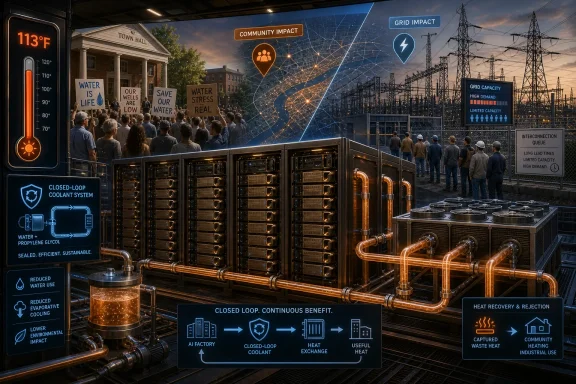
NVIDIA’s answer is to push cooling deeper into the architecture of the AI machine itself. The company’s next-generation systems are designed to run with a recirculated coolant mixture that includes water and propylene glycol, a familiar ingredient in antifreeze-like thermal systems. The notable detail is temperature: the loop can reportedly operate at up to 113 degrees Fahrenheit, warm enough to reduce reliance on additional chilling gear.
That matters because old cooling assumptions break under AI density. A conventional enterprise rack and a rack packed with modern accelerators are not in the same thermal universe. The AI rack concentrates power, heat, and failure risk into a much tighter footprint, and that makes cooling a first-order design constraint rather than a facilities afterthought.
NVIDIA is not merely selling GPUs anymore. It is selling a stack: chips, racks, networking, power profiles, and thermal expectations. When the company says water use is largely solved, it is also saying that the next AI factory must be treated as an engineered system from silicon to substation.
The Hotter Coolant Is the Point
The intuitive way to cool something is to make the coolant cold. The more interesting industrial move is to design chips, racks, and loops that can tolerate warmer coolant while still operating safely. NVIDIA’s claimed 113-degree Fahrenheit target is significant because higher coolant temperatures can make heat rejection easier and reduce dependence on energy-hungry chillers.
This is not magic. Heat still has to go somewhere. A closed loop does not repeal thermodynamics; it changes the mechanism by which heat is carried away from the chip and expelled from the facility.
In a traditional evaporative cooling setup, water consumption is tied to the process of dumping heat. Water absorbs heat and evaporates, which is efficient but consumes water. In a recirculating liquid loop, the fluid can move heat from chips to heat exchangers without being continuously consumed in the same way.
The difference between using water and consuming water is where much of the public confusion lives. A closed loop may contain water, and it may be filled with a water-based fluid, but it does not necessarily draw down fresh supplies during normal operation. That is why Microsoft and NVIDIA are now so eager to talk about “filled once” designs.
The warmer the coolant can run, the more flexible the facility becomes. It can potentially reject heat to outside air over more hours of the year, rely less on mechanical chilling, and operate in hotter climates without falling back on thirsty evaporative systems. For operators, that can mean lower water consumption and potentially lower cooling energy, although the final number depends on climate, facility design, workload, redundancy requirements, and how aggressively the system is run.
Microsoft Set the Frame Before NVIDIA Walked Into It
NVIDIA’s announcement lands in a conversation Microsoft has already helped define. Earlier in June, Satya Nadella promoted the idea that Microsoft’s newest AI data centers can use as little water annually as a single restaurant, thanks to a closed-loop liquid cooling design that is filled once and then recirculated.
That comparison is politically powerful because it compresses an intimidating industrial facility into a familiar civic object. A restaurant is not frightening. A 315-acre AI campus with its own substation strategy is.
Microsoft’s message was not that every existing data center suddenly stopped consuming water. It was that the newest AI-oriented designs are shifting away from evaporative cooling during normal operation. In Microsoft’s telling, direct-to-chip liquid cooling and air-cooled heat rejection can dramatically reduce operational water demand.
NVIDIA is now reinforcing the same narrative from the supplier side. If Microsoft can say its campuses are designed around closed loops, NVIDIA can say its AI systems are capable of operating inside those loops at useful temperatures. The two messages support each other: the cloud provider wants community permission, while the chipmaker wants infrastructure buyers to see liquid cooling as part of the platform rather than as a custom burden.
This is how standards emerge in practice. Not first through regulation or a white paper, but through the largest buyers and suppliers converging on what “modern” is supposed to mean. A few years ago, liquid cooling sounded exotic to many enterprise buyers. In the AI era, air alone increasingly sounds like nostalgia.
The Water Fight Was Always a Proxy War
The danger in NVIDIA’s “largely solved” framing is that it can make the community debate sound narrower than it is. Water consumption has been one of the most visible objections to AI data center expansion, but it is not the only objection. In many regions, it is not even the limiting factor.
Electricity is the larger wall. Microsoft and Google have both been scrutinized for power consumption that rivals or exceeds the electricity use of many countries, and global data center demand is projected to climb sharply as AI workloads expand. Even if a new facility consumes very little water for cooling, it still needs enormous amounts of power.
That power has to come from somewhere. In some markets, it may be matched with renewable contracts. In others, it may increase demand on gas generation, delay coal retirements, require new transmission, or force utilities to make expensive grid upgrades that ratepayers fear they will ultimately subsidize.
This is why the water breakthrough, if it proves out at scale, should be treated as a redistribution of controversy rather than an end to it. Data center developers may defuse the most emotionally immediate complaint, only to intensify arguments over electricity bills, grid reliability, land acquisition, noise, backup generators, and local tax concessions.
For WindowsForum readers who live in the world of hardware, this is familiar. Solving one bottleneck exposes the next. The CPU gets faster, so memory becomes the constraint. Storage latency falls, so the network becomes the bottleneck. Data centers are no different: reduce water consumption, and the power question becomes impossible to dodge.
The “AI Factory” Is Becoming a Civic Actor
The language around AI infrastructure has shifted from “data centers” to “AI factories” for a reason. A classic data center suggested storage, compute, and cloud services. An AI factory suggests continuous industrial production, with inputs, outputs, supply chains, and neighbors who have to live next to it.
That language is more honest than the old cloud metaphor. The cloud was never weightless; it was concrete, steel, fiber, transformers, diesel, water, and land. Generative AI has made that physical reality harder to hide because the scale-up is so aggressive.
Communities are now being asked to host infrastructure whose benefits may be globally distributed while its burdens are locally concentrated. A model trained or served in one county may generate revenue for a company headquartered thousands of miles away. The local bargain depends on jobs, taxes, utility investments, and promises that the facility will not degrade quality of life.
Microsoft has started using “community-first” language around AI infrastructure, explicitly acknowledging concerns about water use and electricity bills. That is not charity; it is a permitting strategy. Companies have learned that technical superiority does not automatically translate into local consent.
NVIDIA’s cooling claim fits this new politics. If a developer can say that a new AI campus will not be a major water consumer during normal operations, it removes one of the easiest arguments against approval. But communities will still ask what happens during heat waves, outages, drought restrictions, expansion phases, and emergency modes.
Warm Liquid Cooling Is a Hardware Story With Software Consequences
For Windows enthusiasts and IT administrators, the obvious question is whether this matters outside hyperscale AI campuses. The answer is yes, though not immediately in the way a desktop builder might imagine. Liquid cooling in the data center is moving from niche deployment to default assumption for the highest-density workloads.
That shift will influence server design, rack standards, procurement cycles, hosting costs, and cloud service architecture. If the most efficient AI systems require warm liquid loops, then the data centers that can support those loops will have an advantage. Workloads may increasingly be routed not just by region and price, but by thermal and power efficiency.
Enterprise IT rarely gets the luxury of ignoring hyperscale trends. Technologies that begin in top-end cloud infrastructure often trickle down as new expectations for resilience, telemetry, and lifecycle management. Liquid-cooled AI servers will bring new operational questions: leak detection, service procedures, coolant chemistry, warranties, technician training, and facility compatibility.
There is also a software scheduling angle. If cooling and power become more tightly integrated with workload orchestration, the infrastructure stack may need to understand thermal headroom in near real time. AI clusters already behave less like generic compute pools and more like specialized industrial machinery. Cooling-aware scheduling is a logical next step.
Microsoft, NVIDIA, and other major players will not advertise it this way, but the AI boom is making the data center less abstract to software people. The physical layer is pushing upward. Developers may not need to know the coolant mixture, but the cost, availability, and placement of AI compute will increasingly reflect that hidden plumbing.
The Kenya Episode Shows the Limits of Engineering Alone
The report that Microsoft’s proposed $1 billion data center project in Kenya stalled over power cost guarantees is a reminder that cooling improvements do not solve national energy arithmetic. According to accounts of the dispute, the Kenyan government balked at committing to the capacity costs Microsoft wanted for Azure operations, with President William Ruto reportedly warning that the facility’s power demand would be so large it would require “switching off half the country.”
That remark is politically charged, and the exact economics of the project deserve careful scrutiny. But as a symbol, it captures the problem perfectly. AI infrastructure can be technically elegant and still collide with basic questions of grid capacity and public obligation.
In wealthier markets, those tensions may be hidden behind complex utility proceedings and long interconnection queues. In developing markets, they can be blunt. If a country needs power for homes, factories, schools, hospitals, and electrification, a hyperscale AI facility must justify why it deserves such a large slice of the system.
This is where the industry’s sustainability language can sound strangely incomplete. A facility may be water-efficient, carbon-matched, and architecturally advanced, yet still be a poor fit for a grid that cannot absorb it. Infrastructure is not sustainable in the abstract; it is sustainable in a place.
The Kenya example also hints at a future in which countries negotiate harder with cloud providers. Governments want digital infrastructure, but not at any price. The new questions will be less about whether a region can attract an AI campus and more about whether the terms leave the host community stronger.
The GPT-4 Water Bottle Claim Needs More Precision Than the Debate Gives It
The claim that GPT-4 can consume up to three water bottles to generate 100 words has traveled widely because it is memorable. It is also the kind of statistic that needs careful handling. AI water estimates vary depending on whether they count direct cooling water, indirect water used in electricity generation, regional climate, data center efficiency, and the assumptions made about model size and inference workload.
That does not make the concern fake. It means the debate often collapses several different accounting systems into one viral image. A user prompt does not literally open a tap beside a GPU for a fixed number of bottles; the water intensity depends on where and how the computation is served.
Closed-loop cooling directly attacks the on-site cooling portion of that footprint. It does not automatically eliminate the water associated with power generation, supply chains, chip fabrication, or backup systems. Nor does it erase the water used by older data centers still running conventional cooling designs.
This distinction matters because the industry will be tempted to use next-generation designs as a shield for the entire installed base. A brand-new AI campus with low operational water consumption is not proof that all cloud regions, colocation facilities, and legacy workloads are equally efficient. The transition will be uneven.
For users, the most honest takeaway is that per-query water claims are useful as a warning sign, not as a precise meter. They reveal that AI has physical costs. They do not substitute for facility-level disclosure.
The Disclosure Gap Is Now the Industry’s Biggest Trust Problem
If NVIDIA and Microsoft are right that water consumption can be dramatically reduced in new AI facilities, they should welcome more transparent reporting. The problem is that the public usually gets polished claims before it gets comparable data. “Restaurant-level” water use and “largely solved” cooling sound impressive, but they are not standardized metrics.
The data center industry already uses measures like power usage effectiveness and water usage effectiveness, but public reporting is inconsistent and often too aggregated to answer local questions. A global sustainability report may tell investors a story, yet fail to tell a town whether a specific campus will strain a specific watershed.
Communities need site-level commitments. They need to know expected annual water withdrawals, consumptive use, emergency operating assumptions, peak-day behavior, power demand, backup generation plans, and who pays for grid upgrades. Without those details, even good engineering can look like spin.
Vendors also need to separate capability from deployment. NVIDIA can design a system capable of low-water operation, but the real-world outcome depends on how operators build around it. Microsoft can design a closed-loop campus, but older facilities and different geographies may still have different profiles.
The next phase of AI infrastructure politics will punish vague sustainability language. A company that says “zero water consumption” will be asked whether it means normal cooling operations, total facility operations, annualized net consumption, or some narrower definition. The public is learning the vocabulary quickly.
Enterprise IT Should Read This as a Procurement Signal
The immediate buyers of NVIDIA’s newest AI infrastructure are hyperscalers, sovereign AI projects, and the largest enterprise deployments. But IT leaders outside that tier should still pay attention because the cooling shift will shape the economics of AI services they consume.
If liquid-cooled AI clusters are cheaper to operate at scale, those savings may eventually show up in cloud pricing, capacity availability, or service margins. If they are more expensive to build but easier to permit, they may become the price of admission in constrained markets. Either way, cooling will be part of the business case.
Procurement teams should start asking vendors more direct questions. Where is the workload served? What cooling architecture supports it? What are the provider’s water and power disclosures for that region? Are there commitments around not shifting utility costs to local ratepayers?
Those questions may sound far removed from choosing an AI service or GPU-backed instance type, but they are becoming part of risk management. A cloud dependency tied to a controversial or delayed data center build can become a capacity problem. A sustainability claim that fails under scrutiny can become a reputational problem.
There is also a governance angle. Many organizations are building AI policies focused on data privacy, copyright, security, and model reliability. Environmental and infrastructure risk has often been treated as a separate corporate sustainability issue. The scale of AI compute is making that separation harder to defend.
The Old Data Center Compromise Is Breaking
For years, the compromise around data centers was relatively simple. Communities accepted large, quiet buildings in exchange for tax revenue, some jobs, and the prestige of being part of the digital economy. The facilities were not always loved, but they were often treated as low-impact compared with factories or logistics hubs.
AI is straining that compromise. The buildings are denser, the power requirements are larger, the cooling challenge is sharper, and the companies behind them are richer and more politically visible. Residents are less willing to accept generic promises because the scale of the ask has changed.
This does not mean every data center objection is well-founded. Some debates exaggerate water use, misunderstand closed-loop systems, or ignore the economic benefits of digital infrastructure. But industry defenders make their own mistake when they treat community resistance as ignorance rather than negotiation.
NVIDIA’s warm liquid cooling announcement is best understood as part of that negotiation. It gives developers a better answer to one of the strongest objections. It does not give them a blank check.
The industry wants to present AI infrastructure as inevitable. Communities increasingly see it as conditional. The winner will be the company that understands that “can be built” and “should be built here” are different arguments.
The Real Win Is Narrower Than the Marketing
NVIDIA deserves credit if its next-generation systems can operate reliably with warm recirculated coolant at scale. That is a meaningful engineering advance, and it could reduce both water consumption and cooling complexity for AI clusters. It also aligns the hardware roadmap with the environmental reality of community scrutiny.
But the word “solved” is doing a lot of work. Water consumption for new, purpose-built AI systems may be largely addressed under normal operating conditions. Water consumption across the entire data center estate is not solved. Energy demand is not solved. Grid cost allocation is not solved. Local trust is not solved.
The better framing is that liquid cooling gives the AI industry a chance to retire its worst water habits before they become politically fatal. That is not nothing. In regions where drought and municipal water stress are already major concerns, it could be the difference between a project that is rejected and one that can be debated on broader terms.
It also shifts responsibility from vague future innovation to present procurement choices. If low-water cooling is now technically possible, then operators that continue to build thirsty facilities in stressed regions will face harder questions. The excuse that “AI just needs that much water” becomes less persuasive.
Engineering progress changes the moral baseline. Once a better design exists, the old design becomes a choice.
The AI Boom’s New Plumbing Comes With New Rules
The practical picture is clearer than the marketing haze suggests. NVIDIA’s claim is important, but it is not a license for unchecked expansion.
- NVIDIA’s next-generation AI systems reportedly use a recirculated water-and-propylene-glycol coolant that can operate at up to 113 degrees Fahrenheit.
- Warmer liquid cooling can reduce the need for conventional chilling equipment and may sharply lower water consumption during normal data center operations.
- Microsoft is pushing a similar closed-loop message for its newest AI data centers, including claims of restaurant-level annual water use at some new facilities.
- These designs address direct cooling water far more than they address total electricity demand, grid strain, or indirect water use from power generation.
- Communities evaluating AI campuses should demand site-specific water, power, emergency operation, and cost-allocation disclosures rather than relying on companywide sustainability claims.
- Enterprise IT buyers should treat cooling architecture and regional infrastructure risk as part of AI vendor due diligence, not as background environmental trivia.
NVIDIA’s announcement is a sign that the AI industry has heard the first wave of public resistance and is redesigning around it. That is progress, but it is also an admission: the cloud’s physical footprint has become impossible to abstract away. The next fight will not be over whether AI data centers can use less water; it will be over whether lower-water AI infrastructure can be powered, permitted, and governed in a way that communities believe is worth the bargain.
