
As reported by Fierce Network from AMD’s Advancing AI 2026 conference in San Francisco, Rob Bunger, Schneider Electric’s global director of data center solution architecture, described trained workers as a major global constraint. Mark Kidd, executive vice president and general manager for Iron Mountain’s data center and asset lifecycle management businesses, framed the problem more bluntly: the industry’s talent-development system has not kept pace with the growth in required skills.
For Windows administrators and enterprise IT teams, this is not a distant construction-sector problem. The availability of skilled people affects when new colo capacity comes online, how reliably high-density hardware is commissioned, how quickly an outage can be diagnosed, and whether an organization can turn an approved AI project into a functioning production environment. GPUs may be the visible bottleneck, but data center labor is becoming part of the deployment schedule.
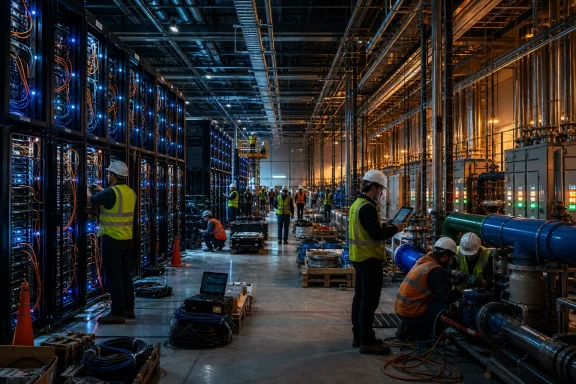 The AI buildout needs trades as much as technologists
The roles in greatest demand do not primarily resemble the office jobs usually invoked in debates over AI and automation. Operators need electricians who can work on high-voltage distribution, mechanical engineers who understand heat rejection and chilled-water systems, specialists in liquid cooling, commissioning personnel, and technicians who can rack, cable, service and replace hardware at scale.
That distinction matters because an AI facility is not simply a larger server room. High-density systems move immense electrical loads and generate enough heat to require integrated decisions across utility connections, substations, switchgear, UPS equipment, cooling distribution units, heat exchangers, building controls and the racks themselves. A delay in any one layer can leave expensive IT equipment waiting for the physical environment needed to run it.
The pressure becomes clearer at the rack level. Schneider Electric and AMD announced their jointly developed Helios reference design on July 23, positioning it as a validated blueprint for AMD’s rack-scale AI deployments. The design supports racks rated up to 246 kW and modular clusters reaching 10.4 MW of IT load, with liquid-cooling approaches intended to remove as much as 84% of the heat.
Those figures illustrate why traditional staffing assumptions no longer work. A technician familiar with conventional enterprise racks, or an electrician accustomed to lighter commercial loads, may still have a valuable foundation. But modern AI sites require deeper expertise in high-density power delivery, liquid-cooling operations, monitoring systems, safety procedures and the interaction between IT equipment and facility infrastructure.
For an IT organization, that means the critical skills are spread across teams that are often purchased, contracted or managed separately: facilities, construction, colocation providers, equipment vendors, systems integrators and internal infrastructure staff. When any of those groups is understaffed, a project may have a design and approved budget but no practical path to an operational date.
Standard designs are also a response to the staffing gap
Schneider Electric’s answer is not just to recruit more people. Bunger told Fierce Network that standardization makes systems easier for workers to install and maintain. That is one reason the industry is leaning so heavily into repeatable reference architectures, pre-engineered modules and prefabricated power and cooling systems.
The Helios design is a good example of the strategy. Rather than asking every customer and contractor to solve a 246 kW rack deployment from first principles, the reference architecture defines an integrated approach to power, cooling, facility layout and lifecycle management. Schneider Electric says the design uses ETAP and EcoStruxure IT Design CFD tools for electrical and thermal validation, along with digital-twin capabilities and operational monitoring through AVEVA tooling.
A validated design does not eliminate the need for skilled workers. It reduces the amount of one-off engineering, lowers the chance that an installation team has to improvise around an incompatible component, and makes training more repeatable. In effect, the industry is trying to convert bespoke construction work into a more productized deployment model.
That could matter especially for enterprises relying on colocation providers or building regional AI capacity. A reference design gives procurement and infrastructure teams a clearer framework for evaluating whether a provider’s proposed build is realistic. It can also make operational handoffs less fragile, because the monitoring, power and cooling assumptions are known before a rack arrives on the floor.
The trade-off is that standardization can shift rather than erase complexity. A modular system still depends on local utility interconnection, code compliance, site-specific water and heat-rejection choices, and a workforce able to maintain the equipment over years. The value lies in reserving scarce expertise for the problems that truly must be solved locally.
Colleges, trade schools and veterans programs become infrastructure partners
The workforce shortage is pushing data center vendors and operators toward training arrangements that would once have been treated as corporate social responsibility rather than capacity planning. Schneider Electric is working with community colleges and other training institutions, while also participating in programs aimed at veterans and other potential talent pipelines. Iron Mountain sees universities and education partners taking a larger role in producing workers with the technical skills the sector needs.
This is a more consequential change than a few recruitment events. Community colleges and trade schools can provide the practical electrical, HVAC, controls and technician foundations that data center operations require, while employers can layer on vendor-specific certifications and supervised field experience. Veterans programs can also connect employers with candidates accustomed to structured procedures, safety-critical environments and technical maintenance work.
Iron Mountain has emphasized internships, mentorship and development of existing staff as part of its own talent strategy. That internal investment is important because the industry cannot merely poach from a limited pool of electricians, technicians and mechanical specialists without worsening the shortage elsewhere. The practical objective is to create career paths that retain people after they enter the field.
There is also a useful corrective here to the simplistic claim that AI’s economic story is solely about displacement. Boston Consulting Group’s April report, AI Will Reshape More Jobs Than It Replaces, estimated that 50% to 55% of U.S. jobs could be reshaped by AI over the next two to three years. BCG’s model did not forecast near-term aggregate unemployment; it argued that workforce planning, upskilling and reskilling have to be built into business strategy.
Data center work makes that conclusion tangible. AI software may automate or accelerate portions of white-collar work, but building the physical platform for those models requires people in roles that remain highly dependent on real-world judgment, safety practices and physical presence. The AI economy is increasing demand for skilled technical labor even as it changes other kinds of work.
Water, power and public acceptance are now linked to staffing
The labor problem is arriving as communities increasingly question the environmental and civic cost of new data centers. Residents and local officials want answers about power demand, water consumption, land use, backup generation, tax revenue, noise, employment and whether the promised local benefits will materialize.
Kidd told Fierce Network that operators need more direct engagement with local stakeholders rather than assuming support for development. That is a practical business requirement, not simply a messaging exercise. A project delayed by permitting disputes or community resistance can magnify the effects of an already tight labor market by disrupting construction schedules and making it harder to retain contractors through a long approval process.
Schneider Electric’s Bunger also argued that public discussion can miss efficiency improvements in cooling and energy management. Liquid cooling is often treated as synonymous with higher water use, but that is not necessarily true. Systems designed to transfer heat efficiently at higher temperatures can reduce cooling overhead, and some approaches can reduce reliance on water-intensive heat rejection compared with traditional designs.
Still, liquid cooling is not a universal environmental answer. The local outcome depends on the cooling architecture, climate, water source, electrical mix, building design and operational practices. Operators that present a generic sustainability claim without site-specific numbers are likely to find communities increasingly skeptical.
For IT buyers, this turns sustainability disclosures and facility design into due-diligence issues. An organization placing AI workloads in a colo facility should understand not only the power and resiliency specifications, but also whether the operator has a credible cooling plan, workforce pipeline and community engagement strategy. Capacity that looks plentiful on a sales slide may not be available on the intended timetable.
The next bottleneck is operational, not theoretical
AMD expects volume Helios deployments in the second half of 2026, and Schneider Electric’s reference design is meant to reduce the integration risk around those high-density environments. But the hardware will only be one part of the rollout. Each deployment still needs people who can safely install it, validate it, monitor it and repair it when something fails.
That makes workforce development a strategic issue for every company building, supplying or consuming AI infrastructure. The next phase of the data center race will not be decided only by who secures the most accelerators or megawatts. It will also be decided by who can staff the physical systems that turn those resources into reliable compute.
