
Grafa’s report correctly identifies Supermicro as a beneficiary of AI infrastructure spending, but its peer comparison mixes current Supermicro results with older financial periods from Dell, NVIDIA, and Arista. That makes the scale of the current market easier to underestimate. Dell’s cited $23.4 billion quarter and NVIDIA’s $44.1 billion revenue/$39.1 billion Data Center quarter are fiscal 2026 results reported in May 2025, not current 2026 comparisons.
The newer records are significantly larger. Dell reported $43.8 billion in revenue for fiscal 2027’s first quarter in May 2026, including $16.1 billion in AI-optimized server revenue. NVIDIA reported $81.6 billion in revenue and $75.2 billion in Data Center revenue for its fiscal 2027 first quarter. Arista’s fiscal 2026 first-quarter revenue was $2.709 billion, rather than the $1.97 billion figure used in the supplied comparison. The direction of the story is right; the older peer figures are not a reliable measure of the race Supermicro is entering.
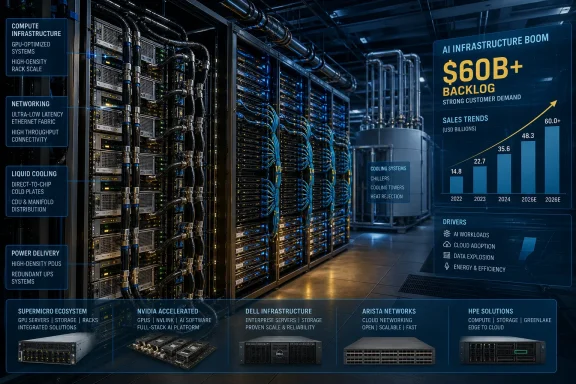 Supermicro’s margin recovery changes the immediate story
Supermicro’s revenue growth has been apparent for several quarters, but the recovery in gross margin is the more revealing part of its fourth-quarter update. In late July, the company had told investors that fourth-quarter revenue would land near the low end of its $11 billion to $12.5 billion guidance range while forecasting gross margin of 15% to 17%, well above its earlier 8.2% to 8.4% expectation. Reuters reported at the time that the company attributed the improvement to customer and product mix.
The reported 17.5% gross margin therefore exceeded even that upgraded preliminary range. For a systems maker assembling GPU-dense servers, that is meaningful: revenue can rise rapidly while profitability remains poor if scarce accelerators, memory, networking components, and expedited manufacturing are passed through with little markup. A margin rebound suggests Supermicro is shipping a more favorable mix of integrated systems, rather than merely moving a larger volume of low-margin hardware.
It does not prove that 17.5% is a permanent margin floor. AI infrastructure sales are susceptible to sharp quarter-to-quarter shifts because a relatively small number of very large deployments can change the mix of GPU platforms, direct-liquid-cooling equipment, storage, networking, and services. Still, Supermicro’s fiscal 2027 revenue outlook of $65 billion to $72 billion relies on far more than unit volume. It assumes the company can keep converting large orders into deployed systems without surrendering the better economics it just reported.
That is the operational test for a company positioned between component suppliers and cloud or enterprise customers. NVIDIA captures value through the accelerators and networking silicon that define the compute platform. Supermicro must obtain those parts, configure them into qualified systems, build and test racks, and get them to a data center ready to supply enough power, cooling, and network capacity.
A $60 billion order quarter is a capacity warning
The $60 billion order figure should be read as evidence of demand and delivery pressure, not as $60 billion of immediately booked revenue. Supermicro has said it entered fiscal 2027 with record backlog after receiving more than $60 billion in new orders in the fourth quarter. Its reported fiscal 2027 sales guidance, even at the high end, remains below that single-quarter order figure.
That gap is the key practical detail missing from a simple “AI server demand is growing” narrative. Orders must move through component allocation, system validation, manufacturing, logistics, customer acceptance, and data-center readiness before they become recognized sales. A buyer that has reserved systems is not necessarily ready to install them. A vendor with a large backlog is not necessarily able to ship every configuration on the customer’s preferred timeline.
For infrastructure teams, the bottleneck may not be the server chassis at all. A new GPU cluster can require:
- A power plan that accounts for rack density, redundant feeds, and the electrical work required upstream of the server row.
- A cooling design compatible with the selected systems, particularly when direct liquid cooling is involved.
- High-bandwidth network fabrics and optics sized for east-west traffic, not simply conventional data-center uplinks.
- Firmware, driver, GPU, NIC, storage, and cluster-management validation before production workloads are admitted.
The vendor race is consequently reaching beyond conventional server specifications. Dell, HPE, Supermicro, NVIDIA and Arista compete in overlapping layers of the same deployment: compute platforms, storage, fabrics, rack integration, and operational support. The systems that arrive first are not automatically the systems that can be placed into service first.
Dell, NVIDIA and Arista show how the spending stack has widened
Dell’s most recent disclosed quarter demonstrates why the older $23.4 billion revenue reference no longer captures the market. Dell said it booked $24.4 billion in AI orders and recognized $16.1 billion of AI-optimized server revenue in fiscal 2027’s first quarter. Those results make Dell a much more direct comparison for Supermicro than the year-old figures presented in Grafa’s roundup.
NVIDIA’s latest figures show the supplier side of the same buildout. Its $75.2 billion in Data Center revenue for the April 2026 quarter includes more than GPUs: the company has been pushing InfiniBand, Spectrum-X Ethernet, and NVLink systems as the interconnect foundation for large AI deployments. For server makers, that means the bill of materials, software stack, and design validation are increasingly shaped by a platform vendor’s road map.
Arista represents the networking consequence. Its fiscal 2026 first-quarter revenue of $2.709 billion reflects demand well above the $1.97 billion figure cited in the supplied story. AI clusters drive unusually intensive traffic between accelerators, storage, and distributed training or inference nodes. A procurement plan centered on server count but light on switching capacity, optics, cabling, and fabric design will produce an expensive underused cluster.
HPE’s June fiscal second-quarter results also point to the breadth of this spending. The company reported $7.7 billion in Cloud & AI revenue, up 22.9% year over year. The term “AI infrastructure” is often used as shorthand for GPUs, but the financial results across these vendors show the money flowing through server assembly, networking, storage, integration, and the facilities required to operate dense systems.
Supermicro still has to finance the buildout
The strength in orders and margins does not remove Supermicro’s execution risk. Before the fourth-quarter results, the company’s March-quarter filing showed $1.3 billion in cash and cash equivalents against $8.8 billion in bank debt and convertible notes, while cash used in operations reflected the working-capital demands of building systems at scale. Scaling an AI-server supplier requires inventory, supplier commitments, manufacturing capacity, and in many cases customer-specific configurations before payment is fully collected.
That is why an order backlog should not be treated as a cash balance. A rapidly growing backlog can strengthen a vendor’s negotiating position and provide revenue visibility, but it can also consume cash if the supplier must buy accelerators, memory, storage, networking gear, and cooling equipment before shipments convert to invoices and collections.
Supermicro said it raised capital to support demand and expanded U.S. manufacturing capacity in Silicon Valley. Those steps address the problem directly, but the company’s fiscal 2027 outlook now sets a demanding standard: the market will be watching delivery cadence, cash conversion, inventory growth, and whether gross margin remains near the fourth-quarter level as it fulfills a vastly larger book of business.
What enterprise buyers should do with the signal
For Windows Server, Linux, virtualization, and AI platform administrators, this is less a reason to chase a server vendor’s quarterly results than a reason to tighten deployment planning. The same demand that is raising vendor revenue can affect lead times for accelerator-equipped systems, network hardware, high-capacity power distribution, and cooling infrastructure.
Procurement and platform teams should separate a supplier’s quoted ship date from the date a cluster can pass acceptance testing. They should also obtain a configuration-level support matrix for GPU drivers, NIC firmware, storage drivers, operating systems, hypervisors, orchestration software, and management controllers before committing to a rack design. This matters especially where a Windows-based management estate has to coexist with Linux-based AI training and inference nodes.
Supermicro’s quarter confirms that AI infrastructure demand has not cooled. But the corrected comparison with Dell, NVIDIA, Arista, and HPE shows a market that has advanced faster than the supplied peer figures suggest. The competitive question is no longer which vendor can announce an AI server; it is which supplier can reliably deliver a complete, supportable cluster while customers are still racing to secure the power, cooling, and network capacity to turn it on.
