

It was a whirlwind October for the AI industry: major cloud and chip vendors pushed new tools and silicon, Google reported a landmark verifiable quantum result, Apple shipped the new M5 for Macs and iPads, Microsoft and OpenAI formalized a sweeping partnership recapitalization, and industry players from NVIDIA to AMD and Intel unveiled hardware and national-scale systems that push compute toward petaflops and beyond — all developments that reshape how AI will be built, deployed, and controlled over the next decade.
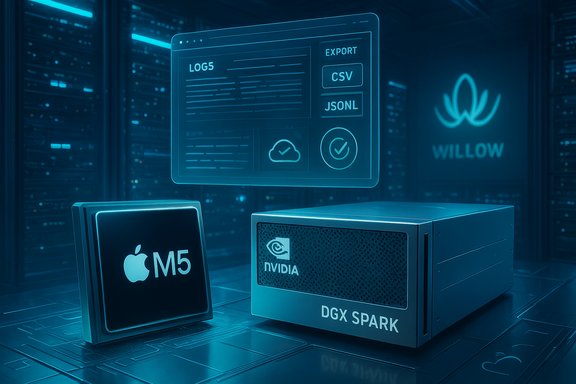
The last quarter has been characterized by two simultaneous trends. First, vendors are layering operational features — logging, dataset exports, agent builders, model governance and cloud integration — on top of raw model capability to help developers and enterprises move AI from experiment to production. Google’s new AI Studio logs and datasets tooling is the clearest example of this push toward observability and MLOps. Second, the hardware and governance fences are being re-drawn. New chips and systems (Apple’s M5, NVIDIA’s DGX Spark, Intel’s Panther Lake, AMD-powered DOE supercomputers) are increasing on-device and datacenter performance, while corporate agreements and public‑private projects are defining who controls frontier compute, who owns model IP, and how AGI milestones will be validated. Microsoft’s recently announced definitive agreement with OpenAI — which restructures ownership and extends certain IP windows into the early 2030s — is an industry-defining example. This article summarizes the key announcements, verifies the technical claims where possible, and analyzes what these changes mean for developers, enterprises, and Windows users — including the upside and the risks.
Practical enterprise takeaways
The practical reality for Windows users, developers and IT leaders is straightforward: take advantage of the new tools for observability and on‑device inference, but govern them deliberately. The upside is enormous: faster research cycles, richer on‑device experiences, and industry‑grade agent workflows. The downside — concentration of control, regulatory friction, and governance gaps — will require constant attention from technologists and policy makers alike.
The industry is building the instruments and the rules simultaneously. The next 12–36 months will be decisive: adoption, governance and interoperability choices made now will set the architecture of commercial AI for the next decade.
Source: WNDU Artificial Intelligence (A.I. Update | Nov. 7, 2025
 Background / Overview
The last quarter has been characterized by two simultaneous trends. First, vendors are layering operational features — logging, dataset exports, agent builders, model governance and cloud integration — on top of raw model capability to help developers and enterprises move AI from experiment to production. Google’s new AI Studio logs and datasets tooling is the clearest example of this push toward observability and MLOps. Second, the hardware and governance fences are being re-drawn. New chips and systems (Apple’s M5, NVIDIA’s DGX Spark, Intel’s Panther Lake, AMD-powered DOE supercomputers) are increasing on-device and datacenter performance, while corporate agreements and public‑private projects are defining who controls frontier compute, who owns model IP, and how AGI milestones will be validated. Microsoft’s recently announced definitive agreement with OpenAI — which restructures ownership and extends certain IP windows into the early 2030s — is an industry-defining example. This article summarizes the key announcements, verifies the technical claims where possible, and analyzes what these changes mean for developers, enterprises, and Windows users — including the upside and the risks.Google: AI Studio observability and a quantum milestone
Logs + datasets in Google AI Studio: practical MLOps gains
Google rolled out logs and datasets in Google AI Studio to let developers capture GenerateContent API interactions, inspect inputs and outputs, and export problematic or representative interactions as datasets for offline evaluation and retraining. The feature supports exporting in CSV or JSONL, keeps project logs for a default retention window (logs expire after 55 days unless curated into datasets), and lets developers optionally share selected datasets with Google to help model improvements. This is a clear operational maturity step: you can enable logging with a toggle in the AI Studio dashboard and use those logs to reproducibly debug and benchmark model behavior. Why it matters- Faster debugging: trace a user complaint to the exact model call (request/response).
- Evaluation pipelines: build reproducible challenge sets from real traffic for regression tests.
- Governance: datasets make it feasible to retain audit trails and to run offline fairness and safety checks.
- Logs default to a limited retention window and project storage quotas; teams must curate important logs into datasets to keep long-term records. Sharing datasets with vendors for model improvement has privacy and compliance implications and must be governed accordingly.
Quantum Echoes on Willow: a claimed verifiable advantage
Google’s Quantum AI team published a technical demonstration where their Willow quantum processor ran an algorithm named Quantum Echoes, and reported a verifiable speed advantage — roughly 13,000× faster than the best classical approach used for comparison. The claim emphasizes verifiability: the quantum computation gives an output that can be repeatedly checked against expectations, an important step beyond prior demonstrations that were noisy or only statistically favorable. What to verify and how to read the claim- This is a specific algorithmic claim under controlled conditions; it is not the same as broad “quantum supremacy” claims for general-purpose workloads.
- The speedup figure depends on the chosen classical baseline, the problem encoding, and the hardware used for the comparison; independent reproduction and peer-reviewed publication (technical papers, datasets, and code) are the usual tests of robustness.
- The claim is meaningful for quantum‑native algorithms in chemistry and materials simulation (the demonstrated use case), but it does not imply an imminent replacement of classical HPC across most AI workloads.
Apple’s M5 chip: a consumer AI leap
Apple’s M5 family was introduced as the next-generation Apple Silicon focused on accelerating on-device AI and GPU workloads across MacBook Pro, iPad Pro and Vision Pro form factors. Apple and multiple industry outlets report the M5 delivers a substantial jump in peak GPU and neural compute compared with the M4 — Apple positioned the M5 as delivering more than four times the peak GPU power for AI compared with M4 in vendor messaging and early hands-on reports. The M5-equipped devices began shipping/availability in mid‑ to late‑October, with several product lines refreshed. Why this matters for WindowsForum readers and developers- On-device inference: higher neural accelerator throughput makes local LLM inference and multimodal AI more feasible without always routing to cloud APIs, which benefits latency, privacy, and disconnected scenarios.
- Developer opportunity: apps that previously had to rely on server-side inference can now deliver richer AI experiences locally, opening new UX patterns in creative and productivity apps.
- Ecosystem competition: Apple’s move puts pressure on Intel, AMD and Arm‑based OEMs to accelerate on-chip neural performance for PCs and tablets.
- Vendor peak-power and benchmark claims often reflect specific internal workloads or peak FP/INT capabilities. Independent benchmarking on representative AI workloads (LLM inference, vision transformers, multimodal pipelines) is necessary to compare real‑world throughput and power efficiency.
Microsoft & OpenAI: a definitive agreement that changes the map
In late October 2025 Microsoft and OpenAI announced a comprehensive restructuring of their partnership, formalizing OpenAI’s recapitalization into a Public Benefit Corporation (PBC) and defining long-range commercial and IP terms. Under the agreement Microsoft will hold an investment that the companies value at roughly $135 billion — representing about 27% post‑recapitalization on an as‑converted diluted basis. The contract preserves Microsoft as OpenAI’s frontier model partner and extends model and product IP rights through 2032, with narrower research‑category IP protections extending to 2030 or until AGI verification by an independent expert panel. The agreement also unlocks multi‑cloud compute flexibility for OpenAI while locking in very large incremental Azure commitments. Key implications- Long-term platform advantage for Microsoft: extended IP windows and Azure commercial commitments consolidate Microsoft’s Copilot and Azure‑first enterprise play for many years.
- Greater flexibility for OpenAI: converting to a PBC and loosening single-cloud compute exclusivity gives OpenAI the ability to source compute and partners required for future scaling.
- AGI governance innovation: the agreement requires independent verification before AGI-triggered contractual changes take effect, inserting an external gate into a previously ambiguous milestone framework.
- Concentration: Microsoft’s large economic stake and extended IP rights create a durable competitive moat, but they also concentrate control over frontier model access and commercialization.
- Auditability: external verification for AGI is a governance improvement, but the design and authority of that expert panel will be hotly scrutinized by regulators and the research community.
- Strategic tension: the deal balances Microsoft’s product-led incentives against OpenAI’s desire to partner broadly; the precise mechanics of exclusivity and revenue‑share for third‑party collaborations will determine downstream market openness.
NVIDIA: DGX Spark brings petaflop-class desktop AI
At GTC, NVIDIA highlighted the DGX Spark, a compact Grace Blackwell‑powered system aimed at bringing up to one petaflop of AI performance to the desktop form factor. NVIDIA framed this as enabling on-premise prototyping, fine-tuning, and inference for AI developers and researchers without requiring a datacenter instance. The company also announced a broader DGX personal lineup (DGX Station) to cover a range of local AI compute needs. What “one petaflop” means in practice- A petaflop denotes roughly 10^15 floating-point operations per second — a common shorthand for peak compute but not a direct measure of LLM training or inference throughput (those workloads often depend on memory bandwidth, model parallelism, and precision formats).
- The significance here is accessibility: moving high‑scale inference and limited fine-tuning nearer to researchers/teams improves iteration speed and reduces cloud costs for certain workflows.
- Price, OEM availability, and the supported precision formats (FP4, BFLOAT, INT8) will determine how useful these boxes are for real LLM tuning workloads.
- Many production-scale trainings still require multi‑rack fabrics and specialized interconnects, so DGX Spark is best read as a powerful edge/prototyping system rather than a datacenter replacement.
AMD + DOE: Lux AI and Discovery at Oak Ridge
AMD and the U.S. Department of Energy announced two flagship systems for Oak Ridge: Lux AI and Discovery, designed to accelerate AI-for-Science and national research. Lux AI is positioned as an early-deployed AI factory cluster (deployed in early 2026) while Discovery targets the next leap in converged HPC+AI infrastructure. Both systems will be AMD-accelerated and built by HPE/partners, designed to support large‑scale model training and complex scientific workflows. Why these systems matter- Sovereign capability: Lux and Discovery represent a public‑private push to ensure U.S. leadership in AI infrastructure for science, energy, national security and advanced manufacturing.
- AI-for-science: the DOE posture is explicit: these machines will accelerate discovery cycles for materials, fusion, medicine, and more — domains where domain-specific models and tight HPC integration deliver outsized value.
- Deployment complexity and integration of next‑gen software stacks make timelines optimistic; Lux targets early 2026 and Discovery will follow. These systems require long software and ecosystem readiness to realize promised scientific returns.
Intel Panther Lake: client 18A silicon enters production
Intel disclosed Panther Lake, its first client-family chips produced on the new 18A process, with high‑volume production planned in Arizona. The 18A node is positioned as Intel’s response to competitive process nodes, aiming for improved performance-per-watt and higher transistor density for client CPUs intended for laptops and desktops. Industry reporting indicates high-volume production targets later in 2025 at Fab 52 in Arizona. Significance for the PC ecosystem- If Intel meets yields and timings, Panther Lake on 18A would help narrow the process gap for client performance and power efficiency, benefiting Windows notebooks and high‑performance ultrabooks.
- Supply chain and OEM adoption cycles will determine how quickly Panther Lake accelerates machine‑level AI on client Windows devices compared with Apple’s vertically integrated M5 approach.
- Performance gains and process claims should be judged against independent benchmarking once retail hardware is available. Early press claims track vendor guidance and analyst estimates.
OpenAI product updates and ChatGPT changes: what’s verified
The WNDU summary lists GPT‑5 Instant as the default for signed‑out users, shared projects for group collaboration, and the web rollout of ChatGPT Pulse. Vendor product rollouts can be fluid and regionally staged; some features (like new model defaults and collaborative workspace features) often roll out progressively. Public company product notes and platform changelogs are the authoritative sources to confirm GA status in specific regions and user segments. File-level reporting in our internal threads corroborates that GPT‑5 and collaboration features were being rolled out aggressively through late 2025, but some claims about defaults for signed‑out users or the exact Pulse web availability window required per-region verification. Treat product rollout claims as provisionally accurate pending vendor changelog confirmation in your region.Practical enterprise takeaways
- Administrators should verify which model is the default for their tenant and whether shared projects are enabled by policy before relying on these features in production workflows.
- Rolling out collaborative agent workflows requires governance controls (data access, connectors, DLP rules) to avoid accidental data exposure when project-level collaboration is enabled.
Microsoft + LSEG: bringing AI‑ready financial data into workflows via MCP
Microsoft and the London Stock Exchange Group (LSEG) announced steps to inject AI‑ready financial data directly into customer workflows by linking LSEG’s licensed market data to custom AI agents built in Microsoft Copilot Studio and deployed in Microsoft 365 Copilot. This integration uses an LSEG‑managed server running the Model Context Protocol (MCP) so institutions can securely plug LSEG data into agents while preserving interoperability with in‑house systems and third‑party apps. The move is explicitly aimed at reducing integration friction for financial institutions that need licensed, auditable data inside agent workflows. Why this matters for financial services- Interoperability: MCP‑based connectors mean banks and trading firms can integrate licensed pricing and reference data into agents without bespoke adapters for each vendor.
- Compliance: LSEG‑managed MCP servers and contractual licensing simplify legal and audit obligations for regulated institutions.
- Speed of deployment: Copilot Studio + MCP lowers time-to-value for production agents in trading, treasury, and risk workflows.
- Financial institutions must still manage model governance, data lineage, and model auditing when deploying agents into front‑office or risk workflows.
- Licensing constraints and audit trails remain nondisposable: institutions should validate that agent access patterns conform to LSEG’s licensing terms.
Analysis: strengths, opportunities, and risks
Notable strengths and opportunities
- Operational maturity: Tools like Google’s AI Studio logs and dataset exports lower the barrier to production-grade MLOps, enabling repeatable evaluation and safer rollouts.
- Hardware diversity: Apple’s M5, NVIDIA’s DGX Spark, Intel’s 18A Panther Lake and AMD’s national-scale systems together expand choices across on-device, edge, and exascale compute — which reduces single‑vendor bottlenecks and helps match workloads to architectures.
- Strategic capital flows: Microsoft/OpenAI’s restructuring unlocks capital and governance changes that could accelerate frontier R&D while preserving product integration advantages that benefit enterprise customers.
- Vertical integration for regulated sectors: Microsoft+LSEG’s MCP work illustrates how licensed, auditable data can be plugged into agent workflows that enterprise users actually trust.
Key risks and downside scenarios
- Concentration of frontier IP and compute: Extended IP windows and big equity stakes create durable competitive moats; this concentration raises antitrust and systemic‑risk questions, especially for essential infrastructure like large‑scale model access and training compute.
- Vendor-driven defaults: When vendors choose model defaults for signed‑out or consumer experiences, it shapes generalized behavior — but those defaults may not align with enterprise compliance or data‑handling needs.
- Security and privacy: Logging and dataset export features, while operationally valuable, widen the attack surface and increase the risk of accidental data exposure unless tenants enforce strict access controls and retention policies.
- Energy and supply constraints: National‑scale systems and aggressive training schedules are energy‑intensive; capacity constraints in GPUs and specialized chips remain a gating factor for the fastest‑moving labs and startups.
Practical guidance for developers, IT leaders, and Windows users
- Verify default model and rollout status for your tenant and country before embedding a vendor default into production flows. Vendor defaults can change; confirm via vendor changelog or admin portals.
- Use logging and dataset tools to build evaluation pipelines: curate representative failure cases into datasets and run automated regression tests before deploying model updates.
- Apply data governance to exported logs: treat logs as sensitive artifacts, limit retention, and use encryption and access controls when datasets are shared externally.
- For on-device AI adoption, benchmark real LLM inference scenarios on actual silicon (M5, Panther Lake, or discrete GPUs) rather than relying solely on vendor peak‑power claims.
- For regulated industries using licensed datasets (finance, health), favor MCP-like managed connectors and insist on contractual clarity around data lineage and auditability.
- Track compute and IP governance developments closely if your organization depends on frontier models: the Microsoft‑OpenAI agreement materially changes access dynamics through the early 2030s and may affect pricing and availability.
Conclusion
October’s flurry of announcements marks a transition from capability arms races to ecosystem engineering: vendors are shipping the operational plumbing — logs, datasets, managed connectors, compact petaflop systems — that lets organizations use advanced AI reliably. At the same time, hardware advances (M5, DGX Spark, Panther Lake) and national investments (Lux AI, Discovery) materially raise the ceiling for what is technically feasible in research and enterprise settings. The Microsoft–OpenAI definitive agreement reframes long‑term commercial and IP realities, while Google’s quantum Echoes result underlines that new classes of algorithms and hardware will reshape scientific computing on different time horizons.The practical reality for Windows users, developers and IT leaders is straightforward: take advantage of the new tools for observability and on‑device inference, but govern them deliberately. The upside is enormous: faster research cycles, richer on‑device experiences, and industry‑grade agent workflows. The downside — concentration of control, regulatory friction, and governance gaps — will require constant attention from technologists and policy makers alike.
The industry is building the instruments and the rules simultaneously. The next 12–36 months will be decisive: adoption, governance and interoperability choices made now will set the architecture of commercial AI for the next decade.
Source: WNDU Artificial Intelligence (A.I. Update | Nov. 7, 2025
