

Aikido Technologies’ plan to tuck servers inside the submerged ballast tanks of a floating wind turbine and use North Sea cold to cool high-density AI racks reads like the convergence of two desperate infrastructure problems: hyperscalers hungry for electricity and coastal communities increasingly resistant to colossal land-based data centers. The concept is elegant in its simplicity—co-locate renewable generation with compute and use a closed-loop, freshwater ballast as a liquid-cooling medium—yet it collides with a thicket of engineering, environmental, regulatory and operational risks that will determine whether the idea is a niche curiosity or a scalable new class of data-center infrastructure.
Offshore floating wind has matured rapidly in the past half-decade, moving from experimental spar buoys to semisubmersible platforms capable of hosting multi-megawatt turbines in deep water. Aikido Technologies, a San Francisco startup known for a fold-up “flat-pack” floating platform design, is now proposing a further twist: use the empty internal volume of a turbine’s submerged legs to host liquid-cooled data halls. The company has unveiled a design called AO60DC that pairs a 15–18 MW wind turbine and integrated batteries with roughly 10–12 MW of “AI-grade compute” embedded in the platform. Aikido says it will test a compact, 100 kW prototype in the North Sea off Norway before the end of 2026 and aims for larger commercial fields thereafter.
Parallel work in China has already produced what developers there call the first wind-powered underwater data center, deployed off Shanghai in October 2025. That project was promoted as a proof of concept for harnessing offshore wind together with seawater cooling to reach multi-megawatt capacity while minimizing land use. Together, these efforts signal an industry exploring the same fundamental idea from different technical and regulatory starting points: put compute at the source of renewable power and leverage ambient ocean cooling to cut thermal management costs.
Key environmental safeguards that should be implemented in pilots:
The two approaches—Aikido’s modular AO60DC and China’s larger, state-led UDC—offer complementary lessons: small, public pilots to validate physics and operations; and, where policy alignment exists, larger rapid deployments to scale capacity.
But the devil lives in the details. Returning heat into a fragile marine environment, reliably maintaining tungsten‑like uptime in a corrosive salt atmosphere, and tying offshore compute into terrestrial networks at competitive total cost are all non-trivial challenges. Early pilots must publish hard operational KPIs, environmental monitoring, and cost data. Transparency will determine whether regulators, hyperscalers and financiers buy into the model.
If the technology proves robust and cost-competitive, offshore floating data farms could become a meaningful component of the global compute mix—especially in regions where onshore options are constrained. If not, those pilots will still provide invaluable lessons about thermal transfer, modular deployment, and the real costs of putting data hardware into the sea.
Either way, the experiment marks a pivotal moment in the infrastructure debate: the industry is no longer asking whether we need more compute, but where and how to build it in a world where land, power and public consent are all scarce. The sea is the next frontier—both a resource and a test bed—and the coming pilots will tell us whether the future of data centers rides on waves or drowns in complexity.
Source: Tom's Hardware US startup plans to build data centers inside ocean-based wind turbines, servers water cooled via chilly North Sea — each leg houses a data center, firm set to launch three-legged prototype in Norway’s North Sea this year
 Background
Offshore floating wind has matured rapidly in the past half-decade, moving from experimental spar buoys to semisubmersible platforms capable of hosting multi-megawatt turbines in deep water. Aikido Technologies, a San Francisco startup known for a fold-up “flat-pack” floating platform design, is now proposing a further twist: use the empty internal volume of a turbine’s submerged legs to host liquid-cooled data halls. The company has unveiled a design called AO60DC that pairs a 15–18 MW wind turbine and integrated batteries with roughly 10–12 MW of “AI-grade compute” embedded in the platform. Aikido says it will test a compact, 100 kW prototype in the North Sea off Norway before the end of 2026 and aims for larger commercial fields thereafter.Parallel work in China has already produced what developers there call the first wind-powered underwater data center, deployed off Shanghai in October 2025. That project was promoted as a proof of concept for harnessing offshore wind together with seawater cooling to reach multi-megawatt capacity while minimizing land use. Together, these efforts signal an industry exploring the same fundamental idea from different technical and regulatory starting points: put compute at the source of renewable power and leverage ambient ocean cooling to cut thermal management costs.
How the concept works
Basic architecture
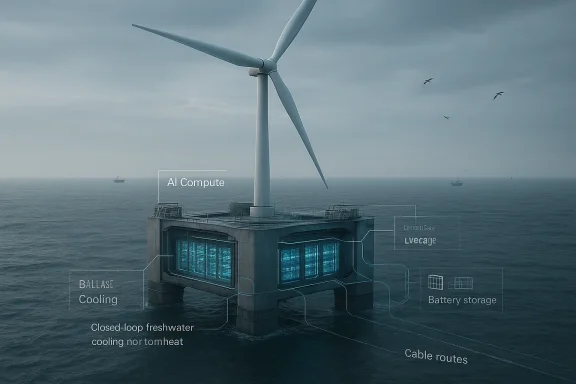
- A semisubmersible floating platform supports a large rotor at the center and three tripod legs extending outward into the water.
- Each leg contains ballast tanks; Aikido’s twist is to convert the upper sections of those ballast tanks into sealed, liquid-cooled data halls.
- Fresh water (kept inside the ballast tanks) acts as the working fluid for closed-loop cooling: pumped up to racks to remove heat, then returned to the ballast where conduction through steel walls and surrounding cold seawater rejects the heat.
- Batteries are installed onboard for smoothing power delivery, and the platform remains grid-connected as a fallback when wind production dips.
Claimed capacity and prototypes
- The pilot unit Aikido plans for Norway is a compact, 100 kW demonstrator intended to validate continuous power delivery, seawater-cooled heat rejection and operational readiness in the North Sea environment.
- Aikido’s full AO60DC design envisions a 15–18 MW wind turbine with about 10–12 MW of colocated compute (3–4 MW per leg), plus integrated battery storage to ride through low-wind periods.
Cooling approach
- Closed-loop freshwater is used to avoid introducing seawater into electronic systems and to mitigate corrosion risk in the immediate heat-transfer loop.
- Heat from GPU/CPU racks is transferred to the freshwater loop; warmed ballast water is run back into the leg and cooled by conduction to the surrounding seawater through the tank structure.
- Non-liquid-cooled elements (switches, auxiliary electronics) are handled with localized air-conditioning loops, since current commercial liquid-cooling for certain networking gear remains limited.
Why this idea is attractive right now
- Power at source: AI workloads are driving enormous new electricity demand, and hyperscalers are racing to secure low-carbon power. Co-locating compute with renewable generation can reduce the complexity of onshore grid upgrades, land acquisition, and public opposition.
- Free ambient cooling: Ocean temperatures a few dozen meters below surface can provide significant heat sink capacity, potentially reducing the operational cost of thermal management compared with conventional air-cooled land facilities.
- Land-sparing and political optics: Offshore platforms sit beyond the immediate viewshed of communities and may avoid the “not-in-my-backyard” licensing fights that have slowed many onshore data center and wind projects.
- Modular deployment: Prefabricated, flat-pack assembly and quayside integration promise faster, more flexible rollout compared with constructing large onshore campuses.
- Sovereign compute: Nations or regions that want domestic control over critical AI infrastructure could favor floating solutions within Exclusive Economic Zones (EEZs) or territorial waters.
Engineering and operational challenges
1. Energy intermittency and battery sizing
Wind is variable. While the North Sea has strong resource potential, seasonal dips and multi-day low-wind events are real. Onboard batteries and grid ties help, but they change the economics: batteries sized for multi-day operation quickly become cost-prohibitive.- Practical pilot metrics to measure: battery round-trip efficiency, usable battery energy (kWh) per kW of compute, and fraction of compute hours sustained during low-wind stretches.
2. Heat rejection and marine thermal impact
Rejecting tens of megawatts of heat into a small volume of ocean near the platform raises ecological questions.- Thermal plume modeling is required to evaluate local temperature rise, stratification effects, and potential impacts on benthic and pelagic species.
- The closed-loop freshwater design reduces direct seawater contamination risk, but the platform still dumps heat into the ocean via conduction through steel tanks; regulators will require robust environmental impact assessments.
3. Corrosion, fouling and long-term marine exposure
Saltwater is unforgiving: corrosion, galvanic reactions, biofouling and marine growth accelerate component failure.- Even with freshwater closed loops, external piping, sea interfaces, and hull structures face accelerated degradation and expensive preventive maintenance.
- Design countermeasures: cathodic protection, specialized coatings, corrosion-tolerant materials, and redundant piping with easy access for replacement.
4. Maintenance, access, and logistics
- Routine maintenance requires vessel support and often divers or remote-operated vehicles (ROVs). Anything beyond quick fixes is far more complex than land-based maintenance bays.
- Rapid swap-out of prefabricated “data modules” quayside minimizes offshore work, but that depends on reliable port infrastructure and favorable sea states during deployment windows.
5. Security and geopolitical risk
- Offshore infrastructure may be more exposed to nation-state interference, sabotage, or physical attacks. Incidents against subsea cables in recent years have heightened these concerns.
- Physical security layers must be considered: surveillance, maritime exclusion zones, coast guard coordination, hardened hardware enclosures, and distributed fault tolerance to avoid single points of failure.
6. Network connectivity and latency
- Offshore sites require robust subsea cable connections to mainland PoPs to maintain low latency and sufficient bandwidth. Laying and protecting these cables adds cost and risk.
- For latency-sensitive applications, site placement relative to major urban hubs will be a critical tradeoff.
7. Regulatory complexity
- Offshore installations face a patchwork of maritime law, coastal state permitting, environmental regulations and national security reviews.
- Heat discharge, chemical use, marine mammal protections, fishing area impacts and navigational safety are all regulatory touchpoints that can delay projects.
Environmental and ecological considerations
Putting compute into the marine environment is not merely a technical swap of cooling methods—it changes the local thermal and physical environment. Even modest, continuous heat rejection can alter plankton blooms, localized oxygen levels and migration patterns if not carefully modeled and monitored. Regulators will demand baseline ecological surveys and long-term monitoring plans. Developers must also plan for accidental discharges (e.g., chemicals, lubricants) and end-of-life decommissioning that restores seabed and water quality.Key environmental safeguards that should be implemented in pilots:
- Continuous water-quality and temperature monitoring around the platform.
- Emergency shutdown procedures that minimize thermal and chemical release.
- Clear decommissioning plans and financial assurance for removal.
- Collaboration with marine biologists during site selection and monitoring.
Economic and business model analysis
CAPEX and OPEX drivers
- CAPEX drivers: floating platform fabrication, turbine cost, subsea cable installation, modular data-hall fabrication, batteries, and marine deployment logistics.
- OPEX drivers: vessel operations, periodic major maintenance, anti-fouling recoating, corrosion repair, and insurance premiums for marine risk.
Competitive positioning
- The primary market is buyers seeking low-carbon, politically palatable compute: national sovereign projects, hyperscalers with renewable mandates, edge compute for coastal regions, and compute-for-energy trading models.
- Compared to land-based greenfield builds, offshore platforms may win in regions where grid constraints or community opposition make onshore expansion slow or expensive.
- The China projects show an alternate route: state-backed, concentrated investments in rapid demonstration to lock in domestic advantages.
Scalability and unit economics
- Unit economics hinge on turbine capacity, capacity factor, battery cost, and amortization of marine infrastructure.
- Larger farms (many platforms in an array sharing export cables and O&M vessels) may realize economies of scale, but initial arrays will need to demonstrate acceptable PUE, availability and lifecycle costs to attract hyperscaler commitments.
Practical test plan and pilot KPIs
For the Norway 100 kW demonstrator and any subsequent pilot, the following KPIs should be non-negotiable:- Availability (percent uptime) measured over seasonal cycles.
- Delivered compute hours per kW of nameplate turbine capacity.
- End-to-end PUE (including battery/charge/discharge losses and cable transmission losses).
- Battery endurance (hours of full-load backup) and degradation curve over time.
- Heat rejection effectiveness: delta-T across the ballast loop and empirical ocean thermal plume dispersion.
- Corrosion and material degradation rates measured against baseline land-based components.
- Mean time to repair (MTTR) for different failure classes, and logistical hours required for offshore interventions.
- Network latency/packet loss compared to mainland equivalents.
- Environmental monitoring outputs: temperature anomalies, dissolved oxygen variance, and biological impact indices.
- Maintenance and vessel days per year, and O&M cost per kW per year.
Security and resilience: design recommendations
- Adopt a defense-in-depth physical security model that assumes both conventional vandalism and state-level interference.
- Design compute stacks for graceful degradation: spread sensitive workloads across multiple platforms and encourage stateless architectures where possible.
- Harden subsea comms and diversify cable routes. Explore partnerships with national telecom operators or include redundant microwave or fiber pairs to shore.
- Implement strict software and hardware supply-chain provenance: components for offshore platforms will be difficult to rapidly replace and therefore require rigorous vetting.
Regulatory and policy obstacles to anticipate
- Environmental permitting will focus on heat discharges and marine habitat impacts. Proactive environmental baseline studies accelerate regulatory review.
- Maritime safety authorities will require navigational risk assessments and potentially exclusion zones; coordination with fisheries and shipping interests is essential.
- National security agencies will scrutinize foreign ownership, cross-border data flows, and physical access, especially for platforms near contested waters.
- Insurance markets may impose special terms for marine data assets; expect higher premiums during early adoption phases.
Comparisons and context: China’s underwater experiment
China’s October 2025 deployment of a wind-powered underwater data center off Shanghai demonstrates a different path: centralized, state-backed investment and rapid demonstration. That project was presented as a multi-phase build with tens of megawatts planned and emphasized seawater cooling and direct offshore-wind power. For Western developers, the Chinese model shows both the potential speed of rollout when there is strong political alignment and the questions that follow about environmental transparency, operational assumptions, and long-term reliability in harsh marine settings.The two approaches—Aikido’s modular AO60DC and China’s larger, state-led UDC—offer complementary lessons: small, public pilots to validate physics and operations; and, where policy alignment exists, larger rapid deployments to scale capacity.
Risks that could sink the idea — and mitigations
- Risk: Seasonal and multi-day wind lulls reduce compute availability. Mitigation: conservative battery sizing, grid interconnects, workload scheduling policies and hybrid deployments that can burst to land-based power.
- Risk: Unforeseen marine corrosion and biofouling increase OPEX and cause downtime. Mitigation: rigorous materials testing, aggressive anti-fouling strategies, and modularized, hot-swappable data modules.
- Risk: Regulatory hurdles around heat discharge and marine ecosystems. Mitigation: early regulatory engagement, transparent environmental monitoring and adaptive heat rejection control.
- Risk: Cable damage and physical security threats. Mitigation: redundant routes, active monitoring, and maritime enforcement partnerships.
- Risk: Higher-than-expected insurance and financing costs. Mitigation: blended financing with government or export-backed guarantees, and phased risk reduction through pilot data.
What success looks like — and what failure looks like
Success for an offshore data-center platform will be a demonstrable, repeatable set of pilot metrics showing:- Reliable, continuous operation across seasonal cycles with competitive PUE.
- Manageable and predictable O&M costs that compare favorably with constrained shore sites.
- Environmental metrics within regulatory limits and community acceptance of installations.
- A clear path to scale where arrays share export infrastructure and O&M resources.
Roadmap and timelines — realistic expectations
Aikido’s 100 kW demonstrator in Norway is a sensible first step to validate thermal physics, materials behavior and operational routines. Key phases should be:- Controlled quayside commissioning and stress testing of the module and ballast loop.
- Short offshore soak tests (weeks) under instrumented conditions to validate heat rejection and dynamic behavior.
- Extended seasonal pilot (months to a year) to gather availability, corrosion data and operational costs.
- Incremental scaling to multi-megawatt platforms and eventual farm-level demonstrations with shared export cable economics.
Final analysis: pragmatic optimism tempered by engineering realism
The Aikido concept is one of those convergent ideas—where advances in floating wind engineering, liquid cooling, prefabrication and the hyperscale industry’s appetite meet in a place that looks promising on paper. The pilot planned for the North Sea is the right move: a high-energy environment with strong regulatory institutions and an experienced marine supply chain.But the devil lives in the details. Returning heat into a fragile marine environment, reliably maintaining tungsten‑like uptime in a corrosive salt atmosphere, and tying offshore compute into terrestrial networks at competitive total cost are all non-trivial challenges. Early pilots must publish hard operational KPIs, environmental monitoring, and cost data. Transparency will determine whether regulators, hyperscalers and financiers buy into the model.
If the technology proves robust and cost-competitive, offshore floating data farms could become a meaningful component of the global compute mix—especially in regions where onshore options are constrained. If not, those pilots will still provide invaluable lessons about thermal transfer, modular deployment, and the real costs of putting data hardware into the sea.
Either way, the experiment marks a pivotal moment in the infrastructure debate: the industry is no longer asking whether we need more compute, but where and how to build it in a world where land, power and public consent are all scarce. The sea is the next frontier—both a resource and a test bed—and the coming pilots will tell us whether the future of data centers rides on waves or drowns in complexity.
Source: Tom's Hardware US startup plans to build data centers inside ocean-based wind turbines, servers water cooled via chilly North Sea — each leg houses a data center, firm set to launch three-legged prototype in Norway’s North Sea this year
