

OnePlus's newest flagship, the OnePlus 15, has arrived as a deliberately provocative entry in the premium-phone market — marrying an unprecedented 7,300 mAh battery and Snapdragon 8 Elite Gen 5 performance with a new imaging pipeline and a tougher-than-usual build — and it’s being pitched explicitly as a rival to Apple’s iPhone and Samsung’s Galaxy lineup.
OnePlus has spent the last half‑decade shifting from a value‑focused “flagship killer” to a full‑blown premium contender. The OnePlus 15 continues that progression by leaning into two themes the company thinks will win customers: uncompromised performance and real‑world endurance. That strategy is visible in the product decisions here — a very large, multi‑day battery, cutting‑edge Qualcomm silicon, a high‑refresh LTPO OLED, and a redesigned imaging stack that replaces the Hasselblad co‑branding with OnePlus’s own DetailMax engine. This release follows OnePlus’s usual China‑first cadence and moved to global markets in November 2025 with regional pricing that positions the 15 noticeably below the top‑tier devices from Apple and Samsung in many markets. That combination of aggressive hardware and competitive pricing is the central thesis of OnePlus’s bid for a bigger slice of premium smartphone buyers.
This device’s greatest strengths are easy to articulate: rare multi‑day battery life in a flagship form factor, leading‑edge processing for gaming and productivity, and competitive pricing relative to other top‑tier phones. The trade‑offs — camera sensor sizes, additional weight, and regional differences in charging — are real and visible. They are not necessarily deal breakers, but they are important to weigh against the priorities that make you choose a flagship in the first place.
For Apple and Samsung, OnePlus’s strategy matters because it changes the value equation in the premium tier. If mainstream buyers come to prize battery life and peak performance more than the last 10–20% of camera improvements, OnePlus’s approach will force competitors to re‑examine their product and pricing mixes.
Buyers should verify regional specifications and warranty terms, test ergonomics if possible, and be aware that early firmware updates are likely to refine camera and software behaviour. For the right buyer — a heavy‑use Android enthusiast or a mobile gamer who wants a full day-plus run time without compromise — the OnePlus 15 is a compelling, competitively priced alternative to the usual premium suspects.
Source: The Eastleigh Voice OnePlus 15 launches globally, targets Apple and Samsung dominance
 Background
OnePlus has spent the last half‑decade shifting from a value‑focused “flagship killer” to a full‑blown premium contender. The OnePlus 15 continues that progression by leaning into two themes the company thinks will win customers: uncompromised performance and real‑world endurance. That strategy is visible in the product decisions here — a very large, multi‑day battery, cutting‑edge Qualcomm silicon, a high‑refresh LTPO OLED, and a redesigned imaging stack that replaces the Hasselblad co‑branding with OnePlus’s own DetailMax engine. This release follows OnePlus’s usual China‑first cadence and moved to global markets in November 2025 with regional pricing that positions the 15 noticeably below the top‑tier devices from Apple and Samsung in many markets. That combination of aggressive hardware and competitive pricing is the central thesis of OnePlus’s bid for a bigger slice of premium smartphone buyers. Design and durability: premium finishes, industrial toughness
New finishes and materials
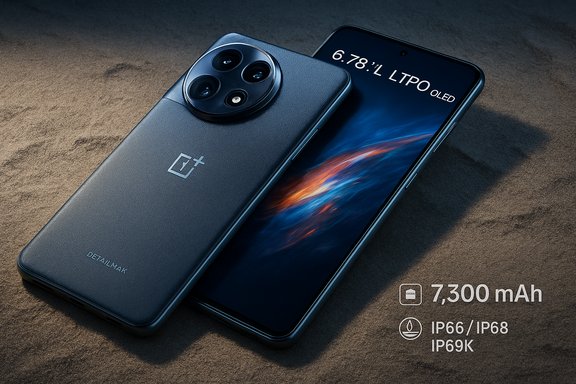
OnePlus has introduced the Sand Storm finish as a flagship differentiator. The Sand Storm variant pairs a treated metal frame using micro‑arc oxidation (MAO) with a fibreglass rear panel intended to balance tactile grip, scratch resistance, and lightness. The MAO process is singled out by OnePlus and industry reporting as a way to harden the frame beyond typical aluminum alloys.IP ratings and what they mean
OnePlus advertises unusually broad ingress protections — listing IP66, IP68, IP69 and IP69K test compliance — which, if accurate, indicate the device has been laboratory‑tested for dust, immersion at certain depths, and high‑pressure, high‑temperature spray tests used in industrial contexts. These ratings are a meaningful marketing point: very few mainstream flagships call out multiple IP certifications to this extent. However, as always with lab standards, users should understand these are controlled tests and do not make a device “indestructible” under all real‑world conditions.Performance and display: top silicon, gamer‑friendly panel
Snapdragon 8 Elite Gen 5 and memory
At the core of the OnePlus 15 is the Qualcomm Snapdragon 8 Elite Gen 5 SoC, the company’s most powerful mobile platform in 2025. OnePlus pairs this with up to 16 GB LPDDR5X RAM and UFS 4.1 storage, and an aggressive thermal solution the company calls a 360° Cryo‑Velocity cooling system to manage sustained loads during gaming and productivity. These components position the 15 as one of the fastest Android phones available for high‑frame‑rate gaming and heavy multitasking workloads.Display: 1.5K LTPO AMOLED, 165 Hz
The OnePlus 15 uses a 6.78‑inch 1.5K LTPO AMOLED panel tuned for competitive responsiveness — with an industry‑leading 165 Hz refresh peak (adaptive down to very low refreshes for battery savings) and a very high touch sampling rate for gaming. The panel also supports HDR formats and extremely high HBM (high brightness mode) numbers in marketing material, aimed at outdoor visibility and cinematic playback. The shift to a 1.5K panel (from a 2K‑class panel on some earlier models) is a trade‑off OnePlus says was necessary to meet cost, power, and touch‑latency targets. Why that matters:- 165 Hz smooths animations and game frame pacing when supported by the title and GPU.
- The LTPO backplane lets the system reduce refresh rate aggressively to save power during static content.
- The resolution and peak brightness balance in‑hand sharpness and battery efficiency for a large screen.
Endurance and charging: a battery that changes the product equation
The headline figure: 7,300 mAh
The most attention‑grabbing hardware spec is the 7,300 mAh battery — among the largest ever offered in a flagship sold outside ultra‑niche categories. OnePlus markets it as a multi‑day battery for typical users, citing long video playback and gaming time figures in lab claims. Multiple reviews and reports have echoed this, noting that in real‑world use the OnePlus 15 can reliably deliver up to two days of moderate usage for many users.Fast wired and wireless charging — with regional caveats
The charging story is generous on paper: OnePlus lists 120 W wired fast charging in regions where regulatory and supply constraints allow, plus 50 W wireless charging and reverse wireless capabilities. However, several outlets and regional pages note that the U.S. variant is limited to 80 W wired due to local power‑regulation and accessory compatibility differences. This is an important buyer caveat: charging specifications can vary by market and by the charging brick included or sold separately. Practical takeaway:- Expect class‑leading battery life for daily use, but verify the regional charging spec before you assume 120 W speeds.
- OnePlus deploys bypass charging and other battery‑management techniques meant to limit heat during fast charging and extend battery health over years, but longevity claims are based on lab cycles and manufacturer testing.
Camera and imaging: DetailMax replaces Hasselblad — partial gains, possible compromises
Triple 50 MP array and periscope tele
The OnePlus 15 rear camera module uses three 50 MP sensors in a wide / ultra‑wide / periscope telephoto arrangement, with the telephoto offering roughly 3.5× optical reach. On paper, that’s a flexible setup that covers everyday framing needs and mid‑range optical zoom without resorting to heavy digital zooming. The front camera is a 32 MP unit capable of high‑resolution stills and 4K video capture.Imaging engine: DetailMax
Notable this generation is OnePlus’s decision to discontinue the Hasselblad co‑branding and move to an in‑house image pipeline labeled DetailMax (or similar branding in regional materials). OnePlus says DetailMax focuses on enhancing fine detail and colour accuracy while improving motion capture and low‑light algorithms. Early reviews observe that while daytime results are strong, low‑light performance and dynamic‑range handling can be more conservative than the best camera phones — a trade‑off partly attributable to sensor size choices and the company’s software tuning. Camera considerations:- Strengths: consistent color rendering, strong video codecs (including Dolby Vision in supported modes), and a flexible zoom range for everyday use.
- Tradeoffs: reviewers note smaller sensor footprints than some rivals and the loss of Hasselblad co‑engineering may matter to buyers who prioritise low‑light and computational photography as the top decision factor. Expect very good, but not class‑leading, low‑light stills compared to the absolute camera champions.
Software and AI: OxygenOS 16 on Android 16, plus practical AI enhancements
OnePlus ships the 15 with Android 16 layered with OxygenOS 16, and the company is advertising a set of AI features aimed at productivity, contextual suggestions, and smarter photography workflows. The software includes performance optimisations for high‑frame‑rate gaming and battery‑aware background prioritisation, alongside camera features that use the DetailMax engine for motion clarity and burst management. Some regions will also see close integrations with broader AI stacks advertised by OnePlus partners. Important software notes:- OnePlus’s OxygenOS has matured from a “near‑stock” aesthetic to a feature‑rich overlay. That introduces more capabilities but also raises the stakes for software quality and timely updates.
- Several early reviews flag minor software bugs and capture‑speed inconsistencies in the imaging pipeline that OnePlus will need to address in updates. These are not uncommon at launch for feature‑dense flagships and often improve over the first few months of firmware releases.
Pricing and availability: competitive entry pricing with regional nuance
OnePlus’s global pricing strategy for the 15 undercuts some rivals while still sitting squarely in premium territory. Official OnePlus listings and multiple outlets report a base price around US$899 / $899.99 for the 12 GB + 256 GB variant in key markets, with higher memory/storage tiers pushing into the $999–$1,099 range depending on configuration. OnePlus’s staged rollout followed its China debut, with a November global introduction and rolling availability across Europe, Africa, and parts of Asia. Regional pricing snapshot and caution:- Several local outlets in markets like Kenya report retail prices in the range of KSh 110,000–135,000 for the 16 GB + 256 GB model, with the base 12 GB + 256 GB model slightly cheaper. These local figures reflect importer margins, taxes, and channel pricing, and may vary substantially between authorised resellers and third‑party importers. Buyers should verify local stock, warranty terms, and exact model version before purchase. This regional pricing is reported locally but should be double‑checked with authorised regional retailers.
Why Apple and Samsung should be watching
OnePlus’s OnePlus 15 is not a tentative attempt to move upmarket — it is a direct challenge built on a few concrete differentiators:- Battery advantage: Few mainstream flagships ship a 7,300 mAh battery in a premium chassis. That endurance claim changes the ownership equation for heavy users who historically bought into flagship ecosystems for software and camera advantages but were willing to trade battery life.
- Performance leadership: The Snapdragon 8 Elite Gen 5 platform plus LPDDR5X and UFS 4.1 keep the OnePlus 15 among the fastest Android devices for gaming and multitasking, threatening to outpace older flagship silicon still present in some rival model refreshes.
- Value pressure: With base pricing near $899 in many territories, OnePlus is trying to put pricing pressure on Apple and Samsung at the high end by offering top‑tier silicon and superior battery life for less money. That pricing dynamic forces competitors to re‑examine bundle strategies, trade‑in discounts, and mid‑cycle price adjustments.
- Durability credentials: The combination of MAO treatment, fibreglass back options, and multiple IP certifications gives OnePlus a credible story for buyers who want ruggedness without switching to heavy "rugged phone" categories. This could lure outdoorsy or field‑use customers away from more delicate premium designs.
Considerations and risks for buyers
No flagship is perfect for every user. The OnePlus 15 introduces a new mix of tradeoffs buyers should weigh before switching from Apple or Samsung:- Camera trade‑offs
- The move away from the Hasselblad co‑branding and the use of relatively smaller sensors in some modules means low‑light performance may not match the absolute best camera phones from competitors. Photographers who prioritise night photography or the best telephoto reach may still prefer other flagships.
- Size, weight, and ergonomics
- A 7,300 mAh battery inevitably increases device mass and thickness compared to ultra‑thin rivals. Buyers who prioritise pocketability and single‑hand comfort should handle a sample in‑store before committing. Measurements in early teardowns and hands‑on reviews place the OnePlus 15 toward the heavier end of flagship devices.
- Regional specification differences
- Charging wattage, network band support, and even pre‑installed software packages can vary by market. The U.S. version’s lower wired charging cap (reported at 80 W) is an example; buyers should confirm the exact model SKU and included charger before purchase. Warranty support and repair logistics also differ by country and reseller.
- Software maturity at launch
- Feature‑dense OS builds can ship with teething issues. Early reviewers noted some imaging speed and software stability issues in initial firmware that OnePlus may address via updates. For buyers who prize a completely polished out‑of‑box software experience, waiting a few weeks for updates may be prudent.
- Long‑term brand calculus
- OnePlus is earning premium margins and moving away from its earlier “value flagship” reputation. Buyers who historically leaned on older OnePlus models for great bang‑for‑buck might find this generation less compelling if price sensitivity is their top priority. Conversely, those seeking a performance‑first Android flagship with exceptional battery life should take a close look.
Quick buyer’s checklist (before you press “buy”)
- Confirm the exact SKU for your market (charging wattage, network bands, warranty).
- Test or inspect the device in person for weight and comfort — the battery adds measurable heft.
- If photography is your top priority, compare low‑light samples against top camera phones; consider waiting for firmware improvements.
- Check the bundled charger and accessory compatibility; some regions may require purchasing a separate high‑wattage adapter to unlock maximum charging speeds.
- Verify seller warranty coverage, return policy, and local service centre availability.
Final analysis: a calculated, credible threat — with pragmatic caveats
The OnePlus 15 is a clear statement from OnePlus: premium Android flagships will no longer be a testbed for thinness above all else. By prioritising an enormous battery, a high‑refresh competitive display, top‑end silicon, and a new imaging engine, OnePlus has built a device targeted at a specific but meaningful segment — power users who prize performance and endurance in a premium shell.This device’s greatest strengths are easy to articulate: rare multi‑day battery life in a flagship form factor, leading‑edge processing for gaming and productivity, and competitive pricing relative to other top‑tier phones. The trade‑offs — camera sensor sizes, additional weight, and regional differences in charging — are real and visible. They are not necessarily deal breakers, but they are important to weigh against the priorities that make you choose a flagship in the first place.
For Apple and Samsung, OnePlus’s strategy matters because it changes the value equation in the premium tier. If mainstream buyers come to prize battery life and peak performance more than the last 10–20% of camera improvements, OnePlus’s approach will force competitors to re‑examine their product and pricing mixes.
Buyers should verify regional specifications and warranty terms, test ergonomics if possible, and be aware that early firmware updates are likely to refine camera and software behaviour. For the right buyer — a heavy‑use Android enthusiast or a mobile gamer who wants a full day-plus run time without compromise — the OnePlus 15 is a compelling, competitively priced alternative to the usual premium suspects.
Source: The Eastleigh Voice OnePlus 15 launches globally, targets Apple and Samsung dominance
