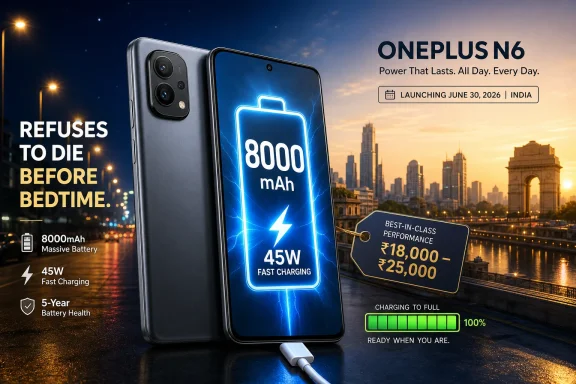
OnePlus is preparing to launch the OnePlus N6 in India on June 30, 2026, as the first handset in its budget-focused N-series, with leaks and official teasers pointing to an 8,000mAh battery, Android 16, 6GB of RAM, and a MediaTek Dimensity-class chipset. The headline spec is not raw speed; it is endurance. OnePlus is making a calculated play for buyers who want the brand’s software polish and battery life without paying Nord or flagship money. If the N6 lands at the rumored sub-₹25,000 price, it could become one of the more interesting budget Android launches of the year.
The OnePlus N6 is not being introduced as a miniature flagship. It is being framed as a phone that stays alive longer, ages more gracefully, and costs less than the devices that usually carry the OnePlus badge. That is a sharper pitch than chasing camera megapixels or synthetic benchmark bragging rights in a market already crowded with aggressive Redmi, Realme, iQOO, and Motorola models.
The confirmed 8,000mAh battery is the center of gravity. OnePlus is reportedly claiming up to three days of use and as much as seven years of battery health, with the phone retaining more than 75 percent of its original capacity after extended charging cycles. Those are marketing claims until independently tested, but they show where OnePlus thinks budget buyers are most willing to compromise: not on battery.
That matters because the budget Android market in India has become a battlefield of spec sheets. Every brand can offer a high-refresh display, 5G support, and a large camera module. Far fewer can make battery endurance feel like the main product identity.
The chipset picture remains slightly muddy. Reports have mentioned MediaTek’s Dimensity 6300 or Dimensity 6400, while the Geekbench CPU configuration has invited more speculation because the reported core clocks do not cleanly settle the debate. Until OnePlus confirms the silicon, the safest reading is simple: this is a budget-to-lower-midrange 5G handset, not a hidden performance monster.
Geekbench leaks are useful, but they are also frequently overinterpreted. A pre-release listing can reveal RAM, Android version, and a rough performance band, but it cannot tell us how the phone handles heat, background app management, camera processing, modem reliability, or battery drain over a long day. For the N6, those real-world tests will matter more than the score.
For buyers, shared DNA is not automatically bad. It can mean lower costs, faster development, and proven components. The question is whether the OnePlus version offers enough differentiation through OxygenOS, update policy, tuning, service support, design, or pricing to justify its badge.
That is where the N6 could either succeed or stumble. If it feels like a Realme phone with a OnePlus logo, enthusiasts will notice. If it brings OnePlus’ cleaner software feel and a more disciplined update experience to a genuinely affordable price point, the badge starts to make sense again.
But physics still applies. A bigger battery usually means more weight, a thicker body, longer charging times unless paired with aggressive fast charging, and more heat-management complexity. OnePlus will need to balance endurance with ergonomics, because a budget phone that lasts forever but feels like a brick will not be universally loved.
The seven-year battery-health claim is also worth watching closely. Long-life battery marketing has become more common as smartphone replacement cycles stretch and regulators push the industry toward durability. If OnePlus can back the claim with transparent charging-cycle data, it gives the N6 a sustainability and ownership-cost story that goes beyond the usual launch hype.
For ordinary users, that means newer platform features, better app compatibility over time, and potentially a longer runway before the phone feels outdated. For IT-minded buyers and small-business deployments, it also means a more current security foundation. In the budget segment, software freshness is often where the spec sheet stops telling the full story.
The open question is update commitment. OnePlus has not, based on the available reporting, fully detailed the N6’s Android upgrade and security patch policy. That detail could determine whether the N6 is merely a good launch-day deal or a device worth recommending two years from now.
Instead of promising flagship-grade speed for less, OnePlus appears to be promising reliability, battery life, and brand familiarity at a lower price. That is a more mature pitch, and probably a more realistic one. Budget buyers in 2026 do not need every phone to pretend it is a gaming flagship; they need one that does the basics well and does not die before dinner.
India is the right market for that experiment. It is price-sensitive, intensely competitive, and large enough to reward a phone that gets one or two priorities exactly right. If the N6 is priced aggressively, it could pressure rivals that have relied on larger batteries as a key differentiator.
The display will be especially important. A high-refresh LCD can be perfectly acceptable at the right price, but an OLED panel would make the phone feel much more premium. Camera hardware will also matter, though expectations should stay realistic in this class. Budget phones can produce good daylight photos, but they rarely overcome small sensors and limited processing in difficult lighting.
Charging speed is the other missing half of the battery story. An 8,000mAh cell sounds excellent, but users will want to know how quickly it refills. If OnePlus pairs the battery with conservative charging, overnight charging may be fine, but quick top-ups will be less impressive. If it offers faster charging without hurting the longevity claim, the N6 becomes much easier to recommend.
The brand’s challenge is credibility. Enthusiasts will look for recycled hardware, bloatware, update promises, and pricing tricks. Mainstream buyers will look for battery life, smoothness, camera quality, and whether the phone feels reliable after six months. OnePlus needs to satisfy both groups enough to make the N-series more than a one-off experiment.
If the company gets the fundamentals right, the N6 could become a useful reset. It would show that OnePlus can still compete on value without pretending every phone needs flagship aspirations. If it gets them wrong, the N-series risks becoming just another label in an already crowded portfolio.
 OnePlus Builds a Budget Phone Around the One Spec Everyone Understands
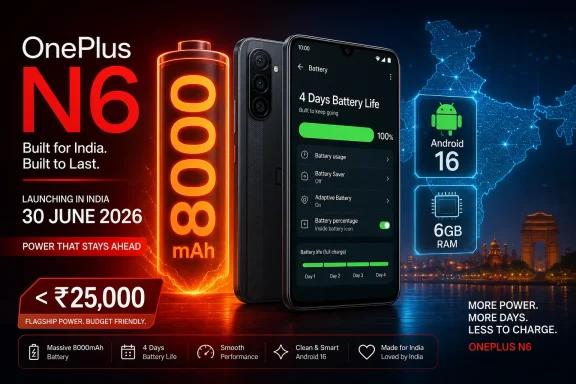
The OnePlus N6 is not being introduced as a miniature flagship. It is being framed as a phone that stays alive longer, ages more gracefully, and costs less than the devices that usually carry the OnePlus badge. That is a sharper pitch than chasing camera megapixels or synthetic benchmark bragging rights in a market already crowded with aggressive Redmi, Realme, iQOO, and Motorola models.The confirmed 8,000mAh battery is the center of gravity. OnePlus is reportedly claiming up to three days of use and as much as seven years of battery health, with the phone retaining more than 75 percent of its original capacity after extended charging cycles. Those are marketing claims until independently tested, but they show where OnePlus thinks budget buyers are most willing to compromise: not on battery.
That matters because the budget Android market in India has become a battlefield of spec sheets. Every brand can offer a high-refresh display, 5G support, and a large camera module. Far fewer can make battery endurance feel like the main product identity.
Geekbench Gives the N6 a Shape, Not a Verdict
The Geekbench listing associated with model number CPH2955 reportedly shows the OnePlus N6 running Android 16 with 6GB of RAM. Its listed scores — 788 single-core and 1,993 multi-core — suggest a modest, everyday-performance phone rather than a gaming-first device. That is not a criticism so much as a category marker.The chipset picture remains slightly muddy. Reports have mentioned MediaTek’s Dimensity 6300 or Dimensity 6400, while the Geekbench CPU configuration has invited more speculation because the reported core clocks do not cleanly settle the debate. Until OnePlus confirms the silicon, the safest reading is simple: this is a budget-to-lower-midrange 5G handset, not a hidden performance monster.
Geekbench leaks are useful, but they are also frequently overinterpreted. A pre-release listing can reveal RAM, Android version, and a rough performance band, but it cannot tell us how the phone handles heat, background app management, camera processing, modem reliability, or battery drain over a long day. For the N6, those real-world tests will matter more than the score.
The Realme Shadow Makes the Story More Complicated
One of the more interesting claims around the N6 is that it may be related to, or possibly reworked from, a Realme P-series device. That would not be shocking. OnePlus, Oppo, and Realme exist within the same broader corporate orbit, and shared hardware platforms have become a normal part of modern smartphone economics.For buyers, shared DNA is not automatically bad. It can mean lower costs, faster development, and proven components. The question is whether the OnePlus version offers enough differentiation through OxygenOS, update policy, tuning, service support, design, or pricing to justify its badge.
That is where the N6 could either succeed or stumble. If it feels like a Realme phone with a OnePlus logo, enthusiasts will notice. If it brings OnePlus’ cleaner software feel and a more disciplined update experience to a genuinely affordable price point, the badge starts to make sense again.
An 8,000mAh Battery Is a Feature and a Trade-Off
A battery this large changes how a phone is used. For students, delivery workers, commuters, field staff, and anyone who treats a power bank as part of daily life, 8,000mAh is not a gimmick. It is the difference between battery anxiety and a device that can survive heavy use without ritual charging.But physics still applies. A bigger battery usually means more weight, a thicker body, longer charging times unless paired with aggressive fast charging, and more heat-management complexity. OnePlus will need to balance endurance with ergonomics, because a budget phone that lasts forever but feels like a brick will not be universally loved.
The seven-year battery-health claim is also worth watching closely. Long-life battery marketing has become more common as smartphone replacement cycles stretch and regulators push the industry toward durability. If OnePlus can back the claim with transparent charging-cycle data, it gives the N6 a sustainability and ownership-cost story that goes beyond the usual launch hype.
Android 16 on a Budget Phone Is the Quietly Important Detail
The Geekbench listing’s Android 16 reference may prove more important than the processor rumor. Budget Android phones often launch with older software or receive slower updates after release. If the OnePlus N6 ships with Android 16 out of the box, it starts its life with a stronger software baseline than many entry-level rivals.For ordinary users, that means newer platform features, better app compatibility over time, and potentially a longer runway before the phone feels outdated. For IT-minded buyers and small-business deployments, it also means a more current security foundation. In the budget segment, software freshness is often where the spec sheet stops telling the full story.
The open question is update commitment. OnePlus has not, based on the available reporting, fully detailed the N6’s Android upgrade and security patch policy. That detail could determine whether the N6 is merely a good launch-day deal or a device worth recommending two years from now.
OnePlus Is Trying to Reclaim the Value Narrative
OnePlus built its reputation by selling performance and polish at prices that embarrassed bigger brands. Over time, the company moved upmarket, became more conventional, and lost some of that early enthusiast magic. The N6 looks like an attempt to recover part of that old value story, but in a different form.Instead of promising flagship-grade speed for less, OnePlus appears to be promising reliability, battery life, and brand familiarity at a lower price. That is a more mature pitch, and probably a more realistic one. Budget buyers in 2026 do not need every phone to pretend it is a gaming flagship; they need one that does the basics well and does not die before dinner.
India is the right market for that experiment. It is price-sensitive, intensely competitive, and large enough to reward a phone that gets one or two priorities exactly right. If the N6 is priced aggressively, it could pressure rivals that have relied on larger batteries as a key differentiator.
The Launch Still Has Several Missing Pieces
The June 30 launch date gives OnePlus time to reveal the remaining details: display type, charging speed, cameras, storage variants, IP rating, weight, and exact pricing. Those details will decide whether the N6 is a serious budget contender or just another large-battery phone with a familiar logo.The display will be especially important. A high-refresh LCD can be perfectly acceptable at the right price, but an OLED panel would make the phone feel much more premium. Camera hardware will also matter, though expectations should stay realistic in this class. Budget phones can produce good daylight photos, but they rarely overcome small sensors and limited processing in difficult lighting.
Charging speed is the other missing half of the battery story. An 8,000mAh cell sounds excellent, but users will want to know how quickly it refills. If OnePlus pairs the battery with conservative charging, overnight charging may be fine, but quick top-ups will be less impressive. If it offers faster charging without hurting the longevity claim, the N6 becomes much easier to recommend.
The N6 Story Is Really About Trust at a Lower Price
The OnePlus N6 is not interesting because it appears on Geekbench. It is interesting because OnePlus is trying to make a cheaper phone without making it feel disposable. That is a difficult balance in the Android market, where budget devices often arrive with loud specs and quiet compromises.The brand’s challenge is credibility. Enthusiasts will look for recycled hardware, bloatware, update promises, and pricing tricks. Mainstream buyers will look for battery life, smoothness, camera quality, and whether the phone feels reliable after six months. OnePlus needs to satisfy both groups enough to make the N-series more than a one-off experiment.
If the company gets the fundamentals right, the N6 could become a useful reset. It would show that OnePlus can still compete on value without pretending every phone needs flagship aspirations. If it gets them wrong, the N-series risks becoming just another label in an already crowded portfolio.
The Specs That Will Decide Whether the N6 Is More Than Hype
The OnePlus N6 is close enough to launch that the broad outline is visible, but not close enough for a final verdict. The battery is the hook; the price, software policy, and day-to-day tuning will decide the story.- The OnePlus N6 is scheduled to launch in India on June 30, 2026, at 12:00 PM IST.
- Official teasers and multiple reports point to an 8,000mAh battery as the phone’s signature feature.
- A Geekbench listing tied to model number CPH2955 reportedly shows Android 16, 6GB of RAM, and budget-class performance scores.
- The processor is still not fully confirmed, with reports pointing toward a MediaTek Dimensity 6300 or Dimensity 6400-class chip.
- The rumored sub-₹25,000 positioning would put the N6 directly into one of India’s most competitive smartphone segments.
- The biggest unanswered questions are charging speed, display quality, camera hardware, weight, and long-term software support.
References
- Primary source: YTECHB
Published: 2026-06-18T09:52:07.178951
OnePlus N6 Appears in Geekbench Listing, Battery Capacity Revealed
OnePlus is preparing to expand into the budget smartphone segment in India, having confirmed plans to introduce its budget-focused "N" series in the market.www.ytechb.com - Related coverage: smartprix.com
OnePlus N6 Confirmed to Pack an 8,000 mAh Battery, Launch Set for June 30 - Smartprix
OnePlus has started revealing more details about its upcoming N-series smartphone ahead of its India debut later this month. The latest teaser confirms one of the phone’s biggest highlights: an 8,000 mAh battery. The teaser also offers a clue about where the phone could be priced, hinting that... www.smartprix.com
- Related coverage: gadgets.beebom.com
OnePlus N6 - Specifications & Launch Date (June 2026) | Beebom Gadgets
Discover the OnePlus N6 with key features like Dimensity 7400 Super, 50MP camera, 6.78 " OLED display and 8000mAh battery. The device is set to launch in India; get the latest specs and launch updates on Beebom Gadgets.gadgets.beebom.com - Related coverage: intaakmedia.com
OnePlus N6 Leak Details 8000mAh Battery Ahead of June 30 Launch
A new OnePlus N6 leak reveals a massive 8000mAh battery ahead of the June 30 launch. Get the latest details on specs, design, and pricing here.intaakmedia.com - Related coverage: thetechoutlook.com
OnePlus N6 Battery Size and Expected Price Range Revealed Ahead of June 30th India Launch - The Tech Outlook
As revealed earlier, OnePlus will be launching its next N6 smartphone in the Indian market later this month on the 30th of June 2026, and the brand had previously teased its design as well.www.thetechoutlook.com - Related coverage: techgenyz.com
OnePlus N6 Launch Date Confirmed With 8000mAh Battery Tease
OnePlus N6 will launch in India on June 30 with an 8000mAh battery, new N Series branding, Amazon availability and ₹18,000–₹25,000 positioning.techgenyz.com
- Related coverage: phonearena.com
OnePlus is setting the stage for two exciting product launches by the end of the month - PhoneArena
An undoubtedly budget-friendly OnePlus N6 handset and some premium-looking Nord Buds 4 earbuds are officially launching on June 30 and June 25, respectively.www.phonearena.com - Related coverage: mysmartprice.com
OnePlus N6 to launch in India on June 30: Price, Specs and Everything we know
OnePlus N6 OnePlus is preparing to re-enter the budget smartphone segment in a big way. The company has officially confirmed that the new OnePlus N6 will launch in India on June 30 at 12 PM, marking the debut of the new N series in the country. An Amazon microsite for the smartphone is already...www.mysmartprice.com
- Related coverage: oneplus.in
OnePlus N6 | Launching June 30, 2026
The all-new mobile phone OnePlus N6 arriving soon at OnePlus Official Store.www.oneplus.in
- Related coverage: gizguide.com
OnePlus N6 confirmed to debut on June 30 as the brands new entry-level line
OnePlus is set to launch its first N series smartphone with a tagline of "Always On, Always Smooth."www.gizguide.com
- Related coverage: latestly.com
OnePlus N6 Launch in India Confirmed on June 30; Check Expected Price, Specifications and Features | 📲 LatestLY
OnePlus is set to launch its first N-series smartphone, the OnePlus N6, in India on June 30, 2026, targeting the budget segment. Priced between ₹18,000 and ₹25,000, the device will feature a sleek design, a powerful MediaTek Dimensity 7400 chipset, an expected 6.78-inch 1.5K OLED 144Hz display...www.latestly.com
- Related coverage: gagadget.com
OnePlus N6: budget phone for India, not for you
OnePlus officially announced the N6, a budget smartphone aimed at younger buyers, launching in India on June 30. The phone is priced between Rs 18,000 and Rs 25gagadget.com
- Related coverage: gadgets360.com