

Intel’s Arc G3 Extreme-powered OneXPlayer 3 began drawing attention in late June 2026 as a premium Windows gaming handheld built around an 8.8-inch 144Hz OLED display, detachable controllers, an 85Wh battery, and Intel’s new handheld-focused graphics silicon. That combination matters because the Windows handheld market has spent years chasing desktop-adjacent power in bodies too small to cool it gracefully. The OneXPlayer 3 suggests the next phase may be less about brute-force wattage and more about systems designed around the uncomfortable truth of handheld PCs: every extra frame has to be paid for in heat, fan noise, battery life, and ergonomics.
The headline is not merely that OneXPlayer has built another large, expensive Windows portable. It is that Intel appears to have found a credible answer to AMD’s long-running dominance in the category, and OneXPlayer has wrapped that answer in one of the more complete hardware packages we have seen from the boutique handheld PC world. If the early testing holds up across more devices and drivers, the OneXPlayer 3 may be remembered less as a single gadget than as a sign that the handheld PC market has finally become competitive at the silicon level.
For years, Windows handheld makers have lived off parts that were never truly born for the job. AMD’s Ryzen Z-series and related mobile APUs did a remarkably good job of giving compact devices enough GPU muscle to run modern games, but the category still felt improvised: laptop silicon repackaged into a device with thumbsticks, tiny speakers, a battery budget, and a thermal envelope that punished ambition. Intel’s earlier attempts, most visibly through the first MSI Claw generation, did little to change that impression.
Arc G3 Extreme is different in posture, even if the broader architecture still descends from Intel’s laptop roadmap. Intel is positioning it as handheld-first silicon, with Arc B390 integrated graphics, XeSS support, and a power curve meant to make sense around the 15W-to-35W range where portable gaming actually lives. That is the right battlefield. A chip that only looks good at 45W or 60W is not a handheld gaming chip; it is a docking-station chip wearing a travel costume.
The OneXPlayer 3 is therefore a useful test case because it does not ask Intel’s chip to perform miracles in a compromised shell. It gives the G3 Extreme a large chassis, fast memory, a large battery, and a display good enough to expose both the strengths and weaknesses of the platform. In the submitted testing, the system reportedly handled lighter games at around 10W to 17W and more demanding titles up to a 35W ceiling, with the sweet spot often landing around 20W to 25W.
That is exactly where the handheld market needs progress. The old question was whether a Windows portable could run big games at all. The better question in 2026 is whether it can run them well enough without turning a commute, couch session, or hotel-room playthrough into a fan-noise audition.
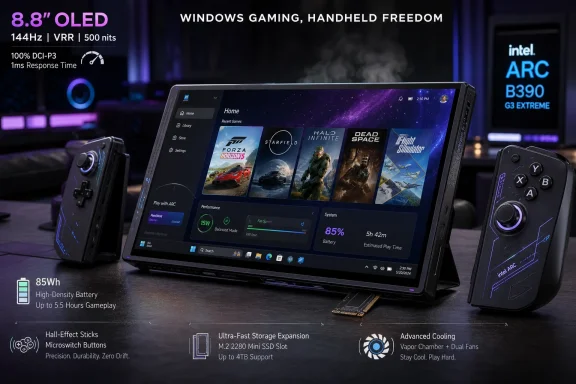
The OneXPlayer 3 looks more coherent. The 8.8-inch OLED panel, 144Hz refresh rate, VRR support, 1200p resolution, detachable controllers, keyboard pogo pins, dual USB4 Type-C ports, USB-A, microSD, mini SSD expansion, fingerprint power button, Hall-effect sticks, and 85Wh battery are not individually shocking in the boutique handheld world. The important bit is how many of them are present at once, and how directly they serve the same idea: this is a Windows PC that wants to be used as a handheld first, a small tablet second, and a tiny laptop when necessary.
That matters because Windows remains both the great advantage and the great liability of these machines. A Steam Deck can succeed with a console-like interface and a controlled software stack. A Windows handheld has access to Game Pass, Epic, GOG, Battle.net, modding tools, anti-cheat-sensitive games, emulators, productivity apps, and every other chaotic advantage of the PC. But it also inherits desktop UI friction, driver dependency, sleep-state weirdness, launcher clutter, and the eternal indignity of trying to close a tiny dialog box with a thumbstick.
The OneXPlayer 3’s design tries to meet Windows halfway. A small trackpad for desktop navigation, detachable controllers, and an optional keyboard do not make Windows elegant on an 8.8-inch screen, but they acknowledge the problem rather than pretending a controller overlay can solve everything. This is the right instinct. Windows handhelds win when they stop imitating consoles and start becoming better tiny PCs.
OLED also changes how performance is perceived. A locked 60fps is not the only acceptable target when VRR and good frame pacing are in play. In the testing described, Forza Horizon 6 reportedly ran at 1200p medium settings with XeSS and held 60fps, but the reviewer preferred a 48fps target for smoother perceived play. That is the sort of practical compromise handheld gaming increasingly depends on.
The dirty secret of portable PC gaming is that chasing 60fps at all costs can be irrational. A stable 40fps, 45fps, or 48fps with low input latency and consistent frame pacing may feel better than an unstable 60fps that forces the chip into an inefficient part of its curve. Valve made that lesson mainstream with the Steam Deck’s refresh-rate controls. Windows handheld makers are still catching up, but panels like this give them more room to operate.
A high-refresh OLED is therefore not just eye candy. It is part of the power-management system. It lets users choose performance targets that preserve battery without making the device feel sluggish, and it gives upscaling technologies like XeSS a better stage on which to hide their compromises.
MicroSD remains useful, especially for indie games, emulation libraries, and media. But it is not the same thing as fast internal-class storage. A removable mini SSD promising transfer speeds far beyond microSD gives users a more credible way to carry large libraries, swap workloads, or expand the device without immediately reaching for a screwdriver.
The catch is price and availability. New storage formats rarely become meaningful until they are boring, cheap, and widely supported. If mini SSD modules remain boutique accessories, the slot will be an interesting novelty. If multiple handheld vendors adopt it, it could become one of those quiet hardware standards that makes the entire category better.
That is why OneXPlayer’s move is worth watching. Boutique vendors often take risks bigger OEMs avoid, and sometimes those risks reveal what the market actually wants. Expandable fast storage is one of those ideas that seems obvious once someone ships it.
In practice, detachable controller systems succeed or fail on details. The submitted impressions are encouraging on the basics: the grips reportedly feel natural, the analog sticks use Hall-effect sensors, the sticks are tighter than earlier OneXPlayer designs, and the face buttons use microswitches with clear actuation. Those details matter because handheld controllers cannot be treated as accessories. They are the device’s primary interface.
There are compromises. The controllers apparently do not have their own batteries or Bluetooth and rely on a USB Type-A receiver when detached. That keeps the design simpler but makes the experience less seamless than a true wireless controller setup. It also raises the usual question for niche handhelds: what happens if the receiver is lost, damaged, or inconvenient to carry?
Still, the broader direction is sensible. A Windows handheld with detachable controls and an optional keyboard can become a surprisingly capable small PC, especially for users who travel light. Nobody should want to write a novel on one, but logging into a server dashboard, editing a document, managing game mods, or handling Discord and browser tasks becomes less absurd when the hardware supports more than one posture.
Reported runtime figures are more interesting than the capacity number. At a standard 20W to 25W TDP, the reviewer saw about two to two and a half hours of play. Lighter games at around 17W reportedly stretched to three and a half to four hours, while some midrange settings in newer games landed closer to three hours. Those are not magical numbers, but they are credible for a high-performance Windows handheld with a large OLED screen.
The real significance is that the G3 Extreme appears useful below its ceiling. If a chip only becomes impressive at 35W, then a large battery merely delays the inevitable. If it can deliver satisfying performance at 17W, 20W, or 25W, then battery life becomes a tuning choice rather than a fixed disappointment.
That is where Intel’s challenge to AMD becomes serious. AMD has owned the handheld conversation because its integrated graphics performance has been strong at practical wattages. Intel does not need to win every benchmark to change the market. It needs to make OEMs and buyers believe there is now another viable power-efficient option with good driver support, good upscaling, and predictable behavior across the Windows game catalog.
At 1200p, the device has enough pixels to look sharp but enough rendering burden to make native resolution expensive. XeSS gives Intel a way to trade some image reconstruction for better frame rates or lower wattage. That trade is especially attractive on an 8.8-inch screen, where the perceptual cost of upscaling can be smaller than it would be on a large monitor.
This is also where Intel’s software story becomes inseparable from its hardware story. AMD has FSR, Nvidia has DLSS, and Intel has XeSS. But handheld buyers do not think in marketing acronyms; they think in whether a game runs smoothly, whether text looks clean, whether shimmering is distracting, and whether frame generation adds latency they can feel. Intel’s handheld future depends as much on consistent game support and driver maturity as on silicon diagrams.
The submitted impressions are positive, but one week of testing is not the same thing as a platform verdict. Windows handhelds live across thousands of games, launchers, middleware quirks, anti-cheat systems, and driver update cycles. Intel’s next task is not merely to produce good review numbers. It is to make Arc G3 Extreme feel boringly reliable.
That matters more as these devices get more expensive. A premium handheld cannot rely on hobbyist tolerance forever. At prices reportedly starting around the upper end of the handheld market, buyers have a right to expect a polished experience. They will not all be willing to troubleshoot controller mapping, scaling problems, driver regressions, sleep-state drain, or launcher behavior.
Microsoft has made gestures toward improving Windows on handhelds, but the platform still lacks a fully convincing native handheld mode. OEM utilities fill the gap, sometimes well, sometimes awkwardly. The result is a category where hardware innovation is moving faster than the operating system experience that should unify it.
The OneXPlayer 3’s hardware makes this tension sharper. With an OLED panel, detachable controls, keyboard mode, fast storage expansion, and a capable Intel chip, the device looks like a mature product. But Windows handhelds still need the software layer to catch up. Until Microsoft treats this form factor as more than a small laptop with gaming controls, companies like OneXPlayer will keep building clever workarounds around a desktop OS.
That does not mean Arc G3 Extreme automatically dethrones Ryzen-based handhelds. AMD’s platform maturity, broad developer familiarity, and existing OEM relationships remain formidable. The Ryzen Z-series and related chips are known quantities, and many buyers will prefer predictable compatibility over a new architecture that still has to prove itself over time.
But competition changes behavior even before it changes market share. If Intel can deliver strong low-wattage performance, OEMs get leverage. Buyers get more configurations. AMD has to respond not only with faster chips, but with better efficiency, better software, and better platform support. That is good for everyone who wants handheld PCs to improve faster than annual spec bumps.
The OneXPlayer 3 is therefore not just a boutique device for enthusiasts with large budgets. It is a signal to the rest of the industry. Intel is no longer asking handheld makers to adapt laptop chips to awkward portable designs; it is offering a platform that appears to understand the category’s constraints.
That makes the value proposition tricky. The Steam Deck remains the reference point for console-like simplicity and price discipline. The ROG Ally and Legion Go families offer mainstream retail presence and stronger support networks. MSI is pushing its own Intel-based Claw refresh. Acer is entering with Predator-branded competition. OneXPlayer has to convince buyers that its mix of display, battery, controls, expansion, and silicon is worth stepping into a more enthusiast-oriented support ecosystem.
For some users, it will be. The OneXPlayer 3 looks especially attractive for people who want a do-everything Windows portable: modern games, emulation, media, light productivity, docking, travel, and experimentation. For those buyers, the device’s flexibility is not bloat. It is the point.
For others, the same flexibility will read as complexity. A simpler, cheaper handheld with fewer modes may be the better machine if the goal is only to play a curated library on the couch. The OneXPlayer 3 is compelling because it is ambitious, but ambition is not free.
This is what maturation looks like in a hardware category. Early products ask whether the form factor works at all. Later products argue over which compromises are acceptable. The OneXPlayer 3 belongs to that second phase. It assumes people want Windows handhelds and then asks how far the category can be pushed before it collapses under weight, price, or software friction.
The answer appears to be: farther than skeptics expected, but not infinitely. A large handheld can still be ergonomic if the balance is right. A powerful chip can still make sense if it performs well at sane wattages. A Windows device can still be practical if the manufacturer provides enough hardware affordances to compensate for the OS.
That is a more interesting story than another benchmark race. The handheld PC market is becoming less about whether these devices can run AAA games and more about whether they can make those games feel natural away from a desk. The OneXPlayer 3 moves that argument forward.
The headline is not merely that OneXPlayer has built another large, expensive Windows portable. It is that Intel appears to have found a credible answer to AMD’s long-running dominance in the category, and OneXPlayer has wrapped that answer in one of the more complete hardware packages we have seen from the boutique handheld PC world. If the early testing holds up across more devices and drivers, the OneXPlayer 3 may be remembered less as a single gadget than as a sign that the handheld PC market has finally become competitive at the silicon level.
 Intel Finally Stops Treating Handhelds Like Small Laptops
For years, Windows handheld makers have lived off parts that were never truly born for the job. AMD’s Ryzen Z-series and related mobile APUs did a remarkably good job of giving compact devices enough GPU muscle to run modern games, but the category still felt improvised: laptop silicon repackaged into a device with thumbsticks, tiny speakers, a battery budget, and a thermal envelope that punished ambition. Intel’s earlier attempts, most visibly through the first MSI Claw generation, did little to change that impression.Arc G3 Extreme is different in posture, even if the broader architecture still descends from Intel’s laptop roadmap. Intel is positioning it as handheld-first silicon, with Arc B390 integrated graphics, XeSS support, and a power curve meant to make sense around the 15W-to-35W range where portable gaming actually lives. That is the right battlefield. A chip that only looks good at 45W or 60W is not a handheld gaming chip; it is a docking-station chip wearing a travel costume.
The OneXPlayer 3 is therefore a useful test case because it does not ask Intel’s chip to perform miracles in a compromised shell. It gives the G3 Extreme a large chassis, fast memory, a large battery, and a display good enough to expose both the strengths and weaknesses of the platform. In the submitted testing, the system reportedly handled lighter games at around 10W to 17W and more demanding titles up to a 35W ceiling, with the sweet spot often landing around 20W to 25W.
That is exactly where the handheld market needs progress. The old question was whether a Windows portable could run big games at all. The better question in 2026 is whether it can run them well enough without turning a commute, couch session, or hotel-room playthrough into a fan-noise audition.
OneXPlayer Builds Around the Chip Instead of Merely Advertising It
OneXPlayer has never been shy about maximalist hardware. The company’s devices often read like somebody took a forum wish list, sorted by most expensive components, and tried to fit everything into a slab. That approach can produce impressive machines, but it can also produce gadgets that feel like engineering demos rather than balanced products.The OneXPlayer 3 looks more coherent. The 8.8-inch OLED panel, 144Hz refresh rate, VRR support, 1200p resolution, detachable controllers, keyboard pogo pins, dual USB4 Type-C ports, USB-A, microSD, mini SSD expansion, fingerprint power button, Hall-effect sticks, and 85Wh battery are not individually shocking in the boutique handheld world. The important bit is how many of them are present at once, and how directly they serve the same idea: this is a Windows PC that wants to be used as a handheld first, a small tablet second, and a tiny laptop when necessary.
That matters because Windows remains both the great advantage and the great liability of these machines. A Steam Deck can succeed with a console-like interface and a controlled software stack. A Windows handheld has access to Game Pass, Epic, GOG, Battle.net, modding tools, anti-cheat-sensitive games, emulators, productivity apps, and every other chaotic advantage of the PC. But it also inherits desktop UI friction, driver dependency, sleep-state weirdness, launcher clutter, and the eternal indignity of trying to close a tiny dialog box with a thumbstick.
The OneXPlayer 3’s design tries to meet Windows halfway. A small trackpad for desktop navigation, detachable controllers, and an optional keyboard do not make Windows elegant on an 8.8-inch screen, but they acknowledge the problem rather than pretending a controller overlay can solve everything. This is the right instinct. Windows handhelds win when they stop imitating consoles and start becoming better tiny PCs.
The OLED Panel Is Not a Luxury Feature Anymore
The display may be the most immediately persuasive part of the OneXPlayer 3. An 8.8-inch OLED panel at 1200p and 144Hz gives the device a visible advantage over older LCD-based handhelds, especially when paired with VRR. The submitted impressions also praise the anti-reflective coating, which is more important than spec sheets usually admit. A handheld screen that looks wonderful only under dim indoor lighting is a compromised portable.OLED also changes how performance is perceived. A locked 60fps is not the only acceptable target when VRR and good frame pacing are in play. In the testing described, Forza Horizon 6 reportedly ran at 1200p medium settings with XeSS and held 60fps, but the reviewer preferred a 48fps target for smoother perceived play. That is the sort of practical compromise handheld gaming increasingly depends on.
The dirty secret of portable PC gaming is that chasing 60fps at all costs can be irrational. A stable 40fps, 45fps, or 48fps with low input latency and consistent frame pacing may feel better than an unstable 60fps that forces the chip into an inefficient part of its curve. Valve made that lesson mainstream with the Steam Deck’s refresh-rate controls. Windows handheld makers are still catching up, but panels like this give them more room to operate.
A high-refresh OLED is therefore not just eye candy. It is part of the power-management system. It lets users choose performance targets that preserve battery without making the device feel sluggish, and it gives upscaling technologies like XeSS a better stage on which to hide their compromises.
The New Storage Slot Is a Small Feature With Big Implications
The mini SSD slot may end up being one of the most forward-looking choices in the OneXPlayer 3, even if it will not sell as many units as the OLED screen. Handheld PCs have a storage problem that microSD cards only partly solve. Modern games are huge, Windows itself is not light, and increasingly aggressive shader caches, launchers, mods, and updates turn a 1TB handheld into a device that feels smaller than the number suggests.MicroSD remains useful, especially for indie games, emulation libraries, and media. But it is not the same thing as fast internal-class storage. A removable mini SSD promising transfer speeds far beyond microSD gives users a more credible way to carry large libraries, swap workloads, or expand the device without immediately reaching for a screwdriver.
The catch is price and availability. New storage formats rarely become meaningful until they are boring, cheap, and widely supported. If mini SSD modules remain boutique accessories, the slot will be an interesting novelty. If multiple handheld vendors adopt it, it could become one of those quiet hardware standards that makes the entire category better.
That is why OneXPlayer’s move is worth watching. Boutique vendors often take risks bigger OEMs avoid, and sometimes those risks reveal what the market actually wants. Expandable fast storage is one of those ideas that seems obvious once someone ships it.
Detachable Controllers Are Useful, But They Still Need an Ecosystem
The OneXPlayer 3’s detachable controllers are another example of the device trying to be more than a simple Steam Deck alternative. The idea is familiar from the Nintendo Switch and Lenovo Legion Go: remove the controls, prop up the screen, and turn the handheld into a tabletop device. In theory, this is ideal for travel, local multiplayer, or laptop-mode use.In practice, detachable controller systems succeed or fail on details. The submitted impressions are encouraging on the basics: the grips reportedly feel natural, the analog sticks use Hall-effect sensors, the sticks are tighter than earlier OneXPlayer designs, and the face buttons use microswitches with clear actuation. Those details matter because handheld controllers cannot be treated as accessories. They are the device’s primary interface.
There are compromises. The controllers apparently do not have their own batteries or Bluetooth and rely on a USB Type-A receiver when detached. That keeps the design simpler but makes the experience less seamless than a true wireless controller setup. It also raises the usual question for niche handhelds: what happens if the receiver is lost, damaged, or inconvenient to carry?
Still, the broader direction is sensible. A Windows handheld with detachable controls and an optional keyboard can become a surprisingly capable small PC, especially for users who travel light. Nobody should want to write a novel on one, but logging into a server dashboard, editing a document, managing game mods, or handling Discord and browser tasks becomes less absurd when the hardware supports more than one posture.
The Battery Story Is Really a Power-Curve Story
The 85Wh battery is one of the OneXPlayer 3’s most important specifications, but battery capacity alone is not the story. Large batteries make handhelds heavier, and weight matters. The submitted testing says the device is large and heavier than some rivals, but that the weight is well distributed enough for long sessions. That is the bargain every premium handheld now has to negotiate.Reported runtime figures are more interesting than the capacity number. At a standard 20W to 25W TDP, the reviewer saw about two to two and a half hours of play. Lighter games at around 17W reportedly stretched to three and a half to four hours, while some midrange settings in newer games landed closer to three hours. Those are not magical numbers, but they are credible for a high-performance Windows handheld with a large OLED screen.
The real significance is that the G3 Extreme appears useful below its ceiling. If a chip only becomes impressive at 35W, then a large battery merely delays the inevitable. If it can deliver satisfying performance at 17W, 20W, or 25W, then battery life becomes a tuning choice rather than a fixed disappointment.
That is where Intel’s challenge to AMD becomes serious. AMD has owned the handheld conversation because its integrated graphics performance has been strong at practical wattages. Intel does not need to win every benchmark to change the market. It needs to make OEMs and buyers believe there is now another viable power-efficient option with good driver support, good upscaling, and predictable behavior across the Windows game catalog.
XeSS Is Becoming Part of the Handheld Contract
Upscaling used to be framed as a concession, something players enabled when hardware could not keep up. On handhelds, it is becoming part of the normal operating model. The OneXPlayer 3’s reported performance in games such as Forza Horizon 6, Final Fantasy VII Remake, LEGO Batman: The Dark Knight, and The Adventures of Elliot shows how central XeSS can be to the experience.At 1200p, the device has enough pixels to look sharp but enough rendering burden to make native resolution expensive. XeSS gives Intel a way to trade some image reconstruction for better frame rates or lower wattage. That trade is especially attractive on an 8.8-inch screen, where the perceptual cost of upscaling can be smaller than it would be on a large monitor.
This is also where Intel’s software story becomes inseparable from its hardware story. AMD has FSR, Nvidia has DLSS, and Intel has XeSS. But handheld buyers do not think in marketing acronyms; they think in whether a game runs smoothly, whether text looks clean, whether shimmering is distracting, and whether frame generation adds latency they can feel. Intel’s handheld future depends as much on consistent game support and driver maturity as on silicon diagrams.
The submitted impressions are positive, but one week of testing is not the same thing as a platform verdict. Windows handhelds live across thousands of games, launchers, middleware quirks, anti-cheat systems, and driver update cycles. Intel’s next task is not merely to produce good review numbers. It is to make Arc G3 Extreme feel boringly reliable.
Windows Remains the Feature and the Friction
The OneXPlayer 3 is ultimately a Windows gaming handheld, and that defines both its appeal and its limits. For WindowsForum readers, this is the familiar trade: Windows gives you the real PC gaming ecosystem, but it does not become a console simply because someone attached analog sticks.That matters more as these devices get more expensive. A premium handheld cannot rely on hobbyist tolerance forever. At prices reportedly starting around the upper end of the handheld market, buyers have a right to expect a polished experience. They will not all be willing to troubleshoot controller mapping, scaling problems, driver regressions, sleep-state drain, or launcher behavior.
Microsoft has made gestures toward improving Windows on handhelds, but the platform still lacks a fully convincing native handheld mode. OEM utilities fill the gap, sometimes well, sometimes awkwardly. The result is a category where hardware innovation is moving faster than the operating system experience that should unify it.
The OneXPlayer 3’s hardware makes this tension sharper. With an OLED panel, detachable controls, keyboard mode, fast storage expansion, and a capable Intel chip, the device looks like a mature product. But Windows handhelds still need the software layer to catch up. Until Microsoft treats this form factor as more than a small laptop with gaming controls, companies like OneXPlayer will keep building clever workarounds around a desktop OS.
AMD Is No Longer the Only Serious Answer
The larger competitive story is Intel’s re-entry into a market AMD helped define. The Steam Deck, ROG Ally, Legion Go, MSI Claw, and OneXPlayer ecosystem all pushed the Windows handheld conversation forward, but AMD’s integrated graphics credibility shaped buyer expectations. Intel now has a chance to reset that narrative.That does not mean Arc G3 Extreme automatically dethrones Ryzen-based handhelds. AMD’s platform maturity, broad developer familiarity, and existing OEM relationships remain formidable. The Ryzen Z-series and related chips are known quantities, and many buyers will prefer predictable compatibility over a new architecture that still has to prove itself over time.
But competition changes behavior even before it changes market share. If Intel can deliver strong low-wattage performance, OEMs get leverage. Buyers get more configurations. AMD has to respond not only with faster chips, but with better efficiency, better software, and better platform support. That is good for everyone who wants handheld PCs to improve faster than annual spec bumps.
The OneXPlayer 3 is therefore not just a boutique device for enthusiasts with large budgets. It is a signal to the rest of the industry. Intel is no longer asking handheld makers to adapt laptop chips to awkward portable designs; it is offering a platform that appears to understand the category’s constraints.
The Price of Completeness Will Decide the Audience
There is no escaping the premium positioning. A handheld with Arc G3 Extreme, 32GB of very fast memory, a large OLED display, detachable controllers, an 85Wh battery, USB4, and expandable fast storage is not chasing the entry-level Steam Deck buyer. It is aimed at users who want a portable Windows PC powerful enough to justify its bulk and cost.That makes the value proposition tricky. The Steam Deck remains the reference point for console-like simplicity and price discipline. The ROG Ally and Legion Go families offer mainstream retail presence and stronger support networks. MSI is pushing its own Intel-based Claw refresh. Acer is entering with Predator-branded competition. OneXPlayer has to convince buyers that its mix of display, battery, controls, expansion, and silicon is worth stepping into a more enthusiast-oriented support ecosystem.
For some users, it will be. The OneXPlayer 3 looks especially attractive for people who want a do-everything Windows portable: modern games, emulation, media, light productivity, docking, travel, and experimentation. For those buyers, the device’s flexibility is not bloat. It is the point.
For others, the same flexibility will read as complexity. A simpler, cheaper handheld with fewer modes may be the better machine if the goal is only to play a curated library on the couch. The OneXPlayer 3 is compelling because it is ambitious, but ambition is not free.
The OneXPlayer 3 Makes Handheld PCs Feel Less Experimental
The most encouraging thing about the OneXPlayer 3 is that its best features do not feel like stunts. OLED is now table stakes at the high end. VRR is essential. Hall-effect sticks should be normal. Fast memory matters. Large batteries are necessary if high-wattage modes exist. Detachable controllers and keyboard support are no longer gimmicks if the device is also a Windows PC.This is what maturation looks like in a hardware category. Early products ask whether the form factor works at all. Later products argue over which compromises are acceptable. The OneXPlayer 3 belongs to that second phase. It assumes people want Windows handhelds and then asks how far the category can be pushed before it collapses under weight, price, or software friction.
The answer appears to be: farther than skeptics expected, but not infinitely. A large handheld can still be ergonomic if the balance is right. A powerful chip can still make sense if it performs well at sane wattages. A Windows device can still be practical if the manufacturer provides enough hardware affordances to compensate for the OS.
That is a more interesting story than another benchmark race. The handheld PC market is becoming less about whether these devices can run AAA games and more about whether they can make those games feel natural away from a desk. The OneXPlayer 3 moves that argument forward.
The G3 Extreme Handheld Era Arrives With Caveats Attached
The early case for the OneXPlayer 3 is strong, but it is strongest when viewed as a platform signal rather than a universal recommendation. It shows what Intel’s new handheld silicon can do when paired with premium components, and it gives Windows handheld makers a more credible alternative to AMD than they had a year ago.- The OneXPlayer 3 combines Intel Arc G3 Extreme silicon with an 8.8-inch 144Hz OLED display, VRR support, detachable controllers, and an 85Wh battery.
- Early testing suggests the device is most compelling around 20W to 25W, where performance, fan noise, heat, and battery life appear to balance more sensibly than at maximum wattage.
- Intel’s Arc B390 integrated graphics and XeSS support make the chip feel purpose-built for handheld compromises rather than merely borrowed from laptops.
- The mini SSD slot could become a meaningful storage upgrade path if the format gains broader vendor support and prices fall.
- Windows remains the largest unresolved weakness in the category, because the hardware is becoming more refined faster than Microsoft’s handheld interface story.
- The OneXPlayer 3 is best understood as a premium enthusiast machine, not a budget Steam Deck rival or a simple console replacement.
References
- Primary source: NoobFeed
Published: 2026-06-29T15:50:39.814685
Loading…
www.noobfeed.com - Related coverage: windowscentral.com
MSI Claw 8 EX AI+ review: the handheld gaming dream realized | Windows Central
MSI Claw 8 EX AI+ delivers the handheld experience enthusiasts have waited for, but steep NAND and RAM pricing make it unreachable for many.www.windowscentral.com - Related coverage: notebookcheck.net
OneXPlayer 3 launching globally in June 2026 with Intel Arc G3 Extreme and 144 Hz OLED display - Notebookcheck News
OneXPlayer has announced a new Windows gaming handheld. Launching globally in June 2026, the OneXPlayer 3 combines the Intel Arc G3 Extreme with a 144 Hz OLED display. The handheld features an 85 Wh built-in battery and Hall effect joysticks, too. www.notebookcheck.net
- Related coverage: notebookcheck.org
Lanzamiento mundial del OneXPlayer 3 en junio de 2026 con Intel Arc G3 Extreme y pantalla OLED de 144 Hz - NotebookCheck.org News
OneXPlayer ha anunciado un nuevo dispositivo portátil para juegos con Windows. Lanzado mundialmente en junio de 2026, el OneXPlayer 3 combina el Intel Arc G3 Extreme con una pantalla OLED de 144 Hz. El dispositivo portátil incorpora una batería de 85 Wh y también joysticks de efecto Hall. www.notebookcheck.org
- Related coverage: pcworld.com
OneXPlayer 3 is a new Intel Arc G3 Extreme handheld gaming PC | PCWorld
PCWorld's Adam Patrick Murray is one of the first people to go hands-on with the OneXPlayer 3 at Computex 2026, and this Intel Arc G3 Extreme handheld PC looks promising thanks to its adoption of the detachable controller design popularized by the Nintendo Switch and Lenovo Legion Go.www.pcworld.com - Related coverage: notebookcheck.com
OneXPlayer 3 startet im Juni 2026 weltweit – mit Intel Arc G3 Extreme und 144-Hz-OLED - Notebookcheck News
OneXPlayer hat einen neuen Windows-Gaming-Handheld angekündigt. Der OneXPlayer 3 erscheint weltweit im Juni 2026 und kombiniert die Intel Arc G3 Extreme mit einem 144-Hz-OLED-Display. Außerdem bietet der Handheld einen integrierten 85-Wh-Akku sowie Hall-Effekt-Joysticks. www.notebookcheck.com
- Related coverage: basic-tutorials.com
OneXPlayer 3: 3-in-1 handheld with Intel Arc G3 Extreme starts at $1,399 - Basic Tutorials
The OneXPlayer 3 is here: Intel Arc G3 Extreme, an 8.8-inch 144 Hz OLED display, an 85 Wh battery, and a 3-in-1 design that functions as a handheld device, tablet, and mini-laptop. All specs and prices.basic-tutorials.com - Related coverage: news.lavx.hu
OneXPlayer 3 launches globally in June 2026 with Intel Arc G3 Extreme and 144 Hz OLED screen | LavX News
OneXPlayer’s third handheld brings an Intel Arc G3 Extreme GPU, an 8.8‑inch 144 Hz OLED panel and a detachable controller with built‑in touchpad. The device ships with an 85 Wh battery, Hall‑effect joysticks and a kick‑stand for laptop‑mode use, and will hit Indiegogo in mid‑to‑late June 2026. news.lavx.hu
- Related coverage: technopat.net
ONEXPLAYER 3 geliyor - Technopat
ONEXPLAYER 3; Intel Arc G3 Extreme, 8.8 inç 144 Hz OLED ekran, 85 Wh pil ve ayrılabilir kontrolcüleriyle Windows el konsolu pazarına geliyor.www.technopat.net - Related coverage: minixpc.com
OneXPlayer 3 Gaming Handheld Launches with Intel Arc G3 Extreme, OLED – Minixpc
OneXPlayer has officially released the OneXPlayer 3, a new Windows-based gaming handheld designed to combine portable gaming with laptop-style productivity. The latest device arrives with a focus on high-performance gaming, featuring Intel Arc G3 Extreme graphics, a large OLED display, an 85Wh...minixpc.com - Related coverage: vgtimes.com
Loading…
vgtimes.com - Related coverage: tomshardware.com
Intel challenges AMD’s handheld dominance with new Arc G3 chips — Panther Lake silicon brings up to 14 cores, Arc B390 graphics to handhelds | Tom's Hardware
Intel has lined up partners for the range, including Acer and OneXPlayer.www.tomshardware.com - Related coverage: aroged.com
Loading…
www.aroged.com - Related coverage: techradar.com
MSI Claw 8 EX AI+ with Intel Arc G3 Extreme inside revealed at Computex 2026 | TechRadar
True MFG for the handheld PC gaming marketwww.techradar.com - Related coverage: pcgamer.com
Intel's new handheld gaming chip rumoured to be called 'Core G3 Extreme' and rocks a full-spec Xe3 iGPU with 12 graphics cores | PC Gamer
It's the Panther Lake laptop chip, just slightly tweaked.www.pcgamer.com - Related coverage: t3.com
I tried every major gaming handheld at Computex – here are the 4 best to know about | T3
These handhelds are going to push the envelopewww.t3.com - Related coverage: download.intel.com