

Ontario’s public service has quietly become one of Canada’s most active testbeds for Microsoft’s Copilot, with internal presentations reporting more than 15,000 weekly users and an internal “Copilot Chat InsideOPS” page recording 120,000+ pageviews—figures that the government materials describe as the highest Copilot adoption in the country.
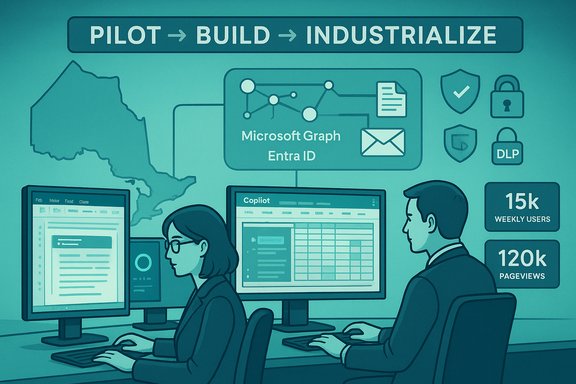
Ontario’s rollout is being presented internally as a staged modernization program: Pilot → Build → Industrialize. The initial phase—establishing “AI foundations”—focuses on low‑risk administrative use cases, before moving to purpose‑built, tenant‑grounded systems and, eventually, scaled deployments across administrative functions. The internal planning slides reportedly state an aspirational productivity target of roughly 20% uplift once Copilot is embedded into workflows.
This program centers on the enterprise Microsoft 365 Copilot experience, not public consumer chatbots. The provincial rollout emphasizes tenant grounding—integrating Copilot with Microsoft Graph (Exchange, SharePoint, Teams, OneDrive) so responses can be contextualized against internal records when tenancy and connectors are configured correctly. The government’s internal guidance also appears to ban or restrict the use of consumer chatbots (for example, Google Gemini or ChatGPT) for many civil‑service tasks while steering staff to the approved Copilot tenant.
External reporting by national media has summarised these claims and published key figures originating from freedom‑of‑information disclosures; those reports quote ministry officials and highlight ministerial sponsorship under Minister Stephen Crawford. Independent federal guidance from the Treasury Board Secretariat (TBS) likewise encourages staged experimentation in low‑risk contexts and insists on risk assessments, privacy review, and human oversight before scaling generative AI in the public sector.
However, the program’s most important tests are still ahead. The headline metrics (15,000 weekly users; 120,000+ pageviews) are notable signals of adoption but remain internal telemetry reported via media; independent validation is required. The transition from pilot to “industrialized” AI depends on contractual guarantees (non‑training and auditability), technical proof of identity and DLP controls, published pilot evaluations, and measured KPIs that quantify real productivity gains and social impacts. Without these pieces, rapid expansion risks creating opaque telemetry, procurement lock‑in, and accountability gaps.
Microsoft’s public enterprise assurances and Canada’s Treasury Board Secretariat guidance provide a sensible policy and technical baseline, but the proof will be in the contracts, telemetry exports and independent audits. Implemented with discipline, Ontario’s approach could free civil servants from tedious work and improve service delivery; implemented without the necessary transparency and contractual teeth, it could become a long‑term governance headache.
Source: Global News
 Background / Overview
Ontario’s rollout is being presented internally as a staged modernization program: Pilot → Build → Industrialize. The initial phase—establishing “AI foundations”—focuses on low‑risk administrative use cases, before moving to purpose‑built, tenant‑grounded systems and, eventually, scaled deployments across administrative functions. The internal planning slides reportedly state an aspirational productivity target of roughly 20% uplift once Copilot is embedded into workflows.This program centers on the enterprise Microsoft 365 Copilot experience, not public consumer chatbots. The provincial rollout emphasizes tenant grounding—integrating Copilot with Microsoft Graph (Exchange, SharePoint, Teams, OneDrive) so responses can be contextualized against internal records when tenancy and connectors are configured correctly. The government’s internal guidance also appears to ban or restrict the use of consumer chatbots (for example, Google Gemini or ChatGPT) for many civil‑service tasks while steering staff to the approved Copilot tenant.
External reporting by national media has summarised these claims and published key figures originating from freedom‑of‑information disclosures; those reports quote ministry officials and highlight ministerial sponsorship under Minister Stephen Crawford. Independent federal guidance from the Treasury Board Secretariat (TBS) likewise encourages staged experimentation in low‑risk contexts and insists on risk assessments, privacy review, and human oversight before scaling generative AI in the public sector.
What the provided materials say (clear, verifiable summary)
- Internal slide decks and presentations describe a three‑phase program: establish AI foundations, build purpose‑built tenant systems, and industrialize AI at scale. These materials frame Copilot use as a modernization program rather than consumer experimentation.
- Headline metrics in those slides: >15,000 weekly Copilot users across the Ontario Public Service (OPS) and >120,000 pageviews of the internal guidance page titled “Copilot Chat InsideOPS.” The slides claim the highest Copilot adoption in Canada. These numbers are reported inside government documents and cited by national media.
- Short‑term use cases being promoted internally are low‑risk, repetitive tasks that map well to generative assistance: drafting and editing in Word/Outlook, meeting summarization, triaging high‑volume email flows, spreadsheet assistance in Excel, and media monitoring. The material also notes pilot experiments with small cohorts of “AI leaders and pioneers” for more complex integrations.
- The internal plan sets aspirational targets—an interim 20% productivity uplift during the build phase and ministerial comments reportedly claiming an “average public servant is saving almost three hours per week” at current rollout levels. The slides and quoted remarks are presented as internal metrics and preliminary results rather than independently audited findings.
- The materials highlight key governance and technical controls to be implemented or recommended: tenant grounding, connector allow‑lists, chat history retention, identity hardening (Entra ID P2, conditional access, PIM), DLP rules and sensitivity labels, telemetry capture for FOI and auditability, and mandatory role‑based AI training for staff.
Verification and cross‑checks with public documents
The central claims in the provided materials and media reporting align with three independently verifiable points:- The media coverage of Ontario’s Copilot rollout and the quoted headline figures are published and available in national news reporting. The Global News piece reproduces the slide metrics and ministerial statements that form the basis of the internal claims.
- Treasury Board Secretariat guidance for Canadian federal institutions recommends cautious, staged experimentation with generative AI and prescribes risk assessment, privacy and legal review, and human oversight—principles reflected in Ontario’s internal road‑map. That federal guidance is published by the Government of Canada and frames the public‑sector best practices that provincial pilots should measure themselves against.
- Microsoft’s enterprise documentation and privacy FAQs state that customer prompts and tenant content are not used to train Microsoft’s foundation models unless a customer explicitly opts in. Microsoft’s published guidance explains tenant controls and non‑training assurances for enterprise Copilot use—an important contractual and technical foundation the OPS programme appears to rely on.
Why Microsoft Copilot is the pragmatic choice for OPS (analysis)
- Existing tenancy and procurement realities: Many public‑sector organisations already run Microsoft 365; adding Copilot seats is often the path of least resistance, avoiding disruptive platform migration. The vendor’s enterprise integration with Microsoft Graph makes Copilot attractive for context‑aware assistance.
- Tenant grounding and enterprise controls: Copilot’s architecture allows for tenant grounding—the service can be configured to operate over an organisation’s internal documents, reducing uncontrolled web grounding if connectors and web‑access settings are tightened. Microsoft’s enterprise statements reinforce that customer data is not used for model training unless the tenant opts in.
- Feature fit for administrative uplift: Copilot’s strengths—draft generation, summarization, meeting transcription, spreadsheet assistance and low‑code automation (Copilot Studio)—map to established high‑volume tasks in government operations where modest accuracy trade‑offs can be managed with human oversight. The internal materials explicitly target these low‑risk wins.
Strengths of Ontario’s approach (what the materials get right)
- Measured, staged experimentation: The “pilot → build → industrialize” posture is consistent with recognized best practice for public‑sector AI adoption—start with small cohorts, capture telemetry and measure before scaling. The materials’ staged road‑map is a defensible tactical posture.
- Focus on low‑risk administrative use cases: Targeting drafting, triage, meeting summaries and spreadsheet assistance reduces the immediate exposure to high‑stakes decision errors. These are appropriate first use cases to validate productivity claims.
- Visible ministerial sponsorship: A named program sponsor accelerates procurement and provides political accountability. Ministerial buy‑in can help secure training budgets and gate the program’s expansion behind policy milestones.
- Emphasis on technical controls and identity hardening: The materials explicitly call for Entra ID P2, conditional access, PIM and DLP—controls that materially reduce the risk profile if implemented correctly. That technical emphasis is a necessary precondition for safe enterprise Copilot deployments.
Risks and governance gaps to watch (critical analysis)
- Data governance and sovereignty: Tenant misconfiguration or overly permissive connectors can expose protected or personal data. Even with Microsoft’s assurances, contractual clarity matters: the government must document whether vendor contracts explicitly prohibit the use of prompts or tenant content for model training and whether telemetry exports and audit rights are guaranteed. The internal slides note these risks, but public confirmation of contractual terms would be required for full confidence.
- Hallucinations and factual accuracy: Generative models can produce plausible but incorrect outputs. Any Copilot‑generated content that flows into citizen‑facing communications, adjudicative outcomes, or legal advice must be subject to mandatory human review. KPI selection should include hallucination rates and human correction rates. The materials recommend tracking these metrics, but an independent evaluation is needed to quantify real‑world error rates.
- Records management, FOI and auditability: AI‑assisted drafts may be government records subject to Freedom of Information and archival rules. Departments must capture prompts, outputs and decision trails in discoverable, exportable archives. The internal plan calls for telemetry capture, but verification requires published retention policies and demonstrable export capability.
- Procurement lock‑in and switching costs: Large‑scale licensing of a single ecosystem can create long‑term switching costs. Procurement teams must negotiate audit rights, non‑training guarantees, deletion and export clauses, and contractual obligations for telemetry retention; these contractual protections are often the decisive factor in whether a pilot can remain accountable at scale.
- Workforce and social impacts: Productivity uplift claims must be paired with reskilling pathways and redeployment plans. Without transparent workforce plans, the program risks anxiety and resistance among civil servants. The materials mention role transformation, but detail and measurable workforce outcomes are required.
Actionable checklist for credible public‑sector Copilot deployments
The internal materials already include a policy and technical checklist; below is a condensed, actionable version tailored for OPS and other public bodies implementing tenant‑grounded Copilot:- Publish a public brief naming the cloud tenancy, the Copilot configuration baseline, and whether prompts/outputs are contractually excluded from vendor model training. Why: transparency reduces public distrust and clarifies legal boundaries.
- Enforce identity hardening: require Entra ID P2, Privileged Identity Management (PIM), multi‑factor authentication (MFA) and device posture checks for all Copilot users. Why: limits account misuse and lateral movement.
- Apply DLP and sensitivity labels across Copilot‑connected apps to block PII, classified or privileged information from being processed in the assistant. Why: prevents accidental data leaks.
- Capture and retain Copilot prompts, responses and usage telemetry as auditable records and make them exportable for FOI and external audits. Why: preserves accountability and legal defensibility.
- Require mandatory scenario‑based AI training, signed acceptable‑use agreements and role‑specific playbooks for licensed users. Why: reduces misuse and raises awareness of hallucination risk.
- Contractually require non‑training/non‑use guarantees and audit rights from vendors; demand telemetry export capability and contractual terms that permit independent evaluation. Why: prevents vendor data dependence and enables independent validation.
- Pilot with measurable KPIs: adoption by app and role, average sessions per user, hallucination rate, human correction rate, validated time‑saved per task and downstream service quality impacts. Why: turns anecdote into evidence.
- Publish a transparent pilot evaluation with methodology, baseline measures and telemetry exports.
- Harden tenant controls and identity protections for pilot cohorts.
- Expand only after independent audit and role‑based training are in place.
Technical and contractual verification — what to demand from vendors
- A binding contractual statement that customer prompts and tenant content will not be used to train foundation models unless explicitly opted into by the customer; exportable proof that the feature is disabled at the tenant level. Microsoft’s enterprise documentation supports the plausibility of this claim, but procurement must secure contractual confirmation and audit rights.
- Exportable telemetry and audit logs that include session details (anonymized or redacted for privacy when necessary), error and hallucination tracking, user adoption metrics and connector usage. This must be preserved to satisfy FOI and archival obligations.
- Clear data residency, processing and deletion clauses for all data handled by Copilot and any associated agent automations. Clarify where inference occurs (tenant vs. vendor cloud) and whether any material or telemetry is retained outside the tenant.
Measuring success: meaningful KPIs, not PR targets
The internal slides set a 20% productivity uplift target and cite ministerial claims of “three hours saved per week.” Those are reasonable program objectives but not proof of impact. A credible evaluation should include:- Baseline process time studies and time‑motion analysis for targeted tasks.
- Controlled A/B experiments (where feasible) comparing outcomes with and without Copilot assistance.
- Rework rate and human correction rate for Copilot outputs.
- Citizen‑facing metrics: response time, accuracy of public communications, FOI inquiry volume related to AI outputs.
- Longitudinal workforce metrics: role changes, redeployment rates, reskilling completion rates and staff satisfaction indexes.
Broader implications for digital government and procurement
Ontario’s program functions as a testing ground for several systemic questions facing modern digital governments:- Can large bureaucracies adopt fast‑moving AI tech while preserving FOI, records management and auditability? The answer depends less on product features and more on procurement terms and operational discipline.
- Will procurement velocity outpace governance? Rapid seat purchases without enforceable contractual guarantees create long‑term switching costs and opaque telemetry issues. Procurement must negotiate durable audit rights and non‑training clauses.
- How will public trust be sustained? Transparency about where data flows, whether outputs are auditable and how human oversight is enforced will determine citizen acceptance. Publishing independent pilot evaluations is central to trust‑building.
Final appraisal — measured optimism with conditions
Ontario’s move to pilot Microsoft Copilot at scale in the OPS is a credible, pragmatic modernization step: it leverages existing tenancy, targets low‑risk administrative tasks, and appears to emphasise technical controls and staged expansion. The program’s strengths are real and reflect lessons learned from other public‑sector pilots.However, the program’s most important tests are still ahead. The headline metrics (15,000 weekly users; 120,000+ pageviews) are notable signals of adoption but remain internal telemetry reported via media; independent validation is required. The transition from pilot to “industrialized” AI depends on contractual guarantees (non‑training and auditability), technical proof of identity and DLP controls, published pilot evaluations, and measured KPIs that quantify real productivity gains and social impacts. Without these pieces, rapid expansion risks creating opaque telemetry, procurement lock‑in, and accountability gaps.
Microsoft’s public enterprise assurances and Canada’s Treasury Board Secretariat guidance provide a sensible policy and technical baseline, but the proof will be in the contracts, telemetry exports and independent audits. Implemented with discipline, Ontario’s approach could free civil servants from tedious work and improve service delivery; implemented without the necessary transparency and contractual teeth, it could become a long‑term governance headache.
Conclusion
The Ontario Public Service’s tentative use of Microsoft Copilot represents a significant public‑sector experiment in generative AI adoption. The internal documents and media reporting show high early uptake and an ambitious roadmap. Those signs are encouraging for modernization efforts, but they must be matched by published evaluations, enforceable contractual safeguards, auditable telemetry and robust identity and data protection measures to ensure that the productivity gains are real, verifiable and accountable. The coming months—particularly the release of independent pilot evaluations and procurement disclosures—will determine whether Ontario’s program is a model for responsible digital government or a cautionary lesson in rushed adoption.Source: Global News
