

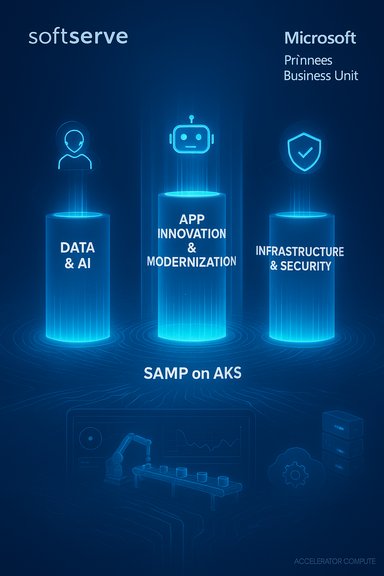
SoftServe’s announcement of a dedicated Microsoft Partner Business Unit (BU) marks a deliberate pivot from broad partnership to a tightly focused, Microsoft-aligned go‑to‑market strategy that packages the vendor’s decades of Azure and data engineering experience into a single organizational vehicle intended to accelerate enterprise adoption of data, AI, app modernization, and cloud security capabilities. The BU consolidates SoftServe capabilities across three core pillars — Data & AI, App Innovation & Modernization, and Infrastructure & Security — and promises faster time‑to‑value through prebuilt platforms (notably the SoftServe Adaptive Modernization Platform, SAMP, on Azure Kubernetes Service) and “agentic” AI accelerators intended to move customers from concept to production in weeks. The company framed the move as the next era of a long Microsoft alliance in a press release from Nov. 18, 2025.
SoftServe positions the Microsoft BU as a formal home for a set of capabilities it says were built over more than 20 years of collaboration with Microsoft. The new unit explicitly targets the commercial levers Microsoft is pushing across the enterprise stack: unified data platforms (Microsoft Fabric), model and agent runtimes (Azure AI Foundry, Copilot Studio), and cloud infrastructure (AKS, Azure governance). SoftServe’s CRO, Volodymyr Semenyshyn, framed the BU as a specialization engine for agentic AI, data analytics and business intelligence, claiming accreditation to advise, plan and deliver Microsoft Fabric projects. The announcement coincides with SoftServe’s presence at Microsoft Ignite and follows a year of partner recognitions and ecosystem wins that the company has highlighted in its public materials.
This article parses the announcement, validates the highest‑impact claims, and provides a critical assessment for enterprise buyers and IT leaders evaluating SoftServe as a Microsoft‑centric integrator. Wherever possible, claims are cross‑checked against vendor case studies, partner accreditation signals, and independent third‑party coverage; any marketing‑forward assertions that could not be reliably verified are flagged and contextualized.
Recommended evaluation steps:
SoftServe’s Microsoft Partner Business Unit is a logical and potentially valuable consolidation for enterprises seeking a single integrator to deliver Microsoft‑centric data + AI + app modernization projects. The technical artifacts (SAMP on AKS, digital twin work with Krones, NVIDIA collaboration) are credible and backed by published case material and partner recognition. However, the commercial value of the BU will be determined by the rigor of the partner’s evidence: Partner Center specializations, audited references, reproducible PoCs, and contractual commitments around security and compliance. Enterprises should treat the BU as a promising option but require concrete, auditable proof before authorizing production rollouts.
Source: The Manila Times Partner Business Unit Marks Next Era of SoftServe-Microsoft Collaboration, Driving AI Impact Across Enterprises
 Background / Overview
SoftServe positions the Microsoft BU as a formal home for a set of capabilities it says were built over more than 20 years of collaboration with Microsoft. The new unit explicitly targets the commercial levers Microsoft is pushing across the enterprise stack: unified data platforms (Microsoft Fabric), model and agent runtimes (Azure AI Foundry, Copilot Studio), and cloud infrastructure (AKS, Azure governance). SoftServe’s CRO, Volodymyr Semenyshyn, framed the BU as a specialization engine for agentic AI, data analytics and business intelligence, claiming accreditation to advise, plan and deliver Microsoft Fabric projects. The announcement coincides with SoftServe’s presence at Microsoft Ignite and follows a year of partner recognitions and ecosystem wins that the company has highlighted in its public materials.This article parses the announcement, validates the highest‑impact claims, and provides a critical assessment for enterprise buyers and IT leaders evaluating SoftServe as a Microsoft‑centric integrator. Wherever possible, claims are cross‑checked against vendor case studies, partner accreditation signals, and independent third‑party coverage; any marketing‑forward assertions that could not be reliably verified are flagged and contextualized.
What the Microsoft BU includes: productized capability and GTM focus
SoftServe’s public messaging groups the BU into three solution pillars. Each pillar maps directly to Microsoft’s enterprise roadmap and partner incentives.Data & AI: Fabric, analytics, and actionable insights
- The BU claims specialization around Microsoft Fabric, tying that capability to data unification, analytics acceleration, and AI automation. The press release states SoftServe is a Microsoft Fabric Featured Partner and among the small set of providers authorized to design and deliver Fabric implementations. This is presented as the primary route SoftServe will use to deliver retrieval‑augmented workflows, unified lakehouse/warehouse fabrics, and agentic copilots grounded in enterprise data.
- Independent material published by SoftServe highlights a specific manufacturing case (Krones) that ties AI-enabled digital twins to Fabric/Azure infrastructure and demonstrates simulation and analytics use cases; that case study is hosted on SoftServe’s resources hub. The Krones example is emblematic of the BU’s pitch: use Fabric/Azure + accelerated compute to turn engineering workflows into operational decisioning.
App Innovation & Modernization: SAMP on AKS and faster release cycles
- A headline technical artifact in SoftServe’s messaging is the SoftServe Adaptive Modernization Platform (SAMP) running on Azure Kubernetes Service (AKS). SAMP is presented as a platform engineering accelerator that standardizes IaC, CI/CD, governance, cost controls, and security to speed migrations and modernization. SoftServe materials describe SAMP as enabling platform deployment in minutes and rolling updates “up to 20x faster.” The SAMP architecture and benefits are covered in detail on SoftServe’s blog and in an Azure Marketplace listing.
- Beyond platform claims, the BU emphasizes enabling Copilot Studio and Azure AI Foundry integrations so that newly modernized applications can embed copilots and agents without repeated re‑architecture.
- Request a live SAMP demo showing end‑to‑end governance and a history of update cadence for a comparable customer.
- Ask for measured metrics (release time before/after) and contractually bound SLAs for modernized workloads.
- Demand to see the Azure Marketplace offer and any independent audit or third‑party reference for cost/throughput claims.
Infrastructure & Security: cloud security specializations and ecosystem partners
- The BU foregrounds Cloud Security specializations and cites partnerships with NVIDIA, Databricks, and Ansys (Synopsys) to amplify compute‑intensive workloads and domain simulations. SoftServe’s recent awards and partner activity—such as being named NVIDIA’s 2025 Americas NPN Service Delivery Partner of the Year—support the claim that SoftServe has active, deep vendor collaborations for accelerated computing and digital twin workloads.
- The company also promotes standard secure migration and optimization patterns (Defender for Cloud, Azure Policy, Entra integrations) and positions the BU as a consolidated vendor for cloud‑native security and scale.
Case study spotlight: Krones digital twin — results, stack, and the numbers
SoftServe highlights a manufacturing engagement with Krones (bottling and packaging machinery) as a showcase for the BU’s cross‑vendor execution model. The published SoftServe case study claims a compact, multi‑partner delivery (Ansys, CADFEM, Microsoft, NVIDIA, SoftServe) and reports dramatic improvements:- Baseline: computational fluid dynamic (CFD) simulations that historically took 3–4 hours.
- Outcome: SoftServe’s collaborative digital twin reduced simulation cycles dramatically — the publicly available SoftServe case study reports simulations taking about 30 minutes per cycle, enabling much faster iteration and scenario analysis. The case study describes the integrated stack (Azure, AKS, Ansys Fluent, NVIDIA Omniverse/accelerated compute, and SoftServe orchestration) and the two‑month rapid delivery cadence.
- The press release distributed via third‑party wires also referred to reductions in unplanned downtime (claimed at ~15% in year one) and asserted simulation speed reductions “from up to four hours down to five minutes.” There is a discrepancy between the SoftServe case study (30 minutes) and the press release’s five‑minute claim; public, independently verifiable sources for the five‑minute figure were not found in the vendor material reviewed. Given that the SoftServe case study directly details the stack and the testing environment, it is the stronger primary reference, while the five‑minute statistic appears inconsistent and should be treated with caution.
What’s credible — and what needs buyer diligence
SoftServe’s Microsoft BU announcement is credible in several respects:- The company has an established history of Microsoft partnership and Azure‑centric offerings; its SAMP artifact, Azure Marketplace presence, and public blog posts document specific platform artifacts and processes.
- Recent ecosystem awards and partner recognitions (notably NVIDIA’s 2025 Americas NPN Service Delivery Partner of the Year) substantiate strength in accelerated compute and GenAI delivery — a capability that matters for digital twin and other heavy workloads.
- The Krones case study provides a concrete, multi‑vendor delivery narrative with technical stack details: Ansys Fluent for CFD, Azure for cloud and AKS, NVIDIA acceleration, and SoftServe orchestration. That makes the Krones engagement a reasonable exemplar of the BU’s intended delivery model.
- Fabric Featured Partner / authorized advisor claims: many vendors claim Fabric competencies and partner badges. Microsoft maintains partner directories and Partner Center artifacts that are the authoritative record; buyers should ask to see the partner’s Partner Center snapshot showing the precise Fabric Featured Partner status, the date awarded, and the audited specializations or advanced specializations the partner holds. Public marketing copy alone is not sufficient evidence for procurement governance.
- Hard numeric claims that vary across publications: for example, the Krones simulation time is reported as 30 minutes in the SoftServe case study, but the press release also contains a conflicting “five minutes” figure. Where such variance exists, demand an engineering runbook and the test conditions (mesh resolution, approximation models, compute SKU and node counts, GPU vs CPU runtime, caching/approximation strategies). Without that context, numbers can be misleading.
- Agentic Catalyst and “three agents in 30 days” assertions: the press release cites an “Agentic Catalyst” program that claims to deploy three tailored AI agents in 30 days. This is a powerful commercial promise but requires scrutiny: confirm the scope of “agents” (read‑only advisory agents vs. agents that execute privileged actions), data governance and PII handling, and the acceptance criteria for go‑live. Ask for an agent acceptance checklist, audit logs, and a security plan that details least‑privilege provisioning for Entra identities.
How enterprises should evaluate SoftServe’s Microsoft BU offerings
Enterprise procurement and technical decision makers should treat this as a go‑to‑market consolidation that simplifies vendor engagement — but they must insist on rigorous, auditable evidence before moving from PoC to production.Recommended evaluation steps:
- Ask for Partner Center evidence: request the SoftServe Microsoft Partner Center snapshot showing the Fabric Featured Partner status, specializations (Analytics on Azure, Kubernetes on Azure, Cloud Security), and any Copilot or Foundry advanced specializations.
- Demand measurable references: at least two customer references with contactable references and contractual KPIs (e.g., pre/post modernization release cadence, downtime reduction, simulation runtimes with the compute SKU and model fidelity documented).
- Run a scoped Proof of Concept (PoC): define a 4–8 week PoC with agreed‑upon success metrics, SLAs, and an exit/roll‑forward plan. Make the PoC contractually measurable (time, cost, fidelity).
- Verify governance and security: require architecture artifacts that show Entra identities for agents, Purview/Purview‑like observability for Fabric data, and the deployment of Defender for Cloud with policy baselines applied.
- Check third‑party attestations: for high‑cost projects ask for SOC2 / ISO27001 documentation relevant to the delivery teams, and if AI agents will access sensitive data insist on red‑team testing or model governance audits.
Strategic implications for Microsoft and the partner ecosystem
SoftServe’s moves reflect broader partner dynamics in the Microsoft ecosystem:- Microsoft’s platform roadmap is increasingly verticalized: partners that can combine Fabric (data), Foundry/Copilot Studio (agent orchestration), and cloud scale (AKS/accelerated GPU compute) are in a good position to convert pilot interest into procurement. SoftServe’s BU aligns with that stack and aims to capture end‑to‑end engagements.
- Hyperscaler‑agnostic differentiators remain important: firms that claim deep Microsoft specialization still must demonstrate cross‑vendor competence where customers need hybrid or multi‑cloud portability. SoftServe’s NVIDIA award and the Ansys/Simulations partnerships suggest capability in GPU and domain simulation stacks, which is a positive indicator when workloads are compute heavy.
- Shortening time‑to‑value is the partner battlefield: claims such as “three tailored AI agents in 30 days” and “rollouts 20x faster” are aimed at the procurement metric buyers care about most — predictable, fast ROI. Partners that can deliver clearly documented, repeatable playbooks will win. The buyer’s job is to make those playbooks contractual and auditable.
Strengths, risks, and final assessment
Strengths:- Clear alignment with Microsoft’s platform play (Fabric, Copilot Studio, AKS) and credible proof points in SAMP and Krones case work.
- Tangible partnerships with compute and simulation leaders (NVIDIA, Ansys) that support high‑fidelity workloads and industry use cases; recent partner awards reinforce execution capability.
- A unified BU makes it easier for clients to get a single accountable team for data, app modernization, and security delivery — this reduces vendor churn and the common “blame game” among multiple integrators.
- Some headline metrics in marketing/press materials vary across channels (e.g., Krones simulation runtime claims). These discrepancies must be reconciled with engineering evidence.
- Partner program claims such as Fabric Featured Partner status require direct verification in Microsoft Partner Center; buyers must request Partner Center artifacts.
- Agentic AI programs (agents in production) raise governance, auditability, and data‑access risk. Operational procedures around agent approvals, credential rotation, and telemetry retention must be contractually enforced.
SoftServe’s Microsoft Partner Business Unit is a logical and potentially valuable consolidation for enterprises seeking a single integrator to deliver Microsoft‑centric data + AI + app modernization projects. The technical artifacts (SAMP on AKS, digital twin work with Krones, NVIDIA collaboration) are credible and backed by published case material and partner recognition. However, the commercial value of the BU will be determined by the rigor of the partner’s evidence: Partner Center specializations, audited references, reproducible PoCs, and contractual commitments around security and compliance. Enterprises should treat the BU as a promising option but require concrete, auditable proof before authorizing production rollouts.
Practical checklist before contracting SoftServe’s Microsoft BU
- Obtain Partner Center snapshot (specializations, dates, and Partner ID).
- Request two refereed customer engagements with measurable KPIs and contactable references.
- Insist on an engineering runbook for any performance claims (simulation runtime, downtime reduction, release cadence).
- Contract a time‑boxed PoC with acceptance criteria, go/no‑go gates, and cost/cap estimate for production scale.
- Require security and model governance artifacts (SOC2/ISO docs, agent approval flows, telemetry retention policy).
Source: The Manila Times Partner Business Unit Marks Next Era of SoftServe-Microsoft Collaboration, Driving AI Impact Across Enterprises
