

NTT’s “Building for AI: Modernizing applications with Microsoft Azure” positions AI as the central force reshaping application modernization—and it’s a practical roadmap, not just a marketing slogan. rview
Cloud-first modernization has entered a new phase: AI-first modernization. The conversation has moved beyond “lift-and-shift” to questions of how to re-architect systems so they become actively intelligent, secure, and business‑impactful. NTT’s piece argues that enterprises should treat Microsoft Azure as the platform of choice for this transition, combining Azure’s evolving AI stack with NTT’s systems-integration capabilities and vertical IP to accelerate real outcomes.
This article unpackes the technical claims against current Azure documentation and industry reporting, and provides a practical, risk-aware blueprint for Windows‑centric teams and enterprise architects planning to modernize applications with Azure and partner services like those from NTT.
Modernization used to be about cost, scalability, and operational resilience. AI adds new constraints and opportunities:
Why this matters: Cloud Accelerate Factory is designed to offload predictable, repeatable tasks (e.g., landing zone creation, VM/database migration, basic security hardening), allowing partners and customers to focus engineering teams on differentiating application work. The program does come with eligibility rules and regional availability—so treat “zero‑cost” as a bounded benefit rather than unconditional free labor.
At the other end, Microsoft is expanding serverless GPU compute and container‑based GPU offerings that reduce operations overhead for bursty inference or managed training jobs—useful for prototypes, PoCs, or hat must scale to meet demand without dedicating persistent VM capacity.
Strengths:
AI is rapidly changing the calculus of application modernization. NTT’s play—pairing Azure’s enterprise agent and GPU capabilities with SI delivery and skilling—is sensible and grounded in the capabilities Microsoft is shipping today. That said, successful modernization will still require disciplined governance, explicit cost modeling, and iterative rollouts. Use available partner programs and platform tooling to de-risk the journey, but don’t let vendor enthusiasm obscure the hard work of data hygiene, identity, and operational controls that make AI modernization both possible and sustainable.
Source: NTT, Inc. New 404
Cloud-first modernization has entered a new phase: AI-first modernization. The conversation has moved beyond “lift-and-shift” to questions of how to re-architect systems so they become actively intelligent, secure, and business‑impactful. NTT’s piece argues that enterprises should treat Microsoft Azure as the platform of choice for this transition, combining Azure’s evolving AI stack with NTT’s systems-integration capabilities and vertical IP to accelerate real outcomes.
This article unpackes the technical claims against current Azure documentation and industry reporting, and provides a practical, risk-aware blueprint for Windows‑centric teams and enterprise architects planning to modernize applications with Azure and partner services like those from NTT.
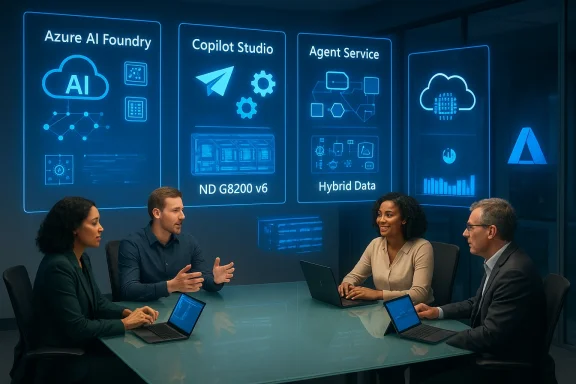 Why AI changes modernization priorities
Modernization used to be about cost, scalability, and operational resilience. AI adds new constraints and opportunities:- Data: AI applications require curated, high-quality data pipelines and low-latency access to knowledge stores.
- Compute diversity: GPU and specialized accelerator planning become first‑class architecture decisions.
- Observability and governance: model behavior, fairness, and lineage must be tracked.
- Integration surface: AI agents and copilots need secure, identity-aware access to corporate systems.
The Microsoft Azure toolkit for rosoft has consolidated and expanded several programs and services designed specifically for the cloud + AI modernization journey. Key pieces to understand:
Azure Accelerate and Cloud Accelerate Factory
Microsoft now groups migration, modernization, and hands-on deployment assistance under Azure Accelerate, which packages assessment tooling, funding, and the Cloud Accelerate Factory—a mechanism for Microsoft experts to deliver zero‑cost deployment assistance for eligible projects. This is explicitly positioned to reduce friction on landing zones, migrations, and PaaS replatforms.Why this matters: Cloud Accelerate Factory is designed to offload predictable, repeatable tasks (e.g., landing zone creation, VM/database migration, basic security hardening), allowing partners and customers to focus engineering teams on differentiating application work. The program does come with eligibility rules and regional availability—so treat “zero‑cost” as a bounded benefit rather than unconditional free labor.
Azure AI Foundry (formerly Azure AI Studio)
Microsoft’s Azure AI Foundry unifies model access, agent frameworks, SDKs, and governance features into a single development and operations environment. Announced and expanded at recent Ignite conferences, the Foundry provides:- A central portal for building AI apps and agents.
- An SDK (Python and C#, with JS on the roadmap) and app templates.
- Integration paths for Azure OpenAI models plus third‑party and partner models.
- Built‑in evaluation, tracing, and governance tooling to produce model cards and operational telemetry.
Azure AI Agent Service and Copilot Studio
Microsoft distinguishes two complementary entry points for agentic solutions:- Copilot Studio: Low-code/no-code experiences for knowledge workers and business builders to create copilots and task automation. Recent updates enable agents to act autonomously using UI automation (“computer use”) where APIs don’t exist—this is powerful but increases the need for careful governance.
- Azure AI Agent Service: A developer-oriented, scalable service for building secure, stateful agents that integrate model inference, tools, and enterprise data sources. This service is part of the Foundry ecosystem and emphasizes interoperability, observability, and managed deployment.
GPU infrastructure: ND GB200‑v6 and serverless options
High‑end training and generative workloads require advanced GPU instances. Microsoft’s ND GB200‑v6 VM series leverages NVIDIA’s Blackwell (GB200) GPUs and associated high‑bandwidth networking to deliver multi‑GPU performance for large model training and fine‑tuning. These specs (multi‑GPU per VM, NVLink fabric, and very high memory footprints) are now documented in Microsoft Learn and are critical to sizing training and inference workloads at scale.At the other end, Microsoft is expanding serverless GPU compute and container‑based GPU offerings that reduce operations overhead for bursty inference or managed training jobs—useful for prototypes, PoCs, or hat must scale to meet demand without dedicating persistent VM capacity.
NTT’s positioning: systems integration + IP + skilling
NTT’s article fram partnership play: Azure provides the platform and toolchain while NTT provides vertical know‑how, automation IP (RPA, knowledge-management),y. Key takeaways from that position:- NTT recommends preferencing Azure as the target platform for modernization, enabling co‑selling, marketplace accelerators, and streamlined partner delivery.
- They advocate combining RPA and knowledge management tools with AI agents to deliver measurable productivity improvements and process automation.
- Skilling is essential: NTT emphasizes certifying large numbers of engineers on Azure to close execution risk and to scale delivery teams.
A practical, step‑by‑step modernization roadmap
Below is a pragmatic path Windows and enterprise teams can follow to modernize safely, migrate strategically, and add AI value.- Discovery and business‑value mapping
- Inventory applications, data flows, and integrations.
- For each app, evaluate business outcomes AI could improve (customer experience, automation, decision support).
- Use Azure Migrate and assessment tooling to capture dependencies and a cost/sustainability baseline.
- Target architecture and compute sizing
- Decide which apps will be rehosted, replatformed, or rewritten as cloud‑native services.
- For AI workloads, determine training vs inference requirements and size GPU needs accordingly—ND GB200‑v6 for heavy training; serverless GPU/containerized inference for elastic serving.
- Data and knowledge engineering
- Centralize and govern data stores using Fabric, Azure Data Lake, and Azure AI Search where appropriate.
- Create secure knowledge indices for agents and ensure access controls with Microsoft Entra (Azure AD lineage).
- Build minimum‑viable agents and copilots
- Use Copilot Studio for knowledge worker-facing copilots and Azure AI Agent Service for developer-built, stateful agents.
- Establish observability and evaluation metrics from day one (trace logs, model cards, cost telemetry).
- Pilot, measure, and scale with Azure Accelerate
- Engage programs such as Azure Accelerate or Cloud Accelerate Factory to jumpstart infrastructure, get funded assessments, and reduce early execution risk where eligible.
- Productionize with governance and safety controls
- Put in place model reporting (Azure AI Reports / Foundry telemetry), identity controls, VNET isolation, CMKs, and least‑privilege tool access following the Azure Well‑Architected Framework.
Architecture patterns and best practices
- Hybrid‑data pattern: Keep sensitive data on‑prem or in private storage and bring models to the data using Azure Arc / Foundry connectors where possible, minimizing public egress.
- Agent gateway pattern: Route agent actions through a control plane that enforces policy, auditing, and throttling—this is the Copilot Control System concept Microsoft highlights.
- Model abstraction layer: Build an abstraction to allow swapping models (OpenAI, third‑party, in‑house fine‑tuned) without changing service contracts.
- Serverless inference with autoscaling: For unpredictable traffic, prefer containerized serverless GPU or managed inference endpoints to reduce idle costs.
- Canaryed model rollouts: Use staged deployments with automated rollback triggers and continuous evaluation pipelines.
Governance, security, and compliance: non‑negotiables
AI adds new attack and compliance vectors. Focus on:- Identity and access management: integrate agents and services with Microsoft Entra to enforce least privilege and conditional access.
- Data residency & encryption: adopt BYOS (bring‑your‑own‑storage) options where available and manage keys with CMKs.
- Observability: trace model inputs, outputs, and action trails. Generate model cards and bias/fairness reports as part of the release pipeline.
- Business approvals for autonomous actions: require approval gates for agents that can perform financial or sensitive operations.
Cost and ROI considerations
NTT and various Microsoft matclaims for AI modernization—some marketing pieces suggest rapid payback. Treat these with caution. Marketing ROI statistics are useful for direction, but cost modeling must be done specifically for your workloads.- Key cost drivers:
- GPU training time and VM sizing (ND GB200‑v6 are premium instances).
- Storage and egress patterns for large knowledge corpora.
- Operational overhead for governance, monitoring, and security.
- Cost levers:
- Use spot/low-priority VMs for non‑urgent training.
- Prefer PaaS-managed services for databases and analytics to reduce ops spend.
- Leverage Azure Accelerate credits and partner funding when available to defray initial expenses.
Strengths of the Azure + NTT approach
- Integrated stack: Foundry + Agent Service + Copilot Stnt development and operations environment that covers both citizen-developer and pro‑developer journeys.
- Partner delivery scale: SI partners like NTT bring domain accelerators, RPA integrations, and trained delivery teams—this reduces execution risk for large enterprises.
- Enterprise model options: Azure Foundry’s strategy to offer multiple models and providers reduces vendor lock‑in risk while enabling enterprises to pick the model that fits their use case.
- Infrastructure parity: With GPUs like ND GB200‑v6, Azure supports the compute scale required for frontier model work.
Risks and mitigations
- Risk: Over‑automation without governance
- Mitigation: Enforce approval workflows, policy gates, and human‑in‑the‑loop controls for high‑risk actions.
- Risk: Unexpected costs from large model inference
- Mitigation: Pilot with smaller models, implement throttling and cost alerts, and model caching strategies.
- Risk: Data leakage or poor data hygiene
- Mitigation: Use private storage options, VNETs, CMKs, and strong data classification before agent training or indexing.
- Risk: Skills shortage and delivery capacity gaps
- Mitigation: Invest in skilling programs and leverage partner‑provided delivery teams, as NTT recommends.
- Risk: Vendor dependency on a single model/provider
- Mitigation: Adopt a model abstraction layer and prefer platforms (like Foundry) that support multi‑model ecosystems.
Implementation checklist for Windows teams
- Inventory: Create a dependency map of apps and data stores using Azure Migrate.
- Prioritize: Rank applications by business value and AI fit (low, medium, high).
- Sandbox: Use Azure Accelerate funded sandboxes for PoCs.
- Security baseline: Define Entra roles, VNET architecture, and encryption policy.
- Build pipeline: Implement CI/CD with model testing and canaryed deployments.
- Observability: Integrate Application Insights, tracing, and model performance dashboards.
- Skills: Enroll platform engineers in Foundry/Agent Service training and business teams in Copilot use/controls.
- Partner engagement: Define roles for SIs like NTT—who will deliver landing zones, who will own copilots, and who will maintain models.
Case examples and what they teach us
NTT’s approach and public Microsoft customer examples consistently show one pattern: start small, measure impact, and use partners to scale repeatable patterns.- Example pattern: lift a customer service app to PaaS, index historical tickets into an Azure AI index, deploy a Copilot for agents to surface relevant past cases, and measure time‑to‑resolution improvements before moving to autonomous triage. Tach reduces risk and builds trust with stakeholders.
Final assessment: strengths, trade‑offs, and recommendation
NTT’s guidance is pragmatic: combine Azure’s evolving agent and GPU capabilities with systems integrator delivery and skilling programs to accelerate modernization. That approach benefits from Microsoft’s investment in Foundry, Agent Service, and partner programs such as Azure Accelerate—each validated by Microsoft documentation and independent reporting.Strengths:
- A cohesive product roadmap from Microsoft that aligns infrastructure, developer tooling, and governance.
- The ability to run high‑end training on ND GB200‑v6 hardware when needed.
- SI partners like NTT can reduce time‑to‑value and provide vertical accelerators.
- Costs for frontier model workloads can be high without careful sizing.
- Governance and identity integration remain the top blockers for safe production adoption; tooling helps but does not remove the need for policy and human oversight.
- Treat projects as a two‑track program: stabilize platform and data foundations (landing zones, identity, storage) while running parallel AI PoCs that validate business outcomes. Use Azure Accelerate and partner engagements to reduce delivery friction, and insist on measurable metrics for ROI and safety before scaling.
AI is rapidly changing the calculus of application modernization. NTT’s play—pairing Azure’s enterprise agent and GPU capabilities with SI delivery and skilling—is sensible and grounded in the capabilities Microsoft is shipping today. That said, successful modernization will still require disciplined governance, explicit cost modeling, and iterative rollouts. Use available partner programs and platform tooling to de-risk the journey, but don’t let vendor enthusiasm obscure the hard work of data hygiene, identity, and operational controls that make AI modernization both possible and sustainable.
Source: NTT, Inc. New 404
