

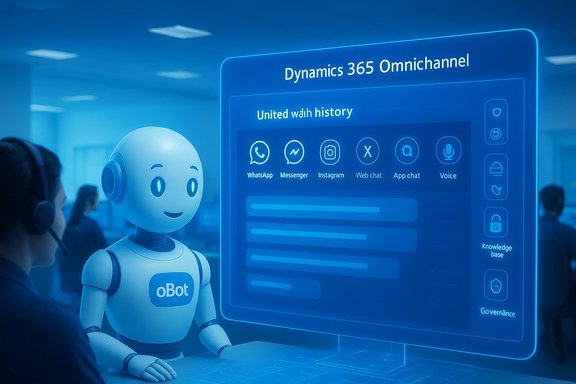
Ooredoo Qatar’s move to unify customer engagement on Microsoft Dynamics 365 and an Azure-backed AI stack — crystallized in the oBot digital assistant — marks a decisive shift in telecom customer care: a single, AI-enabled platform that promises seamless cross-channel journeys, measurable efficiency gains, and a blueprint for authentic intelligence in service operations.
Background
As customer expectations accelerate, telecommunications providers are under constant pressure to make every interaction feel immediate, contextual, and effortless. Ooredoo Qatar confronted a familiar operational problem: customers were migrating from traditional voice calls to social and messaging platforms such as WhatsApp, Messenger, Instagram, and X, while the company’s response had been to add channels one-by-one. The result was siloed operations, inconsistent context between agents, and friction for customers who switched channels mid-journey. Ooredoo’s response was to consolidate all customer-facing channels onto a single intelligent platform built on Microsoft Dynamics 365 and Azure AI Foundry, and to roll out oBot, a generative-AI assistant that leverages retrieval-augmented generation (RAG) over curated knowledge sources and large models (Ooredoo reports GPT‑4o as the model powering Obot). The public case narrative frames the transformation as a twin technical and organizational effort — centralize data and orchestration, then layer AI for scale and continuity.What Ooredoo built: a technical overview
Unified omnichannel on Dynamics 365
Ooredoo centralized inbound messages, social platforms, web chat, app chat, and voice into Dynamics 365 Omnichannel. That unified agent surface gives agents a single pane-of-glass with the customer’s entire interaction history, metadata, and transaction context — eliminating the “start-over” problem when customers switch channels. Microsoft’s customer story emphasizes this consolidation as the foundation for consistent experiences and rapid addition of AI-driven capabilities.AI stack: Azure AI Foundry, RAG, and GPT-4o
The AI layer combines:- Azure AI Foundry for model hosting, orchestration, and managed AI services.
- A retrieval-augmented generation approach to ground generative outputs in Ooredoo’s knowledge base and policies.
- A large multimodal foundation model (Ooredoo publicly cites GPT‑4o for oBot) to generate human-like conversational responses and drive natural-language voice interactions. Ooredoo has publicly showcased oBot across the Ooredoo app, web, and social channels and discussed plans for real‑time voice and avatar experiences.
Agent assist and automation
The deployment augments agents with AI-driven automation:- Automated self-service handled by oBot, resolving routine queries without human involvement.
- Agent assist capabilities (summaries, recommended replies, next-best-actions) to reduce average handling time and after-call work.
- Workforce orchestration to match staffing to demand across channels, enabled by unified telemetry and analytics.
Reported outcomes and what they mean
According to Microsoft and Ooredoo’s published narrative, early outcomes include:- Faster WhatsApp response times and improved consistency across channels due to consolidated routing.
- Significant increases in self-service rates, with many routine queries now resolved by oBot.
- Average handling time falling from seven minutes to five minutes, attributed to unified agent tooling and AI augmentation.
- Greater agent productivity and the ability to redeploy human effort toward proactive engagement (upsell/cross-sell, complex issues).
Cross-referencing the public record
Ooredoo’s own press releases and regional reporting corroborate the vendor narrative that oBot is a central, GPT‑4o‑powered pillar of Ooredoo’s CX strategy and that the company is scaling AI broadly across its organization (including Microsoft 365 Copilot licensing for the workforce). Gulf Times and Ooredoo press statements describe the Web Summit Qatar 2025 reveal of oBot and the plan to roll it out across app, web, WhatsApp, and social channels. Reuters reporting on Ooredoo’s regional AI infrastructure investments (notably an agreement to bring Nvidia technology to Ooredoo’s data centers) provides additional context: the telco is investing in hardware and capacity to host higher‑scale AI services for both internal and B2B customers. These items together paint a consistent picture: platform consolidation, model-backed assistants, and underlying compute investments.Strengths: why this architecture works for telco CX
- True omnichannel continuity: Centralizing interaction state and customer history removes the re‑onboarding friction that breaks customer trust and wastes agent time. A single data plane drives coherent routing and hand-offs.
- Speed to feature: Choosing a first-party Microsoft stack (Dynamics 365 + Azure) simplifies integration between the agent desktop, telemetry, and AI services — reducing time to deploy agent assist, summarization, and omnichannel routing. This is a standard benefit Microsoft highlights across Dynamics 365 contact center transformations.
- AI-enabled scale: Grounded generative models, when paired with RAG and curated knowledge bases, enable meaningful self‑service. The business effect is clear: fewer human seats required for routine queries and higher availability across time zones and channels. Ooredoo positions oBot to shift agent work toward higher-value tasks.
- Infrastructure readiness for advanced AI: Ooredoo’s investments in data‑center capacity and partnerships (e.g., Nvidia) indicate a long-term plan to host higher-performance AI workloads and offer related services to enterprise customers — not just a hosted SaaS dependence. This improves performance options and data residency control.
Risks, caveats, and governance requirements
While the outcomes are compelling, scaling a unified, model-driven customer platform carries real technical and business risks:1) Model risk and hallucinations
Generative models can produce fluent but incorrect responses. In customer service, even a single incorrect answer can trigger reputational damage or financial loss. Grounding (RAG) helps, but it must be robust: knowledge retrieval, source validation, versioning, and deterministic fallbacks are mandatory. Customer disclosures and human‑in‑the‑loop escalation rules are required to maintain safety and compliance.2) Data governance and privacy
Telco data is sensitive (billing, location, identity). Consolidating channels means consolidating access: strict role-based access controls, encryption at rest and in transit, retention policies, and auditable logs are essential. Data residency requirements (national regulations, cross‑border transfers) must be enforced at the storage and model-training layers. Public case materials do not disclose full governance artifacts, so potential buyers should demand documentation and audits.3) Vendor lock-in and platform coupling
Deep coupling with one cloud and application stack accelerates delivery but increases dependence on licensing, roadmaps, and platform changes. Mitigation tactics include: API-driven modularity, exportable data schemas, and a hybrid hosting strategy where sensitive workloads remain on premises or within sovereign cloud environments.4) Operational resilience and availability
Contact centers are business-critical. Centralization concentrates risk: outages, identity/edge failures, or model-service disruptions can impact every channel. Robust disaster recovery, multi-region failover, and tested fallbacks (IVR menus, cached knowledge responses, manual queues) are non-negotiable. Historical incidents in large cloud platforms have shown the business impact of edge or identity failures — plan for them.5) Change management and skills
Shifting 200+ agents from channel-specific tasks to a single platform requires retraining, new SLAs, and a cultural shift. Performance gains depend heavily on governance, prompt engineering, and ongoing knowledge management processes. Without investment in upskilling and supervision, AI tools can underdeliver.6) Regulatory and ethical exposure
Deploying generative AI in customer-facing contexts raises questions about disclosure (is the user interacting with an AI?, liability for advice, and adherence to advertising/marketing rules. Telcos operating across jurisdictions must map agent outputs and policies to local law.Implementation best practices — an actionable checklist
- Data & identity
- Build a canonical customer record (single customer view) in a governed data plane (Dataverse or equivalent).
- Enforce strong identity and least-privilege access control across agent and model layers.
- Knowledge & grounding
- Maintain a curated, versioned knowledge corpus for RAG.
- Implement retrieval scoring, source attribution, and a human‑review pipeline for knowledge updates.
- Model constraints & prompt governance
- Use constrained prompts and templates for customer‑facing responses.
- Implement confidence thresholds and fallback logic (e.g., escalate to human agent when model confidence is low).
- Observability & QA
- Instrument latency, hallucination rate, escalation frequency, and customer sentiment.
- Establish daily QA cycles and retrospective audits for adverse incidents.
- Privacy, compliance & residency
- Encrypt all PII, log all model inputs/outputs for audit with anonymization where appropriate.
- Validate cross-border model calls against local regulations and data residency requirements.
- Resilience & fallbacks
- Design synchronous and asynchronous fallbacks (cached answers, offline mode) for outages.
- Test failovers with realistic load and channel‑switch scenarios.
- People & process
- Redefine KPIs: measure first‑contact resolution, next‑best action influence, and agent coaching outcomes.
- Train agents on AI literacy, escalation criteria, and prompt management.
Business considerations and ROI expectations
- Expect initial value to come from deflecting routine queries to AI self‑service, reducing after‑call work through automated summarization, and improving first‑contact resolution via context continuity.
- Realistic pilots should aim to validate:
- Deflection rate — percentage of queries handled entirely by AI without human touch.
- Handling time reduction — measured per channel and case complexity.
- CSAT and Net Promoter Score movement for AI-handled interactions.
- Vendors commonly report double-digit productivity improvements in early deployments; treat early claims as directional and require proof-of-value pilots in the specific operational context before scaling.
The strategic horizon: agentic service and avatars
Ooredoo’s stated roadmap points beyond chatbots: agentic AI, real‑time voice, and avatar-based experiences where the same intelligence manifests across text, voice, IVR, and retail kiosks. The design principles Ooredoo lists — Action over Answers, One Mind, Many Bodies, Trust by Design — indicate a focus on transactional capability (making changes on behalf of customers) and continuity across devices. Realizing that vision requires:- Tight coupling between conversational surfaces and transactional APIs.
- Real‑time voice models with safe content guarantees and robust latency profiles.
- Explainability and explicit consent flows to maintain trust.
How to evaluate similar vendor/customer claims
When vendors cite reductions in handling time or increases in self‑service, procurement and engineering teams should:- Request access to the measurement methodology and raw metrics used in published claims.
- Insist on a 90‑day pilot that replicates production traffic (mix of channels and query complexity).
- Negotiate contractual SLAs that include availability, latency, and model‑behaviour guarantees plus clear remediation routes for harmful outputs.
- Require third‑party security and data‑privacy attestations (SOC 2, ISO 27001, or equivalent) and the right to audit data flows where feasible.
Conclusion
Ooredoo Qatar’s Dynamics 365‑centered rebuild and the launch of oBot illustrate a pragmatic pattern that many telecom operators will follow: unify channels and customer data first, then scale conversational AI using grounded generative models and managed AI infrastructure. The approach delivers clear operational advantages — continuity across channels, faster response times, and elevated self‑service — but it also introduces non‑negligible risks that must be managed through rigorous governance, observability, and human oversight. For telcos and large service organizations, the lesson is straightforward: AI multiplies both opportunity and responsibility. Success depends less on which model is used and more on how data is governed, knowledge is curated, and human oversight is embedded. Ooredoo’s work is an early exemplar of a balanced path: invest in infrastructure and governance, deploy AI where it delivers measurable value, and design for continuity and trust as the default.Source: Microsoft Ooredoo Qatar uses Dynamics 365 and sets a new standard: Unified AI platform delivers seamless, personal customer experience
