

China’s low-cost, open-source AI models have triggered a quiet but consequential shift in enterprise AI procurement: many businesses are choosing models such as Alibaba’s Qwen and the newcomer DeepSeek for production workloads because they are dramatically cheaper — and in some cases effectively free — while delivering “good enough” capability for a wide range of practical tasks. This movement, documented by a major empirical study of real-world token usage and reflected in comments from high-profile technology leaders, is forcing a re-evaluation of value in the AI stack and creating fresh strategic, regulatory, and technical challenges for companies that assumed the market would consolidate around U.S.-developed proprietary models.
For CIOs and platform leaders, the imperative is clear: design procurement and system architectures that treat models as interchangeable components of a broader inference fabric. That means industrializing benchmarking for performance-per-dollar, hardening governance for provenance and data residency, and building operational playbooks that let organizations pivot as both model quality and geopolitics evolve. The era of one-size-fits-all AI vendor selection is over; the era of pragmatic, multi-model engineering has begun.
Source: SlashGear China's Open-Source AI Models Might Be Outpacing American Companies In Cost - SlashGear
 Background
The data: open models gaining real traction
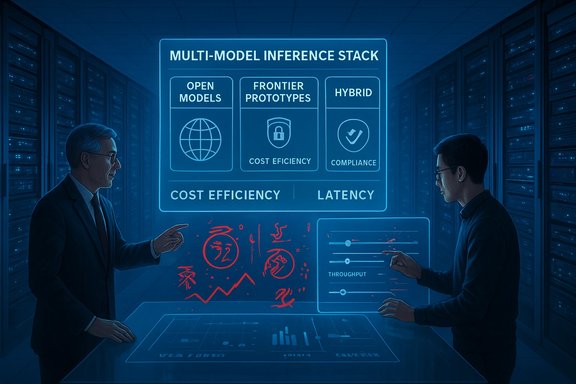
A December industry study of over 100 trillion tokens of real-world LLM traffic shows that open-weight models — including a rapidly growing cohort of Chinese-developed open models — grew from a near-negligible share in late 2024 to a meaningful share of usage by late 2025. In the OpenRouter study, Chinese open-source models rose from roughly 1.2% of weekly token volume in late 2024 to as much as ~30% in some weeks of 2025, contributing substantially to a broader open-source surge. That movement reflects more than curiosity: it indicates developers and production systems are routing real inference traffic to these models. At the same time, reporting and industry coverage have highlighted that enterprises are routinely making cost-driven choices when assembling multi-model production stacks, mixing high-priced proprietary models for edge-case, high-assurance tasks and cheaper open models for volume workloads. This multi-model approach shows that cost and latency, not just peak capability, determine what gets used in production.Why price now beats prestige for many business workloads
The simple arithmetic of inference
For most production use cases — customer support routing, automated ticket triage, content generation at scale, code-assist pipelines — the bulk of expense is inference. Proprietary frontier models carry a premium per token that scales with traffic; but open-weight Chinese models and other OSS offerings can be deployed at much lower cost, either via inexpensive hosted APIs or through self-hosting on cheaper cloud instances. The net effect: for high-volume, lower-risk tasks, switching models can produce dramatic savings in operating expense. Industry reporting indicates some businesses have reported annual savings in the low- to mid-six-figures after moving non-mission-critical inference to cheaper models.Performance-per-dollar: not the same as benchmark superiority
Proprietary models tend to lead on benchmarks tied to reasoning accuracy, hallucination mitigation, and narrow safety constraints. But many enterprise tasks reward throughput, latency, and predictable cost more than edge-case reasoning finesse. Where a cheaper model answers correctly 95% of the time and does so at much lower latency and cost, the business case to use that model is compelling. The recent market behavior — enterprises blending models in production stacks — confirms this pragmatic calculus.The open-source advantage: customization and control
Open-weight models allow enterprises to fine-tune, quantize, and run models behind their own firewalls — or to use hosted endpoints with looser licensing fees. That flexibility removes a layer of vendor lock-in and allows companies to align models tightly with their products, data, and performance targets. When cost, customization, and speed matter more than having the last decimal point of accuracy, open models win.Case studies and market signals
Airbnb’s practical mix: Qwen in production
Airbnb’s CEO publicly described the company’s AI agent as a “multi-model” system relying on 13 different models, and specifically noted Alibaba’s Qwen as a fast and cheap model the company uses heavily in production while relegating some OpenAI models to less frequent roles. Those comments underline a real-world pattern: large consumer platforms optimize for latency, cost, and broad multilingual support — attributes where Qwen and similar models can excel.Early adopters and reported savings
Journalistic reporting has cited entrepreneurs and firms claiming substantial annual savings — for example, one report relayed an anonymized claim that switching to Qwen reduced AI spend by roughly $400,000 a year for a particular business. Those figures are illustrative rather than universal, but they help explain why engineering teams and finance officers are rethinking vendor choices. Cost savings at that scale materially affect total cost of ownership and can justify organizational risk tolerance for alternative vendors.DeepSeek’s rapid ascent and regulatory pushback
DeepSeek — an example of a Chinese AI startup that released highly cost-effective open models — generated rapid adoption for workloads where price and performance were the primary drivers. That fast adoption prompted regulatory scrutiny in multiple jurisdictions due to concerns about data residency, privacy, and provenance of training data. Several governments and agencies moved to restrict or ban DeepSeek in sensitive contexts, and regulators in Europe and elsewhere opened investigations. The DeepSeek case is an early warning: rapid cost-driven adoption can collide with national security, privacy, and compliance boundaries.What the numbers actually show — and their limits
OpenRouter’s 100-trillion-token dataset
The OpenRouter/a16z “State of AI” analysis is one of the most comprehensive usage studies available, sampling over 100 trillion tokens. It shows open-weight models, especially Chinese open models, captured a sizable slice of token volume in 2025. But the study’s dataset reflects OpenRouter’s traffic mix and partner integrations; it is not a complete worldwide census. In other words, the trend is real and significant within the observed dataset, but generalizing to every enterprise without qualification risks overstatement.Corroboration across outlets
Reporting from major outlets corroborates the direction of the trend: open-source Chinese models have surged in adoption, and enterprises are openly choosing cheaper models for production. Independent stories documenting corporate anecdotes, combined with the OpenRouter dataset, provide a consistent narrative: cost-sensitive workloads are moving to cheaper alternatives. That said, aggregated market share and economic impact figures vary by dataset and timeframe, so close scrutiny of the data origin and definitions is essential before drawing definitive market-share conclusions.Technical trade-offs: where cheaper models shine and where they don’t
Strengths of low-cost / open Chinese models
- Cost-efficiency for high-volume inference — lower per-token cost translates directly to lower operating expense.
- Customizability — open-weight models can be fine-tuned, quantized, or run on specialized inference stacks for latency gains.
- Language and region optimization — some Chinese models exhibit strong multilingual support or domain-specific strengths that can benefit international apps.
- Speed and latency — when optimized and colocated, these models often deliver lower round-trip latency than remote API calls to distant proprietary endpoints.
Limitations and technical risks
- Hallucination and factuality — frontier proprietary models frequently perform better on hard reasoning and misinformation resistance out of the box; open models may require careful fine-tuning and retrieval augmentation to reach the same level for critical tasks.
- Tooling and integration maturity — proprietary ecosystems often include production-ready guardrails, monitoring, and enterprise SLAs; open stack deployments require assembly and operational maturity.
- Model evolution — rapid open-model release cycles can be an operational burden: continuous re-evaluation is necessary to avoid regressions and maintain safety posture.
Enterprise risk profile: compliance, supply chain, and geopolitics
Data residency and regulatory exposure
Using foreign-hosted models or routing enterprise data to offshore inference endpoints raises regulatory flags — especially in finance, healthcare, telecom, and government. DeepSeek’s international trajectory shows how a runaway adoption story can be interrupted by privacy and national-security interventions. Enterprises must map legal obligations (data residency, export controls, sectoral rules) before migrating sensitive workflows to cheaper overseas models.Supply chain and chip constraints
China’s AI advancement is notable even as the country faces limits in advanced semiconductor supply. That constraint pushes local labs to optimize models for available hardware and innovate in quantization and algorithm-hardware co-design. But it also means global hardware supply and geopolitics — including sanctions and export controls — can rapidly change the economics of self-hosting or vendor selection. A model that appears cheap today can become less attractive if hardware access is restricted.Vendor risk and IP provenance
Open models may incorporate third-party data or open-source components whose licensing or provenance is unclear. For enterprises, the risk is twofold: legal exposure and unpredictable behavior in production (e.g., copyright leaks or poisoned training artifacts). Due diligence on model provenance and governance processes is now a required procurement step.A practical decision framework for CIOs and platform architects
Step 1: Classify workloads by risk and value
- Mission-critical, regulated, safety-sensitive (e.g., clinical decision support, legal advice) — favor highest-assurance proprietary or heavily validated models.
- High-volume, low-risk automation (e.g., routing, templated responses) — prioritize cost-efficient open models with monitoring.
- Mixed or evolving tasks — adopt multi-model stacks with fallbacks and human-in-the-loop controls.
Step 2: Benchmark for performance-per-dollar
- Establish baseline metrics: latency, token cost, error rate, hallucination frequency.
- Run side-by-side production trials with real traffic slices; measure cost per resolved transaction rather than tokens alone.
Step 3: Build guardrails and monitoring
- Logging, model explainability tooling, and automated drift detection.
- Cost controls and throttles to prevent runaway expenses if a cheaper model behaves unpredictably.
Step 4: Governance and legal review
- Verify data residency, IP provenance, and licensing.
- Consult privacy and security teams before connecting sensitive data to offshore endpoints.
Strategic implications for U.S. cloud and model providers
The multi-model reality undermines pure-monopolistic bets
The emergence of low-cost open models means customers do not have to commit exclusively to a single provider’s offering. That undermines assumptions that venture-scale bets on proprietary models would automatically lock-in all enterprise spend. Instead, major cloud and model vendors must compete on cost, latency, interoperability, and the enterprise feature set (security, compliance, SLAs).Where U.S. firms hold the advantage
- Frontier reasoning capability — for the highest-precision, safety-critical tasks, leading proprietary models still set the bar.
- Enterprise-grade services — mature tooling, compliance playbooks, and scale SLAs remain differentiators.
- Hybrid solutions — offering private, hosted versions of frontier models to reduce data exposure is a path for retained share.
The regulatory and geopolitical overlay
National-security concerns will shape procurement
DeepSeek’s regulatory pushback shows that model origin matters. Governments will continue weighing economic efficiencies against national-security and privacy implications. That dynamic will produce a patchwork of restrictions and safe-harbor paths; procurement teams must track local policy and maintain flexible architectures that can swap inference backends without breaking customer-facing services.Trade policy and chip controls affect long-term economics
If export controls tighten on advanced chips or if cloud-access to certain hardware is constrained, the economic advantage of some vendor-hosted models could shift. Companies should stress-test vendor strategies against plausible geopolitical scenarios and prefer architectures that allow portability across clouds and edge deployments.Financial modeling: how to calculate real TCO when choosing a model
Key inputs to model
- Per-token inference price or per-request price (hosted).
- Infrastructure amortization and compute cost if self-hosting (instance hours, reserved capacity).
- Developer and Ops labor for deployment, monitoring, and model maintenance.
- Cost of errors: estimated human intervention, remediation, and reputation impact.
- Regulatory compliance costs and any projected fines or remediation expenses.
Example approach (simplified)
- Measure real traffic and average prompt/completion token lengths.
- Multiply by per-token inference price for each candidate model.
- Add fixed operational costs (hosting, monitoring).
- Compare annualized totals and sensitivity to traffic growth.
- For high-volume, predictable tasks, cheap models win on pure cost.
- For low-volume, high-risk tasks, higher-priced models often justify their premium.
What’s next: coexistence, competition, and consolidation
Multi-model stacks become standard
The most likely near-term landscape is coexistence: frontier proprietary models for high-assurance and innovation tasks; low-cost open models for bulk inference; and hybrid or in-house deployments where data sensitivity demands it. Firms that build operational competence across diverse models will be advantaged.U.S. firms must compete on total enterprise value
Competing on raw model quality alone is not enough. Enterprises demand predictable cost, compliance, support, and portability. U.S. vendors that pair frontier models with enterprise-ready tooling and clear governance will retain strategic accounts; those that do not risk losing broad production workloads to lower-cost alternatives.Watch for regulatory-driven shifts
Expect pockets of restricted model use in regulated sectors and public procurement. That segmentation will create both winners and losers and will likely accelerate the development of enterprise-grade, domestically hosted model offerings.Risks and caveats
- The OpenRouter dataset, while large and influential, is one platform’s slice of usage; trends must be validated across datasets before broad generalizations are made.
- Anecdotal savings figures (for example, the reported $400,000 year-over-year saving for one business) illustrate potential impact but are not a universal guarantee; each organization’s architecture and usage profile will produce different results.
- Rapid adoption of inexpensive, foreign-hosted models can invite regulatory, privacy, and security scrutiny that may negate raw cost advantages if mitigation and compliance costs are not factored in.
Conclusion
The enterprise AI market is entering a pragmatic phase in which cost-efficiency, latency, and operational flexibility increasingly matter as much as headline model accuracy. Chinese-developed open models such as Qwen and DeepSeek — enabled by rapid iteration, open weights, and favorable pricing — now occupy meaningful real-world inference share for many production workloads. That shift challenges assumptions about vendor lock-in and reveals a new multi-model equilibrium: businesses will mix and match models to optimize cost and performance, while balancing regulatory and security obligations.For CIOs and platform leaders, the imperative is clear: design procurement and system architectures that treat models as interchangeable components of a broader inference fabric. That means industrializing benchmarking for performance-per-dollar, hardening governance for provenance and data residency, and building operational playbooks that let organizations pivot as both model quality and geopolitics evolve. The era of one-size-fits-all AI vendor selection is over; the era of pragmatic, multi-model engineering has begun.
Source: SlashGear China's Open-Source AI Models Might Be Outpacing American Companies In Cost - SlashGear
