

A new collaborative effort called the Open Gaming Collective (OGC) has launched with the explicit aim of reducing duplicated work across Linux gaming projects and providing a shared, upstream-first platform for the core plumbing that makes games run well on Linux.
Linux gaming has been on a steady rise for the last several years: Valve’s work on Proton and Steam Deck pushed compatibility and brought millions of players’ attention to the platform, and a growing ecosystem of distributions and projects has followed, each optimizing for different devices, hardware, or user experiences. That growth, though, came with fragmentation. Distribution and project maintainers often ended up solving the same low-level problems independently — kernel tweaks for controller and GPU support, input stacks for handheld devices, packaging and maintenance of essential components such as gamescope, and packaging or patching Mesa, Vulkan tooling, and driver stacks. The result: duplicated effort, divergent forks and patches, and slower propagation of improvements to the broader Linux community.
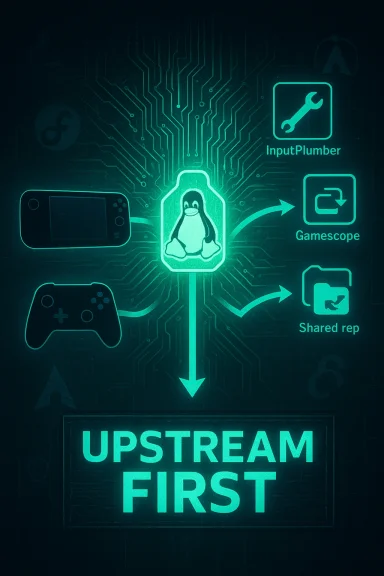
The OGC is explicitly pitched as an antidote: a working group of projects and organizations that will collaborate on maintaining shared components (a gaming-focused kernel, input tooling, Gamescope and related display/ compositor tooling, and more) and prioritize getting improvements upstream to their canonical homes rather than keeping permanent forks. The group’s website and founding announcements spell out this “Upstream First” philosophy as a core policy.
The announcement rolled out publicly on January 28–29, 2026, with posts on the OGC site, on Bazzite’s official forum, and through several founding members’ blogs. These early communications lay out both the technical priorities and the immediate, practical changes to some member projects.
Notably, some prominent projects have chosen not to join. Early public reactions and community threads show CachyOS — a project with its own handheld-focused edition and patches — saying it has opted not to participate, citing concerns about perceived bureaucracy, mismatched priorities (handheld focus vs desktop), and certain associations between members it prefers to avoid. That friction is already visible in community discussion and helps illustrate that collaboration across diverse projects will not be friction-free.
Practically, that means features formerly implemented in HHD — things like fan control and RGB management for supported devices — will be moved into the Steam UI where supported, with an overlay for features Steam does not yet expose. For hardware that needs older libraries, Bazzite will continue to provide rollback and pinning options while triaging issues. The public messaging stresses a gradual, careful migration rather than an abrupt removal of functionality.
Why this matters in practice: when one widely used project like Bazzite converges on shared libraries and kernel maintenance, it reduces the number of parallel implementations that hardware vendors or users need to support. For developers, it means fewer divergent patches to manage; for users, it means a smoother upgrade path and wider device compatibility more quickly.
There are two immediate implications:
Mainstream Linux-gaming media noted the practical benefits and singled out Bazzite’s announced technical migrations as an important early signal that the OGC intends to produce concrete changes, not just high-level promises.
For hardware makers: a coordinated set of upstream-focused patches means that supporting Linux hardware could become easier in the long run — vendors can aim for a smaller set of maintained interfaces knowing multiple distros test and consume the same kernel tweaks and userland tooling. But this will depend on the OGC’s success in upstreaming and maintaining high-quality, well-documented patches.
For distro maintainers and developers: the trade-off will be upfront work to align with OGC standards and contribution processes, in exchange for less long-term maintenance overhead and better shared test coverage. Projects that can tolerate some short-term migration work stand to gain the most.
But success is not guaranteed. Governance, upstream relationships, membership inclusivity, and careful handling of community politics will determine whether the OGC becomes a durable force for consolidation and quality — or another fractured body that struggles to coordinate across differing priorities. The coming months will tell: watch for upstream patch merges, public roadmaps, and additional projects joining (or publicly explaining why they won’t). For now, the formation of the OGC is a hopeful and pragmatic step worth following closely.
Sources and further reading (selection)
Source: TechPowerUp Open Gaming Collective Forms to Enhance Linux Gaming | TechPowerUp}
 Why this matters now
Linux gaming has been on a steady rise for the last several years: Valve’s work on Proton and Steam Deck pushed compatibility and brought millions of players’ attention to the platform, and a growing ecosystem of distributions and projects has followed, each optimizing for different devices, hardware, or user experiences. That growth, though, came with fragmentation. Distribution and project maintainers often ended up solving the same low-level problems independently — kernel tweaks for controller and GPU support, input stacks for handheld devices, packaging and maintenance of essential components such as gamescope, and packaging or patching Mesa, Vulkan tooling, and driver stacks. The result: duplicated effort, divergent forks and patches, and slower propagation of improvements to the broader Linux community. The OGC is explicitly pitched as an antidote: a working group of projects and organizations that will collaborate on maintaining shared components (a gaming-focused kernel, input tooling, Gamescope and related display/ compositor tooling, and more) and prioritize getting improvements upstream to their canonical homes rather than keeping permanent forks. The group’s website and founding announcements spell out this “Upstream First” philosophy as a core policy.
The announcement rolled out publicly on January 28–29, 2026, with posts on the OGC site, on Bazzite’s official forum, and through several founding members’ blogs. These early communications lay out both the technical priorities and the immediate, practical changes to some member projects.
Who’s in the collective (and who isn’t)
Founding members listed on the OGC site and in related posts include a mix of established gaming-focused projects and smaller teams focused on handhelds and gaming distros: Universal Blue / Bazzite, ASUS Linux, ShadowBlip, PikaOS, Fyra Labs, ChimeraOS, Nobara, and Playtron among others. The membership reflects a cross-section of projects that build or maintain gaming-focused kernels, handheld tooling, or system layers used by players on desktop PCs and handhelds.Notably, some prominent projects have chosen not to join. Early public reactions and community threads show CachyOS — a project with its own handheld-focused edition and patches — saying it has opted not to participate, citing concerns about perceived bureaucracy, mismatched priorities (handheld focus vs desktop), and certain associations between members it prefers to avoid. That friction is already visible in community discussion and helps illustrate that collaboration across diverse projects will not be friction-free.
What the OGC will do — technical pillars
The OGC’s stated scope centers on foundational layers of the Linux gaming stack. From the founding documents and posts, the headline technical pillars are:- A shared, gaming-focused kernel — an OGC kernel that will centralize patches and hardware enablement work for controllers, wheels, secure boot, and other peripherals. The project explicitly emphasizes an upstream-first approach: work should be reviewed for inclusion in the mainline Linux kernel where possible.
- Shared input tooling — standardizing on or maintaining tools like InputPlumber (an input stack used by SteamOS and several projects) to avoid each distro reinventing handheld and controller input handling. Some projects plan to phase out older, bespoke input daemons in favor of a shared InputPlumber-based approach.
- Shared packaging and maintenance of userland components — gamescope, Mesa patches or coordination around Mesa/Vulkan upstreaming, and other essential runtime tooling will be housed under the OGC umbrella and shared among members. The aim is to provide repeatable, reliable artifacts that member projects can consume rather than patching these pieces individually.
- Upstream coordination — a formal effort to get patches upstream into Mesa, the kernel, GNOME/Wayland ecosystem components, and driver repositories instead of indefinitely maintaining downstream forks. This is a long-term health play to reduce technical debt across the ecosystem.
Early concrete moves: the Bazzite example
One of the clearest immediate outcomes of the OGC formation is the set of changes announced by Bazzite (Universal Blue). In a forum post on January 28, 2026, Bazzite’s founder outlined plans that include phasing out Bazzite’s bespoke Handheld Daemon (HHD) in favor of InputPlumber (used by SteamOS and other projects), adopting the OGC kernel, and sharing patches to Valve packages and other components with the collective for upstreaming and communal maintenance.Practically, that means features formerly implemented in HHD — things like fan control and RGB management for supported devices — will be moved into the Steam UI where supported, with an overlay for features Steam does not yet expose. For hardware that needs older libraries, Bazzite will continue to provide rollback and pinning options while triaging issues. The public messaging stresses a gradual, careful migration rather than an abrupt removal of functionality.
Why this matters in practice: when one widely used project like Bazzite converges on shared libraries and kernel maintenance, it reduces the number of parallel implementations that hardware vendors or users need to support. For developers, it means fewer divergent patches to manage; for users, it means a smoother upgrade path and wider device compatibility more quickly.
The “Upstream First” policy — good for long-term health, but not frictionless
The OGC’s “Upstream First” policy — meaning patches and improvements should, wherever sensible, be submitted to the original upstream project rather than kept only in a downstream fork — is one of the collective’s most consequential commitments. Upstreaming reduces duplication, improves long-term maintainability, and helps ensure that fixes reach the widest user base, but upstreaming also requires sustained engagement with upstream maintainers, strong code quality, compliance with upstream project policies, and patience while maintainers review and accept changes.There are two immediate implications:
- Workload shifts: OGC members will likely need to invest more effort in crafting patches that meet upstream projects’ expectations (maintainer conventions, regression tests, coherent changelogs), which can be more work initially than maintaining a downstream patch. The payoff is less long-term maintenance burden and broader benefit.
- Governance and diplomacy: upstreaming often entails discussions with maintainers who have different priorities. Successful upstreaming requires respectful, sustained collaboration; if the OGC takes a heavy-handed or siloed approach, it could cause friction or slow adoption of patches. The group’s future ability to work productively with upstream projects (Mesa, kernel maintainers, Wayland compositors) will be a decisive factor in its success.
Potential upsides — why the community should be cautiously optimistic
- Efficiency gains: pooled resources mean fewer teams solving the same problems, faster bug fixes, and consistent behavior across distros that consume OGC components. That’s particularly valuable for time-sensitive areas like controller support and GPU driver work, where downstream forks can introduce regressions or diverging behavior.
- Better hardware support: coordinated kernel and firmware efforts can increase the likelihood that newer devices (or niche controllers and wheels) work out of the box sooner, since the same patches will be tested across multiple distributions and hardware configurations.
- Improved security and maintainability: central maintenance of critical components can simplify security patching and auditing, and the upstream-first approach reduces the lifetime cost of maintaining separate forks.
- Clearer user experience: by standardizing on components like InputPlumber and Gamescope, downstream projects can focus on higher-level UX differences rather than re-implementing plumbing. For users, this can translate into fewer compatibility headaches and a more consistent feel between gaming-focused distributions.
Risks, unknowns, and community concerns
No collective is a silver bullet, and there are several areas where the OGC’s ambitions could run into challenges:- Governance and transparency: early communications present OGC as a working group, but the structure for decision-making, membership rules, and conflict resolution will matter. Transparency around who controls the shared repositories, release cadence, and how external contributors can engage will determine whether the project is seen as inclusive or gatekept. The early opt-outs and public skepticism show these governance questions already matter.
- Cultural fit with upstream maintainers: upstream projects (e.g., the Linux kernel, Mesa) have their own contributor norms. The OGC must work as a constructive partner, not a separate silo trying to shove changes downstream. That requires long-term commitment to code quality, review responsiveness, and building trust with existing maintainers.
- Vendor and association politics: public comments from projects that declined to join suggest concerns about being associated with certain members or the specter of “bureaucratic” overhead. Associations between members (real or perceived) influence whether others will want to collaborate closely. The OGC will need to manage optics and membership boundaries carefully to avoid alienating potential contributors.
- Resource concentration vs. diversity: pooling resources is efficient, but if OGC components become the de facto standard, smaller projects may feel compelled to conform even when their priorities differ. The collective must balance standardization with room for experimentation and diversity of approaches.
Early community reactions
Initial reaction has been mixed but engaged. Coverage in independent outlets framed the OGC announcement as “exciting” and potentially very beneficial for Linux gaming if the group follows through with upstream-first practices, while community forums and Reddit threads highlighted both enthusiasm and reservations — from excitement about fewer duplicated efforts to concerns about governance and the decision by some projects not to join. The public thread where CachyOS representatives discussed opting out highlights how social and political considerations can be as important as technical ones when multiple projects come together.Mainstream Linux-gaming media noted the practical benefits and singled out Bazzite’s announced technical migrations as an important early signal that the OGC intends to produce concrete changes, not just high-level promises.
What to watch next (short-term and medium-term milestones)
If you’re tracking the OGC and its potential impact, here are tangible milestones to watch for over the coming months:- Public repositories and governance documents: the degree to which the OGC publishes clear contribution guidelines, a public roadmap, and governance docs (how decisions are made, membership criteria) will indicate its transparency and long-term viability. The HackMD and site materials are a start, but formalized governance will matter.
- Kernel patch flow upstream: watch whether OGC patches are being submitted to mainline maintainers and, importantly, accepted. Upstream acceptance will be the clearest sign the “Upstream First” approach is working.
- Gamescope, Mesa, and input tooling maintenance: collaborative updates and shared CI for gamescope or Mesa-related tweaks, plus coordination around InputPlumber releases, will show whether the group can operationalize shared maintenance.
- Adoption by additional distros and projects: if more projects sign on and adopt OGC components, it will indicate the initiative is gaining momentum and delivering tangible benefits rather than just creating another optional layer.
- Community sentiment and opt-ins/opt-outs: watch how projects that initially declined to join respond over time. Do they come around after seeing concrete technical wins? Or do political or philosophical divisions harden? The answer will shape whether the OGC becomes a unifying force or one more axis of fragmentation.
How this could change day-to-day life for gamers and hardware makers
For gamers: the immediate changes you’ll notice (and these depend on which distribution you use) could include fewer device-specific bugs, faster driver fixes landing into the kernels your distro ships, and more consistent behavior between different gaming-focused distros as they adopt shared components. For handheld users, standardized input and overlay behavior (when the Steam UI handles features like fan control or RGB) should reduce the mental overhead of running different distros on the same device.For hardware makers: a coordinated set of upstream-focused patches means that supporting Linux hardware could become easier in the long run — vendors can aim for a smaller set of maintained interfaces knowing multiple distros test and consume the same kernel tweaks and userland tooling. But this will depend on the OGC’s success in upstreaming and maintaining high-quality, well-documented patches.
For distro maintainers and developers: the trade-off will be upfront work to align with OGC standards and contribution processes, in exchange for less long-term maintenance overhead and better shared test coverage. Projects that can tolerate some short-term migration work stand to gain the most.
Final take — a pragmatic hope
The Open Gaming Collective is not a flashy, single product launch; it’s an organizational experiment in collaborative software stewardship. If the group lives up to its upstream-first promise and uses its pooled resources responsibly, it could substantially reduce duplicated work across the Linux gaming ecosystem and make life easier for gamers, distro maintainers, and hardware vendors alike. The early, concrete moves (Bazzite’s migration to InputPlumber and adoption of the OGC kernel) are practical signals that members want to deliver tangible results rather than just rhetoric.But success is not guaranteed. Governance, upstream relationships, membership inclusivity, and careful handling of community politics will determine whether the OGC becomes a durable force for consolidation and quality — or another fractured body that struggles to coordinate across differing priorities. The coming months will tell: watch for upstream patch merges, public roadmaps, and additional projects joining (or publicly explaining why they won’t). For now, the formation of the OGC is a hopeful and pragmatic step worth following closely.
Sources and further reading (selection)
- The Open Gaming Collective — mission and founding members.
- GamingOnLinux coverage of the OGC formation (January 29, 2026).
- Bazzite / Universal Blue announcement describing concrete changes and the OGC commitment (January 28, 2026).
- Fyra Labs blog announcing their role as a founding member and outlining shared component plans.
- Public working-docs and scope description on HackMD describing “Upstream First” and technical scope.
- Pull specific passages from the OGC’s HackMD governance draft and summarize them for implications to contributors and maintainers.
- Produce a short checklist for a distro or project maintainer considering joining OGC (what to prepare, what to expect).
- Monitor and summarize incoming upstream merges from OGC repositories over the next few months and report progress.
Source: TechPowerUp Open Gaming Collective Forms to Enhance Linux Gaming | TechPowerUp}
