

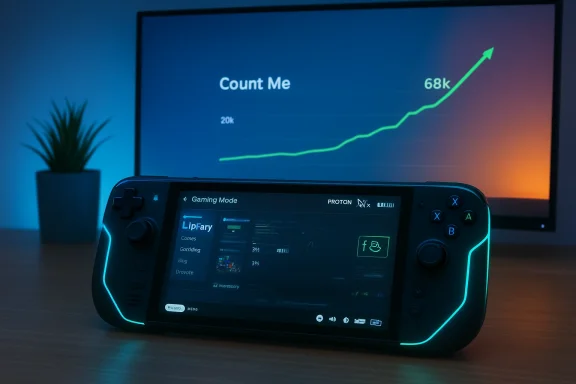
Bazzite’s public usage tracker shows what looks like a seismic shift in a corner of the PC gaming world: in roughly eight months the distribution’s publicly-reported user metric jumped from the low tens of thousands to around 68,200, a more-than-threefold increase that coincides with the end of mainstream support for Windows 10 and an uptick in popular handheld demos showing Linux-based systems outperforming Windows in portable scenarios. That growth matters because it is not just a vanity metric — it signals a broader, practical reassessment among gamers about whether Windows is always the best choice for playing modern games, and it highlights how technologies like Valve’s Proton and a new generation of gaming-focused Linux distributions have narrowed the gap between “can it run?” and “should I install it?” for many players.
Background
Windows 10 reached its official end of free support on October 14, 2025, when Microsoft stopped providing routine security updates, feature improvements, and free technical assistance for consumer installations. That sunset left a meaningful fraction of the PC installed base facing an uncomfortable choice: upgrade to Windows 11 (with its stricter hardware requirements and increasing coupling to Microsoft cloud services), buy new hardware, pay for Extended Security Updates for another year, or try something else. For a subset of gamers the “something else” has increasingly been Linux — and more specifically, gaming-first distributions that bake in Proton, Steam Gaming Mode, and hardware-focused tweaks from the start.Bazzite is one of the best-known examples of that next wave. Built on an atomic Fedora-style foundation and marketed explicitly as a gaming-first distro for desktops, handhelds, and HTPCs, Bazzite positions itself as a ready-to-play alternative with Steam preinstalled, improved CPU scheduling and power profiles, pre-bundled drivers, and a “gaming mode” UI that mirrors the console-like experience many players want on handheld PCs. The project publicly indicates it uses rpm-ostree/DNF Count Me telemetry to estimate active users, and its website displays a “join the community” area that references those statistics as the basis for its user metric.
What happened — the headline numbers and where they come from
- The headline claim: Bazzite’s reported user metric rose from roughly 20,000 (a June 2025 baseline reported in some industry roundups) to about 68,200 over eight months, a near tripling in that period.
- Where the tally originates: Bazzite’s site points to DNF/rpm-ostree “Count Me” telemetry as the statistic source. That mechanism is a standardized, anonymous repository-metadata ping used by Fedora-derived atomic/OSTree systems to estimate install bases. It is not an exact census, but it is useful for trend analysis.
- Why the figure is dynamic: Count Me tallies change as systems update and as projects adjust repository configuration; conservative readers should treat the number as a rolling estimate that can shift day to day.
Overview: why gamers are switching (or at least trying)
Three practical, repeatable reasons explain the move in broad strokes:- Proton compatibility closing the library gap
- Valve’s Proton, the compatibility layer that makes many Windows games runnable on Linux without developer ports, has matured dramatically. Community and project data show a large majority of titles now launch on Linux with acceptable or adjustable performance, and continued development on Proton/GE-Proton variants keeps improving both compatibility and performance.
- For many gamers the question is no longer “will it run?” but “does it run well enough?” In a surprising number of cases the answer has been “yes — and sometimes better than on Windows” on the same hardware.
- Handheld demos that change expectations
- High-visibility tests and videos comparing Linux builds (including Bazzite and SteamOS-like images) to stock Windows images on handheld PCs produced impressive results for Linux: better battery life, smoother thermals, and more consistent frame pacing in some titles. When a mainstream reviewer or a viral video shows you can put a gaming handheld in someone’s hands and get longer sessions and better thermals on Linux, that lowers the friction to try an alternative OS. These demos — and the subsequent hands-on reports — appear to have helped accelerate installs on handheld devices.
- A policy-driven push away from older Windows
- The end of mainstream Windows 10 support on October 14, 2025, forced choices. Some users leased Extended Security Updates or upgraded; others chose to explore alternatives. For a subset of gamers with unsupported hardware or a philosophical dislike of Windows 11’s requirements and account policies, a game-focused Linux distro became an attractive, practical option.
How Bazzite makes gaming on Linux feel like a real choice
Bazzite’s approach combines several concrete features that lower the traditional barriers to using Linux as a gaming OS:- Preinstalled gaming stack: Steam is included and configured for “Gaming Mode,” and community launchers like Lutris and Heroic are integrated so games from multiple stores can be added into one library.
- Hardware-focused drivers and tuning: Bazzite ships with the latest Mesa stacks for AMD/Intel and packaged Nvidia drivers for consumer GPUs, plus device-specific tweaks and udev rules to improve controller behavior and display handling.
- Atomic images and rollback: Bazzite’s OSTree-based model lets users update confidently; if an update causes an issue, the prior image remains available as a fallback.
- Handheld tuning: The distribution applies specialized CPU schedulers, power profiles, and game-scoped thermal limits that many users report translate directly into better thermals and battery life on constrained handheld hardware.
- UX focus: Desktop environments and Steam Gaming Mode are tailored to handheld and touch experiences so the OS feels polished for living-room and portable gaming.
Technical reality check — what Proton and modern Linux actually deliver
Linux gaming’s current strengths rest on a mature compatibility stack and a community-driven ecosystem:- Proton/Wine advances: Proton bundles modern Wine improvements, DXVK/vkd3d translation layers, and targeted patches to support game launchers, anti-cheat workarounds (where possible), and APIs that used to be Windows-only. The net effect is that a large portion of the Steam catalog can launch on Linux and often perform acceptably.
- Lower system overhead in some scenarios: On handheld PCs, Linux’s leaner background services and ability to tune CPU governors and schedulers can yield better thermal and power performance than a general-purpose Windows install tuned for desktop usage.
- Community databases and testing: ProtonDB and Valve’s Deck Verified program provide crowdsourced and curated compatibility data, letting prospective switchers check the status of the titles they care about before they make changes.
- Kernel and input stack work: Collaborative efforts (including the recently announced Open Gaming Collective involving Bazzite’s maintainers and other projects) are focused on upstreaming patches for input handling, Gamescope/windowing, and kernel improvements that benefit all gaming distros. That coordination reduces duplicated engineering and accelerates fixes.
Caveats and risks — why Linux is not yet a full, universal replacement
The positive momentum comes with significant, real limitations that matter to many players and to enterprises:- Anti-cheat remains the single largest blocker: Titles that use kernel-level anti-cheat drivers (common in certain competitive shooters and massively multiplayer titles) are frequently incompatible with Proton and with many Linux-based setups. Some developers have made accommodations, but many leading publishers still ship anti-cheat as a Windows kernel module that cannot run under Linux. For competitive gamers who must play those titles, Windows remains required.
- Peripheral and vendor support gaps: While driver coverage has improved, exotic or proprietary controllers, certain RGB or fan-control utilities, and vendor-specific firmware update tools often only run on Windows. Users who need full vendor toolchains may be forced to dual-boot or keep a Windows partition.
- Enterprise and social software: Game developers and streamers who rely on specific Windows-only tooling (some capture overlays, professional streaming encoders, or publisher-provided launchers and DRM systems) may find gaps.
- Measurement fuzziness: The user counts Bazzite posts are estimates derived from repository “count me” telemetry and represent a conservative proxy rather than a precise audit. These are useful trend indicators but should be interpreted cautiously.
- Support expectations: The Linux ecosystem is voluntary and distributed; for mainstream, nontechnical users used to Windows Update and manufacturer support, the transition can entail a steeper support curve unless they stick to mainstream, well-supported hardware or a guided installer.
Privacy and telemetry — what DNF Count Me tells us (and omits)
Bazzite’s public user estimate is derived from an established mechanism used on rpm-ostree/atomic systems: the DNF “Count Me” mechanism. That telemetry sends anonymized repository metadata pings on a repeating schedule and is used by Fedora-related projects to estimate install base size. It is:- Anonymous by design: Count Me doesn’t contain identifiable user accounts; it increments usage estimates from repository requests.
- Opt-out-able: Users familiar with systemd and rpm-ostree can disable the countme timer if they prefer not to be included.
- An estimate, not a ledger: Count Me is good for trend detection but not for precise billing or unique-device accounting.
Practical steps for a gamer considering the switch
If you’re a gamer reading the Bazzite numbers and thinking about trying Linux, here’s a pragmatic sequence:- Inventory your must-play titles.
- Check ProtonDB and Deck Verified to see whether the games are labeled Verified, Playable, or require specific community fixes.
- Confirm hardware compatibility.
- For handhelds, check Bazzite’s documented supported models. For GPUs and externals (capture cards, docks, headsets), search for Linux driver support and vendor tooling.
- Try a live image or dual-boot first.
- Keep Windows for titles that require anti-cheat or vendor tools. Dual-booting lets you test without losing access to Windows-only software.
- Use image-based/atomic installs for safe updates.
- Bazzite’s OSTree model simplifies rollback; use that workflow to avoid bricking a daily-driver machine.
- Plan for missing tooling.
- If you stream, map which encoders or overlays you need and verify Linux options. Many streamers use OBS on Linux, but some capture cards need vendor drivers or firmware updates that may be Windows-only.
- Community is your ally.
- Join distro Discords, subreddits, and the Bazzite Discourse for device-specific tips and known workarounds. Community knowledge is often where Proton fixes and launchers get the most practical coverage.
Broader implications — what this means for Microsoft, Valve, and game publishers
- For Microsoft: the shift is not an existential threat, but a credible signal that a subset of power users will vote with their installs when product choices and upgrade paths become painful. Large-scale migration for casual users is unlikely, but the move of enthusiasts and handheld-first gamers can shape perception and third-party tooling trends.
- For Valve and the Linux community: Proton and the Deck ecosystem continue to demonstrate the business case for developer investments in cross-platform compatibility. The rise of game-suitable distros and collaborative projects like the Open Gaming Collective amplifies upstream contributions and reduces friction for hardware vendors to support Linux.
- For publishers and anti-cheat vendors: the scaling of Linux gaming will pressure anti-cheat ecosystems to adapt or face user friction. If a sizeable user base argues that kernel-level anti-cheat is both unnecessary and a blocker, publishers may be forced to provide Linux-compatible anti-cheat methods or maintain Linux-friendly paths.
Strengths, weaknesses, and the longer view
Strengths:- Bazzite and sibling distros remove many of the historical barriers to Linux gaming: packaged drivers, preconfigured launchers, handheld tuning, and atomic updates.
- Proton and community tools deliver remarkably broad compatibility for a platform that historically struggled to run Windows-only titles.
- The community and open-source nature mean that gains on one distro often benefit others through upstream patches and shared tools.
- Anti-cheat remains a major blocker in several top-tier competitive titles — and until that gap narrows, Linux will not be a universal gaming replacement.
- Peripheral and vendor-specific tooling gaps remain real for streamers and users who need proprietary vendor utilities.
- Estimation methods for adoption are imprecise; the Bazzite numbers indicate momentum but should be considered in context.
- If current trends continue, Linux gaming will occupy a larger, sustainable niche where handhelds, indie-heavy libraries, and single-player experiences flourish. The next tipping points will likely be publisher-level decisions around anti-cheat and increasing native support from first-party studios — which would remove the remaining friction for many users.
Conclusion
Bazzite’s publicly-reported surge — a near-tripling of its estimated users over eight months — is more than a single-distribution success story. It is a visible symptom of a larger, technical, and social migration: gamers being willing to try well-curated, gaming-focused Linux distributions because the software stack now makes that move less punitive and, in some cases, measurably better for certain hardware profiles. The change is not universal — anti-cheat and some vendor dependencies keep Windows as the safe default for many competitive and professional users — but the calculus has shifted. For players who prioritize longer battery life on handhelds, lower thermal ceilings, or a console-like, no-fuss gaming experience on a PC, installing a gaming-oriented Linux distribution is no longer an act of techno-optimism; it’s a reasonable, practical choice.Source: XDA Bazzite triples its userbase in 8 months as gamers seek a Windows alternative
