

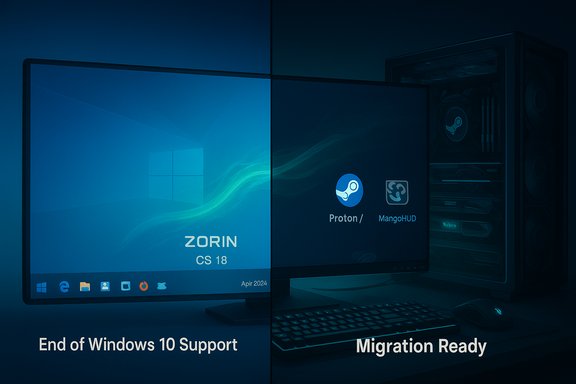
The end of free, mainstream support for Windows 10 has produced one of the clearest and most measurable jolts the desktop market has seen in years: mainstream switchers are testing alternatives in unprecedented numbers, and two Linux distributions — Zorin OS and Bazzite — have emerged as the immediate beneficiaries of that surge for two distinct audiences. Zorin’s migration-focused polish has made it the natural destination for general consumers and small offices, while Bazzite’s gaming-first, immutable design has attracted players seeking a familiar, low-friction gaming experience without buying new hardware. The numbers being reported — Zorin OS 18 surpassing roughly one million downloads in weeks and Bazzite serving over a petabyte of ISOs in a month — are headline-grabbing and real, but they require careful unpacking: downloads indicate trial and intent, not guaranteed permanent migration.
Microsoft officially ended mainstream support for Windows 10 on October 14, 2025, removing routine security updates and technical assistance for retail Home and Pro editions and creating a hard calendar inflection point for hundreds of millions of PCs. That decision left most Windows 10 users with three practical choices: upgrade eligible machines to Windows 11, enroll in a time‑limited Extended Security Updates (ESU) program, or move to another supported operating system. For a very large installed base, Windows 11 is not a practical in-place option because of firmware and CPU checks such as TPM 2.0, UEFI Secure Boot and curated processor families — the result being a genuine upgrade vs replace calculus for many households and small organizations. Linux distributions have been steadily improving usability, hardware support, and application compatibility for more than a decade. What changed in 2025 is that a calendar event converted latent curiosity into immediate action: users who otherwise might have procrastinated were forced to make a near-term decision about security, cost and device longevity. That created a rare window where targeted, migration-friendly distros reached far beyond their typical audience. Community telemetry and vendor announcements confirm a spike in trial activity centered on migration-focused releases timed to the Windows 10 end‑of‑support date.
The true story will be written in retention rates, enterprise pilots, OEM decisions and whether issues that still matter — anti‑cheat, proprietary peripherals, vertical apps and contracted support obligations — are resolved at scale. For readers facing the Windows 10 deadline, the pragmatic approach is clear: pilot, test, and plan a staged migration rather than an all‑or‑nothing leap. The immediate winners in the post‑Windows‑10 moment are clear, but the long‑term market impact depends on whether trials convert into long‑term usage and whether the ecosystem — drivers, game anti‑cheat, support vendors and hardware partners — moves to meet that demand.
Source: ZDNET The top 2 Linux distros Windows 10 users are fleeing to right now - and why
 Background / Overview
Microsoft officially ended mainstream support for Windows 10 on October 14, 2025, removing routine security updates and technical assistance for retail Home and Pro editions and creating a hard calendar inflection point for hundreds of millions of PCs. That decision left most Windows 10 users with three practical choices: upgrade eligible machines to Windows 11, enroll in a time‑limited Extended Security Updates (ESU) program, or move to another supported operating system. For a very large installed base, Windows 11 is not a practical in-place option because of firmware and CPU checks such as TPM 2.0, UEFI Secure Boot and curated processor families — the result being a genuine upgrade vs replace calculus for many households and small organizations. Linux distributions have been steadily improving usability, hardware support, and application compatibility for more than a decade. What changed in 2025 is that a calendar event converted latent curiosity into immediate action: users who otherwise might have procrastinated were forced to make a near-term decision about security, cost and device longevity. That created a rare window where targeted, migration-friendly distros reached far beyond their typical audience. Community telemetry and vendor announcements confirm a spike in trial activity centered on migration-focused releases timed to the Windows 10 end‑of‑support date.Zorin OS: the polished gateway for Windows refugees
The claim — what happened and how it’s verified
Zorin Group timed the release and messaging of Zorin OS 18 to align with Windows 10’s end of support, and the result was a pronounced surge in downloads: Zorin announced that Zorin OS 18 reached roughly one million downloads in just over a month, with about 78% of those downloads originating from Windows machines. Those numbers were published by the project and quickly repeated across mainstream and specialist press. The raw announcement is a legitimate, company-published metric; independent outlets and community trackers corroborated the spike and framed it in the context of the Windows EoL inflection. Important caveat: download counts measure interest and trials, not completed conversions. A downloaded ISO might be used for live USB testing, a virtual machine, multiple mirror fetches, or a full bare‑metal install; a single user may produce multiple downloads. Treat Zorin’s one‑million figure as a clear indicator of scale and market interest rather than proof of one million desktop migrations.What Zorin OS 18 delivers — technical and UX highlights
Zorin OS 18 is explicitly positioned as a Windows-to-Linux gateway. Key verified technical elements that make it attractive to switchers include:- Built on an Ubuntu 24.04 LTS base with modern hardware-enablement (HWE) kernels — releases have been reported shipping with Linux 6.14 in general images — which improves out‑of‑box driver coverage for GPUs, Wi‑Fi and docking hardware.
- A Zorin Appearance layout switcher that provides Windows‑like desktop presets, reducing the cognitive load for people who have used Windows for years.
- Built-in OneDrive browsing via GNOME Online Accounts and a Web Apps utility (PWA-to-desktop) to keep access to Microsoft 365 and cloud workflows familiar. These features address the two biggest migration anxieties — cloud continuity and web‑app parity — even though they do not perfectly replicate Windows selective‑sync semantics.
- An updated Wine/compatibility stack and migration assistant that scans Windows installers and proposes practical remediation paths: native Linux equivalents, Web App, Wine/Proton wrapper, or virtualization. This is triage-oriented, not a magic compatibility converter.
Strengths for mainstream users
- Low cognitive switching cost. One‑click layouts and a familiar taskbar/menu model mean users can be productive within hours.
- Hardware compatibility. Ubuntu LTS foundation and a newer kernel improve driver coverage on older but otherwise capable machines.
- Migration tooling and documentation. Zorin’s migration assistant, bundled Web Apps, and readily available community help make short pilots feasible.
- Polish and packaging. Zorin focuses on first‑boot delight; that matters when nontechnical users evaluate alternatives.
Risks and limits
- Downloads ≠ installs ≠ retention. The biggest analytical caveat: a million downloads is not the same as one million active daily users. Mirror fetches, re-downloads and VM usage inflate numbers. Independent analysts repeatedly emphasize this distinction.
- Specialized Windows software. Niche vertical apps, hardware-specific vendor drivers (scanners, medical devices, bespoke accounting software) and some enterprise tools remain barriers to full conversion.
- Peripherals and firmware. Fingerprint readers, proprietary wireless stacks, some docking station features and vendor‑specific firmware may need additional community or vendor work to behave identically under Linux.
- Support SLAs. For organizations that require contractually guaranteed support and remote management tooling, migration requires planning, training and possibly third‑party support contracts.
Bazzite: gaming-first, immutable, and suddenly viral
The numbers — petabytes and practical meaning
Bazzite, a younger, gaming‑focused distro descended from an immutable, Fedora‑based lineage, announced that it delivered over 1 petabyte of ISOs in a 30‑day window; outlet calculations put that at roughly 140–150k ISO downloads in a month given average ISO sizes. Tom’s Hardware reported the milestone and estimated the downloads by dividing the reported data served by average ISO size; other syndication outlets repeated the same math and cross‑checked Bazzite’s social posts announcing the traffic spike. Those independent confirmations make the petabyte figure credible as a measure of served traffic — again, with the usual caveats that “serves” imply trials and downloads, not guaranteed permanent adoption.Technical identity — immutable design, rpm‑ostree and gaming tooling
Bazzite is explicitly a gaming-first distribution built on an immutable Fedora Atomic-style model, using rpm-ostree (atomic updates, rollback support) and shipping with preconfigured gaming tooling:- Immutable root + atomic updates. The distro uses an rpm-ostree approach, which makes the base filesystem largely read-only and enables atomic upgrades and straightforward rollback to a known good state — a security and stability advantage for less technical users. This architecture is well-documented in Bazzite project pages and package metadata.
- Preinstalled gaming stack. Bazzite includes Steam, Proton/Wine tooling, Gamescope, MangoHud, and packaging or scripts to support non‑Steam launchers like Epic and GOG. It offers images tuned for Nvidia or AMD configs, lowering the install friction for GPU-accelerated gaming.
- Broad hardware support and multiple desktop options. Desktop spins (GNOME, KDE, Steam Big Picture, Hyprland) and ARM64 support for handhelds (e.g., Steam Deck-like devices) widen its addressable hardware footprint.
Why gamers are trying Bazzite
- Out‑of‑box gaming readiness. Preinstalled Proton, Steam, and driver packaging reduce the manual setup that historically deterred Windows‑to‑Linux gamers.
- Immutable stability. Atomic updates reduce the risk of system breakage from a single package upgrade — appealing for players who want reliability without deep maintenance.
- Non‑Steam support. Built support for Epic, GOG and other launchers reduces friction for players with multi‑store libraries.
Risks and structural limitations
- Anti‑cheat and competitive multiplayer. Kernel‑level anti‑cheat systems that expect Windows are still a major blocker for many online competitive titles. While community and vendor work is progressing, several big-name multiplayer titles remain effectively incompatible without Windows or a dual‑boot fallback.
- Smaller ecosystem. Bazzite’s community and corporate backing are smaller than major distros; that means fewer mirrors, third‑party vendor QA and less formal support infrastructure.
- Unclear long‑term scale. A traffic spike driven by a calendar event is meaningful for awareness and testing, but Bazzite faces the same retention curiosity gap as Zorin: trials do not equal daily active installs.
- Platform fragmentation. Multiple gaming distros solving similar problems can create support fragmentation for game developers and driver vendors.
Two migrations, two audiences — why both matter
The current headline narrative is not a single mass exodus, but rather the convergence of two distinct migration vectors triggered by the same catalyst:- Regular users and productivity seekers are moving toward Zorin OS because it reduces day‑one friction, offers cloud continuity and can revive older hardware without new hardware purchases.
- Gamers and handheld adopters are moving toward Bazzite (and other gaming-focused distros) because they need an out‑of‑the‑box gaming stack and the immutable model that reduces maintenance risk.
Practical migration checklist — a short playbook
- Inventory critical software and peripherals: browsers, VPN, accounting tools, printers, scanners, specialized hardware.
- Create full backups and a disk image of the Windows drive; keep images until you’re confident the migration is successful.
- Boot candidate distros from a Live USB: test Wi‑Fi, audio, webcam, printing, GPU acceleration and external storage.
- Test Windows‑only apps under Wine/Bottles/Proton and in a Windows VM (VirtualBox, VMware, GNOME Boxes).
- Stage pilot installs on noncritical machines or in a dual‑boot configuration before widescale rollouts.
- If migrating gamers: test Proton compatibility on Steam and check for anti‑cheat blockers on the specific titles you play.
- Put a rollback plan in place (Timeshift snapshots or bare-metal disk images) and confirm restore works.
Broader implications — security, economics and the desktop market
- Security: For many users, a supported Linux distribution on older hardware provides a more secure posture over time than an unpatched, unsupported Windows 10 installation. Zorin’s Ubuntu LTS base and Bazzite’s Fedora lineage promise ongoing updates that extend device lifetimes. Microsoft’s ESU program buys time but is a paid, temporary bridge; for many households, Linux is a cost-free alternative.
- Economics & waste: If Linux adoption meaningfully delays device replacement, the environmental and personal finance benefits are real. Extending hardware lifecycles reduces e‑waste and postpones capital outlays for many households.
- Market dynamics: Sustained conversion could push OEM refurbishers to ship more machines with Linux preinstalled and might accelerate vendor support for Linux drivers and anti‑cheat solutions. That said, enterprise migration remains a cautious, measured process requiring SLAs, application validation, and retraining.
- Gaming ecosystem: Valve’s Proton work and changes to the Steam client (Proton enabled by default in recent updates) have materially improved the Linux gaming experience and reduced a major friction point for players considering a switch. Proton 10.x and ongoing Proton Experimental updates have broadened compatibility and performance for many titles, but anti‑cheat remains the single largest barrier for competitive multiplayer.
Critical analysis and caveats
The data points driving today’s headlines are verifiable but incomplete by design. Vendor-published download tallies and CDN‑served bytes are strong indicators of interest, and they’ve been repeated enough across independent outlets to treat them as real signals. However:- Retention unknown: Neither Zorin nor Bazzite has published granular active‑install and retention metrics (the hard numbers ecosystem analysts need to claim a permanent shift). Downloads measure intent and trial, not long‑term migration. Observers must wait for device census-style data, active device telemetry (when available), or OEM/IT procurement trends to confirm sustained market share shifts.
- Selection bias: A large share of the downloads came from Windows-origin referrers — that’s a powerful signal — but referrer data and web analytics infer origin; they are not equivalent to an installed-device census. Treat the 78% Windows-origin stat as directional and meaningful, not a precise conversion tally.
- Anti‑cheat and specialized software: A critical set of mainstream use cases (competitive online gaming, industry-specific software, vendor‑locked peripherals) remain significant impediments for a portion of users. For those, a hybrid approach (Linux for general work plus Windows VM or dual‑boot for the remainder) may be the most pragmatic path in the medium term.
- Ecosystem strain: Rapid interest spikes stretch small projects: mirrors fill, issue trackers balloon, and community support channels can be overwhelmed. That’s an operational risk for smaller distributions and a user experience risk for first-time migrators.
Short-term forecast
- Expect continued high trial volumes for migration‑focused distros while the Windows 10 EoL conversation remains top of mind and as OEMs and refurbishers consider alternative preinstall options.
- Gamers will continue experimenting with Bazzite and similar distros as Proton and Steam client improvements make compatibility more reliable for single‑player and many non‑anti‑cheat multiplayer titles. Continued Proton development and Valve client changes (Proton enabled by default) materially reduce friction.
- Sustained mass migration — enough to materially shrink Windows’ desktop share in the short run — remains uncertain until more durable signals appear: active-device counts, adoption in public procurement, and paid support arrangements for larger organizations.
Conclusion
The data are unmistakable: Microsoft’s October 14, 2025 end of mainstream Windows 10 support created a market inflection that dramatically increased real‑world trials of alternative operating systems. Zorin OS and Bazzite captured the headlines for good reasons: Zorin lowered the barrier for everyday Windows users with a familiar UI, OneDrive continuity and migration tooling, while Bazzite offered gamers an immediate, configured path to play without expensive hardware refreshes. Both projects turned curiosity into measurable trials — Zorin with a seven‑figure download milestone and Bazzite with a petabyte of ISOs served in a month — but neither number is a standalone proof of permanent migration.The true story will be written in retention rates, enterprise pilots, OEM decisions and whether issues that still matter — anti‑cheat, proprietary peripherals, vertical apps and contracted support obligations — are resolved at scale. For readers facing the Windows 10 deadline, the pragmatic approach is clear: pilot, test, and plan a staged migration rather than an all‑or‑nothing leap. The immediate winners in the post‑Windows‑10 moment are clear, but the long‑term market impact depends on whether trials convert into long‑term usage and whether the ecosystem — drivers, game anti‑cheat, support vendors and hardware partners — moves to meet that demand.
Source: ZDNET The top 2 Linux distros Windows 10 users are fleeing to right now - and why
