

When Microsoft quietly closed the books on Windows 10 support on October 14, 2025, a predictable cascade of enterprise planning and consumer anxiety followed — and, unexpectedly, a measurable migration toward desktop Linux erupted in its wake. In the five weeks after Zorin Group launched Zorin OS 18 to coincide with the end-of-support date, the distribution reported roughly one million downloads, with the project saying about 78% of those downloads originated from Windows devices — a spike that has turned months of quiet desktop-market churn into a clearly visible movement.
What’s true today is simple and provable: a confluence of product policy (Windows 11 hardware gates), a hard support deadline (October 14, 2025), and migration‑focused Linux engineering produced a visible and measurable reaction in the market. Whether that reaction becomes a multi-year desktop realignment depends on follow-through — from both the Linux communities that must convert trials into long-term users and from Microsoft, which must decide how aggressively to counter the momentum or accept a more pluralistic desktop ecosystem.
Source: Technobezz Windows 10 death is creating a Linux army and Microsoft should be panicking
 Background
What changed on October 14, 2025
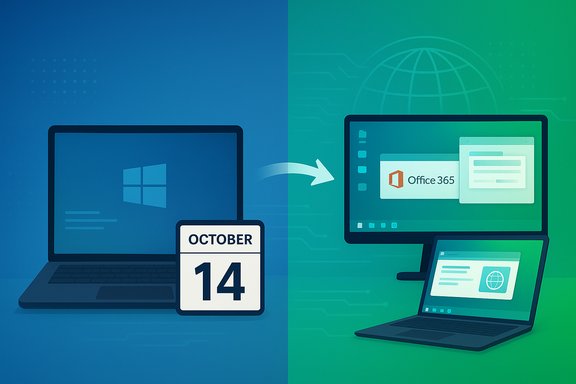
Microsoft’s lifecycle schedule made the shift unavoidable: routine security and feature updates for mainstream Windows 10 editions ended on October 14, 2025, leaving ordinary Home and Pro installations without vendor-supplied monthly security patches unless devices were enrolled in an Extended Security Updates (ESU) program or otherwise covered. That is a binary, operational change — the machines keep booting, but the vendor safety net is gone. The company offered an explicit short-term bridge (consumer ESU options and multi-year commercial ESU licensing), but the practical choices for affected devices narrowed quickly: upgrade eligible hardware to Windows 11, pay for ESU, or move to an alternate, actively maintained operating system. For millions of PCs, Windows 11 is not a realistic path because of hardware checks such as TPM 2.0, UEFI Secure Boot and a curated CPU support list; those requirements created a hard compatibility boundary that suddenly turned functional machines into “unsupported” endpoints.Why the timing mattered
The collision of a hard deadline and manifest hardware friction created a rare behavior-shifting moment. Consumers who would otherwise procrastinate about an OS upgrade were faced with an immediate security calculus: continue on an increasingly risky platform, spend to stay with Microsoft, or adopt a different OS. Zorin Group timed Zorin OS 18’s public launch to that exact window and packaged migration-focused features designed to reduce friction for Windows switchers: Windows-like desktop layouts, OneDrive browsing, Web‑Apps integration for Office 365/Teams, and an improved Windows compatibility stack. Those design choices amplified the effect of the calendar moment.The Zorin Phenomenon: Numbers, meaning, and limits
The raw claim — what Zorin announced
Zorin Group publicly announced that Zorin OS 18 reached approximately one million downloads in a little over a month, and that roughly 78% of those downloads came from Windows machines, a figure the project used to frame Zorin’s mission: easing migration for Windows users. That announcement was quickly reproduced across mainstream outlets, making Zorin the clearest and most quantifiable beneficiary of the immediate post‑Windows‑10 moment.What downloads tell us — and what they don’t
Downloads are a strong, early indicator of interest. They show intent, curiosity and trial behavior at scale. But the metric has important limitations that must be stated plainly:- A downloaded ISO is not a completed installation.
- Many downloads are for live‑USB testing, virtual machines, or repeated mirror fetches.
- Download origin (Windows vs macOS vs Linux) is inferred from referrer analytics and server logs, not a direct census of installed systems.
Why Zorin — product and positioning
Zorin’s success in attracting these trials stems from three deliberate product moves:- Familiar UX: multiple desktop layouts that mimic Windows 10/11 (and macOS) reduce the cognitive cost of switching.
- Cloud continuity: OneDrive integration and Web‑Apps let Microsoft 365 users retain access to files and services without a dramatic workflow change.
- Compatibility-first tooling: bundling an updated Wine runtime, installer triage and RDP tools lowers the friction of running legacy Windows apps.
The larger picture: scale, market share and momentum
How many devices actually face the dilemma?
There’s no single audited inventory that states “X devices are stranded,” but a range of industry estimates point toward hundreds of millions of PCs that become operationally disadvantaged by Windows 11’s hardware floor. Press and industry trackers commonly cite estimates in the range of 200–400 million devices that cannot take the vendor-supported upgrade path without hardware changes or replacements — an estimate built from market-share snapshots, telemetry samples and compatibility scans. These are directional, not census-level, figures, but they are large enough to matter economically and politically.Desktop Linux share at scale
Desktop Linux adoption has been rising for several years, and several web-analytics trackers recorded meaningful upticks in 2024–2025. In the United States, StatCounter’s Global Stats reported desktop Linux crossing the 5% threshold (roughly 5.03% in June 2025), a symbolic milestone repeated across trade outlets and analysis. Globally, Linux generally remains in the low‑single digits for desktop share, but pockets such as education, public-sector servers, research labs and isolated consumer cohorts show faster growth. That regional variance matters: an apparently small percentage gain in a large market (the US) represents millions of users.Is this the “Year of the Linux Desktop”?
The phrase has been invoked for decades, and while 2025’s converging forces — hardware compatibility friction, improved Linux hardware support, gaming advances (Steam/Proton ecosystems), and migration‑focused distros — create arguably the most favorable environment since the 2000s, the question of permanence remains open. The current indicators — spikes in downloads, increased forum traffic, and measurable share gains in targeted geographies — suggest momentum, not an immediate wholesale replacement of Windows as the consumer desktop.Who’s moving — community patterns and user segments
The “Windows refugee” profile
Early adopters testing Zorin and similar distros often fit one of these profiles:- Budget consumers with functional but Windows‑11‑ineligible hardware.
- Privacy‑minded users put off by Windows 11’s telemetry and AI integrations.
- Schools and nonprofits facing replacement budgets and eager to extend device life.
- Enthusiasts and hobbyists experimenting with dual‑boot or live‑USB rescue installs.
What enterprises are doing
Enterprises treat the deadline as a planning milestone rather than a panic moment. Many are using ESU as a scheduled breathing room to finish application modernization and staged upgrades; others are piloting Linux for specific non‑Windows workloads. For enterprises the calculus is usually a formal TCO analysis: hardware refresh costs, migration engineering, potential third‑party support contracts and regulatory compliance. The availability of ESU at a commercial list price starting around $61 per device in Year One (with progressive doubling in subsequent years) has been a major economic factor shaping those choices.Microsoft’s options and where it should be worried
Why Microsoft should take this seriously
The Zorin spike is not a complete market takeover, but it’s a clear test of market elasticity. The company faces risks on three fronts:- Erosion of platform lock-in: users who discover viable non‑Windows workflows and cloud continuity via web apps or progressive web apps may not return to Windows.
- Perception and momentum: a visible migration narrative — particularly one tied to privacy, e‑waste, and perceived forced obsolescence — is damaging reputationally even if it doesn’t move the bulk of corporate desktops.
- Support channel economics: ESU pricing and regional policy pushback (for example, regulatory scrutiny in the EEA that forced concessions around ESU terms) can amplify migration incentives.
What Microsoft can (and arguably should) do
- Reassess friction points. If the objective is platform continuity, lower technical or perceptual friction pushing users away — e.g., clearer upgrade paths for borderline hardware or expanded free ESU provisions for consumers in sensitive markets.
- Backstop OEM and driver support. Stronger OEM partnerships to ensure Windows 11 compatibility on older models or supported microcode/firmware options reduce the “unsupported device” pool.
- Improve migration tooling and experiences. If Microsoft can make the transition to Windows 11 less disruptive (and more privacy-transparent), it retains more users than by leaving the choice to cost or exile.
- Offer a credible, low-friction “grace” path. Targeted subsidies, trade-in programs, or extended support at regional pricing could mute migration momentum where it matters most.
Practical guidance for users and organizations considering Linux
Quick, pragmatic steps (for non-technical and technical readers)
- Inventory and backup: catalog devices and back up important data offsite. Always treat EoL as a migration trigger.
- Test first: use Live USBs or virtual machines to test Zorin OS 18, Linux Mint, or ChromeOS Flex on representative hardware.
- Try web-app continuity: set up Office 365/Google Workspace web apps and PWA shortcuts to confirm workflow continuity.
- Pilot critical apps: verify that business-critical software runs under native Linux equivalents, Wine, or lightweight virtualization.
- Consider staged rollout: use ESU as a timed runway while piloting and staging migrations for lower-risk user groups.
For IT managers
- Run compatibility scans and pilot projects on subsets of the estate.
- Model ESU vs hardware refresh vs migration TCO over a 3-year horizon (ESU pricing often increases annually).
- Engage support partners who can provide Linux SLAs for mixed‑estate environments.
Risks, caveats and the unknowns
Where the Zorin headline may mislead
- Retention unknown: Zorin’s one‑million download milestone quantifies trials, not daily‑active users or long‑term conversions. Persistently measuring active installs would be necessary to claim a durable platform shift.
- Selection bias in analytics: download origin data is an imperfect proxy for eventual system residency; a Windows‑origin download may simply be a trial on the same machine or for a different device.
- Ecosystem constraints: vertical software dependencies, specialized device drivers and enterprise management stacks continue to favor Windows in many mission‑critical contexts.
Real risks for Microsoft
- Reputational momentum: the migration narrative dovetails with existing privacy and e‑waste criticism.
- Channel disruptions: OEMs and retailers must manage trade-in flows and support programs or risk inventory mismatches.
- Competitive ecosystems: growth of Linux gaming (Proton, Steam Deck) and progressive web apps reduces the perceived cost of leaving the Windows ecosystem.
What to watch next — six tactical signals that will determine whether this wave becomes a trend
- Retention telemetry: does Zorin (or other distros) publish active-install and DAU figures? Download spikes are interesting; install-and-stay metrics are decisive.
- ISV commitment: mainstream ISV support (native Linux builds or solid virtualization paths) is necessary for broad enterprise adoption.
- OEM and driver posture: measured improvements in Linux driver availability for popular vendor models will shrink migration friction.
- ESU uptake rates: high ESU enrollment would suggest conservative enterprise behavior; low uptake will accelerate migration testing.
- Government and education pilots: public‑sector migrations would be an early structural indicator of a durable shift.
- Browser/Cloud lock-in: if web-apps and SaaS workflows become the dominant way people work, switching OS will matter less — and migration stickiness will be higher.
Conclusion
Zorin OS 18’s one‑million‑download milestone — with roughly 78% of those downloads initiated from Windows devices — is not a trivial PR win for a Linux distribution; it is the clearest, quantifiable signal yet that Microsoft’s Windows 10 end-of-support decision produced a measurable market opening. The surge represents a large number of trials and tests, and it concretely demonstrates that well-crafted migration UX, cloud continuity features and timing can unlock mainstream curiosity at scale. At the same time, the durable outcome is not preordained. Downloads are the starting point of a longer narrative that requires conversion, retention and enterprise readiness to translate into sustainable market share. Microsoft’s ESU program, enterprise agreements and future product choices will influence whether those one‑million trials become long-term Linux desktops or a temporary surge of experimentation.What’s true today is simple and provable: a confluence of product policy (Windows 11 hardware gates), a hard support deadline (October 14, 2025), and migration‑focused Linux engineering produced a visible and measurable reaction in the market. Whether that reaction becomes a multi-year desktop realignment depends on follow-through — from both the Linux communities that must convert trials into long-term users and from Microsoft, which must decide how aggressively to counter the momentum or accept a more pluralistic desktop ecosystem.
Source: Technobezz Windows 10 death is creating a Linux army and Microsoft should be panicking
