

The end of free support for Windows 10 has produced one of the clearest, most visible waves of Windows-to-Linux curiosity in years: Zorin OS 18, timed to the October 14, 2025 cutoff, registered a rapid, headline-grabbing surge in downloads — a milestone Zorin itself framed as evidence that hundreds of thousands of Windows users are actively testing Linux as a practical alternative.
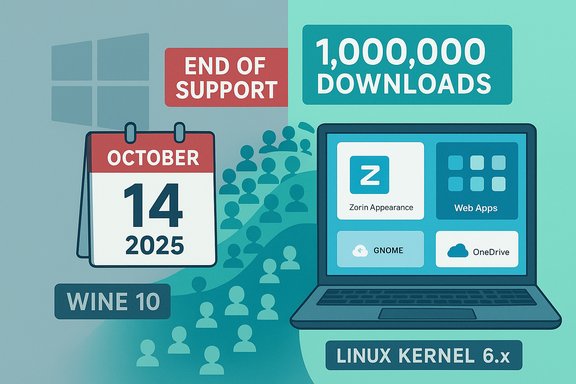
Microsoft formally ended mainstream support for Windows 10 on October 14, 2025, closing a decade-long support window and leaving many users with three basic choices: upgrade eligible machines to Windows 11, enroll in Microsoft’s limited Extended Security Updates (ESU), or migrate to a different operating system. The vendor’s lifecycle pages and public guidance make that cut-off explicit and explain the practical consequences of continuing to run an unsupported OS. Into that calendar pressure stepped Zorin Group. Zorin OS 18 was released on October 14, 2025 and designed specifically to lower the real-world friction that typically stops mainstream Windows users from switching: familiar desktop layouts, OneDrive file access, a Web Apps utility to keep Microsoft 365 workflows intact, and a stronger Windows-app compatibility stack. The Zorin team announced a one‑million-download milestone in mid-November and reported that roughly 78% of those downloads originated from Windows machines, a statistic that quickly dominated media coverage and community discussion. This is the central narrative we’ll unpack: what the numbers actually mean, why Zorin’s product choices matter, the technical realities and limits of migration at scale, and the practical checklist for Windows users considering a move.
That signal is important and signals momentum, but it is not, on its own, proof of a finished platform migration. The long-term outcome depends on the next phase: whether significant numbers of testers convert to sustained use, whether hardware vendors and ISVs invest in first‑class Linux support, and whether projects like Zorin can scale support, documentation, and upgrade quality for a much larger user base.
For individual Windows users confronting the end of Windows 10 support, the practical path is straightforward: back up your data, test alternatives safely (live USBs and VMs), evaluate critical app and peripheral compatibility, and use staged pilots before committing to full cutovers. For organizations, consider ESU as a controlled runway while running measured pilots that test management, imaging, and helpdesk workflows on target Linux distributions.
Zorin OS 18’s milestone is a clear, verifiable marker of a major curiosity wave; it changes the conversation from “could Linux ever be practical for mainstream users?” to “how do we convert trial into trustworthy, supported deployments?” The answer will be written in the months and years of conversion, support investment, and ecosystem response that follow this rare, calendar-driven inflection point.
Source: BGR Over Half A Million Windows Users Are Switching To Linux - Here's Why - BGR
Source: bgr.com Over Half A Million Windows Users Are Switching To Linux - Here's Why - BGR
 Background / Overview
Microsoft formally ended mainstream support for Windows 10 on October 14, 2025, closing a decade-long support window and leaving many users with three basic choices: upgrade eligible machines to Windows 11, enroll in Microsoft’s limited Extended Security Updates (ESU), or migrate to a different operating system. The vendor’s lifecycle pages and public guidance make that cut-off explicit and explain the practical consequences of continuing to run an unsupported OS. Into that calendar pressure stepped Zorin Group. Zorin OS 18 was released on October 14, 2025 and designed specifically to lower the real-world friction that typically stops mainstream Windows users from switching: familiar desktop layouts, OneDrive file access, a Web Apps utility to keep Microsoft 365 workflows intact, and a stronger Windows-app compatibility stack. The Zorin team announced a one‑million-download milestone in mid-November and reported that roughly 78% of those downloads originated from Windows machines, a statistic that quickly dominated media coverage and community discussion. This is the central narrative we’ll unpack: what the numbers actually mean, why Zorin’s product choices matter, the technical realities and limits of migration at scale, and the practical checklist for Windows users considering a move.Why the timing mattered
The Windows 10 deadline created an inflection point
A hard calendar date is special: it forces decisions. Windows 10’s end-of-support date converted what had been a background maintenance problem into an immediate security and cost choice for millions of households, schools, and small businesses. Microsoft’s public guidance pushed users toward Windows 11 where possible, and toward ESU or replacement otherwise — but hardware gatechecks for Windows 11 (TPM 2.0, UEFI Secure Boot, supported CPU lists) mean many otherwise functional machines are ineligible for an in-place vendor-supported upgrade. That structural friction is the main motor that pushed users to evaluate alternatives like Zorin OS 18.Zorin’s launch was strategically timed and product-focused
Zorin OS 18’s October 14 release was not accidental. The distribution’s update introduced specific migration-first features — layout presets that mimic familiar Windows taskbars and menus, OneDrive integration (via GNOME Online Accounts), a “Web Apps” tool to convert cloud services into desktop-like launchers, and an upgraded Windows App Support stack — all designed to reduce three classic migration blockers: unfamiliar UI, cloud file access, and application compatibility. Those engineering and UX choices reduced the perceived risk of switching, turning curiosity into downloads at scale.The numbers: downloads, origin metrics, and what they do — and don’t — prove
Zorin Group reported roughly 1,000,000 downloads of Zorin OS 18 in about five weeks and highlighted that “over 78%” of those downloads were initiated from Windows systems. Those are publisher-issued metrics and they are meaningful: they document trial volumes and show where interest originated. Independent outlets amplified these figures and placed them in context of Windows 10’s end of support. Important caveats — how to read the headline:- Downloads ≠ installs. An ISO download can be used for a live-USB test, a virtual machine, multiple mirror fetches, or for distribution. A single user may produce multiple downloads. Treat the million-download mark as a robust signal of interest and trial, not a census of completed migrations.
- “Windows-origin” is an analytic signal, not an installation audit. The Windows-origin percentage is typically inferred from web-referrer and server-analytics patterns that indicate what browser or platform initiated the download request. This is credible and useful, but it does not equate to a verified inventory of deployed, actively used Linux desktops.
- Conversion and retention matter. The next stages are conversion (how many testers install and keep Zorin) and retention (how many stay productive long-term). Those metrics are private to vendors and require follow-up telemetry or independent surveys to measure reliably.
Technical verification: what Zorin OS 18 ships with (and verification from independent sources)
To evaluate whether Zorin OS 18 is a practical Windows alternative, technical claims must be verifiable. Cross-referencing Zorin’s own release notes with independent reporting yields the following checked facts:- Release date: October 14, 2025. The Zorin blog and release announcement confirm the date.
- Base and lifecycle: built on Ubuntu 24.04 LTS lineage with long-term updates aligned into 2029 (Zorin announced support through at least June 2029). This aligns with standard LTS lifecycle expectations and Zorin’s documentation.
- Kernel and hardware enablement: Zorin 18 images were reported to use a modern hardware-enablement kernel series in the 6.x family (community testing found images using Linux 6.14), improving driver coverage and newer device support.
- Windows compatibility tooling: Zorin labels its compatibility tooling “Windows App Support” and states it is powered by Wine 10, which brings improved Wayland and Vulkan support compared with previous Wine releases. Independent hands-on reviews and the Wine project’s 10.x releases corroborate this integration effort.
- OneDrive and Web Apps: native OneDrive browsing via GNOME Online Accounts and an integrated Web Apps utility are shipped features intended to preserve Microsoft 365 workflows for many users. These are documented in Zorin’s release notes and confirmed by early reviews.
- Editions and pricing: Zorin continues to offer multiple editions — Core (free), Education, Pro (paid), and Lite for older hardware. The Pro edition’s commonly cited one‑time price (~$47.99) appears on Zorin’s store pages and vendor summaries. Pricing may vary by region and occasional promotions; verify the storefront before purchase.
Why many Windows users find Linux attractive right now
Several intersecting reasons explain why a non-trivial share of Windows users are trying Linux distributions like Zorin OS 18 now:- Cost pressure and hardware eligibility: Replacing hardware to meet Windows 11’s requirements or purchasing ESU can be expensive. Linux offers a way to continue using existing, functional machines without Microsoft’s hardware gates.
- Familiarity-first UX: Zorin’s layout presets and the Zorin Appearance tool reduce the cognitive overhead of switching, allowing users to keep a near-Windows experience while benefiting from Linux’s flexibility.
- Cloud continuity: OneDrive browsing and Web App support preserve access to Microsoft 365 documents and services, which addresses the single-largest productivity worry for many users.
- Improved Windows app compatibility: Wine/Proton maturation and Zorin’s bundled Windows App Support make a surprising number of common Windows apps and games practical to run under Linux. Valve’s investment in Linux gaming (Proton) has also improved GPU driver quality, particularly on AMD hardware, making gaming an increasingly practical consideration.
- Privacy and telemetry concerns: Some users cite an aversion to vendor telemetry, built‑in AI features, and forced account linkages as motivations for exploring Linux alternatives. These are personal preferences that factor into the migration calculus for a sizable subset of users.
Practical limitations and migration risks
The enthusiasm is real, but meaningful caveats remain.Application and peripheral compatibility
- Vertical and legacy Windows software — specialized bookkeeping packages, medical or industrial device software, vendor-specific drivers (point-of-sale, certain scanners, barcode systems) — may have no direct Linux equivalents or may require complex virtualization.
- Proprietary peripherals and firmware — some fingerprint readers, vendor-specific docking station features, or vendor-signed firmware updates may not behave identically on Linux without vendor cooperation.
- Gaming edge cases — while gaming on Linux has improved dramatically, anti-cheat systems and certain GPU vendor proprietary drivers can cause friction in specific titles. Valve’s Proton and driver work have closed many gaps, but edge cases remain.
Organizational and enterprise hurdles
- Management and compliance — enterprises using Windows-centric MDM, Active Directory integrations, or bespoke enterprise software will face non-trivial migration costs; dual-boot or virtualization strategies may be needed for legacy apps.
- Support and warranty expectations — consumer hardware vendors and ISVs are not uniformly prepared to support Linux on end-user devices; organizations will need helpdesk playbooks and possible paid support arrangements.
Resource strain for small projects
- A million downloads in a short period stresses mirrors, documentation channels, and community support. Smaller projects like Zorin may face surges in help requests and must prioritize in-place upgrades, mirror capacity, and robust documentation to convert interest into sustainable users.
Critical analysis — strengths and credible risks
Notable strengths
- Low barrier for trial: Live-USB testing, virtual machines, and Web Apps make testing trivial and low-risk.
- Targeted engineering: Zorin’s targeted investments (UI familiarity, OneDrive, Web Apps, updated Wine) directly address the top three psychological blockers for typical Windows users.
- Upstream stability: An Ubuntu 24.04 LTS foundation and an HWE kernel line give Zorin OS 18 a dependable update and driver ecosystem for the medium term.
Plausible risks
- Misreading the metric: Media coverage that equates downloads with migrations risks an inflated narrative of a sudden platform shift. The long-term story is about conversion and retention, not download headlines.
- Support gap for niche hardware/software: For many small businesses and certain vertical sectors, unknown compatibility gaps or lack of vendor support could make migration a costly gamble.
- Concentration and ecosystem dependencies: A sudden spike of users on a small distribution raises questions about whether the project will be able to scale support, QA driver stacks for varied hardware, and maintain image mirrors.
A pragmatic migration checklist (step-by-step)
- Back up everything: full disk images and cloud backups for important data.
- Create a live USB and run Zorin OS 18 for one workweek in real tasks (email, productivity, printing). Use a modern SSD/VHD or spare machine if available.
- Test critical apps:
- Check for native Linux clients.
- Evaluate Web App parity (Microsoft 365 web apps, Google Workspace).
- Test compatibility via Wine/Proton or in a Windows VM for essential Windows-only apps.
- Verify peripherals (printers, scanners, docking stations, audio interfaces, fingerprint sensors).
- If migration is for multiple machines or an organization, run a staged pilot with imaging, MDM/endpoint checks, and a support playbook.
- If a hard dependency remains on a Windows-only app, consider virtualization or isolated Windows machines rather than aborting the migration.
- Confirm update and support expectations — verify Zorin’s upgrade path, LTS support window, and whether paid Pro or third-party support is needed for operational SLAs.
What this means for Microsoft, OEMs, and the Linux ecosystem
- For Microsoft: lifecycle decisions have business consequences. The Windows 10 EOL and Windows 11 hardware gating created a behavioral window that competitors, including open-source projects, could exploit. That does not mean Microsoft loses its desktop primacy overnight, but it does underscore the tangible trade-offs of strict upgrade gating.
- For OEMs and refurbishers: there’s an opportunity to offer Linux-refreshed devices to budget-conscious consumers and institutions, creating a secondary market for refurbished PCs that can run modern, supported OSes without new hardware purchases.
- For the Linux community: this is a rare, high-profile opening to convert trial users into long-term contributors and paid supporters. Converting a surge of downloads into a durable installed base will require vendor partnerships, improved driver testing, and scalable support options.
Verified claims and flagged uncertainties
- Verified: Windows 10 mainstream support ended on October 14, 2025 (Microsoft lifecycle and support pages).
- Verified: Zorin OS 18 launched on October 14, 2025, with feature claims including OneDrive integration, Web Apps, and updated Windows-app compatibility. Zorin announced ~1,000,000 downloads and a Windows-origin statistic of roughly 78% in a public update. These are company-reported metrics and were widely reported by independent outlets.
- Flagged / caution: the exact number of completed, active installs and the long-term retention rate for those downloads are not publicly auditable from the announcement alone; these require vendor telemetry or independent installation surveys. Treat the reported download figures as an accurate measure of trial volume but not as a direct measure of long-term migration.
Final assessment and guidance for readers
The Zorin OS 18 launch and its rapid download trajectory represent an unambiguous, high‑visibility signal: many Windows 10 users are now actively testing Linux as a practical, low-cost alternative to forced hardware upgrades or paid short-term extended support. Zorin’s specific engineering choices — a familiar UX, OneDrive and Web App continuity, and an improved Windows compatibility stack — are precisely the features that make trial likely and meaningful.That signal is important and signals momentum, but it is not, on its own, proof of a finished platform migration. The long-term outcome depends on the next phase: whether significant numbers of testers convert to sustained use, whether hardware vendors and ISVs invest in first‑class Linux support, and whether projects like Zorin can scale support, documentation, and upgrade quality for a much larger user base.
For individual Windows users confronting the end of Windows 10 support, the practical path is straightforward: back up your data, test alternatives safely (live USBs and VMs), evaluate critical app and peripheral compatibility, and use staged pilots before committing to full cutovers. For organizations, consider ESU as a controlled runway while running measured pilots that test management, imaging, and helpdesk workflows on target Linux distributions.
Zorin OS 18’s milestone is a clear, verifiable marker of a major curiosity wave; it changes the conversation from “could Linux ever be practical for mainstream users?” to “how do we convert trial into trustworthy, supported deployments?” The answer will be written in the months and years of conversion, support investment, and ecosystem response that follow this rare, calendar-driven inflection point.
Source: BGR Over Half A Million Windows Users Are Switching To Linux - Here's Why - BGR
Source: bgr.com Over Half A Million Windows Users Are Switching To Linux - Here's Why - BGR
