

Zorin OS 18’s launch has turned a calendar event into a visible migration moment: within roughly a month of its release the Zorin Group reports the distribution was downloaded one million times, and the project says roughly 78% of those downloads originated from Windows machines — a striking early signal that many Windows 10 users chose to test Linux rather than upgrade to Windows 11 or buy short-term extended support.
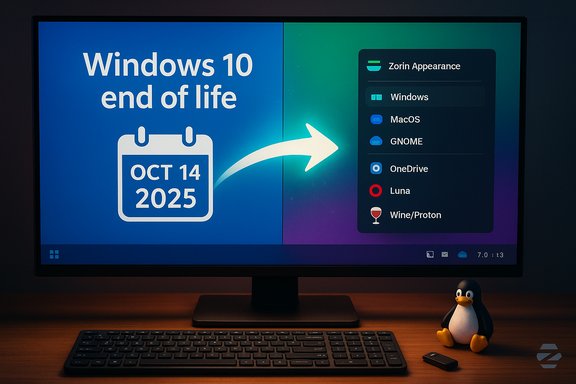
Microsoft formally ended mainstream support for Windows 10 on October 14, 2025, removing the regular stream of free security and feature updates for retail Home and Pro editions and creating a hard decision point for hundreds of millions of PC owners. The company encouraged eligible users to upgrade to Windows 11 or enroll in the limited Extended Security Updates (ESU) program as a temporary bridge. Zorin OS 18 arrived in that window and was explicitly positioned as a migration-friendly desktop: familiar Windows-like layout presets, OneDrive browsing, a Progressive Web App (PWA) installer, and improved Windows-application support via an updated Wine runtime and compatibility tooling. The Zorin team announced the one-million-download milestone in a November 18 blog post and emphasized that over 78% of downloads were initiated from Windows systems. That company announcement is the primary factual anchor for all subsequent coverage.
Key capabilities and design choices:
But the milestone is not, on its own, proof of a mass permanent migration away from Windows. Long-term platform shifts depend on retention, ISV support, OEM driver ecosystems, and enterprise tooling — factors that take months or years to change materially. The next phase of this story will be conversion work: whether Linux distributions and their ecosystems can convert trial interest into sustained, supported deployments at scale.
Readers should treat the one‑million number as a strong indicator of curiosity and early adoption activity, not as proof of a one‑for‑one installed‑base migration. The practical next steps for anyone considering a change remain the same: back up your data, test in a non-destructive environment, validate critical apps and peripherals, and pilot before committing. For the broader industry, Zorin’s success is a reminder that product design aimed at real human friction (familiar UI, cloud continuity, and compatibility tooling) can unlock sizable adoption when macro conditions change — and that adoption will be earned by the projects and vendors who invest in conversion, support, and long-term usability.
Source: GIGAZINE https://gigazine.net/gsc_news/en/20251126-win-10-retirement-zorin-os/
 Background / Overview
Microsoft formally ended mainstream support for Windows 10 on October 14, 2025, removing the regular stream of free security and feature updates for retail Home and Pro editions and creating a hard decision point for hundreds of millions of PC owners. The company encouraged eligible users to upgrade to Windows 11 or enroll in the limited Extended Security Updates (ESU) program as a temporary bridge. Zorin OS 18 arrived in that window and was explicitly positioned as a migration-friendly desktop: familiar Windows-like layout presets, OneDrive browsing, a Progressive Web App (PWA) installer, and improved Windows-application support via an updated Wine runtime and compatibility tooling. The Zorin team announced the one-million-download milestone in a November 18 blog post and emphasized that over 78% of downloads were initiated from Windows systems. That company announcement is the primary factual anchor for all subsequent coverage. Why the timing matters: the Windows 10 cutoff and the upgrade bottleneck
The hard end‑of‑support date
Windows 10’s mainstream lifecycle ended on October 14, 2025; Microsoft’s public guidance makes clear that after that date retail Windows 10 Home and Pro no longer receive free monthly security or feature updates — a meaningful change in risk profile for internet-connected machines. Microsoft also published details about Extended Security Updates (ESU) to give users time to plan a migration.Windows 11’s hardware gates
Windows 11 enforces baseline hardware requirements that exclude many perfectly usable older devices: a supported CPU family, UEFI with Secure Boot, and TPM 2.0 are among the key checks. Those rules make an in-place, vendor-supported upgrade impossible for a non-trivial share of Windows 10 machines without BIOS changes or new hardware, creating a real economic and logistical problem for consumers, schools, and small organizations.The practical choice set for users
Faced with EOL, most consumers effectively had three options:- Upgrade eligible PCs to Windows 11 (hardware permitting).
- Buy time with ESU (limited, paid extension).
- Replace or repurpose the machine — including migrating to an alternative OS such as a Linux distribution.
What Zorin OS 18 offers switchers (features and technical details)
Zorin OS 18 is a deliberate, migration-focused release built to lower the practical barriers that normally stop mainstream users from switching away from Windows.Key capabilities and design choices:
- Familiar desktop layouts: Zorin Appearance offers presets that mimic Windows 10/11, macOS, and other familiar paradigms to reduce muscle‑memory friction.
- Web Apps (PWA installer): converts cloud services (Office 365, Google Docs, Teams, Photoshop Web) into desktop-like launchers, reducing the need to change daily workflows.
- OneDrive browsing: GNOME Online Accounts integration lets users access OneDrive files directly from the Files app for continuity with Microsoft 365 workflows.
- Improved Windows app tooling: updated Wine runtime and installer-detection tooling to triage many common Windows installers into native, web, Wine-wrapped, or virtualized paths.
- Multiple editions: Core, Pro, Education, and a Lite option for older hardware give users options matched to device capability and support expectations.
- Modern platform base: built on the Ubuntu LTS lineage with hardware-enablement kernels (review coverage indicated kernels in the 6.x series for better device compatibility).
The numbers: one million downloads — how to read them
Zorin Group’s announcement is unambiguous: Zorin OS 18 has amassed 1 million downloads in just over a month since release. The project also reported that over 78% of those downloads came from Windows machines. Independent outlets (Tom’s Hardware, TechRadar, and a number of Linux-focused sites) reproduced that claim and placed it in the context of Windows 10’s end‑of‑support. Important technical caveats — downloads ≠ installs:- A downloaded ISO is a strong indicator of interest or intent, but not a proof of completed migration.
- Many downloads are used for live‑USB testing, virtual-machine experiments, multiple re-downloads, or even aborted installs.
- Download origin (Windows vs macOS vs Linux) is typically inferred from HTTP referrers and server analytics that show where the request originated, not where the OS ultimately landed or how long it was used.
Cross-checking and verification of the headline claims
Journalistic due diligence requires independent confirmation beyond the vendor blog:- Zorin’s blog post announcing the milestone provides the raw claim and the 78% breakdown.
- Major technology outlets (Tom’s Hardware and TechRadar) independently reported and analyzed the numbers and cautioned readers about equating downloads with active users.
- StatCounter market-data and other trackers show that Windows 11 overtook Windows 10 earlier in 2025 in some global snapshots, but a very large Windows 10 installed base remained at the time of EOL — a fact that helps explain Zorin’s large Windows-origin download share. Use StatCounter’s Windows-version statistics for precise regional or monthly figures where needed.
Why many Windows 10 users opted to test Linux instead of moving to Windows 11
Several converging forces explain the mass testing behavior:- Cost and hardware constraints: Many households and small organizations faced the choice of paying for ESU, buying new Windows-11-capable hardware, or trying an alternative. For many, a zero‑license‑cost Linux OS that can revive older hardware is the least costly option.
- Privacy and control preferences: Some users were uncomfortable with the tighter Microsoft account and telemetry pathways introduced in more recent Windows setups and viewed Linux as an escape hatch for greater local control. Coverage noted that ESU enrollment changes (requiring specific account links in some cases) upset privacy-sensitive users.
- Improved Linux UX and compatibility: Distros like Zorin have invested heavily in user-friendly UI, cloud continuity, and Windows-compatibility tooling (Wine/Proton), lowering the perceived risk of trying Linux for day‑to‑day work or play.
- Gaming and app parity progress: Proton, VKD3D-Proton, and continued GPU driver improvements have made gaming and many Windows applications more viable on Linux, reducing one of the historical blockers for mainstream users. Independent reviews highlighted improvements in application compatibility and UI polish that made Zorin particularly attractive.
Strengths and opportunities revealed by Zorin’s surge
- Lower cost of refresh: For educational institutions, nonprofits, and budget-sensitive households, Linux offers a way to extend device life and avoid hardware replacements.
- Product-market fit for migration distros: Zorin’s focus on familiarity, cloud continuity, and compatibility is demonstrably effective at converting anxiety into tests — a clear product-market fit for users rejecting forced hardware replacement.
- Channel and service opportunities: The surge opens opportunities for migration services, refurbished-device vendors offering Linux options, and OEMs willing to ship Linux-preloaded models for refurbished markets.
- Momentum for Linux ecosystem: Increased trial volumes may encourage ISVs and peripheral vendors to invest in better Linux support — a virtuous cycle if retention follows trial.
Risks, limitations, and unanswered questions
- Downloads vs. retention: The central uncertainty is conversion: how many downloads resulted in stable, long-term daily use? Historical numbers from many migrations show steep drop-offs between trial and retention. This milestone is encouraging but not definitive.
- Peripherals and vendor drivers: Edge cases remain: printers, specialized hardware, and vendor‑specific power‑management firmware still cause compatibility headaches on Linux for some devices.
- Enterprise complexity: For organizations, application stacks, management tooling, identity integration, and compliance demands make migration far harder than a home-user trial. Zorin’s Business/Education guides help, but large-scale migration requires planning, SLA support, and possibly third-party partners.
- Telemetry and attribution accuracy: Zorin’s “78% from Windows” metric is useful but derived from request-origin analytics and cannot by itself prove the downstream behavior of those users. Treat it as directional evidence.
Practical migration checklist for users (short, actionable)
- Back up everything: create a full image or at minimum copy user data to an external drive or cloud storage.
- Test by non-destructive means: boot a Live USB or install inside a virtual machine to verify hardware and application compatibility.
- Validate cloud workflows: confirm OneDrive/Google Drive access and test PWAs for critical web apps.
- Check Windows-only app needs: attempt Wine/Proton compatibility tests or plan virtualization (VirtualBox/VMware) for unavoidable Windows apps.
- Make a rollback plan: ensure you can restore the original Windows image if needed.
- Staged conversion: start with a secondary device or a small pilot before making a full switch on your main machine.
Strategic implications for Microsoft, OEMs, and ISVs
- Microsoft: The Windows 10 EOL decision and Windows 11 compatibility gates accelerated a user-choice moment. While Microsoft still controls the majority of the desktop market, the EOL event and the ESU friction posed reputational and support risks that will require careful channel and policy management.
- OEMs: There’s an opportunity for vendors to offer refurbished or Linux-preloaded SKUs to budget segments and public procurement channels focused on sustainability.
- Independent Software Vendors (ISVs): If trial volumes convert into meaningful usage, ISVs may find value in offering Linux builds or better web-first equivalents. Web Apps (PWAs) are a practical bridge that reduces the need for native ports.
The longer view: a watershed moment, not a takeover
Zorin OS 18’s one‑million downloads are a striking, verifiable milestone and a clear signal of large-scale trial activity triggered by Windows 10’s EOL. That signal matters: it demonstrates that when the cost of staying on the incumbent platform increases, well-positioned alternatives can attract millions to try something new.But the milestone is not, on its own, proof of a mass permanent migration away from Windows. Long-term platform shifts depend on retention, ISV support, OEM driver ecosystems, and enterprise tooling — factors that take months or years to change materially. The next phase of this story will be conversion work: whether Linux distributions and their ecosystems can convert trial interest into sustained, supported deployments at scale.
Conclusion
The overlap of a firm end‑of‑support date for Windows 10 and the arrival of Zorin OS 18 created a high‑visibility moment in which a migration-focused Linux distribution converted urgency into measurable action. Zorin’s claim of one million downloads — with roughly 78% originating from Windows — is a vendor‑reported milestone corroborated and contextualized by multiple independent outlets and usage data trends. That figure is an important signal: many users chose to test Linux instead of immediately embracing Windows 11 or paid ESU.Readers should treat the one‑million number as a strong indicator of curiosity and early adoption activity, not as proof of a one‑for‑one installed‑base migration. The practical next steps for anyone considering a change remain the same: back up your data, test in a non-destructive environment, validate critical apps and peripherals, and pilot before committing. For the broader industry, Zorin’s success is a reminder that product design aimed at real human friction (familiar UI, cloud continuity, and compatibility tooling) can unlock sizable adoption when macro conditions change — and that adoption will be earned by the projects and vendors who invest in conversion, support, and long-term usability.
Source: GIGAZINE https://gigazine.net/gsc_news/en/20251126-win-10-retirement-zorin-os/
