

Microsoft’s decision to shutter mainstream support for Windows 10 last month has triggered a fast-moving, messy migration moment: millions of PCs sit at a crossroads — upgrade to Windows 11, buy new hardware, pay for temporary Extended Security Updates, or try something else entirely — and a surprising number of users are experimenting with Linux gaming and migration-focused distributions such as Bazzite and Zorin OS.
Windows 10 reached its official end of mainstream support on October 14, 2025. That formal cutoff means routine security patches, feature updates, and technical assistance for consumer Windows 10 Home and Pro editions ended on that date; Microsoft has published guidance and a time-limited Extended Security Updates (ESU) bridge for consumers and businesses that need more time. The calendar event created a clear migration inflection that converted latent curiosity into concrete trials for alternatives. At the same time, Dell told investors during a recent earnings call that roughly 1.5 billion Windows PCs exist in the installed base, and that about 500 million of those devices can upgrade to Windows 11 but have not, while another roughly 500 million are effectively blocked by Windows 11’s stricter hardware requirements — a framing that puts the size of the “sticky” Windows 10 crowd into sharp relief and creates a clear commercial incentive for refresh cycles. That vendor estimate — repeated across coverage of the call — is directional and powerful, but it is a vendor’s market read rather than an auditor-style census. Linux gaming compatibility, largely driven by Valve’s Proton/Wine stack improvements and related driver work, has reached a point where a very large share of Windows titles now at least launch on Linux under Proton. Community-sourced metrics and aggregators show a steady climb in launchable games — figures often summarized in the “about 90%” range — though that number reflects a mix of “launchable” and “playable with tweaks” and is not a single, objective quality metric. Anti-cheat and certain publisher choices remain the most important ecosystem-level blockers.
For enthusiasts and power users, Linux gaming distros like Bazzite offer a compelling option that can deliver perceptible runtime improvements and a cleaner, less telemetry‑heavy experience in many scenarios. For enterprises, mainstream consumers, and competitive gamers, Windows remains the pragmatic default until the compatibility and support gaps close.
The near future will be decided by a small set of high‑leverage moves: whether publishers embrace Linux anti‑cheat, whether Valve and OEMs can sustain hardware momentum, and how Microsoft balances agentic AI ambitions with the basic stability and control that long‑term Windows users demand. The migration story is far from settled, but it is no longer hypothetical — this is a conversion experiment playing out in public, and its outcomes will shape the desktop market for years to come.
Source: Windows Central https://www.windowscentral.com/micr...e-forever-up-and-comer-curse-theres-a-chance/
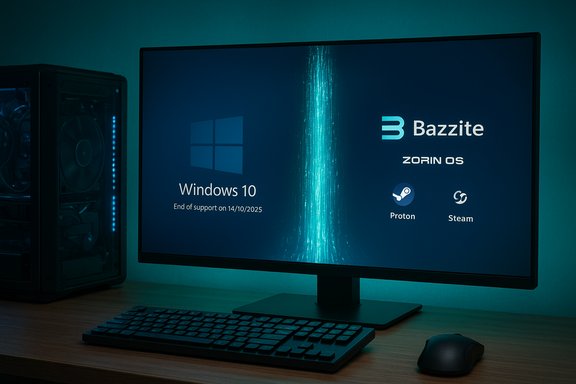 Background / Overview
Windows 10 reached its official end of mainstream support on October 14, 2025. That formal cutoff means routine security patches, feature updates, and technical assistance for consumer Windows 10 Home and Pro editions ended on that date; Microsoft has published guidance and a time-limited Extended Security Updates (ESU) bridge for consumers and businesses that need more time. The calendar event created a clear migration inflection that converted latent curiosity into concrete trials for alternatives. At the same time, Dell told investors during a recent earnings call that roughly 1.5 billion Windows PCs exist in the installed base, and that about 500 million of those devices can upgrade to Windows 11 but have not, while another roughly 500 million are effectively blocked by Windows 11’s stricter hardware requirements — a framing that puts the size of the “sticky” Windows 10 crowd into sharp relief and creates a clear commercial incentive for refresh cycles. That vendor estimate — repeated across coverage of the call — is directional and powerful, but it is a vendor’s market read rather than an auditor-style census. Linux gaming compatibility, largely driven by Valve’s Proton/Wine stack improvements and related driver work, has reached a point where a very large share of Windows titles now at least launch on Linux under Proton. Community-sourced metrics and aggregators show a steady climb in launchable games — figures often summarized in the “about 90%” range — though that number reflects a mix of “launchable” and “playable with tweaks” and is not a single, objective quality metric. Anti-cheat and certain publisher choices remain the most important ecosystem-level blockers. What happened: Bazzite, Zorin, and the post‑Windows‑10 surge
Bazzite’s claim: a petabyte in 30 days
Bazzite — a gaming-first, SteamOS‑style Linux distribution that bundles GPU drivers and supports non‑Steam launchers — announced it "pushed past the petabyte barrier" in late November, saying it delivered over 1 petabyte (1 PB) of ISO downloads in roughly 30 days and recorded about 730,000 site visitors between October 29 and November 28. Tom’s Hardware and other outlets parsed the figures and estimated that, given the ISO sizes Bazzite offers (about 6.6 GB for AMD-ready images and 7.5 GB for NVIDIA-ready images), the bandwidth numbers translate to roughly 140–150k ISO downloads in that month — a striking spike for a small-to-mid‑sized distro. Those download and traffic numbers are real signals of interest, but they are not, by themselves, proof of durable migration. Important caution: converting bytes served into discrete “new users” requires assumptions about average ISO size, caching, repeated downloads, and CDN replication. The 143k–150k figure is an informed estimate derived from reported site traffic and ISO sizes; treat it as a credible indicator rather than a precise, user‑level adoption count.Zorin OS and other distros: gateway migrations, not guaranteed conversions
Zorin OS announced a major uptick in downloads around the same period, reporting approximately 1 million downloads for Zorin OS 18 in a short window after Windows 10 reached end of support, with Zorin itself suggesting a large share of those downloads originated from Windows machines. Again, downloads indicate trial and intent more than proven, long-term conversions: many users create live USB test media, spin VMs, or try multiple ISOs before committing. Still, the combined headline numbers from Bazzite, Zorin, and the broader Linux ecosystem form a pattern that is impossible to ignore.Why the timing matters — and why Linux is suddenly more attractive
- Windows 10’s end-of-support created urgency. The OS still runs, but without security updates it becomes progressively riskier to use for any mission-critical or internet-facing tasks. Microsoft’s official guidance nudges users toward Windows 11 or the ESU program, but both routes have clear frictions.
- Windows 11’s hardware gates (TPM 2.0, specific CPU family requirements, Secure Boot expectations) mean many functional machines are forced into a replace‑or‑repair calculus; for those devices the choice is often “buy new” versus “put something else on the box.” Dell’s investor framing highlights the scale of that dilemma.
- Proton, Mesa, VKD3D‑Proton and other translation-layer work have materially reduced barriers to running a broad swath of Windows titles on Linux — especially single‑player and non‑anti‑cheat multiplayer titles — which lowers the friction of switching for many gamers. Community data shows the share of titles that refuse to launch has fallen to low single-digit percentages in recent snapshots. But the quality of “runs” still varies (Platinum/Gold vs Silver/Bronze on ProtonDB) and some multiplayer ecosystems are still out of reach.
- Smaller distros that target specific audiences — Zorin for Windows-like migration, Bazzite for gaming-first users — can package a tuned experience with drivers, Proton helpers, and storefront support that makes the first-run experience dramatically easier than the Linux of a decade ago. Those conveniences matter to non‑hobbyist switchers.
Technical reality check: what works well, and what still breaks
Strengths and practical wins
- Better out‑of‑the‑box experience for gaming: Bazzite and similar distros ship with preinstalled GPU driver packages, Proton helpers, and curated kernels or Mesa stacks that minimize the initial setup burden for players. For many popular single‑player titles, the “install and play” experience is now realistic.
- Leaner runtime on handhelds: community tests installing Bazzite on handheld hardware such as the ROG Ally family report measurable reductions in shader‑compile hitching and smoother frame‑time consistency in many scenes, sometimes showing double‑digit percentage improvements in 1% lows or average FPS in specific workloads. That real-world evidence explains part of the migration appeal for performance-minded users.
- Lower perceived telemetry and ads: privacy and reduced integrated telemetry are genuine selling points for many switchers, especially users who perceive Windows 11 as more “agentic” and cloud‑centric. Microsoft’s own push toward more agentic AI features in Windows 11 has provoked backlash, which in turn feeds Linux interest among privacy‑minded users.
Where the gaps remain
- Anti‑cheat and protected multiplayer: kernel‑mode anti‑cheat systems and publisher choices remain the single largest practical blocker for competitive online play. Until more developers opt to support Linux anti‑cheat stacks officially, many popular multiplayer titles will remain unavailable without Windows. That’s a hard, transactional constraint for many gamers — not a philosophical objection.
- Vendor and OEM integrations: factory support, BIOS/firmware tooling, and vendor utilities (Armoury Crate, bespoke battery/profiles) are written for Windows. Swapping an OS typically voids official OEM support paths and can break vendor‑specific functionality. Users should expect tradeoffs.
- Commercial and legacy software: enterprise verticals and some legacy desktop tools have deep Windows dependencies or rely on Windows‑only drivers and middleware. For many businesses, a full Linux migration is operationally complex and costly. Zorin and similar distros lower the barrier for consumer use, but enterprise conversions still require planning and support.
- Retention vs. trial: downloads and ISO bytes measure curiosity and trial activity, not installed‑device retention or daily active use. Smaller distros may see heavy initial interest that fades if users encounter show‑stopping compatibility gaps or need features that Windows provides natively.
Strategic analysis: winners, losers, and market implications
Who stands to gain
- Linux distros focused on migration or gaming (Zorin, Bazzite, Pop!_OS, Nobara): a high‑visibility inflection point has enlarged the potential audience from hobbyists to mainstream switchers testing alternatives.
- Valve and the Proton ecosystem: better compatibility and Steam client advances accelerate the practical viability of Linux gaming and create a virtuous cycle of testing, reporting, and fixes. Proton’s maturation is a structural win for non‑Windows gaming.
- OEM refurbishers and secondary‑market sellers: if a credible, supported Linux path becomes mainstream, refurbishers can offer Linux preloads as a lower‑cost option for older devices that can’t meet Windows 11 gates.
Who faces the pressure
- Microsoft: the end of Windows 10 support and the push to a more “agentic” Windows 11 risks alienating a subset of privacy‑sensitive and performance‑oriented users; backlash around agentic features shows there is consumer resistance to an AI‑dominant desktop narrative. That said, Microsoft still controls the default Windows upgrade path and has strong leverage with OEM partners.
- Game publishers unwilling to enable Linux anti‑cheat support: if publishers don’t invest in cross‑platform anti‑cheat or give Valve/publishers better cross‑platform tooling, they will effectively forfeit part of a growing enthusiast audience to alternate ecosystems.
Market plausibility: is this a long-term share shift?
Short answer: maybe, but not imminently. The data show strong, measurable surges in trials and downloads; however, converting those trials into a sustained, material desktop-share loss for Windows requires overcoming entrenched friction points (anti‑cheat, enterprise app compatibility, OEM support). For a durable platform shift, three conditions must be met:- High retention — trials must turn into daily‑use installs at scale.
- Ecosystem parity — more publishers and vendors must commit to Linux support (especially anti‑cheat).
- Commercial support — vendors, OEMs, and paid support providers must offer long‑term, low-friction pathways for non‑technical users.
Practical guidance: what users should do next
- If you run Windows 10 on a primary machine and rely on it for work or competitive multiplayer gaming, do not rush to wipe the drive. Enroll in the ESU program or upgrade to a supported Windows 11 device while you plan tests on spare hardware. Microsoft’s ESU options are explicitly time-limited.
- For curious gamers with spare hardware or a secondary device: create a live USB and test Bazzite, Zorin, or another distro before committing to a full install. Use an external SSD or dual‑boot arrangement so you can return to Windows if needed.
- If your use case is enterprise or business-critical software: begin formal testing cycles in a lab, inventory compatibility blockers (drivers, middleware, anti‑cheat, vendor tools), and plan a staged pilot before any wide migration. Budget for training and potential paid support.
- Gamers dependent on Game Pass or modern anti‑cheat: keep Windows for those titles, or expect to dual‑boot. Track developer announcements about anti‑cheat Linux support and ProtonDB/Boiling Steam reports for title‑specific guidance.
- If privacy and telemetry are your top concerns: a tested Linux distro can reduce surface area quickly. But read the distro’s documentation about update processes, third‑party driver provisioning, and whether the project offers long‑term support images for security updates. Community mirrors and surge traffic can cause delays, so prefer well‑supported projects for critical use.
Risks and unknowns — what to watch for
- Retention metrics: download numbers and CDN bytes are meaningful but incomplete. Watch for public reports of active installs, daily active users, or paid support traction to see if trials become habitual use.
- Anti‑cheat and publisher decisions: if major multiplayer publishers add first‑class Linux anti‑cheat support, that removes the largest single migration blocker for many gamers. Conversely, publisher resistance will keep many gamers anchored to Windows.
- Valve and SteamOS product moves: Valve’s expanding hardware lineup (the newly announced Steam Machine and Steam Frame devices scheduled for Spring 2026) strengthens the commercial case for Linux gaming and could shift developer priorities if those devices sell well. If Valve’s desktop and console‑adjacent devices drive more developer testing, Linux’s practical parity will improve.
- Microsoft’s strategy and messaging: the company’s push toward an “agentic” AI OS for Windows 11 and continued integration of Copilot into the desktop will either force acceptance (if implemented well and perceived as useful) or accelerate defections to alternatives. The present public reaction shows clear skepticism and unease among a vocal segment of users.
Conclusion
The end of Windows 10 support has done more than close a chapter; it created a measurable inflection that amplified interest in alternatives. Bazzite’s petabyte announcement and Zorin’s seven‑figure download surge are real and consequential signals: they show how targeted, migration-friendly Linux offerings can capture significant trial interest when a mainstream OS reaches a hard support cutoff. But downloads and bytes are the opening act — long-term platform shifts require retention, developer buy‑in (especially on anti‑cheat), and vendor support that reaches beyond hobbyist forums.For enthusiasts and power users, Linux gaming distros like Bazzite offer a compelling option that can deliver perceptible runtime improvements and a cleaner, less telemetry‑heavy experience in many scenarios. For enterprises, mainstream consumers, and competitive gamers, Windows remains the pragmatic default until the compatibility and support gaps close.
The near future will be decided by a small set of high‑leverage moves: whether publishers embrace Linux anti‑cheat, whether Valve and OEMs can sustain hardware momentum, and how Microsoft balances agentic AI ambitions with the basic stability and control that long‑term Windows users demand. The migration story is far from settled, but it is no longer hypothetical — this is a conversion experiment playing out in public, and its outcomes will shape the desktop market for years to come.
Source: Windows Central https://www.windowscentral.com/micr...e-forever-up-and-comer-curse-theres-a-chance/
