

OpenAI appears to be quietly building an advertising layer into ChatGPT’s mobile client after developers unpacked a recent Android beta (APK 1.2025.329) and found explicit strings such as "ads feature", "bazaar content", "search ad", and "search ads carousel", a discovery that strongly suggests the company is prototyping commerce- and search‑oriented ad placements for the free tier of the assistant.
OpenAI launched ChatGPT as a largely ad‑free conversational assistant in late 2022 and has since scaled to hundreds of millions of weekly users, extending free access alongside paid Plus/Pro tiers. That rapid growth and the high cost of running large language models have prompted repeated public and private discussions inside the company about alternative revenue streams, including advertising and commerce features. Recent reverse‑engineering of an Android beta APK provides the clearest technical signal yet that ad functionality is being engineered into the client, even if there is no formal product announcement or visible rollout. The artifact driving the coverage is a beta Android build labeled 1.2025.329. Analysts who unpacked the APK found internal resource strings and UI identifiers that map to ad-like components and marketplace-style experiences — not screenshots or enabled UI, but skeletons and feature flags developers add before server-side gating and public tests. That distinction means the evidence is high-confidence that OpenAI is building ad infrastructure, but low-confidence on rollout timing, targeting rules, visual treatment, or revenue arrangements.
OpenAI’s engineering signals make an ad-enabled ChatGPT plausible and increasingly likely, but the critical details — what data will be used, how ads will be labeled, and whether the premium tiers remain shielded — remain unresolved at this stage. The coming weeks and months should reveal whether this is a narrowly scoped commerce experiment or the first phase of a broader ad monetization strategy that reshapes conversational AI economics.
Source: bgr.com ChatGPT Will Soon Display Ads, New Leak Suggests - BGR
 Background / Overview
OpenAI launched ChatGPT as a largely ad‑free conversational assistant in late 2022 and has since scaled to hundreds of millions of weekly users, extending free access alongside paid Plus/Pro tiers. That rapid growth and the high cost of running large language models have prompted repeated public and private discussions inside the company about alternative revenue streams, including advertising and commerce features. Recent reverse‑engineering of an Android beta APK provides the clearest technical signal yet that ad functionality is being engineered into the client, even if there is no formal product announcement or visible rollout. The artifact driving the coverage is a beta Android build labeled 1.2025.329. Analysts who unpacked the APK found internal resource strings and UI identifiers that map to ad-like components and marketplace-style experiences — not screenshots or enabled UI, but skeletons and feature flags developers add before server-side gating and public tests. That distinction means the evidence is high-confidence that OpenAI is building ad infrastructure, but low-confidence on rollout timing, targeting rules, visual treatment, or revenue arrangements. What the leak actually reveals
The concrete artifacts: APK strings and internal identifiers
The most telling elements discovered in the APK are the literal resource strings and component names. The items called out by multiple app analysts include:- ads feature — an apparent feature flag or module namespace indicating an ad subsystem.
- bazaar content — language that strongly evokes a marketplace or curated product card feed, commonly used internally to label commerce fixtures.
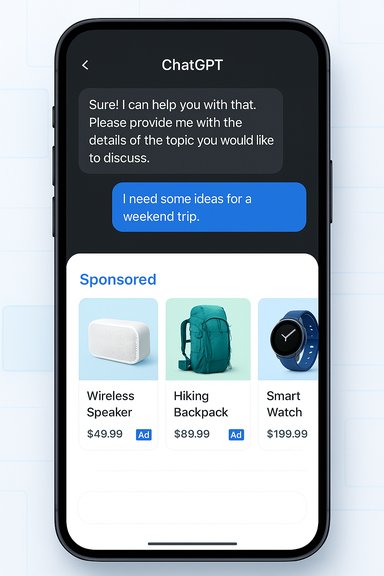
- search ad / search ads carousel — identifiers suggesting ads tied to search/retrieval workflows, likely implemented as horizontally scrollable sponsored cards.
Where ads are likely to appear first
Based on the naming in the APK and industry precedent, the early ad formats are most plausibly tied to retrieval-enabled answers and shopping scenarios rather than being injected into every conversational reply. Expected early placements include:- Marketplace-style product cards ("bazaar") surfaced alongside AI summaries for shopping queries.
- A horizontally scrollable search ads carousel that presents multiple sponsored options when the assistant performs web retrieval.
- Sponsored follow-ups or suggested actions appended to answers in commerce, travel, or local services contexts.
Why OpenAI would add ads: the business logic
Running large, multimodal LLMs at consumer scale is expensive. OpenAI publicly projects significant growth in paying subscribers but also recognizes that subscription revenue alone may not cover the long tail of free‑user compute costs or the demands of new features (multimodal models, agents, memory, live personalization). Ads provide a scalable revenue channel that can subsidize free access while preserving premium, ad‑free experiences for paying users. Advertising is also strategically attractive because ChatGPT is increasingly positioned as a discovery and shopping surface: product comparisons, local service discovery, and integrated shopping assistants create high‑intent moments that advertisers value. Embedding sponsored cards or marketplace placements inside such flows shortens purchase journeys and turns conversational moments into ad inventory.Technical anatomy: how ads in ChatGPT might work
Likely architecture and engineering patterns
From the APK evidence and standard industry practices, an ad system built into ChatGPT’s client would include:- Client‑side feature flags and UI containers (the strings discovered), with server-side gating to enable experiments on subsets of users.
- An ad‑serving endpoint and telemetry channels to fetch sponsored content when a query triggers retrieval or commerce intent detection.
- Auction and ranking layers (likely combining advertiser bids with relevance signals from retrieval models) to determine which sponsored cards are shown and in what order.
- Labeling and rendering rules to make sponsored content visually distinct (badges, card containers, disclaimers).
Data flows and targeting signals (what’s known and what’s not)
The APK strings do not contain explicit telemetry or ad‑targeting code; they reveal UI module names. Critical questions remain unverified and require disclosure:- Whether ChatGPT memories or saved preferences will be used for ad targeting. This has been discussed internally at OpenAI in the past but is not confirmed for a live product. Unverified.
- Whether advertisers will receive any user‑level identifiers or only hashed/aggregated signals. Unverified.
UX and trust: design challenges and best practices
A generative assistant’s chief asset is trust. Mixing paid placements into answers creates unique design and ethical problems not present in classic search or feed advertising.Core UX constraints
- Clear labeling: Ads must be unmistakably labelled as sponsored and visually separable from editorial responses. Transparency about why an ad is shown will be required to preserve credibility.
- Frequency and placement control: Ads should be limited to high‑intent contexts (shopping, services) and capped to prevent experience degradation.
- Opt‑outs and premium guarantees: Paying subscribers should have a guaranteed ad‑free experience, and free‑tier users should have meaningful controls over personalization and targeting.
The trust risk
Even with labels, the inclusion of sponsored content inside conversational answers risks blurring the line between unbiased model output and paid placement. Poorly distinguished ads can reduce user confidence, and any perception that recommendations are commercially motivated will erode ChatGPT’s perceived neutrality. The design bar must therefore be high.Privacy, regulatory and ethical considerations
Memory and personalization
OpenAI’s memory features — which store user preferences and context to improve personalization — are particularly sensitive if used to target ads. Deploying ad personalization using memory without explicit, granular consent would create both user backlash and regulatory risk. Any use of such signals should be opt‑in and auditable.Data sharing and attribution
Ad ecosystems often require signals for attribution and measurement; deciding what telemetry is shared with advertisers (raw or hashed) and how long it’s retained will be a central policy decision. Regulators in multiple jurisdictions are already scrutinizing interactions between ad tech and AI, and OpenAI will need to provide clear documentation and opt‑out mechanisms.Competition, publishers, and the open web
If ChatGPT begins answering queries with fully self-contained, ad‑augmented responses, less traffic may flow back to publishers — a “zero‑click” dynamic that can depress publisher ad revenue and reshape the web’s referral economics. That broader ecosystem impact is material and likely to attract scrutiny from publishers and regulators alike.Possible rollout scenarios and timeline signals
The APK strings are a development signal, not a launch. Practical rollout scenarios include:- Private pilot: Server‑side gating to a small percentage of free users or particular geographies for shopping queries.
- Controlled A/B tests: Visible “Sponsored” badges and card placements in screenshots or user reports, used to collect UX and conversion metrics.
- Gradual expansion: If metrics and trust signals are acceptable, expansion to more categories (travel, local services) and additional ad formats.
Recommendations for users, IT admins and developers
For consumer users
- Expect change: Users on the free tier should prepare for commerce‑centric sponsored content in shopping and search‑style queries.
- Review privacy settings: Monitor memory and personalization toggles and opt out of any ad personalization if you prefer non‑personalized results.
- Consider paid tiers: If an ad‑free experience matters, paid plans are the most straightforward protection — watch for explicit guarantees from OpenAI.
For IT admins and enterprise users
- Audit dependencies: Identify where ChatGPT is integrated into internal workflows and decide whether consumer ad experiments are acceptable in employee‑facing tools.
- Seek contractual clarity: Enterprises should request written assurances around ad exposure, telemetry, and whether organizational data could be used for targeting.
- Use admin controls: Expect and insist on admin toggles that can opt managed accounts out of ad experiments.
For developers and partners
- Ask for separation: Clarify whether APIs and enterprise offerings will remain ad‑free even if consumer apps incorporate ads.
- Confirm data usage: Ensure that interactions produced via your integrations are not used to feed ad targeting without explicit agreement.
Strengths and potential benefits if executed responsibly
If OpenAI follows a conservative, transparent path, ad integration could deliver several benefits:- Sustaining free access: Ads can subsidize compute costs and keep the basic product widely accessible.
- Improved commerce UX: Shoppable cards and marketplace features can shorten purchase paths and provide utility in high‑intent scenarios.
- New advertiser channel: Advertisers gain access to high‑intent conversational moments that can outperform typical display inventory on conversion metrics.
Risks, failure modes and what could go wrong
- Erosion of trust: If sponsored content is not distinct from organic answers, user confidence can fall rapidly.
- Privacy backlashes: Using memories or persistent personal signals for targeting without clear opt‑in will trigger regulatory and reputational harm.
- Publisher harm: Increased zero‑click answers reduce referral traffic to publishers, potentially provoking industry pushback or regulatory interest.
- Dark UX patterns: Excessive or deceptive placements could cause churn among free users and force tougher regulation.
Final assessment and next steps to watch
The presence of explicit ad-related strings in the ChatGPT Android beta (1.2025.329) is a high-confidence sign that OpenAI is building the plumbing for advertising — with an emphasis on commerce and search contexts as suggested by identifiers like "bazaar content" and "search ads carousel". However, the available evidence does not prove a public rollout or the detailed mechanics of targeting, labeling, or data sharing. The most responsible interpretation is that OpenAI has moved from internal discussion to in‑app engineering, but a careful, staged rollout with transparency obligations must follow to avoid undermining the product’s trust. Watch for these definitive signals that would move the needle from hypothesis to confirmed product change:- Public screenshots or user reports showing labeled sponsored placements in ChatGPT responses.
- Updated OpenAI documentation describing ad formats, data usage, and opt‑out mechanisms.
- Admin controls and contractual guarantees for enterprise customers ensuring ad‑free experiences or strict telemetry separation.
OpenAI’s engineering signals make an ad-enabled ChatGPT plausible and increasingly likely, but the critical details — what data will be used, how ads will be labeled, and whether the premium tiers remain shielded — remain unresolved at this stage. The coming weeks and months should reveal whether this is a narrowly scoped commerce experiment or the first phase of a broader ad monetization strategy that reshapes conversational AI economics.
Source: bgr.com ChatGPT Will Soon Display Ads, New Leak Suggests - BGR
